Development of Mathematics Learning Media Using Wordwall to Improve Students' Interest and Learning Outcomes

https://doi.org/10.51574/kognitif.v5i4.3816
Keywords:
Learning Media , Wordwall , Interest in Learning , Learning OutcomesAbstract
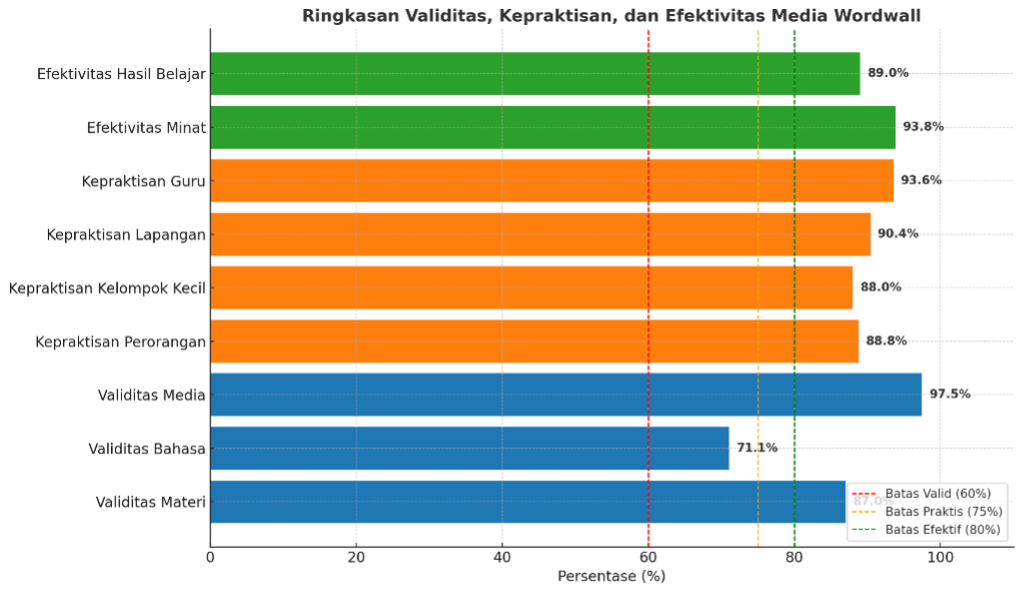
This study addresses the limited use of technology-based instructional media and insufficient instructional time in mathematics learning. It aims to develop and evaluate Wordwall-based learning media in terms of validity, practicality, and effectiveness in improving students’ learning interest and achievement. The study employed a Research and Development design using the ADDIE model up to the evaluation stage. Participants included 32 eighth-grade students from SMP Negeri 3 Huruna and one mathematics teacher. Data were collected through expert validation involving three validators, student and teacher response questionnaires, and learning achievement tests. Data analysis combined descriptive qualitative analysis with quantitative analysis using percentage scores and pretest–posttest comparisons. The findings indicate that the developed media is valid in terms of content, language, and visual design; highly practical, as reflected by positive responses from more than 90 percent of students and teachers; and effective in improving learning interest, with an average increase of 25 percent, as well as learning outcomes, with an N-gain of 0.62 in the medium–high category. The novelty of this study lies in positioning Wordwall not merely as a gamification tool, but as an interactive learning medium systematically integrated within the ADDIE instructional design framework for mathematics learning. Theoretically, this study strengthens evidence on the role of gamification within instructional design. Practically, it offers teachers a viable strategy to address time constraints while enhancing student engagement and learning outcomes.
Downloads
References
Agterberg, D. A., Oostdam, R. J., & Janssen, F. J. J. M. (2022). From speck to story: relating history of mathematics to the cognitive demand level of tasks. Educational Studies in Mathematics, 110(1), 49–64. https://doi.org/10.1007/s10649-021-10093-6
Angeliki Kolovou, Marja van den Heuvel-Panhuizen, & Olaf Köller. (2013). An Intervention Including an Online Game to Improve Grade 6 Students’ Performance in Early Algebra. Journal for Research in Mathematics Education, 44(3), 510. https://doi.org/10.5951/jresematheduc.44.3.0510
Apolonia Hendrice Ramda, Ermilinda S Mulia, Fransiskus Nendi, & Gunur, B. (2023). Interest In Learning Mathematics And Contextual Teaching And Learning With Ethnomatematics Content: Mbaru Tembong. Jurnal Pendidikan Dan Kebudayaan Missio, 15(2). https://doi.org/10.36928/jpkm.v15i2.2085
Clark-Wilson, A., Robutti, O., & Thomas, M. (2020). Teaching with digital technology. ZDM - Mathematics Education, 52(7), 1223–1242. https://doi.org/10.1007/s11858-020-01196-0
Günster, S. M., & Weigand, H. G. (2020). Designing digital technology tasks for the development of functional thinking. ZDM - Mathematics Education, 52(7), 1259–1274. https://doi.org/10.1007/s11858-020-01179-1
Hackenberg, A. J., Aydeniz, F., & Jones, R. (2021). Middle school students ’ construction of quantitative unknowns ⋆. Journal of Mathematical Behavior, 61(December 2020), 100832. https://doi.org/10.1016/j.jmathb.2020.100832
Hsieh, F. J., Wang, T. Y., Hsieh, C. J., & Chu, C. T. (2025). The relationships of preservice teachers’ dispositions and noticing of technology-integrated mathematics teaching activities. ZDM - Mathematics Education. https://doi.org/10.1007/s11858-025-01727-7
Jankvist, U. T., & Niss, M. (2020). Upper secondary school students’ difficulties with mathematical modelling. International Journal of Mathematical Education in Science and Technology, 51(4), 467–496. https://doi.org/10.1080/0020739X.2019.1587530
Kärki, T., McMullen, J., & Lehtinen, E. (2022). Improving rational number knowledge using the NanoRoboMath digital game. Educational Studies in Mathematics, 110(1), 101–123. https://doi.org/10.1007/s10649-021-10120-6
Kosiol, T., Rach, S., & Ufer, S. (2019). (Which) Mathematics Interest is Important for a Successful Transition to a University Study Program? International Journal of Science and Mathematics Education, 17(7), 1359–1380. https://doi.org/10.1007/s10763-018-9925-8
Martínez, S., Guíñez, F., Zamora, R., Bustos, S., & Rodríguez, B. (2020). On the instructional model of a blended learning program for developing mathematical knowledge for teaching. ZDM - Mathematics Education, 52(5), 877–891. https://doi.org/10.1007/s11858-020-01152-y
Mesa, V., Ma, Y., Quiroz, C., Gerami, S., Liakos, Y., Judson, T., & Chamberlain, L. (2021). University instructors ’ use of questioning devices in mathematics textbooks : an instrumental approach. ZDM – Mathematics Education, 0123456789. https://doi.org/10.1007/s11858-021-01296-5
Moore, K. C., Wood, E., Welji, S., Hamilton, M., Waswa, A., Ellis, A. B., & Tasova, H. I. (2024). Using abstraction to analyze instructional tasks and their implementation. Journal of Mathematical Behavior, 74(April), 101153. https://doi.org/10.1016/j.jmathb.2024.101153
Nehls, C., König, J., Kaiser, G., & Blömeke, S. (2020). Profiles of teachers’ general pedagogical knowledge: nature, causes and effects on beliefs and instructional quality. ZDM - Mathematics Education, 52(2), 343–357. https://doi.org/10.1007/s11858-019-01102-3
Nisa, M. A., & Susanto, R. (2022). Pengaruh Penggunaan Game Edukasi Berbasis Wordwall Dalam Pembelajaran Matematika Terhadap Motivasi Belajar. JPGI (Jurnal Penelitian Guru Indonesia), 7(1). https://doi.org/10.29210/022035jpgi0005
OECD. (2018). Programme for International Students Assesment (PISA) Result From PISA 2018.
Regier, P., & Savic, M. (2020). How teaching to foster mathematical creativity may impact student self-efficacy for proving. Journal of Mathematical Behavior, 57(September 2018), 100720. https://doi.org/10.1016/j.jmathb.2019.100720
Rubio, I. M., Ángel, N. G., Esteban, M. D. P., & Ruiz, N. F. O. (2022). Emotional Intelligence as a Predictor of Motivation, Anxiety and Leadership in Athletes. International Journal of Environmental Research and Public Health, 19(12). https://doi.org/10.3390/ijerph19127521
Street, K. E. S., Malmberg, L. E., & Stylianides, G. J. (2022). Changes in students’ self-efficacy when learning a new topic in mathematics: a micro-longitudinal study. Educational Studies in Mathematics, 111(3), 515–541. https://doi.org/10.1007/s10649-022-10165-1
Swidan, O., Bagossi, S., Beltramino, S., & Arzarello, F. (2022). Adaptive instruction strategies to foster covariational reasoning in a digitally rich environment. Journal of Mathematical Behavior, 66. https://doi.org/10.1016/j.jmathb.2022.100961
Thanheiser, E., & Melhuish, K. (2023). Teaching routines and student-centered mathematics instruction: The essential role of conferring to understand student thinking and reasoning. Journal of Mathematical Behavior, 70(December 2022), 101032. https://doi.org/10.1016/j.jmathb.2023.101032
Velani, F. Y., & Retnawati, H. (2020). Application of contextual teaching and learning approaches in improving mathematics interest and learning achievement of elementary school students. Journal of Physics: Conference Series, 1511(1). https://doi.org/10.1088/1742-6596/1511/1/012032
Wilkie, K. J. (2020). Investigating Students’ Attention to Covariation Features of their Constructed Graphs in a Figural Pattern Generalisation Context. International Journal of Science and Mathematics Education, 18(2), 315–336. https://doi.org/10.1007/s10763-019-09955-6
Downloads
Published
How to Cite
Issue
Section
License
Copyright (c) 2025 Putra Mei Anugrah Halawa, Yakin Niat Telaumbanua, Ratna Natalia Mendrofa, Sadiana Lase

This work is licensed under a Creative Commons Attribution-ShareAlike 4.0 International License.
Education and Talent Development Center of Indonesia (ETDC Indonesia)
e-mail: kognitif@gmail.com, website : https://etdc-indonesia.com

Kognitif: Jurnal Riset HOTS Pendidikan Matematika dengan Situs: https://etdci.org/journal/kognitif berlisensi Creative Commons Attribution-ShareAlike 4.0 International License






.png)