Tradition-Based Community Education Model: The Effectiveness of Maddengeng in Ecological Conflict Resolution

https://doi.org/10.51574/ijrer.v5i4.5072
Keywords:
Community Education, Ecological Conflict, Ecopedagogy, Indigenous Knowledge, High School StudentsAbstract
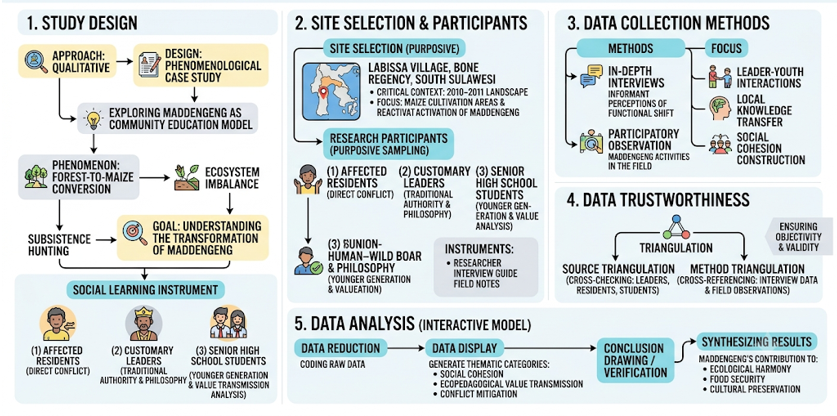
The conversion of forest land into maize plantations in Labissa Village during 2010–2011 disrupted the local ecosystem, triggering a surge in the wild boar (Sus scrofa) population and intensifying human–wildlife ecological conflict. This condition threatened household food security and underscored the urgency of transmitting indigenous ecological knowledge to younger generations before culturally rooted solutions are lost. This study analyzes the Maddengeng tradition as a community-based education model grounded in local wisdom for mitigating ecological conflict. A qualitative phenomenological case-study design was employed, combining in-depth interviews and participatory observation. Informants were selected through purposive sampling and comprised affected residents, customary authority figures (tokoh adat), and senior high school students. Data trustworthiness was established through source and method triangulation, and data were analyzed using an interactive model of reduction, display, and conclusion drawing. Findings indicate that Maddengeng has transformed from a subsistence hunting practice into an adaptive social-learning institution. For residents and customary leaders, the tradition strengthens social cohesion and facilitates conflict resolution; for senior high school students, participation functions as contextual character education and a vehicle for the transmission of local wisdom outside formal schooling. Theoretically and practically, this study contributes to the development of community-based education models that integrate indigenous knowledge into the informal curriculum for youth. It offers a sustainable pathway for maintaining ecological harmony, food security, and cultural identity preservation in Bone Regency, Indonesia.
References
Anderson, K. C., Stern, M. J., Powell, R. B., Dayer, A. A., & Archibald, T. G. (2022). A culturally responsive evaluation framework and its application in environmental education. Evaluation and Program Planning, 92, 102073. https://doi.org/10.1016/j.evalprogplan.2022.102073
Arif, A. M., Nurdin, N., & Elya, E. (2023). Character Education Management at Islamic Grassroot Education: The Integration of Local Social and Wisdom Values. Al-Tanzim: Jurnal Manajemen Pendidikan Islam, 7(2), 435-450. http://doi.org/10.33650/al-tanzim.v7i1.3443
Azzopardi, E., Kenter, J. O., Young, J., Leakey, C., O'connor, S., Martino, S., ... & Pita, C. (2023). What are heritage values? Integrating natural and cultural heritage into environmental valuation. People and Nature, 5(2), 368-383. https://doi.org/10.1002/pan3.10386
Baird, A. (2025). Empowered Authenticity; Promoting Collective Consciousness Raising in Educational Settings. In Dialogue/En Diálogo, 2(1), 64-73. https://journals.calstate.edu/dialogue/article/view/4436
Bakhtiari, Z. (2025). A review of environmental conflict resolution: approaches, challenges, and emerging trends. Discover Global Society, 3(1), 131. https://doi.org/10.1007/s44282-025-00279-1
Berkes, F. (2017). Environmental governance for the anthropocene? Social-ecological systems, resilience, and collaborative learning. Sustainability, 9(7), 1232. https://doi.org/10.3390/su9071232
Bertoldo, J. C. (2026). Learning from absence in times of ecological loss: Vinciane Despret, relationality, and the pedagogical work of fabulation. Research in Education, 122(1), 24-42. https://doi.org/10.1177/00345237251346641
Brennan, M., & Widdop Quinton, H. (2020). An ethical re-framing of curriculum for sustainability education. Curriculum Perspectives, 40(1), 105-110. https://doi.org/10.1007/s41297-019-00095-z
Chavez-Miguel, G., Bonatti, M., Ácevedo-Osorio, Á., Sieber, S., & Löhr, K. (2022). Agroecology as a grassroots approach for environmental peacebuilding: Strengthening social cohesion and resilience in post-conflict settings with community-based natural resource management. GAIA-Ecological Perspectives for Science and Society, 31(1), 36-45. https://doi.org/10.14512/gaia.31.1.9
Dhiaulhaq, A., & McCarthy, J. F. (2020). Indigenous rights and agrarian justice framings in forest land conflicts in Indonesia. The Asia Pacific Journal of Anthropology, 21(1), 34-54. https://doi.org/10.1080/14442213.2019.1670243
Dogan Dervisoglu, C., Yılmaz, E., & Borrego Gomez-Pallete, I. (2026). Implicit and explicit aspects of design learning: unveiling the hidden curriculum. International Journal of Technology and Design Education, 1-25. https://doi.org/10.1007/s10798-026-10102-w
Dovchin, S., Dovchin, U., & Gower, G. (2024). The discourse of the Anthropocene and posthumanism: Indigenous peoples and local communities. Ethnicities, 24(4), 521-535. https://doi.org/10.1177/14687968231219778
Feuerbacher, A., Lippert, C., Kuenzang, J., & Subedi, K. (2021). Low-cost electric fencing for peaceful coexistence: An analysis of human-wildlife conflict mitigation strategies in smallholder agriculture. Biological Conservation, 255, 108919. https://doi.org/10.1016/j.biocon.2020.108919
Hanaček, K., Langemeyer, J., Bileva, T., & Rodríguez-Labajos, B. (2021). Understanding environmental conflicts through cultural ecosystem services-the case of agroecosystems in Bulgaria. Ecological Economics, 179, 106834. https://doi.org/10.1016/j.ecolecon.2020.106834
Hasanuddin, S. (2017). Peranan Pendidikan Agama Islam Pada Tradisi Berburu Babi (Maddengeng) Masyarakat Ponre Kabupaten Bone. Edukasia Islamika, 2(2), 273-290. https://doi.org/10.28918/jei.v2i2.1481
Islamiyah, N., Mahyudi, J., & Sirulhaq, A. (2026). Konflik Ekologis Dan Resistensi Budaya Lokal Dalam Novel Mata Di Tanah Melus Karya Okky Madasari. SeBaSa, 9(1), 264-277. https://doi.org/10.29408/sbs.v9i1.33433
Kim, J. (2024). Why do teachers not change while the national curriculum repeatedly changes?: The ‘Hidden’resistance of teachers in the centralized system of education in South Korea. International Journal of Educational Development, 109, 103105. https://doi.org/10.1016/j.ijedudev.2024.103105
Laiduc, G., & Covarrubias, R. (2022). Making meaning of the hidden curriculum: Translating wise interventions to usher university change. Translational Issues in Psychological Science, 8(2), 221. https://doi.org/10.1037/tps0000309
Mendivelso, M. B., Jaramillo, C. S., & Rubio, D. E. (2024). Disruptive Learning Ecosystems: Transformative Peace Tools in Post-Conflict Rural Contexts. Journal of International Crisis and Risk Communication Research, 7(S10), 1163. https://doi.org/10.63278/jicrcr.vi.529
Migliorini, L., Olcese, M., Cardinali, P., & Madera, F. (2025). Exploring outdoor initiatives as tools for youth engagement, inclusion, and environmental awareness: a multi-case study from Italy and France. Children and Youth Services Review, 108659. https://doi.org/10.1016/j.childyouth.2025.108659
Miles, M. B., Huberman, A. M., & Saldana, J. (2014). Qualitative data analysis. sage.
Misiaszek, G. W. (2023). Ecopedagogy: Freirean teaching to disrupt socio-environmental injustices, anthropocentric dominance, and unsustainability of the Anthropocene. Educational Philosophy and Theory, 55(11), 1253-1267. https://doi.org/10.1080/00131857.2022.2130044
Nawawi, M. (2025). Local wisdom-based science and environmental education management: perspectives from the Bunggu Indigenous community. Jurnal Penelitian Pendidikan IPA, 11(5), 408-418. https://doi.org/10.29303/jppipa.v11i5.11167
Oe, H., Yamaoka, Y., & Ochiai, H. (2022). A qualitative assessment of community learning initiatives for environmental awareness and behaviour change: applying UNESCO education for sustainable development (ESD) framework. International Journal of Environmental Research and Public Health, 19(6), 3528. https://doi.org/10.3390/ijerph19063528
Pérez-Rincón, M., Vargas-Morales, J., & Martinez-Alier, J. (2019). Mapping and analyzing ecological distribution conflicts in Andean countries. Ecological Economics, 157, 80-91. https://doi.org/10.1016/j.ecolecon.2018.11.004
Pribadi, L. A., Kurniady, D. A., Suryadi, S., & Suharto, N. (2026). Phenomenology of community-based personalized learning for character education. Curricula: Journal of Curriculum Development, 5(1), 289-308. https://ejournal-education.upi.edu/curricula/article/view/206
Ritchie, J., & Phillips, L. G. (2023). Learning with Indigenous wisdom in a time of multiple crises: Embodied and emplaced early childhood pedagogies. Educational Review, 75(1), 54-73. https://doi.org/10.1080/00131911.2021.1978396
Srivastava, A., Santagostino, E., Dougall, A., Kitchen, S., Sutherland, M., Pipe, S. W., ... & WFH Guidelines for the Management of Hemophilia panelists and co-authors. (2020). WFH guidelines for the management of hemophilia. Haemophilia, 26, 1-158. https://doi.org/10.1111/hae.14046
Zhu, G., Wu, T., & Shi, K. (2026). The Theoretical Origins, Characteristic Traits, and Practical Pathways of Ecopedagogy. In Handbook of Ecological Civilization: Concept, Philosophy, and Pedagogy (pp. 731-744). Singapore: Springer Nature Singapore. https://doi.org/10.1007/978-981-95-2173-9_64
Zimmerer, K. S., & De Haan, S. (2017). Agrobiodiversity and a sustainable food future. Nature Plants, 3(4), 1-3. https://doi.org/10.1038/nplants.2017.47
Downloads
Published
How to Cite
Issue
Section
License
Copyright (c) 2026 Amiruddin Amiruddin, Syamsul Bahri, Muh. Adnan Yusuf, Hermansyah Hermansyah, Resky Rahmadani, Dias Sanubari, Jesiqa Putri Amanda, Besse Agusnaeni, Besse Putri Ummiahani

This work is licensed under a Creative Commons Attribution-ShareAlike 4.0 International License.