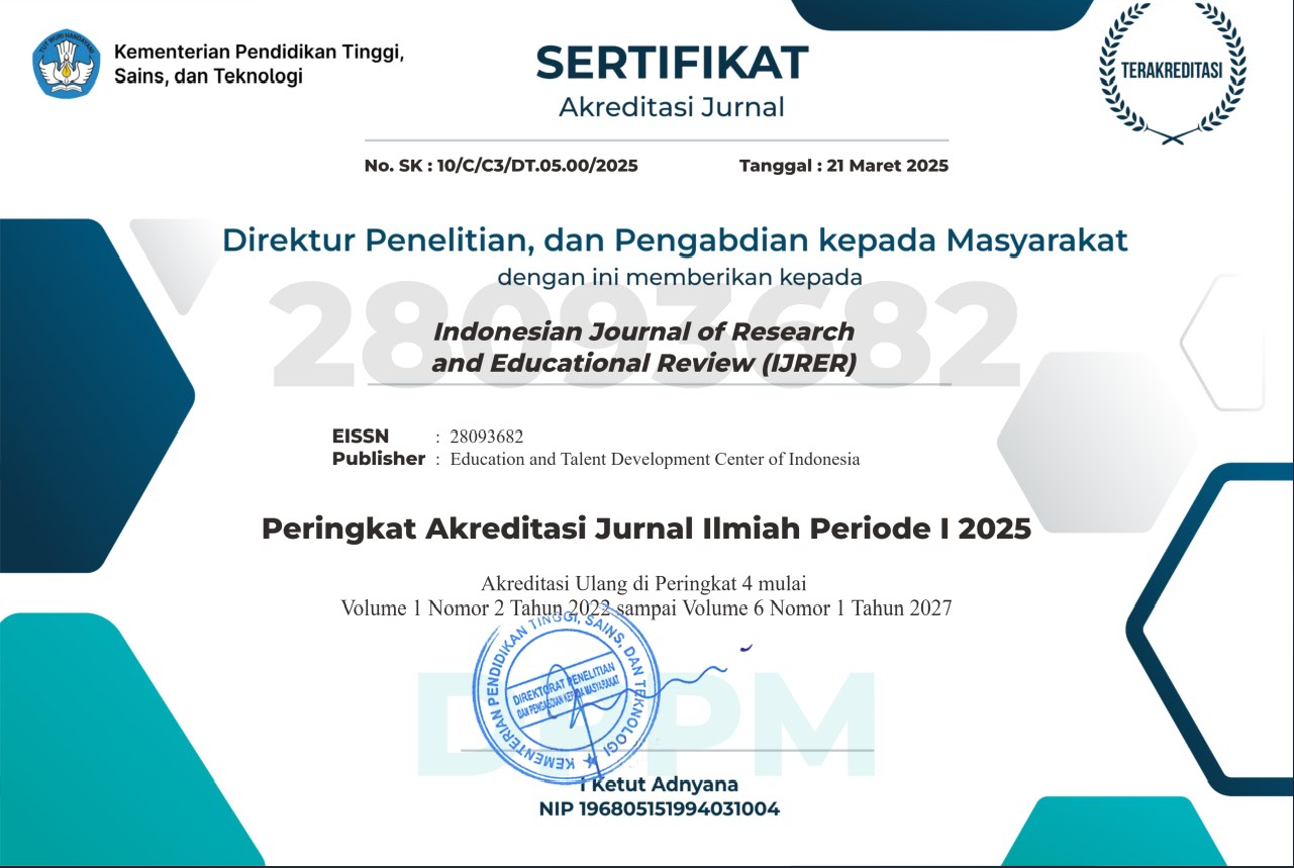
ACREDITATION
Conflict of Interest
The Indonesian Journal of Research and Educational Review (IJRER) requires all participants in the peer-review and publication process—including authors, reviewers, and editors—to declare any potential, financial, personal, or professional conflicts of interest that could inappropriately influence or bias their actions, evaluations, or decisions. Transparency regarding competing interests is essential for safeguarding the objectivity, integrity, and public trust of published educational research.
- Responsibilities of Authors
- Formal Disclosure
- All authors must disclose any financial or non-financial competing interests that might be perceived as influencing the research design, data collection, analytical interpretation, or writing of the manuscript.
- Declaration Statement: Authors must include a dedicated "Declaration of Competing Interests" section immediately preceding the References list.
- Standard Declaration Templates
- If Conflicts Exist: "Funding/Support Disclosure: This study was supported by [Grant Sponsor/Name]. Author A serves as a consultant for [Company/Organization], which produces the educational software evaluated in this study. The remaining authors declare no competing interests."
- If No Conflicts Exist: "Declaration of Competing Interests: The authors declare that they have no known competing financial interests or personal relationships that could have appeared to influence the work reported in this paper."
- Responsibilities of Peer Reviewers: To maintain a rigorous Double-Blind Peer Review process, reviewers must adhere to the following ethical requirements:
- Recusal Imperative: Reviewers must immediately decline a review invitation if they identify any potential conflict of interest, including:
- Recognizing the identity of the authors despite anonymization and having a close collaborative, personal, or competitive relationship.
- Working at the same institution or department as one of the co-authors.
- Direct financial or commercial interest in the outcome or subject matter of the manuscript.
- Confidentiality: Reviewers must not use unpublished information, ideas, or data disclosed in a submitted manuscript for their own research or personal gain.
- Responsibilities of Editors and Editorial Board: Editors (Editor-in-Chief, Associate Editors, and Section Editors) play a critical role in enforcing ethical publishing standards:
- Editorial Recusal: An editor must recuse themselves from handling any manuscript authored or co-authored by themselves, family members, direct colleagues at their institution, or recent close research collaborators.
- Independent Handling: When an editor submits a manuscript to IJRER as an author, the manuscript is processed completely independently by a guest or associate editor. The submitting editor is strictly blocked from accessing internal reviewer comments or decision panels for that manuscript.
- Managing Undisclosed Conflicts of Interest: If a potential conflict of interest is discovered after publication or during the review process, IJRER follows the COPE Flowcharts:
- Under Review: The manuscript evaluation is paused while the Editor-in-Chief requests clarification from the authors. Undisclosed conflicts may lead to immediate Desk Rejection.
- Post-Publication: If an undisclosed competing interest is confirmed post-publication, IJRER will issue a formal Corrigendum / Erratum or, in extreme cases of bias and misrepresentation, an Article Retraction accompanied by an official public statement.