Emotional Intelligence and Learning Interest in Islamic Religious Education and Character Building among Students at High School

https://doi.org/10.51574/ijrer.v5i4.5426
Keywords:
Character Building, Emotional Intelligence, High School, Islamic Religious Education, Learning InterestAbstract
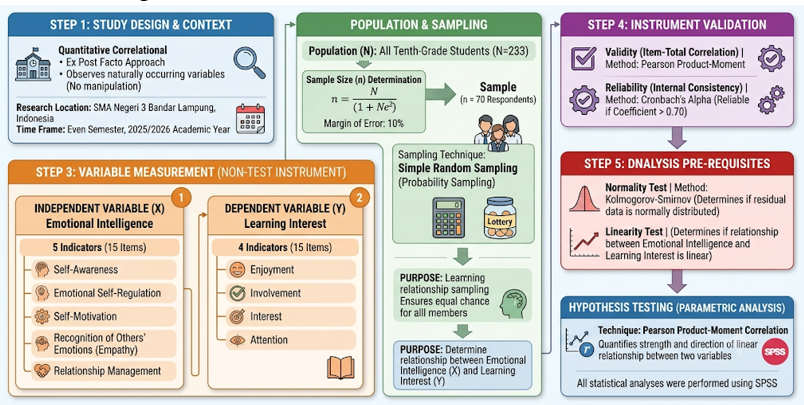
Learning interest is a critical determinant of students' success in the instructional process. In practice, however, many students continue to display low enthusiasm, limited concentration, and minimal engagement during Islamic Religious Education and Character Building (PAI and BP) lessons. Emotional intelligence has been proposed as a factor associated with this problem. This study examined the relationship between emotional intelligence and learning interest among students enrolled in PAI and BP at High School 3 Bandar Lampung, Indonesia. A quantitative correlational, ex post facto design was employed. The population consisted of 233 tenth-grade students, from which 70 respondents were drawn using Slovin's formula (10% margin of error) and a simple random sampling technique. Data were collected through a validated and reliable Likert-type questionnaire and analyzed using Kolmogorov-Smirnov normality tests, linearity tests, and Pearson product-moment correlation. The analysis yielded a correlation coefficient of r = 0.460 with a significance value of p = 0.000 (p < 0.05), indicating a statistically significant, positive relationship of moderate strength between emotional intelligence and learning interest. Students with higher emotional intelligence tended to report higher learning interest, and vice versa. These findings suggest that emotional intelligence plays a meaningful role in fostering learning interest and should be considered in efforts to improve the quality of Islamic religious education instruction.
References
Alfarezel, C. T. (2025). Development of an Islamic character education model based on emotional intelligence to prevent bullying in schools. Journal on Islamic Studies, 2(1), 34-42. https://centerpub.ristek.or.id/index.php/jois/article/view/127
Anam, H. (2022). Sifat-sifat pemimpin pendidik dalam perspektif Al-Qur’an Surah Ali Imran Ayat 159. Risâlah Jurnal Pendidikan Dan Studi Islam, 8(4), 1249-1262. https://doi.org/10.31943/jurnal_risalah.v8i4.344
Antonopoulou, H. (2024). The value of emotional intelligence: Self-awareness, self-regulation, motivation, and empathy as key components. Technium Education and Humanities, 8, 78-92.
Arias, J., Soto-Carballo, J. G., & Pino-Juste, M. R. (2022). Emotional intelligence and academic motivation in primary school students. Psicologia: Reflexão e Crítica, 35(1), 14. https://doi.org/10.1186/s41155-022-00216-0
Al Jaberi, A. T., Alzouebi, K., & Abu Khurma, O. (2024). An investigation into the impact of teachers’ emotional intelligence on students’ satisfaction of their academic achievement. Social sciences, 13(5), 244. https://doi.org/10.3390/socsci13050244
Cholifah, S. (2024). Educational environment in the implementation of character education. Journal of Scientific Research, Education, and Technology (JSRET), 3(2), 816-825. https://jsret.knpub.com/index.php/jrest/article/view/418
Chung, S. R., Cichocki, M. N., & Chung, K. C. (2023). Building emotional intelligence. Plastic and Reconstructive Surgery, 151(1), 1-5. https://doi.org/10.1097/PRS.0000000000009756
Cong, D. H. (2025). Sustainable Development of High-Quality Human Resources. Revista Gestão & Tecnologia, 25(2), 287-315. https://doi.org/10.20397/2177-6652/2025.v25i2.3159
Debyo, L. D., Suarni, N. K., & Gunamantha, I. M. (2024). Hubungan antara kecerdasan emosional dan minat belajar dengan tingkat stres akademik siswa sekolah dasar. PENDASI Jurnal Pendidikan Dasar Indonesia, 8(2), 202-212. https://doi.org/10.23887/jurnal_pendas.v8i2.3359
Dewi, B. D. S. (2025). Analysis of the Learning Interest Profile of Fourth-Grade Students at MI Nurul Islahil Islami in the IPAS Subject in the 2024–2025 Academic Year. PAIDAGOGIA: Jurnal Inovasi Pendidikan dan Pembelajaran, 2(2), 62-69.
Drigas, A., Papoutsi, C., & Skianis, C. (2023). Being an emotionally intelligent leader through the nine-layer model of emotional intelligence—The supporting role of new technologies. Sustainability, 15(10), 8103. https://doi.org/10.3390/su15108103
Filice, L., & Weese, W. J. (2024). Developing emotional intelligence. Encyclopedia, 4(1), 583-599. https://doi.org/10.3390/encyclopedia4010037
Fitri, F., & Hasbi, M. (2025). The relationship between interest and learning motivation to natural science learning outcomes: A narrative review study. ETDC: Indonesian Journal of Research and Educational Review, 4(4), 1478-1487. https://doi.org/10.51574/ijrer.v4i4.3870
Hasibuan, S. E., Manalu, M., Simamora, E. R., Nasution, M. S., & Nasution, S. W. (2026). The Role of Education in Shaping Students' Character and Morals. TABLIGH: Journal of Islamic Studies, 2(1), 79-92.
Kharisma, K., Erlina, E., & Sunarto, S. (2025). Learning Interest: An Experimental Study of the SAVI (Somatic, Auditory, Visual, Intellectual) Learning Model. ETDC: Indonesian Journal of Research and Educational Review, 5(1), 391-403. https://doi.org/10.51574/ijrer.v5i1.4303
Martínez-Rodríguez, A., & Ferreira, C. (2025). Factors influencing the development of emotional intelligence in university students. European Journal of Psychology of Education, 40(2), 60. https://doi.org/10.1007/s10212-025-00956-4
Mulyadi, H., Daud, F., Hartono, H., & Hala, Y. (2025). The Relationship of Emotional Intelligence, Learning Independence and Learning Motivation with Learning Outcomes. Jurnal Penelitian Pendidikan IPA, 11(6), 688-697. https://doi.org/10.29303/jppipa.v11i6.11511
Murayama, K. (2022). A reward-learning framework of knowledge acquisition: An integrated account of curiosity, interest, and intrinsic–extrinsic rewards. Psychological Review, 129(1), 175. https://psycnet.apa.org/doi/10.1037/rev0000349
Mutmainah, S., Makbuloh, D., & Saputra, M. I. (2025). Snowball Throwing Instructional Model: Middle School Students’ Learning Interest in Islamic Education. ETDC: Indonesian Journal of Research and Educational Review, 5(1), 416-430. https://doi.org/10.51574/ijrer.v5i1.4291
Muzakki, Z., & Nurdin, N. (2022). Formation of student character in Islamic religious education. EDUKASIA Jurnal Pendidikan dan Pembelajaran, 3(3), 937-948. https://doi.org/10.62775/edukasia.v3i3.219
Noor, M., & Gamilina, P. (2026). The Correlation of Self-Efficacy and Emotional Intelligence with Learning Interest among Elementary School Students. MANAZHIM, 8(1), 54-72. https://doi.org/10.36088/manazhim.v8i1.6012
Qureshi, Z. (2025). An Islamic Perspective on Emotional Intelligence (A Thematic Study of the Prophet Muhammad’s Personality). Bahria University Journal of Islam and Society (BUJIS), 1(02), 45-58.
Rahman, M. H., Bin Amin, M., Yusof, M. F., Islam, M. A., & Afrin, S. (2024). Influence of teachers’ emotional intelligence on students’ motivation for academic learning: an empirical study on university students of Bangladesh. Cogent Education, 11(1), 2327752. https://doi.org/10.1080/2331186X.2024.2327752
Ridho, F. A., Sitika, A. J., & Susanto, A. (2025). Pengaruh Hubungan Emosional Guru dan Siswa terhadap Minat Belajar PAI di SMP Islam Al-Kautsar Bogor. Jurnal Jendela Pendidikan, 5(03), 518-523. https://doi.org/10.57008/jjp.v5i03.1552
Rijatno, M. K. A. P., Santoso, S., & Susanti, A. D. (2021). Hubungan Antara Kecerdasan Emosional Perilaku Belajar Dan Minat Belajar Dengan Tingkat Pemahaman Akuntansi (Studi Empiris Pada Siswa Smk Akuntansi Di Surakarta). Jurnal Pengembangan Pendidikan Akuntansi dan Keuangan (JPPAK), 2(2). https://doi.org/10.20961/jppak.v2i2.60539
Santos, A. C., Simões, C., Melo, M. H., Santos, M. F., Freitas, I., Branquinho, C., ... & Arriaga, P. (2023). A systematic review of the association between social and emotional competencies and student engagement in youth. Educational Research Review, 39, 100535. https://doi.org/10.1016/j.edurev.2023.100535
Santoso, S. D., & Rukmini, B. S. (2021). Hubungan Antara Kecerdasan Emosional dengan Minat Belajar Pendidikan Kewarganegaraan Siswa Kelas Xi. Jurnal Pendidikan DEWANTARA: Media Komunikasi, Kreasi dan Inovasi Ilmiah Pendidikan, 7(2), 125-131. https://jurnal.stkippgritrenggalek.ac.id/index.php/dewantara/article/view/125
Sari, R. E., Mulyoto, M., & Mulyo, M. T. (2025). Strengthening the Moral Intelligence of Students through Character Education, Morality, and Etiquette in Pesantren. Thawalib: Jurnal Kependidikan Islam, 6(1), 69-84.
Saudagar, F., Janati, S., Mika, M., & Salazar, Y. G. (2024). The Relationship of Emotional Intelligence, Learning Facilities and Interest in Learning to Academic Achievement. Educational Leadership and Management Journal, 2(1), 45-61. https://doi.org/10.22437/element.v2i2.38380
Shavkidinova, D., Suyunova, F., & Kholdarova, J. (2023). Education is an important factor in human and country development. Current research journal of pedagogics, 4(01), 27-34. https://doi.org/10.37547/crjp
Sholeh, M. I., Haris, M., Shobirin, M. S., Wahrudin, B., Muzakki, H., Ismail, T., & Ali, H. (2024). The role of teachers in increasing students' learning motivation in Islamic religious education. Jurnal Pendidikan Agama Islam, 21(2), 421-441. https://doi.org/10.14421/jpai.v21i2.8846
Suprapto, H. (2025). IQ, EQ, SQ, and Social Intelligence: Pillars of Moral Strengthening at Batam Integrated Islamic Junior High School. QALAMUNA: Jurnal Pendidikan, Sosial, dan Agama, 17(2), 1567-1580. https://doi.org/10.37680/qalamuna.v17i2.8174
Surti, N. (2026). Gender Differences in Emotional Intelligence: A Comprehensive Study Using Goleman’s Model. Asia-Pacific Journal of Management Research and Innovation, 22(2), 132-136. https://doi.org/10.1177/2319510X261431073
Susanti, R., & Nukman, M. (2024). Emotional Intelligence in Islamic Religious Education Learning: Approach, Implementation, and Impact on Student Character Development. Journal of Education and Computer Applications, 1(2), 21-27. https://doi.org/10.69693/jeca.v1i2.16
Talan, A., & Tyagi, R. D. (2020). Education and human resource development for sustainability. Sustainability: Fundamentals and applications, 413-438. https://doi.org/10.1002/9781119434016.ch20
Usman, A., Anggreni, J., Hudain, M. A., Bustang, B., & Hanafi, S. (2024). Interest, Emotional Intelligence, and Intellectual Intelligence on PJOK Learning Achievement in Middle School Students. ETDC: Indonesian Journal of Research and Educational Review, 3(3), 118-127. https://doi.org/10.51574/ijrer.v3i3.1867
Wahab, M. A. (2022). Islamic spiritual and emotional intelligence and its relationship to eternal happiness: A conceptual paper. Journal of religion and health, 61(6), 4783-4806. https://doi.org/10.1007/s10943-021-01485-2
Wan, S., Lin, S., Yirimuwen, Li, S., & Qin, G. (2023). The relationship between teacher–student relationship and adolescent emotional intelligence: A chain-mediated mediation model of openness and empathy. Psychology Research and Behavior Management, 1343-1354. https://doi.org/10.2147/PRBM.S399824
Downloads
Published
How to Cite
Issue
Section
License
Copyright (c) 2026 Nuriski Hairuniska, Siti Zulaikhah, Zahra Rahmatika

This work is licensed under a Creative Commons Attribution-ShareAlike 4.0 International License.