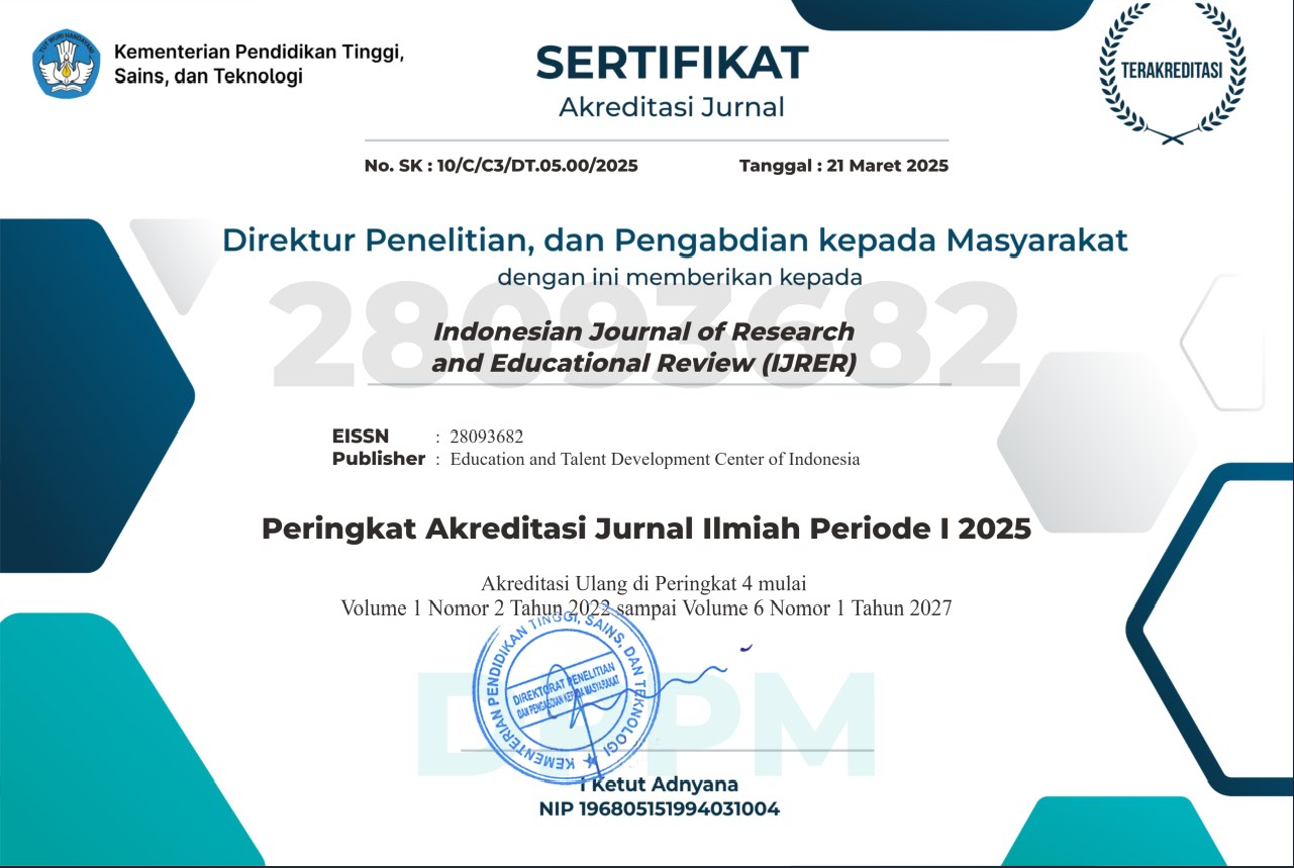
ACREDITATION
Authorship Criteria
Policy Overview
The Indonesian Journal of Research and Educational Review (IJRER) strictly adheres to the ethical standards for academic publishing established by the Committee on Publication Ethics (COPE) and the International Committee of Medical Journal Editors (ICMJE). IJRER enforces these authorship guidelines to guarantee transparency, integrity, and accountability in scientific research and scholarly publishing.
1. ICMJE Four-Criteria Standard for Authorship
To qualify as an author of a manuscript submitted to IJRER, every listed individual must satisfy all four (4) of the following criteria:
- Substantial Intellectual Contribution: Conceived, designed, or substantially contributed to the acquisition, analysis, or interpretation of data for the work.
- Drafting and Critical Revision: Drafted the manuscript or revised it critically for important intellectual content.
- Final Approval: Approved the final version of the manuscript to be published.
- Accountability: Agreed to be accountable for all aspects of the work in ensuring that questions related to the accuracy or integrity of any part of the work are appropriately investigated and resolved
Important Note: Individuals who do not meet all four criteria do not qualify for authorship. Their contributions should be explicitly recognized in the Acknowledgements section instead.
2. Author Roles and Responsibilities
A. Corresponding Author
- Serves as the primary liaison between IJRER, the peer reviewers, and the scientific community throughout the submission, peer review, and publication processes.
- Ensures that all administrative requirements—including institutional affiliations, official e-mail addresses, ORCID iDs, and funding information—are complete and accurate.
- Signs the Authorship Statement & License Agreement on behalf of all co-authors.
- Confirms that all listed co-authors have reviewed, approved the final manuscript, and agreed on the sequence of author names prior to submission.
B. Co-Authors
- Must satisfy all four ICMJE authorship criteria.
- Share collective responsibility for the authenticity, data integrity, methodological validity, and findings presented in the published work.
3. Non-Author Contributors (Acknowledgements)
Contributors who provide support but do not meet all four criteria for authorship must be credited in the Acknowledgements section. Examples of contributions that do not constitute authorship include:
- Provision of research funding, grant acquisition, or general supervision of the research group.
- Technical support, administrative assistance, or provision of laboratory space/equipment.
- Routine data collection or entry without conceptual, analytical, or intellectual synthesis.
- Copyediting, proofreading, or translation services.
4. Policy on Generative AI and AI-Assisted Technologies
In compliance with international COPE and Elsevier guidelines regarding artificial intelligence in academic publishing:
- AI Cannot Be an Author: Generative AI models and AI-assisted tools (e.g., ChatGPT, Gemini, Claude, Copilot) do not possess legal standing or capacity to bear accountability for legal rights, copyright, or data integrity. Consequently, AI tools cannot be listed as an author or co-author.
- Disclosure Obligation: Authors who use AI tools in the preparation of the manuscript (such as for language editing, data processing, or coding) must explicitly disclose their usage in the Methods section or in a dedicated Declaration of Generative AI in Writing Process section, detailing the specific tool used and the purpose of its application.
5. Authorship Misconduct and Malpractice
IJRER strictly prohibits all forms of authorship misconduct. Any suspected malpractice will be investigated in accordance with COPE flowcharts and may result in immediate manuscript rejection or formal retraction.
- Ghost Authorship: Omitting an individual who made substantial intellectual contributions to the research or manuscript writing.
- Guest/Gift Authorship: Including an individual who made no intellectual contribution (e.g., department heads, mentors, or colleagues) to grant honor or artificially inflate the manuscript's authority.
- Honorary Authorship: Assigning authorship solely based on seniority, position, or administrative standing.
- Paper Mills/Authorship Sale: Purchasing, selling, or trading authorship rights or manuscripts generated by commercial services.
6. Changes to Authorship
- Pre-Publication: Any request to modify the author list (adding, removing, or reordering authors) after initial submission must be formally submitted by the Corresponding Author. The request must include an Authorship Change Form signed by all authors (including any author being added or removed), accompanied by a compelling justification for the change. The final approval rests with the Editor-in-Chief.
- Post-Publication: Changes to authorship after online publication are generally not permitted unless an extraordinary editorial error occurred, requiring a formal Corrigendum or Correction notice approved by the Editor-in-Chief.
7. Implementation of CRediT (Contributor Roles Taxonomy)
To ensure maximum transparency, IJRER strongly encourages the use of the CRediT (Contributor Roles Taxonomy). Authors are requested to specify each contributor's role during the submission process according to the 14 standard CRediT categories (Conceptualization, Methodology, Software, Formal Analysis, Writing – Original Draft, Writing – Review & Editing, etc.).