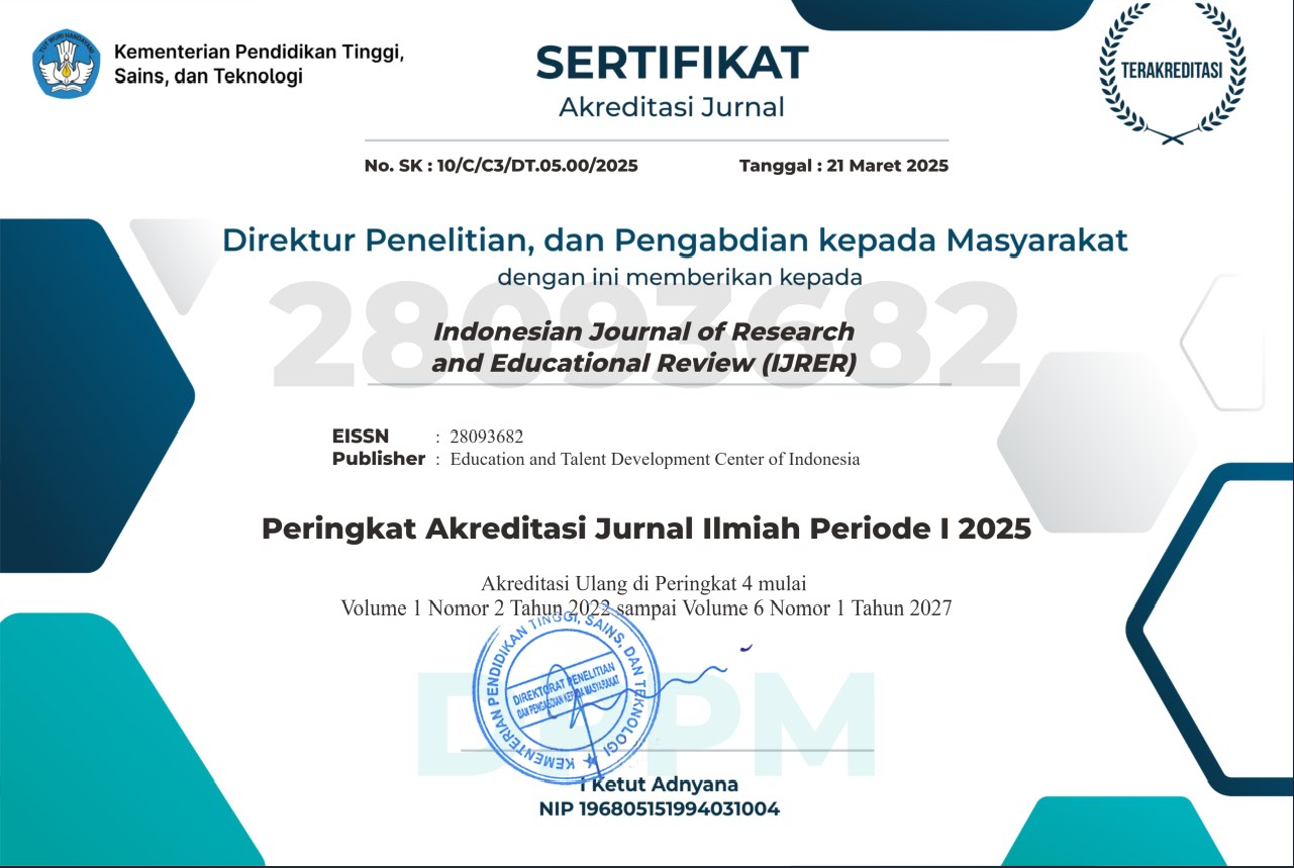
ACREDITATION
Asynchronous learning is important to worldwide higher education's digital transition. Despite extensive technology usage, issues about asynchronous learning media quality and pedagogy persist. Most studies have used the participants' final exam scores to evaluate the effectiveness of asynchronous learning. Consequently, this study seeks to evaluate the efficacy of e-learning media in facilitating asynchronous learning within the Officer Cadet Advancement Training Program (CATP or PASIS) at the higher education level. The primary focus of the research is to identify the level of participant engagement, their perceptions of the effectiveness of e-learning media, and the challenges faced by both participants and facilitators during the learning process. This research employs a mixed-methods approach, combining quantitative data collected through questionnaires administered to 47 respondents at Poltekpel Barombong and qualitative data gathered through in-depth interviews with participants, instructors, and e-learning administrators. The findings indicated that most participants regularly access the platform, complete assignments on time, and feel comfortable with self-directed learning. However, forum participation and learning motivation vary, especially among e-learning novices. While most respondents say e-learning media helps them understand the topic, they still need direct instruction, especially for technical content. Internet instability, lack of two-way communication, and participant digital incompetence are the key issues. Improved material quality, facilitator training, and solid support mechanisms improve e-learning deployment.
Patongloan, A., Prayogi, R., Rumambi, F. J., & Inkriwang, A. (2025). Effectiveness of E-Learning Media in Asynchronous Learning: A Case Study in Higher Education. ETDC: Indonesian Journal of Research and Educational Review , 4(4), 1634–1646. https://doi.org/10.51574/ijrer.v4i4.3949
Downloads
Download data is not yet available.
- Abid, M., Suhrab, M. I. R., Osnin, N. A., Nik, W. M. N. S. W., & Hammad, M. (2024). Assessing the impact of self-e-learning, classroom teaching, and simulation training on learning of COLREG: a survey-based analysis among maritime students at the Universiti Malaysia Terengganu. Australian Journal of Maritime & Ocean Affairs, 1-18. https://doi.org/10.1080/18366503.2024.2398282
- Abuhassna, H., & Alnawajha, S. (2023). The transactional distance theory and distance learning contexts: Theory integration, research gaps, and future agenda. Education Sciences, 13(2), 112. https://doi.org/10.3390/educsci13020112
- Alenezi, M. (2023). Digital learning and digital institution in higher education. Education Sciences, 13(1), 88. https://doi.org/10.3390/educsci13010088
- Alt, D. (2017). Constructivist learning and openness to diversity and challenge in higher education environments. Learning Environments Research, 20(1), 99-119. https://doi.org/10.1007/s10984-016-9223-8
- Al Abri, M. H., Al Aamri, A. Y., & Elhaj, A. M. A. (2024). Enhancing student learning experiences through integrated constructivist pedagogical models. European Journal of Contemporary Education and E-Learning, 2(1), 130-149.
- Al-Fraihat, D., Joy, M., Masa'deh, R. E., & Sinclair, J. (2020). Evaluating E-learning systems success: An empirical study. Computers in human behavior, 102, 67-86. https://doi.org/10.1016/j.chb.2019.08.004
- Bixler, A., Eslinger, M., Kleinschmit, A. J., Gaudier-Diaz, M. M., Sankar, U., Marsteller, P., ... & Robertson, S. (2021). Three steps to adapt case studies for synchronous and asynchronous online learning. Journal of microbiology & biology education, 22(1), 10-1128. https://doi.org/10.1128/jmbe.v22i1.2337
- Cahyadi, T., & Mirianto, A. D. (2023). Peran Teknologi Informasi Dalam Keberhasilan Pendidikan Dan Pelatihan di Bidang Pelayaran. Journal of Syntax Literate, 8(2). https://doi.org/10.36418/syntax-literate.v8i2.11381
- Danaher, M., & Danaher, P. A. (2019). Asynchronous learning. In Encyclopedia of Educational Innovation (pp. 1-6). Springer, Singapore.
- Drumm, S. (2025). Applying individual strategies enhances learning in asynchronous learning paths. Computers and Education Open, 8, 100257. https://doi.org/10.1016/j.caeo.2025.100257
- Du, X., Zhang, M., Shelton, B. E., & Hung, J. L. (2022). Learning anytime, anywhere: a spatio-temporal analysis for online learning. Interactive Learning Environments, 30(1), 34-48. https://doi.org/10.1080/10494820.2019.1633546
- Fadhilah, M., Sutrisna, S., Muslimah, S. N., & Ihsan, M. T. (2021). An exploring methods in online learning: Synchronous and asynchronous. ETDC: Indonesian Journal of Research and Educational Review, 1(1), 74-81. https://doi.org/10.51574/ijrer.v1i1.55
- Fructuoso, I. N., Albó, L., & Beardsley, M. (2022). University students’ preference for flexible teaching models that foster constructivist learning practices. Australasian Journal of Educational Technology, 38(4), 22-39. https://doi.org/10.14742/ajet.7968
- Ghilay, Y. (2024). Rapid Transition to Online Learning: Faculty Distance Training on LMS, Synchronous/Asynchronous Learning, and Computer-Assisted Assessment. Journal of Education and Learning, 13(6), 10-5539. https://doi.org/10.5539/jel.v13n6p61
- Hadullo, K., Oboko, R., & Omwenga, E. (2018). Factors affecting asynchronous e-learning quality in developing countries university settings. International journal of Education and Development using ICT, 14(1). https://www.learntechlib.org/p/183551/
- Halim, U., & Hidayat, N. (2025). The Sequential Levels of the Digital Divide in the Educational Domain Among Indonesian University Students. INJECT (Interdisciplinary Journal of Communication), 10(1), 179-208. https://doi.org/10.18326/inject.v10i1.4427
- Hung, C. T., Wu, S. E., Chen, Y. H., Soong, C. Y., Chiang, C. P., & Wang, W. M. (2024). The evaluation of synchronous and asynchronous online learning: student experience, learning outcomes, and cognitive load. BMC medical education, 24(1), 326. https://doi.org/10.1186/s12909-024-05311-7
- Kalamas Hedden, M., Worthy, R., Akins, E., Slinger-Friedman, V., & Paul, R. C. (2017). Teaching Sustainability Using an Active Learning Constructivist Approach: Discipline-Specific Case Studies in Higher Education. Sustainability, 9(8), 1320. https://doi.org/10.3390/su9081320
- Kim, S., & Kim, D. J. (2021). Structural relationship of key factors for student satisfaction and achievement in asynchronous online learning. Sustainability, 13(12), 6734. https://doi.org/10.3390/su13126734
- Li, J., & Xue, E. (2023). Dynamic interaction between student learning behaviour and learning environment: Meta-analysis of student engagement and its influencing factors. Behavioral Sciences, 13(1), 59. https://doi.org/10.3390/bs13010059
- Liu, M., & Yu, D. (2023). Towards intelligent E-learning systems. Education and Information Technologies, 28(7), 7845-7876. https://doi.org/10.1007/s10639-022-11479-6
- Loeng, S. (2018). Various ways of understanding the concept of andragogy. Cogent Education, 5(1), 1496643. https://doi.org/10.1080/2331186X.2018.1496643
- Matsieli, M., & Mutula, S. (2024). COVID-19 and digital transformation in higher education institutions: Towards inclusive and equitable access to quality education. Education Sciences, 14(8), 819. https://doi.org/10.3390/educsci14080819
- Metz, C. J., & Metz, M. J. (2022). The benefits of incorporating active learning into online, asynchronous coursework in dental physiology. Advances in Physiology Education, 46(1), 11-20. https://doi.org/10.1152/advan.00110.2021
- Mhlanga, D., Denhere, V., & Moloi, T. (2022). COVID-19 and the key digital transformation lessons for higher education institutions in South Africa. Education sciences, 12(7), 464. https://doi.org/10.3390/educsci12070464
- Moorhouse, B. L., & Wong, K. M. (2022). Blending asynchronous and synchronous digital technologies and instructional approaches to facilitate remote learning. Journal of Computers in Education, 9(1), 51-70. https://doi.org/10.1007/s40692-021-00195-8
- Muzaini, M., Rahayuningsih, S., Nasrun, N., & Hasbi, M. (2021). Creativity in synchronous and asynchronous learning during the covid-19 pandemic: a case study. AKSIOMA: Jurnal Program Studi Pendidikan Matematika, 10(3), 1722-1735. http://dx.doi.org/10.24127/ajpm.v10i3.3897
- Neffati, O. S., Setiawan, R., Jayanthi, P., Vanithamani, S., Sharma, D. K., Regin, R., ... & Sengan, S. (2021). An educational tool for enhanced mobile e-Learning for technical higher education using mobile devices for augmented reality. Microprocessors and Microsystems, 83, 104030. https://doi.org/10.1016/j.micpro.2021.104030
- Özbey, M., & Kayri, M. (2023). Investigation of factors affecting transactional distance in E-learning environment with artificial neural networks. Education and Information Technologies, 28(4), 4399-4427. https://doi.org/10.1007/s10639-022-11346-4
- Perhubungan, K. (2023). Kementerian Perhubungan. Direktorat Jenderal Sipil, 13.
- Phanphech, P., Tanitteerapan, T., Mungkung, N., Arunrungrusmi, S., Chunkul, C., Songruk, A., ... & Kinoshita, H. (2022). An analysis of student anxiety affecting on online learning on conceptual applications in Physics: Synchronous vs. asynchronous learning. Education Sciences, 12(4), 278. https://doi.org/10.3390/educsci12040278
- Pramesworo, I. S., Sembiring, D., Sarip, M., Lolang, E., & Fathurrochman, I. (2023). Identification of new approaches to information technology-based teaching for successful teaching of millennial generation entering 21st century education. Jurnal Iqra': Kajian Ilmu Pendidikan, 8(1), 350-370. https://doi.org/10.25217/ji.v8i1.2722
- Ratan, R., Ucha, C., Lei, Y., Lim, C., Triwibowo, W., Yelon, S., ... & Chen, V. H. H. (2022). How do social presence and active learning in synchronous and asynchronous online classes relate to students’ perceived course gains?. Computers & Education, 191, 104621. https://doi.org/10.1016/j.compedu.2022.104621
- Raviolo, P., Messina, S., Mauro, I., & Rondonotti, M. (2021). E-tutor Profiles in Online Higher Education: Skills and Organizational Models. In International Workshop on Higher Education Learning Methodologies and Technologies Online (pp. 187-196). Cham: Springer International Publishing. https://doi.org/10.1007/978-3-030-96060-5_14
- Roach, V. A., & Attardi, S. M. (2022). Twelve tips for applying Moore’s Theory of Transactional Distance to optimize online teaching. Medical Teacher, 44(8), 859-865.
- Rosen, D., & Kelly, A. M. (2023). Mixed methods study of student participation and self-efficacy in remote asynchronous undergraduate physics laboratories: contributors, lurkers, and outsiders. International Journal of STEM Education, 10(1), 34. https://doi.org/10.1186/s40594-023-00428-5
- Schreiber, W. B. (2022). Teaching in a pandemic: Adapting preparations for asynchronous remote learning using three evidence-based practices. Scholarship of Teaching and Learning in Psychology, 8(2), 106. https://psycnet.apa.org/buy/2022-04154-001
- Servant-Miklos, V., & Noordegraaf-Eelens, L. (2021). Toward social-transformative education: An ontological critique of self-directed learning. Critical Studies in Education, 62(2), 147-163. https://doi.org/10.1080/17508487.2019.1577284
- Sharma, A., Bharti, & Pandey, A. (2024). Unleashing the Potential of Technology-Driven Learning Management Systems for Student-Centric Excellence to Empower Higher Education. Engineering Proceedings, 59(1), 195. https://doi.org/10.3390/engproc2023059195
- Stecuła, K., & Wolniak, R. (2022). Influence of COVID-19 pandemic on dissemination of innovative e-learning tools in higher education in Poland. Journal of Open Innovation: Technology, Market, and Complexity, 8(2), 89. https://doi.org/10.3390/joitmc8020089
- Varkey, T. C., Varkey, J. A., Ding, J. B., Varkey, P. K., Zeitler, C., Nguyen, A. M., ... & Thomas, C. R. (2023). Asynchronous learning: a general review of best practices for the 21st century. Journal of Research in Innovative Teaching & Learning, 16(1), 4-16. https://doi.org/10.1108/JRIT-06-2022-0036
- Xianxiao, Z. (2024). Simulation research on interactive entertainment e-learning based on visual saliency testing in music multimedia teaching system. Entertainment Computing, 50, 100676. https://doi.org/10.1016/j.entcom.2024.100676
- Xiao, J. (2025). Revisiting the theory of transactional distance: Implications for open, distance, and digital education in the 21st century. American Journal of Distance Education, 39(1), 113-126. https://doi.org/10.1080/08923647.2024.2303328
- Yaqin, L. N., Prasojo, L. D., Haji-Othman, N. A., Yusof, N., & Habibi, A. (2023). Addressing the digital divide in Indonesian higher education: Insights, implications, and potential solutions. In From digital divide to digital inclusion (pp. 291-307). Springer, Singapore. https://doi.org/10.1007/978-981-99-7645-4_13
- Yildiz Durak, H. (2025). What makes an effective online course experience?: Student perceptions and needs for online course design elements in the context of feedback and collaborative learning. Technology, Knowledge and Learning, 30(2), 969-990. https://doi.org/10.1007/s10758-024-09748-z
- Yin, R. K. (2018). Case study research and applications (Vol. 6). Thousand Oaks, CA: Sage.
- Zeng, H., & Luo, J. (2024). Effectiveness of synchronous and asynchronous online learning: a meta-analysis. Interactive Learning Environments, 32(8), 4297-4313. https://doi.org/10.1080/10494820.2023.2197953
- Zheng, Y. (2024). E-learning and speech dynamic recognition based on network transmission in music interactive teaching experience. Entertainment Computing, 50, 100716. https://doi.org/10.1016/j.entcom.2024.100716
- Zsifkovits, M., Amplatz, L., Triebner, N., Utz, J., Kornhuber, J., & Spitzer, P. (2025). Randomized controlled trial of asynchronous vs. synchronous online teaching formats: equal knowledge after training, greater acceptance and lower intrinsic motivation through asynchronous online learning. BMC Medical Education, 25(1), 850. https://doi.org/10.1186/s12909-025-07481-4
Copyright (c) 2025 Asce Patongloan, Ratnawati Prayogi, Freddy J. Rumambi, Alfred Inkriwang

This work is licensed under a Creative Commons Attribution-ShareAlike 4.0 International License.
Similar Articles
- Selviana Purnama Putri, Irfan Irfan, Muh. Saleh Husain, Web-Based Learning Media Wordwall in Fine Arts Learning to Increase Student Learning Motivation , ETDC: Indonesian Journal of Research and Educational Review : Vol. 4 No. 2 (2025): March
- Neliana Neliana, Mulyadi Mulyadi, Badaruddin Kaddas, Experiencing Citizenship: How Immersive Pedagogies Transform Student Interest and Academic Achievement in Pancasila Education , ETDC: Indonesian Journal of Research and Educational Review : Vol. 5 No. 4 (2026): September
- Dwi Andini Putri , Agung Setia Batubara, Deep Learning-Enhanced Discovery Learning: Impact on High School Students' Environmental Change Outcomes , ETDC: Indonesian Journal of Research and Educational Review : Vol. 6 No. 1 (2026): September - December
- Putri Nurul Saqinah, Andi Ihsan, Arimbi Arimbi, Ramli Ramli, Muh. Adnan Hudain, The Influence of Social Emotional Implementation on Physical Education Learning Outcomes: Digital Technology-Based Learning Model , ETDC: Indonesian Journal of Research and Educational Review : Vol. 4 No. 2 (2025): March
- Habil Eka Setiawan, Students' Learning Interests with Audio-Visual Media in PJOK Subjects , ETDC: Indonesian Journal of Research and Educational Review : Vol. 4 No. 2 (2025): March
- Zahra Nur, Mulyadi Mulyadi, Erwin Nurdiansyah, Show and Tell Learning Method Based on the Discovery Learning Model: Creativity and Learning Outcomes at Primary School , ETDC: Indonesian Journal of Research and Educational Review : Vol. 5 No. 1 (2025): December
- Ferlin Mega Notanubun, Ode Abdurrachman, Leonid Ritiauw, Deep Learning Approach to Improve Student Learning Outcomes in Social Studies at Elementary School , ETDC: Indonesian Journal of Research and Educational Review : Vol. 5 No. 3 (2026): June
- Willy Bachtiar Wijaya, Hasmyati Hasmyati, Asran Asran, Achievement Improvement of Basic Table Tennis Techniques Through The Application of Audio-Visual Learning Media , ETDC: Indonesian Journal of Research and Educational Review : Vol. 1 No. 2 (2022): March
- Fitri Fitri, The Impact of Reading Interest and Learning Habits on Students' Achievement for Integrated Science Learning , ETDC: Indonesian Journal of Research and Educational Review : Vol. 1 No. 4 (2022): September
- Dean R. Matital, Elsinora Mahananingtyas, Leonid Ritiauw, Controversial Issue Learning Model: Social Studies Learning Outcomes at Elementary School , ETDC: Indonesian Journal of Research and Educational Review : Vol. 5 No. 2 (2026): March
<< < 1 2 3 4 5 6 7 8 9 10 > >>
You may also start an advanced similarity search for this article.
Dimensions Badge
Crossmark Badge

Section
Articles