
The Role of Reflective Thinking in Enhancing Mathematical Problem-Solving Skills

https://doi.org/10.51574/kognitif.v6i2.4815
Keywords:
Reflective Thinking, Mathematical Problem Solving , Problem-solving Skills , Matrix learning, Students’ Cognitive ProcessesAbstract
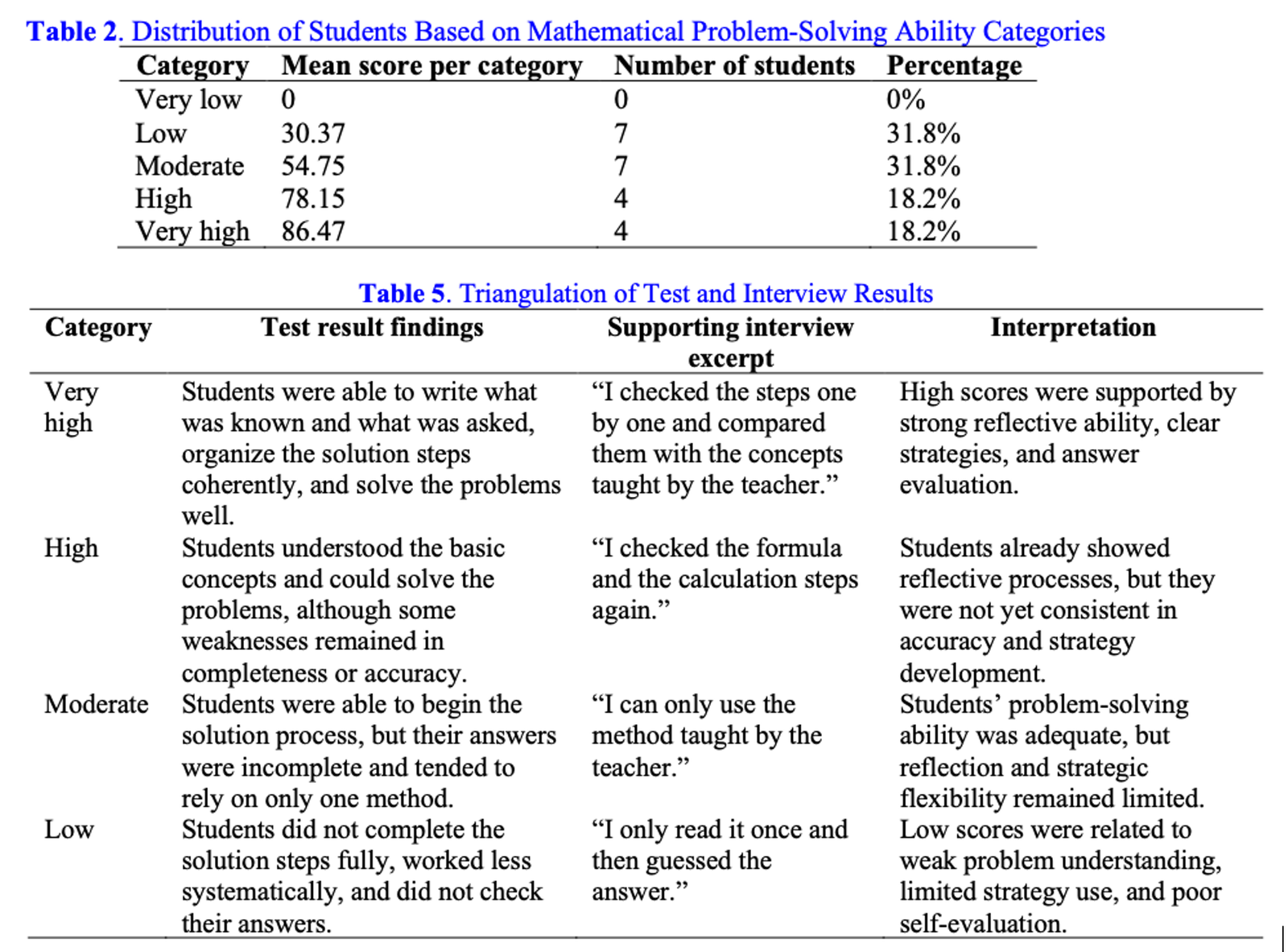
This study was motivated by preliminary findings suggesting that students' mathematical problem-solving skills were deficient. Students encountered challenges in comprehending problem material, formulating solution strategies, executing problem-solving procedures, and evaluating their responses. This study sought to elucidate the function of reflective thinking in enhancing students' mathematical problem-solving capabilities concerning matrices. A descriptive qualitative methodology was utilised, employing 22 eleventh-grade students as participants in the research. Data were gathered by observation, assessments, interviews, and documentation, and were analysed through data reduction, data presentation, and conclusion formulation. The results indicated disparities in students' mathematical problem-solving proficiency across four tiers: extremely high (3 students; mean score = 85.4), high (4 students; mean score = 68.2), moderate (7 students; mean score = 51.7), and low (8 students; mean score = 29.9). This study was prompted by initial observations suggesting that students' mathematical problem-solving skills were deficient. Students encountered challenges in comprehending problem material, formulating solution strategies, executing problem-solving procedures, and evaluating their responses. This study sought to elucidate the function of reflective thinking in enhancing students' mathematical problem-solving skills concerning matrices. A descriptive qualitative methodology was utilised, employing 22 eleventh-grade students as participants in the research. Data were gathered by observation, assessments, interviews, and documentation, then analysed through data reduction, data presentation, and conclusion formulation. The results indicated discrepancies in students' mathematical problem-solving capabilities across four tiers: very high (3 students; mean score = 85.4), high (4 students; mean score = 68.2), moderate (7 students; mean score = 51.7), and low (8 students; mean score = 29.9). Students possessing advanced reflective thinking skills demonstrated a profound understanding of problems, the capacity to identify suitable techniques, rectify errors, and articulate their thought processes eloquently and logically. The findings suggest that reflective thinking significantly enhances pupils' mathematical problem-solving skills. As students' reflective thinking skill increases, their capacity to comprehend challenges, devise and execute suitable techniques, and independently, critically, and systematically assess and enhance their solutions improves.
Downloads
References
Abbeduto, L., Murphy, M. M., Richmond, E. K., Amman, A., Beth, P., Weissman, M. D., Kim, J.-S., Cawthon, S. W., Karadottir, S., Abe, H., Yada, H., Yamamoto, T., Sohma, H., Abraham, S., Perez, P., Adarves-Yorno, I., Jetten, J., Postmes, T., Haslam, S. A., … Elaad, E. (2019). Teacher perceptions of two multi-component interventions: Disability awareness and science. Frontiers in Psychology, 31(2).
Başol, G., & Gencel, I. E. (2013). Reflective thinking scale: A validity and reliability study. Kuram ve Uygulamada Egitim Bilimleri, 13(2), 941–946.
DiNapoli, J., & Miller, E. K. (2022). Recognizing, supporting, and improving student perseverance in mathematical problem-solving: The role of conceptual thinking scaffolds. Journal of Mathematical Behavior, 66. https://doi.org/10.1016/j.jmathb.2022.100965
Evin Gencel, I., & Saracaloğlu, A. S. (2018). The Effect of Layered Curriculum on Reflective Thinking and on Self-Directed Learning Readiness of Prospective Teachers. International Journal of Progressive Education, 14(1), 8–20. https://doi.org/10.29329/ijpe.2018.129.2
Figueroa, A. P., Possani, E., & Trigueros, M. (2018). Matrix multiplication and transformations: an APOS approach. Journal of Mathematical Behavior, 52(October 2017), 77–91. https://doi.org/10.1016/j.jmathb.2017.11.002
Ghanizadeh, A. (2017). The interplay between reflective thinking, critical thinking, self-monitoring, and academic achievement in higher education. Higher Education, 74(1), 101–114. https://doi.org/10.1007/s10734-016-0031-y
Goulet-Lyle, M. P., Voyer, D., & Verschaffel, L. (2020). How does imposing a step-by-step solution method impact students’ approach to mathematical word problem solving? ZDM - Mathematics Education, 52(1), 139–149. https://doi.org/10.1007/s11858-019-01098-w
Kholid, M. N., Putri, Y. P., Swastika, A., Maharani, S., & Ikram, M. (2022). What are the pupils’ challenges in implementing reflective thinking for problem-solving? AIP Conference Proceedings, 2479(July). https://doi.org/10.1063/5.0099600
Kholid, M. N., Swastika, A., Ishartono, N., Nurcahyo, A., Lam, T. T., Maharani, S., Ikram, M., Murniasih, T. R., Majid, Wijaya, A. P., & Pratiwi, E. (2022). Hierarchy of Students’ Reflective Thinking Levels in Mathematical Problem Solving. Acta Scientiae, 24(6), 24–59. https://doi.org/10.17648/acta.scientiae.6883
Kim, N. J., Vicentini, C. R., & Belland, B. R. (2022). Influence of Scaffolding on Information Literacy and Argumentation Skills in Virtual Field Trips and Problem-Based Learning for Scientific Problem Solving. International Journal of Science and Mathematics Education, 20(2), 215–236. https://doi.org/10.1007/s10763-020-10145-y
Muzaini, M., Rahayuningsih, S., Ikram, M., & Nasiruddin, F. A. Z. (2023). Mathematical Creativity: Student Geometrical Figure Apprehension in Geometry Problem-Solving Using New Auxiliary Elements. International Journal of Educational Methodology, 9(1), 139–150. https://doi.org/10.12973/ijem.9.1.139
Sindy Mustika Sari, Aldi Firmansyah, & Reza Lestari. (2022). Analisis Kesulitan Siswa Dalam Menyelesaikan Soal Matematika Problem Solving Berdasarkan Tahapan Heuristik Polya Siswa Kelas XI Ipa. Seminar Nasional Pendidikan Guru Sekolah Dasar Universitas Kuningan, 2(1), 109–114. https://doi.org/10.25134/prosidingsemnaspgsd.v2i1.32
Son, J. W., & Lee, M. Y. (2021). Exploring the Relationship Between Preservice Teachers’ Conceptions of Problem Solving and Their Problem-Solving Performances. International Journal of Science and Mathematics Education, 19(1), 129–150. https://doi.org/10.1007/s10763-019-10045-w
Sormunen, K., Juuti, K., & Lavonen, J. (2020). Maker-Centered Project-Based Learning in Inclusive Classes: Supporting Students’ Active Participation with Teacher-Directed Reflective Discussions. International Journal of Science and Mathematics Education, 18(4), 691–712. https://doi.org/10.1007/s10763-019-09998-9
Szabo, Z. K., Körtesi, P., Guncaga, J., Szabo, D., & Neag, R. (2020). Examples of problem-solving strategies in mathematics education supporting the sustainability of 21st-century skills. Sustainability (Switzerland), 12(23), 1–28. https://doi.org/10.3390/su122310113
Thahir, A., Komarudin, Hasanah, U. N., & Rahmahwaty. (2019). MURDER learning models and self efficacy: Impact on mathematical reflective thinking ability. Journal for the Education of Gifted Young Scientists, 7(4), 1120–1133. https://doi.org/10.17478/jegys.594709
Utami, A. M., Adelia, R., Kurniawati, I., Damayanti, E., & Damara, T. D. (2024). Implementasi Permainan Tic-Tac-Toe sebagai Konteks Pembelajaran Matematika pada Materi Keliling Bangun Datar dalam Menanamkan Kemampuan Pemecahan Masalah Siswa Sekolah Dasar. 08(December 2023), 180–188.
Vicente, S., Verschaffel, L., Sánchez, R., & Múñez, D. (2022). Arithmetic word problem solving. Analysis of Singaporean and Spanish textbooks. Educational Studies in Mathematics, 111(3), 375–397. https://doi.org/10.1007/s10649-022-10169-x
Voica, C., Singer, F. M., & Stan, E. (2020). How are motivation and self-efficacy interacting in problem-solving and problem-posing? Educational Studies in Mathematics, 105(3), 487–517. https://doi.org/10.1007/s10649-020-10005-0
Wilkie, K. J. (2025). ‘Things haven’t gone the way I thought they’d go’: secondary mathematics teachers talk about trialling a problem-solving pedagogy. Journal of Mathematics Teacher Education. https://doi.org/10.1007/s10857-025-09709-y
Downloads
Published
How to Cite
Issue
Section
License
Copyright (c) 2026 This is an open-access under the CC-BY-SA license

This work is licensed under a Creative Commons Attribution-ShareAlike 4.0 International License.
Education and Talent Development Center of Indonesia (ETDC Indonesia)
e-mail: kognitif@gmail.com, website : https://etdc-indonesia.com

Kognitif: Jurnal Riset HOTS Pendidikan Matematika dengan Situs: https://etdci.org/journal/kognitif berlisensi Creative Commons Attribution-ShareAlike 4.0 International License






.png)


