Developing an Interactive E-Booklet Based on Multimedia Learning Theory to Improve Learning Outcomes on Biodiversity

https://doi.org/10.51574/ijrer.v5i4.5085
Keywords:
Biodiversity, Cognitive Learning Outcomes, Interactive E-Booklet, Islamic High School, Multimedia Learning TheoryAbstract
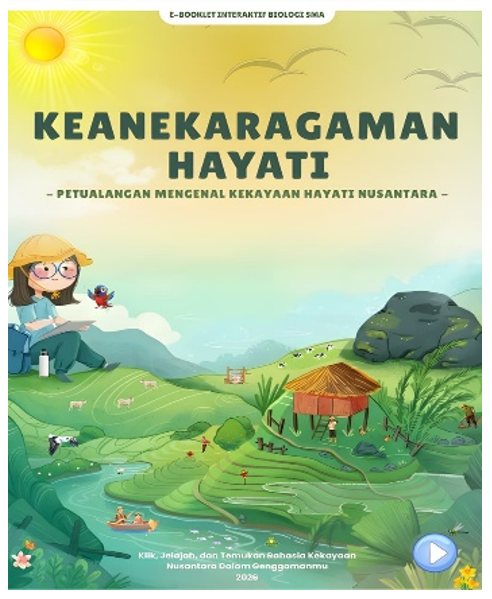
Students frequently struggle with biodiversity concepts due to abstract materials and conventional, static text-based learning. This study aimed to develop, assess the feasibility and practicality, and evaluate the effectiveness of an interactive e-booklet based on multimedia learning theory to enhance student learning outcomes. Utilizing a 4D Research and Development (R&D) model, a sample of 50 tenth-grade students was selected via cluster sampling and divided equally into experimental and control classes at SMA Islam Al Ulum Terpadu Medan. Data gathered through validation sheets, practicality questionnaires, and pretest-posttest cognitive instruments were analyzed using Normalized Gain (N-Gain) and Mann–Whitney U tests. Material experts validated the product as Very Feasible with a 100% consistency score. Practicality metrics increased significantly from Feasible (67.50%) to Very Feasible (86.25%) for teachers, and consistently remained Very Feasible for students in small-group (78.13%) and large-group (88.30%) trials. Crucially, the experimental group achieved a higher posttest average of 93.00 and a medium N-Gain of 0.42, significantly outperforming the control group's posttest average of 80.00 and low N-Gain of 0.25 (Z-count > Z-table). This research contributes an innovative digital solution that actively mitigates cognitive overload, facilitates autonomous learning, and provides teachers with a proven pedagogical tool to optimize students’ conceptual mastery in biology education.
References
Aspandi, A., & Muttaqin, M. A. (2025). Transforming Teacher Roles in Indonesia’s Digital Era: Enhancing Learning Effectiveness and Student Engagement. Journal of General Education and Humanities, 4(4), 1495-1510. https://doi.org/10.58421/gehu.v4i4.616
Bermudez, G. M., & Lindemann-Matthies, P. (2020). “What matters is species richness”—high school students’ understanding of the components of biodiversity. Research in Science Education, 50(6), 2159-2187. https://doi.org/10.1007/s11165-018-9767-y
Çeken, B., & Taşkın, N. (2022). Multimedia learning principles in different learning environments: A systematic review. Smart Learning Environments, 9(1), 19. https://doi.org/10.1186/s40561-022-00200-2
Cladis, A. E. (2020). A shifting paradigm: An evaluation of the pervasive effects of digital technologies on language expression, creativity, critical thinking, political discourse, and interactive processes of human communications. E-Learning and digital Media, 17(5), 341-364. https://doi.org/10.1177/2042753017752583
Fardian, D., Suryadi, D., Prabawanto, S., & Jupri, A. (2025). Conceptualizing linear equations: A snapshot from teaching and learning in Indonesia. Jurnal Ilmiah Ilmu Terapan Universitas Jambi, 9(3), 1205-1226. https://doi.org/10.22437/jiituj.v9i3.37450
Hanif, M., Qudsiyyah, M. A., & Hanifah, N. D. S. (2025). Integrating Information Technology in Islamic Education: A Qualitative Study Using Richard Mayer's Multimedia Learning Theory. Al-Ishlah: Jurnal Pendidikan, 17(2), 2638-2651. https://doi.org/10.35445/alishlah.v17i2.7192
Hanifah, H., Afrikani, T., & Yani, I. (2020). Pengembangan media ajar e-booklet materi plantae untuk meningkatkan hasil belajar biologi siswa. Journal Of Biology Education Research (JBER), 1(1), 10-16. https://journal.unpak.ac.id/index.php/jber/article/view/2631
Honra, J. R. (2025). Enhancing High School Biology Education Students’ Transdisciplinary Thinking Through Design Thinking. The Journal of Experimental Education, 1-17. https://doi.org/10.1080/00220973.2025.2606241
Kautsaranny, S., & Isnawati, I. (2024). Pengembangan E-Book Interaktif pada Materi Keanekaragaman Hayati untuk Melatihkan Keterampilan Berpikir Kreatif Siswa SMA/MA Kelas X. Berkala Ilmiah Pendidikan Biologi (BioEdu), 13(1), 79-88. https://doi.org/10.26740/bioedu.v13n1.p79-88
Lestari, T., Kaspul, K., & Nurtamara, L. (2024). Pengembangan E-Booklet Pada Konsep Sistem Imun Untuk Meningkatkan Hasil Belajar Peserta Didik:(Development of E-Booklet on Immune System Concepts to Improve Learners' Learning Outcomes). BIODIK, 10(4), 645-658. https://doi.org/10.22437/biodik.v10i4.37931
Mariati, S. L. (2024). The influence of interactive learning media on students' learning interest in biology subjects in junior high schools. International Journal of Curriculum Development, Teaching and Learning Innovation, 2(3), 127-135. https://trigin.pelnus.ac.id/index.php/Curriculum/article/view/189
Mayer, R. E. (2024). The past, present, and future of the cognitive theory of multimedia learning. Educational Psychology Review, 36(1), 8. https://doi.org/10.1007/s10648-023-09842-1
Mayer, R. E., Howarth, J. T., Kaplan, M., & Hanna, S. (2018). Applying the segmenting principle to online geography slideshow lessons. Educational Technology Research and Development, 66(3), 563-577. https://doi.org/10.1007/s11423-017-9554-x
Meliyani, A. R., Mentari, D., Syabani, G. P., & Zuhri, N. Z. (2022). Analisis kebutuhan media pembelajaran digital bagi guru agar tercipta kegiatan pembelajaran yang efektif dan siswa aktif. Jurnal Jendela Pendidikan, 2(02), 264-274. https://doi.org/10.57008/jjp.v2i02.179
Morris, N. P., & Lambe, J. (2017). Multimedia interactive eBooks in laboratory bioscience education. Higher Education Pedagogies, 2(1), 28-42. https://doi.org/10.1080/23752696.2017.1338531
Pedrera, O., Ortega-Lasuen, U., Ruiz-González, A., Díez, J. R., & Barrutia, O. (2023). Branches of plant blindness and their relationship with biodiversity conceptualisation among secondary students. Journal of Biological Education, 57(3), 566-591. https://doi.org/10.1080/00219266.2021.1933133
Perta, H., Yulianti, E., & Huang, T. C. (2024). Development of flipped classroom based interactive multimedia on biodiversity concept to increase students’ learning motivation and critical thinking. Jurnal Pendidikan Sains Indonesia (Indonesian Journal of Science Education), 12(3), 614-627. https://dx.doi.org/10.24815/jpsi.v12i3.38487
Pertiwi, N. P. E. W. P., Suarjana, I. M., & Arini, N. W. (2019). Hubungan Antara Motivasi Belajar dan Media Pembelajaran dengan Hasil Belajar Matematika. Jurnal Pedagogi Dan Pembelajaran, 2(3), 301-308. https://doi.org/10.23887/jp2.v2i3.19277
Polikoff, M. S., & Porter, A. C. (2014). Instructional alignment as a measure of teaching quality. Educational Evaluation and Policy Analysis, 36(4), 399-416. 10.3102/0162373714531851
Purnamasari, E. F., Maasawet, E. T., Hudiyono, Y., & Subagiyo, L. (2024). Effectiveness of biology e-module teaching materials based on Flip PDF professional application to improve learning outcomes and critical thinking skills. Jurnal Penelitian Pendidikan IPA, 10(11), 8892-8898. https://doi.org/10.29303/jppipa.v10i11.9147
Ridianti, T. (2024). Pengembangan media e-book pada materi keanekaragaman hayati tumbuhan. Edumedia: Jurnal Keguruan dan Ilmu Pendidikan, 8(1), 1-8. https://doi.org/10.51826/edumedia.v8i1.1139
Sari, I. H. K., Asih, I. S., Khoirunnisa, L., Tamherwarin, H. R. J., & Rizkiani, Z. B. (2023). Pemahaman peta konsep dan miskonsepsi siswa SMA kelas X semester 2 pada materi keanekaragaman hayati. DIAJAR: Jurnal Pendidikan Dan Pembelajaran, 2(2), 152-159. https://doi.org/10.54259/diajar.v2i2.1365
Sholikhah, M., Mumpuni, A., & Sunarsih, D. (2022). Kesesuaian Materi Dan Evaluasi dengan Kompetensi Dasar pada Buku Teks Sekolah Dasar. Jurnal Ilmiah KONTEKSTUAL, 3(02), 107-115. https://doi.org/10.46772/kontekstual.v3i02.658
Sinaga, H., Silalahi, M. V., & Situmorang, M. V. (2023). Pengembangan media pembelajaran e-booklet pada materi keanekaragaman hayati terhadap hasil belajar siswa kelas X SMA Negeri 4 Pematang Siantar. INNOVATIVE: Journal Of Social Science Research, 3(5), 7116-7130. https://j-innovative.org/index.php/Innovative/article/view/5702
Siregar, N. F., & Sriyati, S. (2025). Biodiversity Literacy and Tradition: Development of Student Worksheets Based on the Local Potential of the Indahan Tupporobu Dish for Biology Learning. Al Jahiz: Journal of Biology Education Research, 6(2), 242-258. https://doi.org/10.32332/al-jahiz.v6i2.10901
Susantini, E., Puspitawati, R. P., Raharjo, & Suaidah, H. L. (2021). E-book of metacognitive learning strategies: design and implementation to activate student’s self-regulation. Research and Practice in Technology Enhanced Learning, 16(1), 13. https://doi.org/10.1186/s41039-021-00161-z
Wahyuni, S., Rahmawati, S., Sudibya, E., Lestari, J. W., Therik, J. W., & Pekei, I. F. M. (2024). The urgency of understanding the definition and category of teaching materials as knowledge for biology education students. International Journal of Sustainable English Language, Education, and Science, 1(1), 1-7. https://ejournal.cwcu.ac.id/index.php/IJSELES/article/view/8
Wang, X. M., Hu, Q. N., Hwang, G. J., & Yu, X. H. (2023). Learning with digital technology-facilitated empathy: An augmented reality approach to enhancing students’ flow experience, motivation, and achievement in a biology program. Interactive Learning Environments, 31(10), 6988-7004. https://doi.org/10.1080/10494820.2022.2057549
Yli-Panula, E., Jeronen, E., Lemmetty, P., & Pauna, A. (2018). Teaching methods in biology promoting biodiversity education. Sustainability, 10(10), 3812. https://doi.org/10.3390/su10103812
Zhao, F., Mayer, R. E., Adamo-Villani, N., Mousas, C., Choi, M., & Hauser, K. (2025). Role of race and gender of pedagogical agents in multimedia learning. Journal of Educational Computing Research, 63(4), 801-840. https://doi.org/10.1177/07356331251322469
Downloads
Published
How to Cite
Issue
Section
License
Copyright (c) 2026 Yachsifa Muna, Aida Fitriani Sitompul

This work is licensed under a Creative Commons Attribution-ShareAlike 4.0 International License.