Industrial Practice and Communication Skills: Work Readiness of Electronic Engineering Education Students

https://doi.org/10.51574/ijrer.v5i4.5008
Keywords:
Communication Skills, Engineering Education Students, Industrial Practice, Work ReadinessAbstract
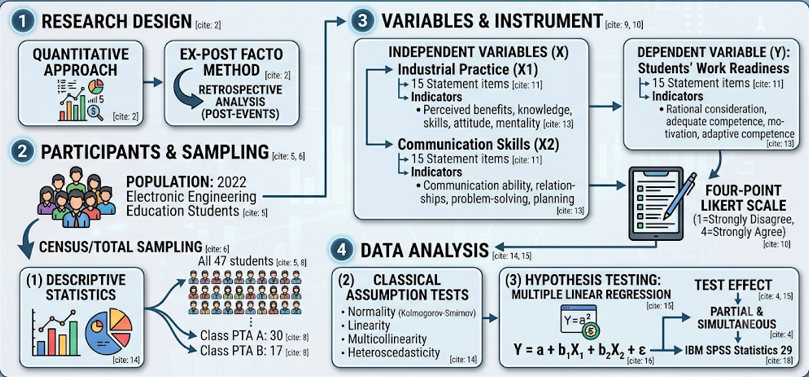
This study examines the effect of industrial practice and communication skills on the work readiness of students in the Electronic Engineering Education Department at Universitas Negeri Makassar, Indonesia. Work readiness is a crucial outcome of higher education, particularly for students preparing to enter the professional workforce, yet prior studies have rarely modeled industrial practice and communication skills jointly within a single regression framework in the vocational-engineering context. A quantitative ex-post facto design was employed, drawing on the entire population of 47 fourth-year students who had completed their industrial internship, using a validated four-point Likert-scale questionnaire (15 items per variable). Data was analyzed through multiple linear regression in IBM SPSS Statistics 29, following tests of validity, reliability, and classical assumptions. The results show that (1) industrial practice has a positive and significant partial effect on work readiness (t = 2.165, sig. = 0.034 < 0.05); (2) communication skills have a positive and significant partial effect on work readiness (t = 3.580, sig. = 0.001 < 0.05); and (3) industrial practice and communication skills simultaneously and significantly affect work readiness (F = 86.529, sig. = 0.001 < 0.05), jointly explaining 78.8% of the variance in work readiness (Adjusted R² = 0.788), with communication skills exerting the more dominant influence (b = 0.709) relative to industrial practice (b = 0.240). These findings suggest that vocational teacher-education curricula should integrate structured industrial-practice programs with deliberate communication-skills training to strengthen graduate employability.
References
Anati, M., Gusnita, W., Kasmita, K., & Siregar, J. (2025). The Effect of Industry Field Practice on the Work Readiness of Culinary Arts Students at Padang State University. Jurnal Pendidikan Tata Boga dan Teknologi, 6(3), 431-441. https://doi.org/10.24036/jptbt.v6i3.26991
Brunhaver, S. R., Jesiek, B. K., Korte, R. F., & Strong, A. C. (2021). The early career years of engineering: Crossing the threshold between education and practice. Engineering Studies, 13(2), 79-85. https://doi.org/10.1080/19378629.2021.1961570
De Prada, E., Mareque, M., & Pino-Juste, M. (2022). Teamwork skills in higher education: is university training contributing to their mastery?. Psicologia: Reflexao e critica, 35(1), 5. https://doi.org/10.1186/s41155-022-00207-1
Dias-Oliveira, E., Pasion, R., da Cunha, R. V., & Coelho, S. L. (2024). The development of critical thinking, team working, and communication skills in a business school–A project-based learning approach. Thinking Skills and Creativity, 54, 101680. https://doi.org/10.1016/j.tsc.2024.101680
Dlamini, N. G., & Dlamini, N. D. (2026). Transitioning from academia to the professional arena: Evaluating higher education curriculum strategies–A review. Industry and Higher Education, 40(1), 49-58. https://doi.org/10.1177/09504222251315274
Enstroem, R., & Schmaltz, R. (2024). Striking gold: navigating the education massification maze for work readiness. Journal of Work-Applied Management, 16(2), 184-199. https://doi.org/10.1108/JWAM-10-2023-0100
Ikejiaku, B., & Tembo, T. (2023). Broad-based learning method (BBLM): A framework for adopting holistic approach to teaching and practice-based learning in the higher education. International Journal of Education, 15(1), 1.
Jackson, D., Riebe, L., Meek, S., Ogilvie, M., Kuilboer, A., Murphy, L., ... & Brock, M. (2023). Using an industry-aligned capabilities framework to effectively assess student performance in non-accredited work-integrated learning contexts. Teaching in higher education, 28(4), 802-821. https://doi.org/10.1080/13562517.2020.1863348
Maharani, C., & Firmansyah, A. (2026). The Effect of internship Experience and skills on student work readiness at STIE AMKOP Makassar. Point of View Research Management, 7(1), 27-33. http://journal.accountingpointofview.id/index.php/POVREMA/article/view/397
Mainga, W., Murphy-Braynen, M. B., Moxey, R., & Quddus, S. A. (2022). Graduate employability of business students. Administrative Sciences, 12(3), 72. https://doi.org/10.3390/admsci12030072
Moore, T., & Morton, J. (2017). The myth of job readiness? Written communication, employability, and the ‘skills gap’in higher education. Studies in higher education, 42(3), 591-609. https://doi.org/10.1080/03075079.2015.1067602
Munir, F. (2022). More than technical experts: Engineering professionals’ perspectives on the role of soft skills in their practice. Industry and Higher Education, 36(3), 294-305. https://doi.org/10.1177/09504222211034725
Mwita, K. M., Kinunda, S., Obwolo, S., & Mwilongo, N. H. (2023). Soft skills development in higher education institutions: students' perceived role of universities and students' self-initiatives in bridging the soft skills gap. International Journal of Research in Business & Social Science, 12(3). https://doi.org/10.20525/ijrbs.v12i3.2435
Naseer, F., Tariq, R., Alshahrani, H. M., Alruwais, N., & Al-Wesabi, F. N. (2025). Project based learning framework integrating industry collaboration to enhance student future readiness in higher education. Scientific Reports, 15(1), 24985. https://doi.org/10.1038/s41598-025-10385-4
O’Reilly, B., & Guidat, T. (2024). How higher education institutions can collaborate with industry to produce work-ready graduates. In Vietnamese Higher Education at a Crossroads: Transformation During the Digital Age (pp. 203-222). Cham: Springer Nature Switzerland. https://doi.org/10.1007/978-3-031-61838-3_8
Poláková, M., Suleimanová, J. H., Madzík, P., Copuš, L., Molnárová, I., & Polednová, J. (2023). Soft skills and their importance in the labour market under the conditions of Industry 5.0. Heliyon, 9(8). https://doi.org/10.1016/j.heliyon.2023.e18670
Rifai, D. S., Widodo, W., & Hasbullah, H. (2025). Boosting Student Work Readiness: A Meta-Analysis of Soft Skills and Teaching Factory. Jurnal Pemberdayaan Masyarakat, 4(4), 982-994. https://doi.org/10.46843/jpm.v4i4.592
Schmidt, J. M., Porter, J. T., Rivera-Amill, V., & Appleyard, C. B. (2023). Promoting crucial team building, collaboration, and communication skills in graduate students through interactive retreats. Advances in Physiology Education. https://doi.org/10.1152/advan.00125.2023
Setyadi, M. R. A., Triyono, M. B., & Daryono, R. W. (2021). The influence of industrial work practices and workshop infrastructure facilities on work readiness of students. Journal of Physics: Conference Series (Vol. 1833, No. 1, p. 012029). IOP Publishing. https://doi.org/10.1088/1742-6596/1833/1/012029
Siddique, S., Ahsan, A., Azizi, N., & Haass, O. (2022). Students’ workplace readiness: Assessment and skill-building for graduate employability. Sustainability, 14(3), 1749. https://doi.org/10.3390/su14031749
Sobri, A. Y., Voak, A., Fairman, B., Wonorahardjo, S., & Suryani, A. W. (2023). Engaging with industry through internships in order to acquire the skills, knowledge and attitudes for the world of work: The Indonesian student experience. Journal of Higher Education Theory and Practice, 23(9), 1-17.
Suroto, S., Sunyono, S., Sukirlan, M., Winatha, I. K., Yuliyanto, R., & Rahmawati, F. (2024). Factors affecting the work readiness of vocational school students: A systematic literature review. Jurnal Pendidikan Progresif, 14(3), 1831-1846. https://doi.org/10.23960/jpp.v14.i3.2024124
Teng, W., Ma, C., Pahlevansharif, S., & Turner, J. J. (2019). Graduate readiness for the employment market of the 4th industrial revolution: The development of soft employability skills. Education+ Training, 61(5), 590-604. https://doi.org/10.1108/ET-07-2018-0154
Turner, M., & Holdsworth, S. (2023). Developing resilience: examining the protective factors of early career construction professionals. Construction Management and Economics, 41(10), 805-819. https://doi.org/10.1080/01446193.2023.2208238
Wadley, D. (2021). Technology, capital substitution and labor dynamics: global workforce disruption in the 21st century?. Futures, 132, 102802. https://doi.org/10.1016/j.futures.2021.102802
Wilopo, C. C., Arianto, A. S., Hartono, P. G., Suade, Y. K. M., & Triany, N. A. (2025). Assessing the work readiness of students: The role of internship experience and soft skill competencies. International Journal of Digital Entrepreneurship and Business, 6(1), 14-30. https://doi.org/10.52238/ideb.v6i1.216
Downloads
Published
How to Cite
Issue
Section
License
Copyright (c) 2026 Vionisa Gassa Langan, Hasanah Nur, Muh. Ma'ruf Idris

This work is licensed under a Creative Commons Attribution-ShareAlike 4.0 International License.