Educational Transformation as a Strategic Solution to Prevent Early Marriage: A Quantitative Study among Senior High School Students

https://doi.org/10.51574/ijrer.v5i4.4862
Keywords:
Adolescents, Early Marriage, Educational Transformation, Guidance Counseling, Life-Skills CurriculumAbstract
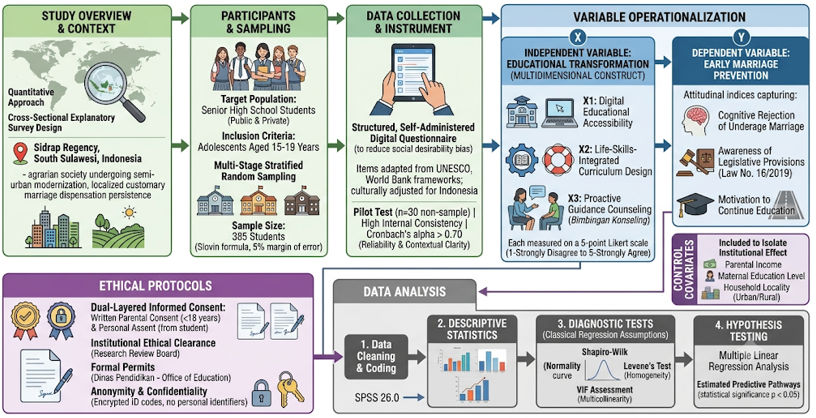
Early marriage remains a critical socio-economic and public health challenge in Sidrap Regency, South Sulawesi, Indonesia, severely limiting adolescent development and exacerbating school dropout rates. This study examines the effect of educational transformation—operationalized through digital accessibility, a life-skills-based curriculum, and guidance counseling—as a strategic institutional mechanism to mitigate early marriage among vulnerable youth populations. Utilizing a quantitative approach with a cross-sectional survey design, primary data were gathered from 385 senior high school students aged 15–19 years, who were selected via multi-stage stratified random sampling techniques. Multiple linear regression analysis was applied to evaluate empirical relationships. The results demonstrate that educational transformation significantly enhances adolescents’ early marriage preventive intentions, jointly explaining 54.2% of the variance (R2 = 0.542, p < .001). Guidance counseling emerged as the most dominant predictor (β = 0.441), followed by the life-skills curriculum (β = 0.394) and digital accessibility (β = 0.162). These findings suggest that optimizing institutional support frameworks, particularly school counseling services and integrated reproductive-health literacy, offers the most potent lever for behavior modification. Theoretically, this research bridges educational sociology and macro-social adolescent behaviors. Practically, it provides a robust, data-driven framework for the Sidrap Regency government and educational policymakers to implement targeted, curriculum-based interventions to systematically reduce regional early marriage rates while highlighting the critical need for sustainable multi-sectoral collaborations.
References
Azzopardi, P. S., Hearps, S. J., Francis, K. L., Kennedy, E. C., Mokdad, A. H., Kassebaum, N. J., ... & Patton, G. C. (2019). Progress in adolescent health and wellbeing: tracking 12 headline indicators for 195 countries and territories, 1990–2016. The Lancet, 393(10176), 1101-1118. https://doi.org/10.1016/S0140-6736(18)32427-9
Barkah, Q., Sintang, S., & Morin, L. (2025). Negotiating Islamic Law and State Norms in Child Marriage Practices in Coastal Indonesia. Antmind Review: Journal of Sharia and Legal Ethics, 2(1), 43-55. https://doi.org/10.63077/fer5kf08
Bhuwania, P., Huh, K., & Heymann, J. (2023). Impact of tuition‐free education policy on child marriage and early childbearing: Does secondary matter more?. Population and Development Review, 49(1), 43-70. https://doi.org/10.1111/padr.12538
Buchmann, C., & Hannum, E. (2001). Education and stratification in developing countries: A review of theories and research. Annual review of sociology, 27(1), 77-102. https://doi.org/10.1016/j.rssm.2021.100583
Chaudhary, S., & Yadavendu, V. (2025). Family structure and its impact on cognitive development in high school students: A critical perspective. International Journal of Current Science Research and Review, 8(4), 34.
Hanafi, S. (2024). Legal Politics of Changes to Marriage Laws in Indonesia. Al-Qadha: Jurnal Hukum Islam dan Perundang-Undangan, 11(1), 68-85. https://doi.org/10.32505/qadha.v11i1.8867
Holijah, H., & Abd Manaf, J. B. (2019). The importance of increasing minimum age for marriage in Indonesian marriage law. Al-'Adalah, 16(2), 411-432. https://doi.org/10.24042/adalah.v16i2.4546
Julianto, V., Shofa, R. L., Kamsi, Haq, A., & Liem, A. (2025). Judges’ perspectives on changes in the legal minimum age at marriage in Indonesia. Journal of Family Studies, 31(1), 94-117. https://doi.org/10.1080/13229400.2024.2419870
Junaedi, M., Muntaqo, L., Haryanto, S., Khoiri, A., & Khanifa, N. K. (2022). The role of schools in early marriage education and reproductive health rights (case study: Students in Wonosobo District). Al-Ishlah: Jurnal Pendidikan, 14(3), 2727-2736. http://journal.staihubbulwathan.id/index.php/alishlah/article/view/1362
Kalamar, A. M., Lee-Rife, S., & Hindin, M. J. (2016). Interventions to prevent child marriage among young people in low-and middle-income countries: a systematic review of the published and gray literature. Journal of Adolescent Health, 59(3), S16-S21. https://doi.org/10.1016/j.jadohealth.2016.06.015
Khan, M. N., Khanam, S. J., Khan, M. M. A., Billah, M. A., & Akter, S. (2024). Exploring the impact of perceived early marriage on women’s education and employment in Bangladesh through a mixed-methods study. Scientific reports, 14(1), 21683. https://doi.org/10.1038/s41598-024-73137-w
Malhotra, A., & Elnakib, S. (2021). 20 years of the evidence base on what works to prevent child marriage: A systematic review. Journal of Adolescent Health, 68(5), 847-862. https://doi.org/10.1016/j.jadohealth.2020.11.017
Mishra, N., Kirabira, T. R., & Onwubiko, J. N. (2023). Intersection of law, religion, customs, and the problem of child marriage in Global South: a comparative study of India, Nigeria and Uganda. In The Indian Yearbook of Comparative Law 2020 (pp. 247-274). Singapore: Springer Nature Singapore. https://doi.org/10.1007/978-981-99-5467-4_12
Parsons, J., Edmeades, J., Kes, A., Petroni, S., Sexton, M., & Wodon, Q. (2015). Economic impacts of child marriage: a review of the literature. The Review of Faith & International Affairs, 13(3), 12-22. https://doi.org/10.1080/15570274.2015.1039262
Psaki, S. R., Melnikas, A. J., Haque, E., Saul, G., Misunas, C., Patel, S. K., ... & Amin, S. (2021). What are the drivers of child marriage? A conceptual framework to guide policies and programs. Journal of Adolescent Health, 69(6), S13-S22. https://doi.org/10.1136/bmjgh-2020-004792
Saepullah, A., Aziz, A., Widayanti, I., Nafi’Hasbi, M. Z., & Muhammad, A. A. (2025). A Contemporary Socio-Legal Evaluation of Indonesia's Post-Reformation Child Marriage Policies. MILRev: Metro Islamic Law Review, 4(2), 1393-1426. https://doi.org/10.32332/milrev.v4i2.10322
Sofyan, A., Hidayah, N., Ramli, M., Aminah, S., & Folastri, S. (2023). Profiling Preferences of the Counseling Paradigm by School Counselors in Indonesia. Konselor, 12(3), 211-221. https://doi.org/10.24036/0202312349-0-86
Syamsiah, N., & Aisyah, S. (2025). Gender justice in Islamic higher education: Challenges and opportunities in the digital age. International Journal of Learning, Teaching and Educational Research, 24(8), 1092-1113.
Taufiq, A., Al Hakim, I., Imaduddin, A., Yudha, E. S., Suryana, D., Khairun, D. Y., & Nurzaman, A. C. (2026). Professional Identity in Transition: Insights from Indonesian Senior High School Counselors. G-Couns: Jurnal Bimbingan dan Konseling, 10(03), 2721-2739. https://doi.org/10.31316/g-couns.v10i03.8521
Ţical, G. M. (2024). The impact of social capital on the perception and reality of public security. International Journal of Legal and Social Order, 4(1), 345-355. https://www.ceeol.com/search/article-detail?id=1293046
Traver-Martí, J. A., Ballesteros-Velázquez, B., Beldarrain, N. O., & Maiquez, M. D. C. C. (2023). Leading the curriculum towards social change: Distributed leadership and the inclusive school. Educational Management Administration & Leadership, 51(3), 554-574. https://doi.org/10.1177/1741143221991849
Yoosefi Lebni, J., Solhi, M., Ebadi Fard Azar, F., Khalajabadi Farahani, F., & Irandoost, S. F. (2023). Exploring the consequences of early marriage: a conventional content analysis. INQUIRY: The Journal of Health Care Organization, Provision, and Financing, 60, 00469580231159963. https://doi.org/10.1177/00469580231159963
Downloads
Published
How to Cite
Issue
Section
License
Copyright (c) 2026 Nurul Hudayanti Mahas, Besse Mutmainnah, Muhammad Ardi, Muh. Nasrullah Yusri, Rasma Rasma, Afriani Afriani, Muhammad Edwin, Dewi Marwah, Andi B. Daulat Samallangi, Andi Lutfia Qalbi

This work is licensed under a Creative Commons Attribution-ShareAlike 4.0 International License.