Educational Values in the "Sere Bissu" Performing Arts Ritual in Bone Regency: A Review of Its Meaning and Function

https://doi.org/10.51574/ijrer.v5i1.4071
Keywords:
Educational Values, Moral, Religious, Sere Bissu, SocialAbstract
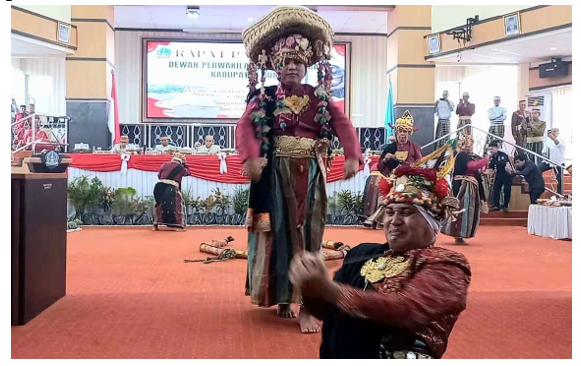
The Sere Bissu ritual performance in Bone Regency is a cultural heritage with significant meanings that have yet to be fully explored, particularly in relation to its role in forming character and community ethics through education. This study examines educational ideals in Bone Regency's Sere Bissu performance through three primary questions: (1) Analyzing performance structure; (2) Identifying educational values; and (3) Analyzing moral educational values' significance and function. This study is descriptive and qualitative. Data collection was carried out through direct observation, in-depth interviews, and documentation during the implementation of the Sere Bissu ritual. This approach was chosen to understand the context and interpretation of values holistically. The research found that (1) Sere Bissu is a ritual performance with multiple stages, including Mappangolo Mappesabbi, Mappakaraja Alusu, Sere Alusu, Sere Mappabbitte, Sere Bibbi, Sere Mangko, Sere Maddampu Alameng, Sere Lemma’, Mammemmang, Maggiri, and Mappatabe. (2) Educational values encompass religious, social, and moral aspects that foster faith, ethics, and cultural character. (3) These educational values emphasize religious devotion, societal harmony, and moral awareness as key foundations in Bugis culture. This study enhances knowledge of educational values by incorporating local wisdom. This study provides practical guidance for educational institutions and cultural activists to conserve and internalize Bugis’ values, particularly in the Sere Bissu rite, as a foundation for national identity.
References
Akhmar, A. M., Muhammad, H. I., Hasyim, M., & Rahman, F. (2023). Ritual Performance as Gradual Recognition: Sere Bissu Maggiriq Dance of South Sulawesi Indonesia. SAGE Open, 13(4), 21582440231209634. https://doi.org/10.1177/21582440231209634
Asrul, T. A. I. (2023). Eksistensi Nilai Pangadereng dalam Interaksi Sosial Masyarakat Bugis: The Existence of Pangadereng Values in the Bugis Community Social Interaction. Dirasat Islamiah: Jurnal Kajian Keislaman, 4(1), 61-69.
de Castro, E. V. (2025). Claude Lévi-Strauss: The Founder of Post-Structuralism. Social Analysis, 69(1), 61-81. https://doi.org/10.3167/sa.2025.690104
Doja, A. (2020). Lévi-Strauss's heroic anthropology facing contemporary problems of the modern world. Reviews in Anthropology, 49(1-2), 4-38. https://doi.org/10.1080/00938157.2020.1794140
Duche-Perez, A. B., & Gutierrez, A. O. A. (2024). Unconscious Structures and Cultural Order: Reexploring The Lévi-Straussian Structuralist Project in Contemporary Anthropology. Revista de Etnologie şi Culturologie, 46-54. https://www.ceeol.com/search/article-detail?id=1298652
Indra, A. B., Darussalam, F. I., Aulia, S., Karman, A. K. A., & Jumriani, J. (2024). The Existence of Bissu in Bugis Culture in the Contemporary Era. Palita: Journal of Social Religion Research, 9(1), 79-90. https://doi.org/10.24256/pal.v9i1.4208
Haruna, I., Caturwati, E., Rustiayanti, S., Herdiani, E., & Saleh, S. (2024). Soul Of Barekkeng: Transformasi dan Interpretasi Nilai Pangadereng dari Budaya Masyarakat Bugis di Sulawesi Selatan. Panggung, 34(4), 532-550. https://doi.org/10.26742/panggung.v34i4.3556
Hidayatulloh, T., & Saumantri, T. (2024). Religious Dialectics in Urban Society in Tolerance Villages of Bandung City: Analysis of Emil Durkheim's Religious Functionalism. Al-Madinah: Journal of Islamic Civilization, 1(1), 1-12. https://doi.org/10.70901/c7wmv865
Iman, A. N. (2025). Sacred gender, Indigenous identity, and community resilience: development lessons from the bissu in South Sulawesi. Development in Practice, 1-7. https://doi.org/10.1080/09614524.2025.2565608
Indarwati, I., Mariana, L., & Rachman, S. (2019). Ritual Para Bissu, Para Waria Sakti di Kabupaten Bone. Jurnal Idiomatik: Jurnal Pendidikan Bahasa dan Sastra Indonesia, 2(1), 15-23. https://ejournals.umma.ac.id/index.php/idiomatik/article/view/252
Mildayani, M., Syukur, M., & Idrus, I. I. (2024). Tergerusnya Bissu Sebagai Tokoh Spiritual dalam Masyarakat Bone. JIIP-Jurnal Ilmiah Ilmu Pendidikan, 7(8), 9230-9235. https://doi.org/10.54371/jiip.v7i8.5705
Noh, M. H., Djana, A., & Abd Fatah, R. (2025). The Thoughts of Emile Durkheim in Modern Sociology; Conceptual Analysis and Application in Social Research in Indonesia. International Journal of Applied and Scientific Research, 3(7), 475-484. https://doi.org/10.59890/ijasr.v3i7.56
Orsini, A. (2024). Durkheim. In Sociological Theory: From Comte to Postcolonialism (pp. 113-155). Cham: Springer Nature Switzerland.
Pranowo, Y. (2024). Modernity, Globalization, and Human Civilization. Sapientia Humana: Jurnal Sosial Humaniora, 4(01), 32-42. https://doi.org/10.26593/jsh.v4i01.7829
Rachmat, R. (2021). Unsur-Unsur Pertunjukan dan Peran Bissu Pada Sere Maggiri Dalam Upacara Ritual Mattompang Arajang: Proses Penyucian Benda Pusaka Kerajaan Bone (Doctoral dissertation, ISI Yogyakarta).
Rahayu, N. W. S. (2021). Eksistensi Pendeta Bugis (Bissu) Dalam Kebertahanan Tradisi Di Kecamatan Segeri. Widya Genitri: Jurnal Ilmiah Pendidikan, Agama dan Kebudayaan Hindu, 12(3), 166-176. https://doi.org/10.36417/widyagenitri.v12i3.426
Rahman, M. T. (2020). Agama dan politik identitas dalam kerangka sosial. Prodi S2 Studi Agama-Agama UIN Sunan Gunung Djati Bandung.
Rahmat, L., & Purnomo, S. H. (2025). The Role of Bissu and Their Existence in Modern Bugis Society of South Sulawesi. Terob: Jurnal Pengkajian dan Penciptaan Seni, 15(2), 1-16. https://doi.org/10.20111/terob.v15i2.86
Raskind, I. G., Shelton, R. C., Comeau, D. L., Cooper, H. L., Griffith, D. M., & Kegler, M. C. (2019). A review of qualitative data analysis practices in health education and health behavior research. Health Education & Behavior, 46(1), 32-39. https://doi.org/10.1177/1090198118795019
Ridder, H. G. (2014). Book Review: Qualitative data analysis. A methods sourcebook. https://doi.org/10.1177/239700221402800402
Rimé, B., & Páez, D. (2023). Why we gather: A new look, empirically documented, at Émile Durkheim’s theory of collective assemblies and collective effervescence. Perspectives on Psychological Science, 18(6), 1306-1330. https://doi.org/10.1177/17456916221146388
Santucci, J. F., Doja, A., & Capocchi, L. (2020). A discrete-event simulation of Claude Lévi-Strauss’ structural analysis of myths based on symmetry and double twist transformations. Symmetry, 12(10), 1706. https://doi.org/10.3390/sym12101706
Sokolovskyi, O., Kobetiak, A., Melnychuk, M., & Chaplinska, O. (2021). Reconstruction of the religious paradigm in the modern globalized world. Wisdom, (2 (18)), 153-160.
Tandi, S. (2019). Educational contribution of Emile Durkheim: a functional assessment. The Research Journal of Social Sciences, 10(2), 146-156.
Taufikin, T., & Ma’shumah, L. A. (2021). Ki Hajar Dewantara's Perspective on The Concept of Independent Education and Its Relevance to The Independent Learning in Indonesia. Edukasia Islamika, 6(1), 90-110. https://doi.org/10.28918/jei.v6i1.560
Triastuti, D. A. (2021). Makna Gerak Tari Alusu Sebagai Tari Penyambutan Tamu Dalam Upacara Adat Di Kabupaten Bone (Doctoral dissertation, Fakultas Seni dan Desain).
Utami, M. W. (2013). Tari Sere Wara di Kabupaten Bone Sulawesi Selatan (Sebuah Kajian Gerak Tari yang Bersumber dari Ritual) (Doctoral dissertation, Fak. SENI DAN DESAIN).
Wahyuni, T., Usman, J., & Suyanta, S. (2023). Ki Hadjar Dewantara's View on Freedom to Learn in His Relationship with Character Improvement. Jurnal Sustainable, 6(2), 526-533. https://doi.org/10.32923/kjmp.v6i2.4050
Wandi, J. I., Afnita, N., & Hefni, H. (2021). Study of" Functional Structure" Emilie Durkheim Reviewed From Educational Anthropology on Character and Behavior Society. Ikhtisar, 1(1), 39-51. https://doi.org/10.55062/ijpi.v1i1.9
Widiyarto, S., & Purnomo, B. (2023). Freedom to learn in Ki Hajar Dewantara's perspective: Historical studies and their relevance to character education. International Journal of Business, Law, and Education, 4(2), 837-844. https://doi.org/10.56442/ijble.v4i2.185
Yeganeh, H. (2024). Conceptualizing the Patterns of Change in Cultural Values: The Paradoxical Effects of Modernization, Demographics, and Globalization. Social Sciences, 13(9), 439. https://doi.org/10.3390/socsci13090439
Downloads
Published
How to Cite
Issue
Section
License
Copyright (c) 2025 Dewi Sri Astuty, Asia Ramli, Nurlina Sjahrir

This work is licensed under a Creative Commons Attribution-ShareAlike 4.0 International License.