Islamic Education and Local Governance: A Collaborative Framework for Combating Child Marriage

https://doi.org/10.51574/ijrer.v5i4.5040
Keywords:
Educational Collaboration, Early Marriage, Islamic Education, Qualitative Study, Village GovernanceAbstract
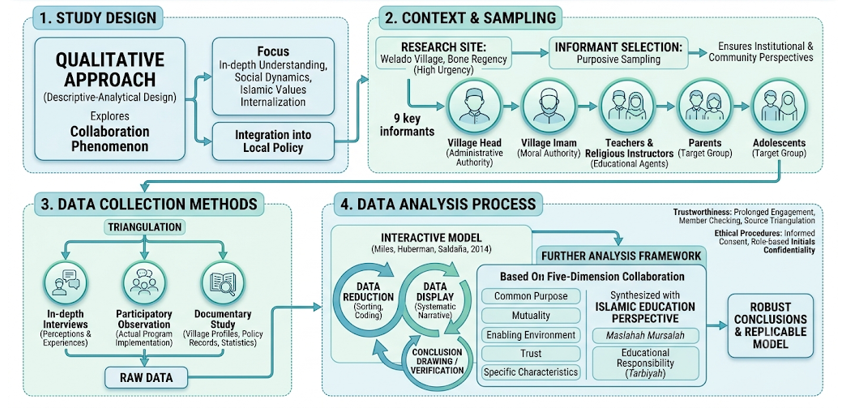
Early marriage in Welado Village, Indonesia, remains a persistent developmental challenge, driven by cultural resistance and superficial religious internalization. This study analyzes the educational collaboration between village government and the community in mitigating early marriage, examining the role of Islamic education in enhancing collaborative effectiveness. Utilizing a descriptive-qualitative approach, data were gathered through in-depth interviews, participatory observation, and documentation with key local stakeholders. Analysis followed data reduction, display, and verification stages, framed around five collaboration dimensions: common purpose, mutuality, enabling environment, trust, and specific personal characteristics. The findings reveal that while common purpose, mutuality, and enabling environments function optimally through shared educational visions, significant constraints persist within trust and specific personal characteristics due to negative public perception and weak cross-sectoral coordination. From an Islamic education perspective, these structural-cultural barriers occur because the core tenets of maslahah (public good), amanah (trustworthiness), and akhlaq (character formation) remain unintegrated into the collaborative framework, rendering existing approaches merely administrative. Theoretically, this study pioneers a community-empowerment-based model of Islamic education. Practically, it underscores the necessity of embedding Islamic educational values as a moral-spiritual foundation within village policies to foster transformative collective awareness for early marriage eradication.
References
Abidin, N. S. Z., & Shamsuddin, M. M. J. (2025). The Misconception of Early Marriage: Reconciling Perspectives Through Maqasid al-Shariah: Salah Tanggap tentang Perkahwinan Awal: Menyelaraskan Perspektif-Perspektif melalui Maqasid al-Shariah. Jurnal Pengajian Islam, 18(1), 123-143. https://doi.org/10.53840/jpi.v18i1.343
Afad, M. N., Ahmad, M., Fajariyah, N., Muniroh, S. M., & Basid, A. (2025). Social Innovation in Faith-Based Organizations: The Role of Nahdlatul Ulama in Preventing Early Adultery and Sexual Violence Among Indonesian Youth. Fikri: Jurnal Kajian Agama, Sosial dan Budaya, 10(1), 220-236. https://doi.org/10.25217/jf.v10i1.5154
Agustin, N., Djawas, M., Husnul, M., Ismail, N., & Amalia, R. (2025). The The Impact of Delayed Marriage due to Education and Career on Female Lecturers in Banda Aceh: A Maʿālat al-Afʿāl Perspective. El-Usrah: Jurnal Hukum Keluarga, 8(2). https://doi.org/10.22373/ujhk.v8i2.31435
Amalya, A. A., & Niswaty, R. (2024). Innovation Strategy to Prevent Child Marriage in Bone Regency (Early Marriage Innovation Case Study). Jurnal Ad'ministrare, 325-337. https://doi.org/10.71309/administrare.v11i2.4782
Amberi, M. (2023). Efforts to Prevent Child Age Marriage in The Study of Islamic Legal Philosophy and Indonesia Positive Law. Samarah: Jurnal Hukum Keluarga Dan Hukum Islam, 7(1), 239-260.
Bakhtiar, B. (2021). Accountability and transparency in financial management of village fund allocations in achieving good governance. ATESTASI: Jurnal Ilmiah Akuntansi, 4(2), 230-245. https://jurnal.feb-umi.id/index.php/ATESTASI/article/view/269
Barkah, Q., Huzaimah, A., Rochmiyatun, S., & Ramdani, Z. (2022). Abandonment of Women’s Rights in Child Marriage; An Islamic Law Perspective. AL-IHKAM: Jurnal Hukum & Pranata Sosial, 17(2), 383-411. https://doi.org/10.19105/al-lhkam.v17i2.6725
Chazan-Cohen, R., Von Ende, A., & Lombardi, C. (2023). Parenting and family self-sufficiency services contribute to impacts of Early Head Start for children and families. Frontiers in psychology, 14, 1302687. https://doi.org/10.3389/fpsyg.2023.1302687
Cummins, N. J. (2025). The causal effects of education on age at marriage and marital fertility. European Review of Economic History, 29(3), 273-320. https://doi.org/10.1093/ereh/heae023
Eden, C. A., Chisom, O. N., & Adeniyi, I. S. (2024). Parent and community involvement in education: strengthening partnerships for social improvement. International Journal of Applied Research in Social Sciences, 6(3), 372-382.
Ferricha, D. (2024). The Role of Religion in Policies of Legal Village-Owned Enterprises to Improve the Economic Rights of Village Communities. Fiat Justisia: Jurnal Ilmu Hukum, 18(2), 167-184. https://doi.org/10.25041/fiatjustisia.v18no2.3606
Goffar, A., & Miftahussurur, W. (2025). Preventing Early Marriage through School–Community Partnerships in Islamic Education. Dinamika: Jurnal Pengabdian kepada Masyarakat, 2(2), 1-13. https://www.dinamika.or.id/index.php/dinamika/article/view/20
Hartati, Satoto, S., Dewi, R., & Diar, A. (2025). Illegal levies in education funding in Indonesia: an analysis of experiences from Jambi Province. Cogent Social Sciences, 11(1), 2450293. https://doi.org/10.1080/23311886.2025.2450293
Hasan, M. F. (2025). Educational authority and regulatory legitimacy: comparing normative systems in pesantren and public schools in Indonesia. Legal Pluralism and Critical Social Analysis, 57(2-3), 182-206.
Hwami, M. (2022). A comparative scoping review of the impact of international economic sanctions on education. Compare: A Journal of Comparative and International Education, 52(6), 949-965. https://doi.org/10.1080/03057925.2020.1846120
Ibrahim, M., Islam, S., Zohriah, O., & Azid, M. (2024). Addressing contemporary ethical and moral issues through islamic education. Journal on Islamic Studies, 1(1), 36-51. https://centerpub.ristek.or.id/index.php/jois/article/view/18
Judiasih, S. D., Rubiati, B., Yuanitasari, D., Salim, E. F., & Safira, L. (2020). Efforts to eradicate child marriage practices in Indonesia: Towards sustainable development goals. Journal of International Women's Studies, 21(6), 135-149. https://vc.bridgew.edu/jiws/vol21/iss6/8/
Kohno, A., Techasrivichien, T., Suguimoto, S. P., Dahlui, M., Nik Farid, N. D., & Nakayama, T. (2020). Investigation of the key factors that influence the girls to enter into child marriage: A meta-synthesis of qualitative evidence. PloS one, 15(7), e0235959. https://doi.org/10.1371/journal.pone.0235959
Lai, T., Huang, Y., & Xiong, J. (2023). Changes in behavior patterns or demographic structure? Re-estimating the impact of higher education on the average age of the first marriage. Frontiers in Psychology, 14, 1085293. https://doi.org/10.3389/fpsyg.2023.1085293
Miles, M. B., Huberman, A. M., & Saldana, J. (2014). Qualitative data analysis. Sage.
Muniri, M., Sulalah, A., & Azis, N. C. (2025). Abid Al-Jabiri’s Epistemological Critique of Early Marriage in Case Based Learning: Contributions to Islamic Education. AL-ISHLAH: Jurnal Pendidikan, 17(3), 4204-4215. http://journal.staihubbulwathan.id/index.php/alishlah/article/view/7185
Mustar, M. (2020). Faktor yang Berhubungan dengan Tradisi Masyrakat dalam Menghadapi Kehamilan dan Persalinan Di Desa Welado. Jurnal Ilmiah Kesehatan Sandi Husada, 9(1), 560-565. https://doi.org/10.35816/jiskh.v11i1.342
Musthofa, M., & Lutfiah, S. Q. (2024). Early marriage and its influence on family harmony in an Islamic perspective. Al-Risalah: Jurnal Studi Agama dan Pemikiran Islam, 15(1), 197-214.
Purwanti, A., & Natalis, A. (2026). Law as text, culture as context: The semiotics of marriage dispensation and judicial considerations in Indonesia. International Journal for the Semiotics of Law-Revue internationale de Sémiotique juridique, 39(2), 729-760. https://doi.org/10.1007/s11196-025-10370-0
Rahman, G. (2025). Transforming Islamic education through value-based leadership: A narrative review. Sinergi International Journal of Islamic Studies, 3(2), 83-95. https://doi.org/10.61194/ijis.v3i2.712
Rahmawati, I., Putri, N., & Norman, E. (2024). Transformational Leadership as a Strategy to Improve Working Relations in Schools through Islamic Values. MES Management Journal, 3(3), 668-676.
Raj, A., Jackson, E., & Dunham, S. (2017). Girl child marriage: A persistent global women’s health and human rights violation. In Global perspectives on women's sexual and reproductive health across the lifecourse (pp. 3-19). Cham: Springer International Publishing. https://doi.org/10.1007/978-3-319-60417-6_1
Ridwan, A., Susanto, I. W., & Rahmawati, A. Y. (2023). Alternative policies for handling abhakalan problem of early marriage in Madura. Journal of Transformative Governance and Social Justice, 1(2), 124-132. https://jurnal.unmer.ac.id/index.php/jtragos/article/view/10208
Rozak, F. A., & Aviana, R. I. (2024). The impact of child Marriage: Challenges to achieving Indonesia's 2045 goals. Jurnal Anifa: Studi Gender Dan Anak, 5(2), 85-101. https://doi.org/10.32505/anifa.v5i2.8184
Samin, S., Talli, A. H., & Bakri, M. (2022). Maqasid Al-Shari'ah perspectives in solution of divorce cases for early marriage. marriage, 6(5), 8685-8697. https://doi.org/10.53730/ijhs.v6nS5.11775
Sharkey, P., & Ittner, T. (2025). Turning Toward the Community: Theory and Evidence for the Role of Community-Oriented Organizations in the Effort to Confront Violence. Annual Review of Criminology, 9. https://doi.org/10.1146/annurev-criminol-111523-122521
Sulthoni, G. I., & Amirya, M. (2024). The Effects of Transparency, Accountability, Village Development, and Political Interest on Village Fund Allocation Management: A Study on Villages in Ponorogo Regency of East Java. Jurnal Ilmiah Akuntansi dan Humanika, 14(2), 316-331. https://ejournal.undiksha.ac.id/index.php/JJA/article/view/76283
Syahmil, M., & Sa-U, S. (2024). Integration Of Al-Qur'anic Values In Child Development Psychology: A Review Of Islamic Education Literature. Jurnal Ilmu Sosial dan Humaniora, 2(4), 148-153.
Tanuri, T. (2025). Exploring the Roles and Challenges of the Sandwich Generation in the Context of Islamic Education and Family Ethics. AL GHAZALI: Jurnal Pendidikan Dan Pemikiran Islam, 5(2), 181-199. http://jurnal.staialjami.ac.id/index.php/AL_GHAZALI/article/view/451
Wahyudi, W., Pakarti, M. H. A., Mukhlas, O. S., Saebeni, B. A., & Zakaria, M. R. A. (2026). Child Marriage in Malaysia and Indonesia in Legal Anthropology Perspective: Between Local Traditions and Islamic Legal Regulation. Dialog Legal: Jurnal Syariah, Jurisprudensi Dan Tata Negara, 2(1), 26-43. https://doi.org/10.64367/dialoglegal.v2i1.105
Wahyuni, H. I., & Sadasri, L. M. (2020). Saving Indonesia's Golden Generation: Preventing Teenage Marriage in Rembang, Central Java (A Case Study). The Indonesian Journal of Southeast Asian Studies, 4(1), 63-74. https://doi.org/10.22146/ikat.v4i1.51554
Wahhaj, Z. (2022). The economics of early marriage: causes, consequences, and policy solutions. In Handbook of labor, human resources and population economics (pp. 1-26). Cham: Springer International Publishing. https://doi.org/10.1007/978-3-319-57365-6_67-1
Zulkarnain, Z., Raharjo, K. M., Fatihin, M. K., & Avriliand, D. (2022). Optimizing the role of non-formal and informal education in realizing independent and sustainable village innovations. KOLOKIUM Jurnal Pendidikan Luar Sekolah, 10(2), 183-192. https://doi.org/10.24036/kolokium.v10i2.547
Downloads
Published
How to Cite
Issue
Section
License
Copyright (c) 2026 Andi Utari Samsir, Ahmad Muktamar, Muhaemin Muchlis, Fitriani Fitriani, Reski Amaliah, Hasdi Anugrah, Muh. Akmal Mubaraq, Lailatil Qadriani, Aulia Novita Handayani

This work is licensed under a Creative Commons Attribution-ShareAlike 4.0 International License.