Hands-On Activity on Fine Motor Skills in Early Childhood Education

https://doi.org/10.51574/ijrer.v5i1.4002
Keywords:
Early Childhood, Fine Motor Skills, Hands-On Activities, Meaningful Learning, Pre-ExperimentAbstract
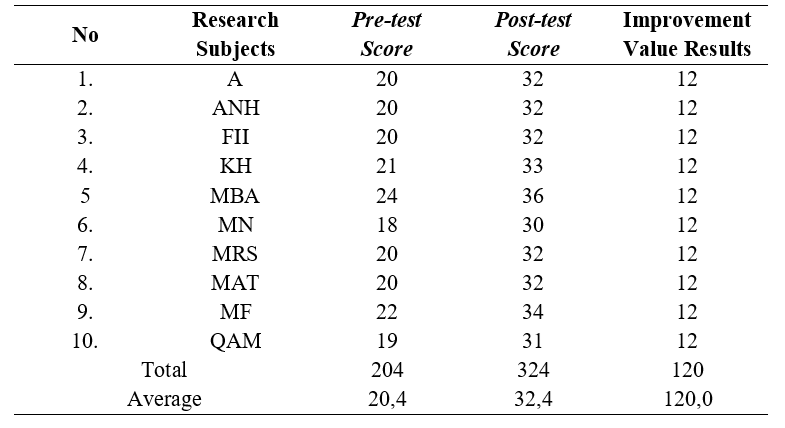
Fine motor skills are a crucial aspect of early childhood education, which is a prerequisite for learning readiness but often requires effective and applicable learning strategies. Therefore, this study aims to test and determine the magnitude of the effect of the implementation of hands-on activity (direct practice activities) on the fine motor development of early childhood children in Early Childhood Education SPAS. Al-Kautsar Bontobiraeng. This study is quantitative with a pre-experimental approach using a one-group pretest-posttest design. The research subjects consisted of 10 children in group B (aged 5–6 years). The main data collection technique was observation using a checklist sheet based on indicators of children's fine motor development. Data was analyzed using the non-parametric Wilcoxon Signed Rank Test due to sample limitations. The results of the study showed a significant increase in children's fine motor ability scores after the intervention. The average pretest score was 20.4, increasing to 32.4 in the posttest. The results of the statistical test showed an Asymp. Sig. value (2-tailed) of 0.000, which is less than 0.05 (0.000 < 0.05). This finding indicates that there is a significant influence of the implementation of hands-on activity on the fine motor development of early childhood. This study provides a practical contribution: hands-on activity is proven to be effective in stimulating and improving children's fine motor skills through direct, fun, and meaningful learning experiences. These results can be a recommendation for early childhood education teachers to adopt direct practice activities in fine motor development stimulation programs.
References
Alias, N. A., Kadar, M., Wan Yunus, F., & Cremin, K. (2024). An exploration of understanding teaching motor skills related to self-care skills among typical preschool children: parents’ and teachers’ perspectives. Journal of Occupational Therapy, Schools, & Early Intervention, 17(2), 201-215. https://doi.org/10.1080/19411243.2023.2168825
Amir, M. K., Sinaga, T. S. W., Pakpahan, J. I., Pangaribuan, S. I., & Supriadi, A. (2025). Physical Motor Development of Early Childhood (Standards for the Level of Child Development Achievements) The Urgency of Gross Motor Development in Early Childhood Development. Jurnal Pendidikan Jasmani (JPJ), 6(1), 55-63. https://jurnal.stokbinaguna.ac.id/index.php/JPJ/article/view/4036
Apriyansyah, C., Tjalla, A., Saptono, A., Hartati, S., Jalal, F., Sukatmi, S., ... & Kurniawaty, L. (2024). Early childhood education: Integrative holistic early childhood development program implementation. Child Education Journal, 6(2), 76-87. https://doi.org/10.33086/cej.v6i2.5990
Bernal, A. F., & Sholl-Franco, A. (2023). Sound and Movement hands-on workshop as a sensorimotor stimulation tool during child development. Cuadernos de Educación y Desarrollo, 15(3), 2424-2444. https://ojs.europubpublications.com/ojs/index.php/ced/article/view/1195
Bondi, D., Robazza, C., Lange‐Küttner, C., & Pietrangelo, T. (2022). Fine motor skills and motor control networking in developmental age. American Journal of Human Biology, 34(8), e23758. https://doi.org/10.1002/ajhb.23758
Chandler, M. C., Gerde, H. K., Bowles, R. P., McRoy, K. Z., Pontifex, M. B., & Bingham, G. E. (2021). Self-regulation moderates the relationship between fine motor skills and writing in early childhood. Early Childhood Research Quarterly, 57, 239-250. https://doi.org/10.1016/j.ecresq.2021.06.010
Cortes, R. A., Green, A. E., Barr, R. F., & Ryan, R. M. (2022). Fine motor skills during early childhood predict visuospatial deductive reasoning in adolescence. Developmental psychology, 58(7), 1264. https://doi.org/10.1037/dev0001354
Ford, T. G., Kwon, K. A., & Tsotsoros, J. D. (2021). Early childhood distance learning in the US during the COVID pandemic: Challenges and opportunities. Children and Youth Services Review, 131, 106297. https://doi.org/10.1016/j.childyouth.2021.106297
Ginting, T. G. (2024). Forming a Solid Foundation: The Role of Early Childhood Education in Character Development. Solo Universal Journal of Islamic Education and Multiculturalism, 2(01), 71-82.
Hsiao, H. S., Chen, J. C., Chen, J. H., Chen, Y. X., & Chung, G. H. (2025). Incorporating the 6E Model Integrated with Creative Thinking Strategies into STEAM Education: Enhancing Children’s Fine Motor Skills, Hands-on Performance, and Learning Behaviors. Early Childhood Education Journal, 1-22. https://doi.org/10.1007/s10643-025-01981-0
Józsa, K., Oo, T. Z., Borbélyová, D., & Zentai, G. (2023). Exploring the growth and predictors of fine motor skills in young children aged 4–8 years. Education Sciences, 13(9), 939. https://doi.org/10.3390/educsci13090939
Kamaruddin, I., Dalail, W., Mahendika, D., Mulisi, A. S., & Rif'at, M. (2023). Developing Fine Motor Skills in Early Childhood through Plasticine Media. Journal of Childhood Development, 3(2), 9-23.
Maknun, L., & Zulfahmi, M. N. (2025). Strategies for Developing Fine Motor Skills in Children Aged 5-6 Years Through Weaving Cassava Leaf Stalks: A Case Study at Tamrinussibyan Islamic Kindergarten. Mitra Ash-Shibyan: Jurnal Pendidikan dan Konseling, 8(01), 47-60. https://doi.org/10.46963/mash.v8i01.2368
Martzog, P., Stoeger, H., & Suggate, S. (2019). Relations between preschool children’s fine motor skills and general cognitive abilities. Journal of Cognition and Development, 20(4), 443-465. https://doi.org/10.1080/15248372.2019.1607862
Maryam, N. H., Fairuzillah, M. N., & Khan, M. N. (2025). The Role Of Parents In Self-Help Skills For Physical Motor Development Of Children. JP2KG AUD (Jurnal Pendidikan, Pengasuhan, Kesehatan dan Gizi Anak Usia Dini), 6(01), 42-55.
Özkan, Z., & Kale, R. (2023). Investigation of the effects of physical education activities on motor skills and quality of life in children with intellectual disability. International Journal of Developmental Disabilities, 69(4), 578-592. https://doi.org/10.1080/20473869.2021.1978267
Priyadi, A. T., Wati, I. D. P., Amir, A., Yuliana, Y. G. S., Khory, F. D., Sastaman, P., ... & Haetem, M. (2024). How are motor skills and writing readiness in children?: A literature review. Retos: nuevas tendencias en educación física, deporte y recreación, (61), 141-147.
Priyantoro, D. E., & Hasanah, U. (2023). Implementation of coloring activities early childhood in developing fine motor skills. Journal of Childhood Development, 3(1), 1-12. https://journal.iaimnumetrolampung.ac.id/index.php/jcd/article/view/3139
Raynal, A., Lavigne, H., Goldstein, M., & Gutierrez, J. (2022). Starting with parents: Investigating a multi-generational, media-enhanced approach to support informal science learning for young children. Early Childhood Education Journal, 50(5), 879-889. https://doi.org/10.1007/s10643-021-01209-x
Sandt, D. D. (2020). Effective implementation of animal assisted education interventions in the inclusive early childhood education classroom. Early Childhood Education Journal, 48(1), 103-115. https://doi.org/10.1007/s10643-019-01000-z
Scheuer, C., Herrmann, C., & Bund, A. (2019). Motor tests for primary school aged children: A systematic review. Journal of sports sciences, 37(10), 1097-1112. https://doi.org/10.1080/02640414.2018.1544535
Scheiber, B., Mildner, S., & Federolf, P. (2025). Parental and Educator Perceptions of Implementing Standardized Screenings for Early Detection of Motor Skills in Preschoolers: A Representative Survey. Child: Care, Health and Development, 51(4), e70124. https://doi.org/10.1111/cch.70124
Sherry, K., & Draper, C. E. (2013). The relationship between gross motor skills and school readiness in early childhood: making the case in South Africa. Early Child Development and Care, 183(9), 1293-1310. https://doi.org/10.1080/03004430.2012.721358
Smits-Engelsman, B., & Verbecque, E. (2022). Pediatric care for children with developmental coordination disorder, can we do better?. Biomedical journal, 45(2), 250-264. https://doi.org/10.1016/j.bj.2021.08.008
Strooband, K. F., Howard, S. J., Okely, A. D., Neilsen-Hewett, C., & de Rosnay, M. (2023). Validity and reliability of a fine motor assessment for preschool children. Early Childhood Education Journal, 51(5), 801-810. https://doi.org/10.1007/s10643-022-01336-z
Sutapa, P., Pratama, K. W., Rosly, M. M., Ali, S. K. S., & Karakauki, M. (2021). Improving motor skills in early childhood through goal-oriented play activity. Children, 8(11), 994.
Taverna, L., Bellavere, M., Tremolada, M., Santinelli, L., Rudelli, N., Mainardi, M., ... & Tosetto, B. (2021). Oncological children and well-being: Occupational performance and HRQOL change after fine motor skills stimulation activities. Pediatric reports, 13(3), 383-400. https://doi.org/10.3390/pediatric13030046
Watts, R., & Pattnaik, J. (2023). Perspectives of parents and teachers on the impact of the COVID-19 pandemic on children’s socio-emotional well-being. Early Childhood Education Journal, 51(8), 1541-1552. https://doi.org/10.1007/s10643-022-01405-3
Zampella, C. J., Wang, L. A., Haley, M., Hutchinson, A. G., & de Marchena, A. (2021). Motor skill differences in autism spectrum disorder: A clinically focused review. Current psychiatry reports, 23(10), 64. https://doi.org/10.1007/s11920-021-01280-6
Downloads
Published
How to Cite
Issue
Section
License
Copyright (c) 2025 Sintia Sintia, Sri Sufliati Romba, M. Yusran Rahmat

This work is licensed under a Creative Commons Attribution-ShareAlike 4.0 International License.