Fifth-Grade Students’ Conceptual Understanding of Fractions: A Qualitative Study

https://doi.org/10.51574/kognitif.v6i3.5861
Keywords:
Elementary School Students , Fraction Concept Understanding , Mathematical Ability Level , Qualitative Descriptive , Study Task-Based Interview , Visual RepresentationAbstract
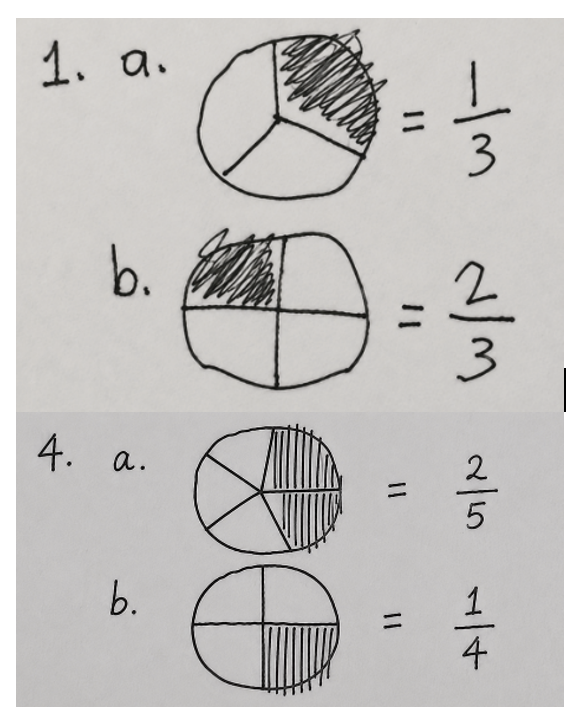
Understanding fraction concepts is a fundamental foundation for mathematics learning at the elementary school level; however, students often struggle to connect symbols, visual representations, the characteristics of fraction forms, and operations in contextual problems. This study aimed to describe fifth-grade students' understanding of fraction concepts at UPT SD Negeri 041 Padang. A qualitative descriptive design was employed, involving three participants purposively selected to represent high, moderate, and low mathematics ability categories. Data were collected through a fraction concept understanding test consisting of five essay items and task-based interviews. The test instrument and interview guide were validated by two experts using Aiken's V index, yielding average values of 0.875 and 0.861, respectively. Data were analyzed interactively through data reduction, data display, and conclusion drawing and verification. The credibility of the findings was maintained through method triangulation among written responses, interviews, and field notes. The results revealed three patterns of understanding. Students with stronger understanding were able to explain equivalent fractions, classify mixed fractions, distinguish common fractions from whole numbers, represent fractions visually, and systematically apply fraction operations in contextual problems. Students with partial understanding could verbally explain basic concepts but were inconsistent in classifying fraction forms and translating symbols into visual representations. Students with lower understanding tended to rely on surface features, such as visual similarity or the presence of specific numbers, without fully grasping the quantitative relationship among numerator, denominator, and fraction value. These findings underscore the need for fraction assessment to evaluate students' answers, reasoning, representations, and strategies in an integrated manner. Fraction instruction should connect concrete objects, visual representations, symbols, and contextual problems, while encouraging students to explain and verify their problem-solving strategies.
Downloads
References
Adu-Gyamfi, K., Schwartz, C. S., Sinicrope, R., & Bossé, M. J. (2019). Making sense of fraction division: domain and representation knowledge of preservice elementary teachers on a fraction division task. Mathematics Education Research Journal, 31(4), 507–528. https://doi.org/10.1007/s13394-019-00265-2
Aki Murata, Laura Bofferding, Bindu E. Pothen, Megan W. Taylor, & Sarah Wischnia. (2012). Making Connections Among Student Learning, Content, and Teaching: Teacher Talk Paths in Elementary Mathematics Lesson Study. Journal for Research in Mathematics Education, 43(5), 616. https://doi.org/10.5951/jresematheduc.43.5.0616
Čadež, T. H., & Kolar, V. M. (2018). How fifth-grade pupils reason about fractions: a reliance on part-whole subconstructs. Educational Studies in Mathematics, 99(3), 335–357. https://doi.org/10.1007/s10649-018-9838-z
Copur-gencturk, Y. (2021). Teachers ’ conceptual understanding of fraction operations : results from a national sample of elementary school teachers. 525–545.
Copur-Gencturk, Y., & Doleck, T. (2021). Strategic competence for multistep fraction word problems: an overlooked aspect of mathematical knowledge for teaching. Educational Studies in Mathematics, 49–70. https://doi.org/10.1007/s10649-021-10028-1
Eriksson, H., & Sumpter, L. (2021). Algebraic and fractional thinking in collective mathematical reasoning. Educational Studies in Mathematics, 473–491. https://doi.org/10.1007/s10649-021-10044-1
Habibi, H., & Suparman, S. (2020). Literasi Matematika dalam Menyambut PISA 2021 Berdasarkan Kecakapan Abad 21. JKPM (Jurnal Kajian Pendidikan Matematika), 6(1), 57. https://doi.org/10.30998/jkpm.v6i1.8177
Hu, A., Hatfield, N. J., & Beckman, M. D. (2025). Exploring individuals’ computational thinking with data. ZDM - Mathematics Education, 57(1), 119–135. https://doi.org/10.1007/s11858-025-01669-0
Im, S. H., & Jitendra, A. K. (2020). Analysis of proportional reasoning and misconceptions among students with mathematical learning disabilities. Journal of Mathematical Behavior, 57. https://doi.org/10.1016/j.jmathb.2019.100753
Kafetzopoulos, G. I., & Psycharis, G. (2022). Conceptualization of function as a covariational relationship between two quantities through modeling tasks. Journal of Mathematical Behavior, 67(July), 100993. https://doi.org/10.1016/j.jmathb.2022.100993
Kaiser, G., König, J., Krauss, S., Buchholtz, N., & Gruber, H. (2025). Are teacher expertise and teacher competence complementary or contradictory research paradigms? Reflections on a possible integration and first conceptualizations. ZDM - Mathematics Education. https://doi.org/10.1007/s11858-025-01743-7
Kotto, M. A., Babys, U., & Gella, N. J. M. (2022). Meningkatkan Kemampuan Penalaran Matematika Siswa Melalui Model PBL (Problem Based Learning). Jurnal Sains Dan Edukasi Sains, 5(1), 24–27. https://doi.org/10.24246/juses.v5i1p24-27
Lee, H. S., Coomes, J., & Yim, J. (2017). Teachers’ conceptions of prior knowledge and the potential of a task in teaching practice. Journal of Mathematics Teacher Education, 1–23. https://doi.org/10.1007/s10857-017-9378-y
Lee, M. Y., & Lee, J. E. (2021). Pre-service Teachers’ Selection, Interpretation, and Sequence of Fraction Examples. International Journal of Science and Mathematics Education, 19(3), 539–558. https://doi.org/10.1007/s10763-020-10062-0
Liljekvist, Y., Mellroth, E., Olsson, J., & Boesen, J. (2017). Conceptualizing a Local Instruction Theory in Design Research: Report from a Symposium. Swedish Society for Research in Mathematics Education, 119–128. http://ncm.gu.se/media/smdf/Published/No11_Madif10/119128_madif_SY003_liljekvist.pdf
MacDonald, B. L., Kroesch, A. M., Bajwa, N. P., Barrett, J., Hunt, J. H., & Tobias, J. (2025). Whole number and fraction reorganization of knowledge: A case of Dalton and Angela, two third grade children with intensive supports in mathematics. Journal of Mathematical Behavior, 77(June 2024), 101212. https://doi.org/10.1016/j.jmathb.2024.101212
Nabila, L. A., & Widjajanti, D. B. (2020). Self-esteem in mathematics learning: How to develop it through contextual teaching and learning approach? Journal of Physics: Conference Series, 1581(1). https://doi.org/10.1088/1742-6596/1581/1/012049
Nugroho, P. B., Nusantara, T., As’ari, A. R., Sisworo, Hidayanto, E., & Susiswo. (2018). Critical thinking disposition: Students skeptic in dealing with ill-logical mathematics problem. International Journal of Instruction, 11(3), 635–648. https://doi.org/10.12973/iji.2018.11343a
Pedersen, P. L., & Bjerre, M. (2021). Two conceptions of fraction equivalence. Educational Studies in Mathematics, 135–157. https://doi.org/10.1007/s10649-021-10030-7
Purnomo, Y. W., Pasri, Aziz, T. A., Shahrill, M., & Prananto, I. W. (2022). Students’ failure to understand fraction multiplication as part of a quantity. Journal on Mathematics Education, 13(4), 681–702. https://doi.org/10.22342/jme.v13i4.pp681-702
Qiu, X., & Wu, S. sheng. (2019). Contextual variables of student math proficiency and their geographic variations in Missouri. Applied Geography, 109. https://doi.org/10.1016/j.apgeog.2019.102040
Rich, K. M., Yadav, A., & Schwarz, C. V. (2019). Computational thinking, mathematics, and science: Elementary teachers’ perspectives on integration. Journal of Technology and Teacher Education, 27(2), 165–205.
Tan Sisman, G., & Aksu, M. (2016). A Study on Sixth Grade Students’ Misconceptions and Errors in Spatial Measurement: Length, Area, and Volume. International Journal of Science and Mathematics Education, 14(7), 1293–1319. https://doi.org/10.1007/s10763-015-9642-5
Tobias, J. M. (2013). Prospective elementary teachers’ development of fraction language for defining the whole. Journal of Mathematics Teacher Education, 16(2), 85–103. https://doi.org/10.1007/s10857-012-9212-5
Tohir, M. (2019). Hasil PISA Indonesia Tahun 2018 Turun Dibanding Tahun 2015 (Indonesia’s PISA Results in 2018 are Lower than 2015). Open Science Framework, 2.
Van Hoof, J., Verschaffel, L., De Neys, W., & Van Dooren, W. (2020). Intuitive errors in learners’ fraction understanding: A dual-process perspective on the natural number bias. Memory and Cognition, 48(7). https://doi.org/10.3758/s13421-020-01045-1
Vorhölter, K. (2018). Conceptualization and measuring of metacognitive modelling competencies: Empirical verification of theoretical assumptions. ZDM - Mathematics Education, 50(1–2), 343–354. https://doi.org/10.1007/s11858-017-0909-x
Wilkie, K. J., & Hopkins, S. (2024). Primary students’ relational thinking and computation strategies with concrete-to-symbolic representations of subtraction as difference. Journal of Mathematical Behavior, 73(April 2023), 101121. https://doi.org/10.1016/j.jmathb.2023.101121
Zulkardi, Meryansumayeka, Putri, R. I. I., Alwi, Z., Nusantara, D. S., Ambarita, S. M., Maharani, Y., & Puspitasari, L. (2020). How students work with pisa-like mathematical tasks using covid-19 context. Journal on Mathematics Education, 11(3), 405–416. https://doi.org/10.22342/jme.11.3.12915.405-416
Downloads
Published
How to Cite
Issue
Section
License
Copyright (c) 2026 This is an open-access under the CC-BY-SA license

This work is licensed under a Creative Commons Attribution-ShareAlike 4.0 International License.
Education and Talent Development Center of Indonesia (ETDC Indonesia)
e-mail: kognitif@gmail.com, website : https://etdc-indonesia.com

Kognitif: Jurnal Riset HOTS Pendidikan Matematika dengan Situs: https://etdci.org/journal/kognitif berlisensi Creative Commons Attribution-ShareAlike 4.0 International License






.png)