Determinants of Students’ Mathematics Achievement: The Roles of Critical Thinking, Self-Efficacy, and Metacognitive Awareness Through Achievement Motivation

https://doi.org/10.51574/kognitif.v6i1.4128
Keywords:
Mathematics Achievement , Critical Thinking, Self-Efficacy, Metacognitive Awareness, Achievement MotivationAbstract
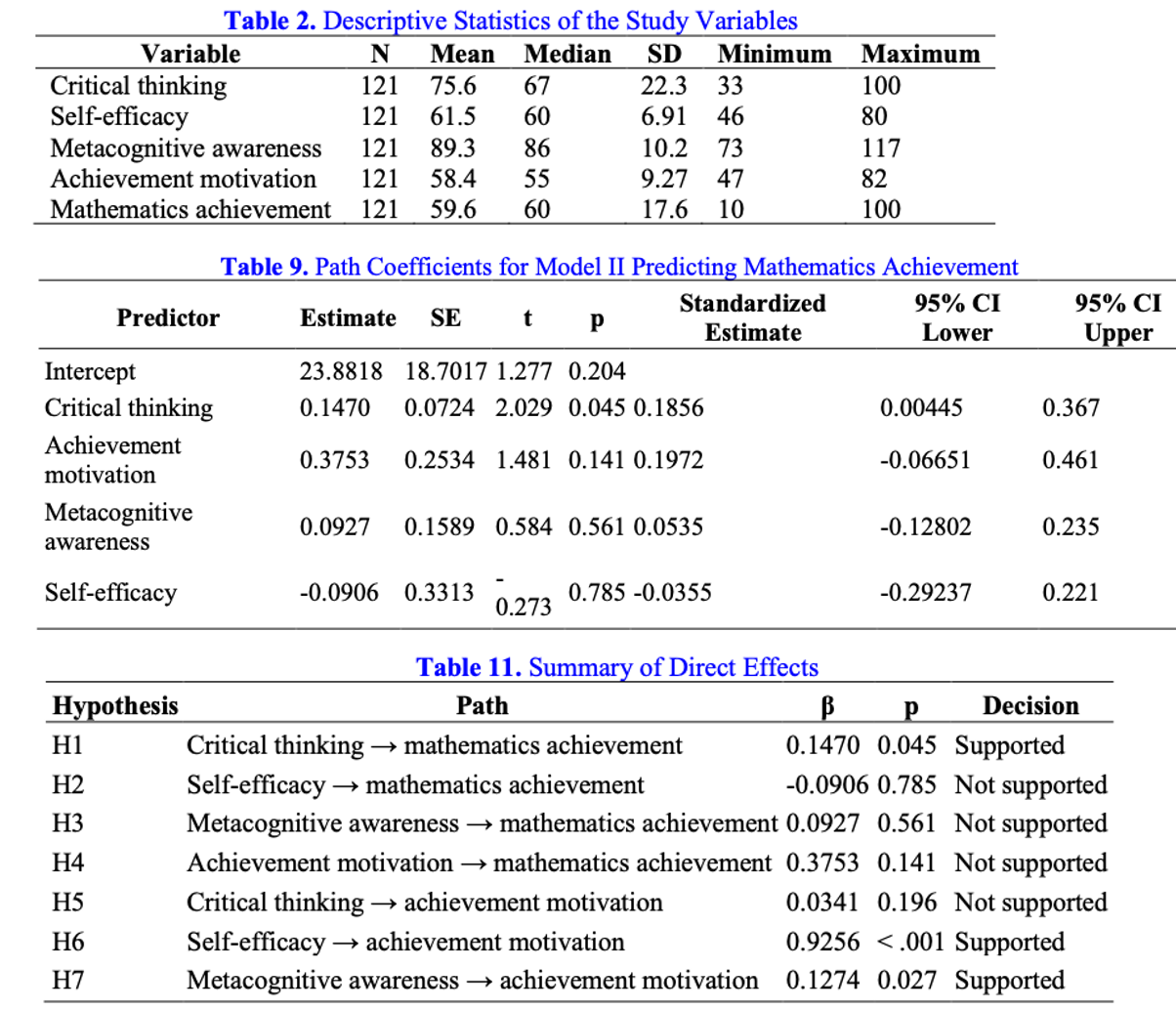
This study examines whether students’ internal factors, namely critical thinking ability, self-efficacy, and metacognitive awareness, contribute to mathematics achievement directly and indirectly through achievement motivation. This study therefore aimed to analyze the direct and indirect effects of critical thinking ability, self-efficacy, and metacognitive awareness on mathematics achievement through achievement motivation among 121 eighth-grade students. A quantitative ex post facto design was employed, and the data were analyzed using path analysis to investigate the proposed causal relationships. Descriptive findings showed that students’ critical thinking ability was at a moderate level (M = 75.6), self-efficacy was high (M = 61.5), metacognitive awareness was high (M = 89.3), and achievement motivation was moderate (M = 58.4). However, mathematics achievement was also only at a moderate level (M = 59.6). The results revealed that critical thinking ability had a significant direct effect on mathematics achievement (β = 0.1470, p = 0.045). By contrast, self-efficacy (β = -0.0906, p = 0.785), metacognitive awareness (β = 0.0927, p = 0.561), and achievement motivation (β = 0.3753, p = 0.141) did not show significant direct effects on mathematics achievement. In the first path model, only self-efficacy (β = 0.9256, p < 0.001) and metacognitive awareness (β = 0.1274, p = 0.027) significantly predicted achievement motivation. Overall, the model explained only 3.07% of the variance in mathematics achievement (R² = 0.0307). These findings indicate that critical thinking ability is the only variable in the model that significantly predicts mathematics achievement, while other factors outside the model may have a more substantial role.
Downloads
References
Callingham, R., & Siemon, D. (2021). Connecting multiplicative thinking and mathematical reasoning in the middle years. Journal of Mathematical Behavior, 61(December 2020), 100837. https://doi.org/10.1016/j.jmathb.2020.100837
Cromley, J. G., Booth, J. L., Wills, T. W., Chang, B. L., Tran, N., Madeja, M., Shipley, T. F., & Zahner, W. (2017). Relation of Spatial Skills to Calculus Proficiency: A Brief Report. Mathematical Thinking and Learning, 19(1), 55–68. https://doi.org/10.1080/10986065.2017.1258614
Fonger, N. L. (2019). Meaningfulness in representational fluency: An analytic lens for students’ creations, interpretations, and connections. Journal of Mathematical Behavior, (October), 1–26. https://doi.org/10.1016/j.jmathb.2018.10.003
Geretschläger, R., & Donner, L. (2022). Writing and choosing problems for a popular high school mathematics competition. ZDM – Mathematics Education, (0123456789). https://doi.org/10.1007/s11858-022-01351-9
Gulkilik, H., Moyer-Packenham, P. S., Ugurlu, H. H., & Yuruk, N. (2020). Characterizing the growth of one student’s mathematical understanding in a multi-representational learning environment. Journal of Mathematical Behavior, 58(March 2019), 100756. https://doi.org/10.1016/j.jmathb.2020.100756
Hackenberg, A. J., Aydeniz, F., & Jones, R. (2021). Middle school students ’ construction of quantitative unknowns ⋆. Journal of Mathematical Behavior, 61(December 2020), 100832. https://doi.org/10.1016/j.jmathb.2020.100832
Hamidy, A., Maula, I., & Lam, K.-F. T. (2023). The influence of online learning readiness on mathematics achievement with mathematics self-efficacy as an intervening variable. Al-Jabar : Jurnal Pendidikan Matematika, 14(2). https://doi.org/10.24042/ajpm.v14i2.17929
Hartmann, L. M., Schukajlow, S., Niss, M., & Jankvist, U. T. (2024). Preservice teachers’ metacognitive process variables in modeling-related problem posing. Journal of Mathematical Behavior, 76(September), 101195. https://doi.org/10.1016/j.jmathb.2024.101195
Hoang, N. T. (2020). A model of organizing activities for training metacognitive skills for primary education students in Mathematics teaching methodology courses. Vietnam Journal of Education, 4(1). https://doi.org/10.52296/vje.2020.6
Hsieh, F. J., Wang, T. Y., Hsieh, C. J., & Chu, C. T. (2025). The relationships of preservice teachers’ dispositions and noticing of technology-integrated mathematics teaching activities. ZDM - Mathematics Education. https://doi.org/10.1007/s11858-025-01727-7
Jeannotte, D., & Kieran, C. (2017). A conceptual model of mathematical reasoning for school mathematics. Educational Studies in Mathematics, 96(1). https://doi.org/10.1007/s10649-017-9761-8
Kaiser, G., König, J., Krauss, S., Buchholtz, N., & Gruber, H. (2025). Are teacher expertise and teacher competence complementary or contradictory research paradigms? Reflections on a possible integration and first conceptualizations. ZDM - Mathematics Education. https://doi.org/10.1007/s11858-025-01743-7
Khozaei, S. A., Zare, N. V., Moneghi, H. K., Sadeghi, T., & Taraghdar, M. M. (2022). Effects of quantum-learning and conventional teaching methods on learning achievement, motivation to learn, and retention among nursing students during critical care nursing education. Smart Learning Environments, 9(1). https://doi.org/10.1186/s40561-022-00198-7
Kinnear, G., Hood, G., Lardet, E., Sheard, C., & Foster, C. (2024). Lecturers’ use of questions in undergraduate mathematics lectures. Journal of Mathematical Behavior, 76(September), 101190. https://doi.org/10.1016/j.jmathb.2024.101190
Kuntze, S., Aizikovitsh-Udi, E., & Clarke, D. (2017). Hybrid task design: connecting learning opportunities related to critical thinking and statistical thinking. ZDM - Mathematics Education, 49(6), 923–935. https://doi.org/10.1007/s11858-017-0874-4
Lee, H. S., Sanei, H., Famularo, L., Masters, J., Bradshaw, L., & Schellman, M. (2023). Validating a concept inventory for measuring students’ probabilistic reasoning: The case of reasoning within the context of a raffle. Journal of Mathematical Behavior, 71(June), 101081. https://doi.org/10.1016/j.jmathb.2023.101081
Lee, Y., Capraro, R. M., & Bicer, A. (2019). Affective Mathematics Engagement: a Comparison of STEM PBL Versus Non-STEM PBL Instruction. Canadian Journal of Science, Mathematics and Technology Education, 19(3), 270–289. https://doi.org/10.1007/s42330-019-00050-0
Lehmann, T. H. (2023). Using algorithmic thinking to design algorithms: The case of critical path analysis. Journal of Mathematical Behavior, 71(August 2022), 101079. https://doi.org/10.1016/j.jmathb.2023.101079
Ma’rufi, Ilyas, M., Salwah, Pasandaran, R. F., & Ikram, M. (2020). Exploration of pre-service teachers’ pedagogical content knowledge in mathematics learning in senior high school based on gender and academic skills. Journal for the Education of Gifted Young Scientists, 8(4), 1361–1371. https://doi.org/10.17478/jegys.780399
Marufi, M., Ilyas, M., Ikram, M., & Erbilgin, E. (2025). Assessing What Students Think About Solving Word Problems: The Case of Reversible Reasoning in Students. Center for Educational Policy Studies Journal. https://doi.org/10.26529/cepsj.2094
Milenković, A., & Stevanić, J. (2025). Integrating Cooperative Learning in Distance Education for Methodology of Teaching Mathematics Course. Pedagogika-Pedagogy, 97(2). https://doi.org/10.53656/ped2025-2.06
Ødegaard, R. P., Arnesen, K. K., & Langfeldt, M. B. (2024). Tools to support learning to plan discussions that promote students’ mathematical reasoning. Journal of Mathematics Teacher Education, (1). https://doi.org/10.1007/s10857-024-09668-w
Ogrodzka-Mazur, E., Szafrańska, A., Malach, J., & Chmura, M. (2017). The use of E-learning resources by academic teachers– A Polish-Czech comparative study. New Educational Review, 50(4), 169–185. https://doi.org/10.15804/tner.2017.50.4.14
Olsher, S., Abdu, R., & Shalata, M. (2025). The relationships between student content-specific grouping and teachers-students’ interactions during online collaborative mathematical task solving. Educational Studies in Mathematics, 119(2), 249–268. https://doi.org/10.1007/s10649-024-10382-w
Paoletti, T., Stevens, I. E., Acharya, S., Margolis, C., Olshefke-Clark, A., & Gantt, A. L. (2024). Exploring and promoting a student’s covariational reasoning and developing graphing meanings. Journal of Mathematical Behavior, 74(April), 101156. https://doi.org/10.1016/j.jmathb.2024.101156
Regier, P., & Savic, M. (2020). How teaching to foster mathematical creativity may impact student self-efficacy for proving. Journal of Mathematical Behavior, 57(September 2018), 100720. https://doi.org/10.1016/j.jmathb.2019.100720
Rincón, Y. R., Munárriz, A., & Magreñán Ruiz, A. (2025). Flipped Classroom or flip to foster self-regulation competencies in Mathematics in Economics and Business students. International Journal of Educational Research, 130. https://doi.org/10.1016/j.ijer.2025.102556
Rogowska, A. M., Tataruch, R., Niedźwiecki, K., & Wojciechowska-Maszkowska, B. (2022). The Mediating Role of Self-Efficacy in the Relationship between Approach Motivational System and Sports Success among Elite Speed Skating Athletes and Physical Education Students. International Journal of Environmental Research and Public Health, 19(5). https://doi.org/10.3390/ijerph19052899
Safrudiannur, & Rott, B. (2019). The different mathematics performances in PISA 2012 and a curricula comparison: enriching the comparison by an analysis of the role of problem solving in intended learning processes. Mathematics Education Research Journal, 31(2), 175–195. https://doi.org/10.1007/s13394-018-0248-4
Şahin, Ş., Şahin, E., Sağdilek, E., Vatansever, Ş., Birinci, Y. Z., Güngör, A. K., & Kızıltan, E. (2020). The Comparison of Mental Rotation Performances and Academic Achievements in Students of the Faculty of Sport Sciences and Education Sciences. Journal of Education and Learning, 9(3). https://doi.org/10.5539/jel.v9n3p66
Scheibling-Sève, C., Pasquinelli, E., & Sander, E. (2020). Assessing conceptual knowledge through solving arithmetic word problems. Educational Studies in Mathematics, 103(3), 293–311. https://doi.org/10.1007/s10649-020-09938-3
Street, K. E. S., Malmberg, L. E., & Stylianides, G. J. (2022). Changes in students’ self-efficacy when learning a new topic in mathematics: a micro-longitudinal study. Educational Studies in Mathematics, 111(3), 515–541. https://doi.org/10.1007/s10649-022-10165-1
Turan, M. B., & Koç, K. (2018). The impact of self-directed learning readiness on critical thinking and self-efficacy among the students of the school of physical education and sports. International Journal of Higher Education, 7(6). https://doi.org/10.5430/ijhe.v7n6p98
Vamvakoussi, X. (2017). Using analogies to facilitate conceptual change in mathematics learning. ZDM - Mathematics Education, 49(4), 497–507. https://doi.org/10.1007/s11858-017-0857-5
Vidic, T., Irena, K., & Duranovic, M. (2022). The role of teachers ’ support and enthusiasm in predicting mathematics anxiety and confidence among students t. Journal of Eduaction Elementary, 15(1), 51–69.
Weiland, T., Orrill, C. H., Nagar, G. G., Brown, R. E., & Burke, J. (2020). Framing a robust understanding of proportional reasoning for teachers. Journal of Mathematics Teacher Education, (0123456789). https://doi.org/10.1007/s10857-019-09453-0
Yurekli, B., Isiksal Bostan, M., & Cakiroglu, E. (2020). Sources of preservice teachers’ self-efficacy in the context of a mathematics teaching methods course. Journal of Education for Teaching, 00(00), 1–15. https://doi.org/10.1080/02607476.2020.1777068
Yurekli, B., Stein, M. K., Correnti, R., & Kisa, Z. (2020). Teaching mathematics for conceptual understanding: Teachers’ beliefs and practices and the role of constraints. Journal for Research in Mathematics Education, 51(2), 234–247. https://doi.org/10.5951/jresematheduc-2020-0021
Zanden, P. J. A. C. Van Der, Denessen, E., Cillessen, A. H. N., Meijer, P. C., Zanden, P. J. A. C. Van Der, Denessen, E., & Cillessen, A. H. N. (2020). Fostering critical thinking skills in secondary education to prepare students for university : teacher perceptions and practices. Research in Post-Compulsory Education, 25(4), 394–419. https://doi.org/10.1080/13596748.2020.1846313
Downloads
Published
How to Cite
Issue
Section
License
Copyright (c) 2026 This is an open-access under the CC-BY-SA license

This work is licensed under a Creative Commons Attribution-ShareAlike 4.0 International License.
Education and Talent Development Center of Indonesia (ETDC Indonesia)
e-mail: kognitif@gmail.com, website : https://etdc-indonesia.com

Kognitif: Jurnal Riset HOTS Pendidikan Matematika dengan Situs: https://etdci.org/journal/kognitif berlisensi Creative Commons Attribution-ShareAlike 4.0 International License






.png)