Snowball Throwing Instructional Model: Middle School Students’ Learning Interest in Islamic Education

https://doi.org/10.51574/ijrer.v5i1.4291
Keywords:
Interactive Learning, Islamic Religious Education, Learning Interest, Middle School, Snowball ThrowingAbstract
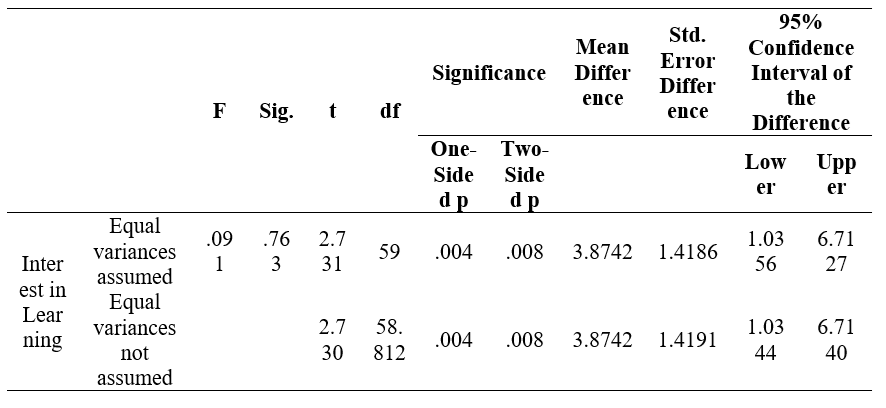
This study intends to determine the effect of the snowball-throwing learning model on students' learning interest in Islamic religious education at the middle school level. The initial problem was low student interest and attention due to monotonous learning methods. This research employed a quantitative approach with a post-test-only control group type of quasi-experimental design. The method of sampling involved one experimental class using the Snowball Throwing model and one control class using conventional methods at Middle School 1 Waway Karya. The instrument used was a learning interest questionnaire that had been tested for validity and reliability. Data analysis was conducted through normality tests, homogeneity tests, and t-tests. The results indicated that the data were normally distributed and homogeneous. The t-test yielded a significance value of 0.008, which is less than 0.05 (p < 0.05), indicating a significant difference in learning interest between the two groups. Students who learned using the snowball-throwing model had a higher learning interest compared to students who learned with conventional methods. The activity of making and throwing questions in the form of paper balls was proven to be able to increase students' interest and attention in learning. The contribution of this research is to offer the snowball throwing model as an effective alternative learning strategy to increase students' learning interest in Islamic religious education subjects.
References
Agustin, D., & Gumala, Y. (2025). Analisis Penerapan Model Pembelajaran Snowball Throwing Terhadap Peningkatan Hasil Belajar Peserta Didik : Literatur Riview. Social Edu: Jurnal Ilmu Sosial Dan Pendidikan, February, 52–64. https://doi.org/10.37286/jmp.v4i1.251
Ahya, I. N., & Kholisna, T. (2022). Kesejahteraan Guru Honorer terhadap Etos Kerja Guru SMA Swasta. Jurnal Literasi Psikologi, 2(2), 64–77.
Aini, F. I., & Khoiri, M. (2024). Efektivitas Pembelajaran Bangun Datar Menggunakan Model Pembelajaran Snowball Throwing Terhadap Siswa SDI Nurul Mushthofa. Hexagon: Jurnal Ilmu Dan Pendidikan Matematika, 2(1), 73–78. https://doi.org/10.33830/hexagon.v2i1.6053.
Ambarsari, S. N., Muharom, F., & Suoriyanto. (2024). Implementation of the snowball throwing method in PAI subjects to improve student learning outcomes. Cendikia : Media Jurnal Ilmiah Pendidikan, 14(4), 399–406. https://doi.org/10.35335/cendikia.v14i4.4853
Aprilliani, Y., Primahardani, I., & Supentri. (2024). Pengaruh Model Pembelajaran Koaboratif Berbasis Masalah Terhadap Kreativitas Belajar Siswa Kelas IX SMP IT Al-Fityah Pekan Baru. Jurnal Manajemen Pendidikan Dan Pelatihian, 8(1), 15–22. https://doi.org/10.35446/diklatreview.v8i1.1655
Atay, M. G. (2025). The relationship between medical students ’ interest in learning and their ability to solve mathematical problems : the chain-mediating role of teacher-student relationship and self-efficacy. Frontiers, 1–10. https://doi.org/10.3389/fpsyg.2025.1531262
Aulia, V. T., Efendi, N., Oktira, Y. S., Efrina, G., Nahdlatul, U., & Sumbar, U. (2024). Peningkatan Hasil Belajar dengan Menggunakan Model Snowball Throwing Pada Pembelajaran Tematik Kelas V Di SD Negeri 01 Ulak Karang. INNOVATIVE: Journal Of Social Science Research, 4(2), 571–583. https://indopediajurnal.my.id/index.php/jurnal/article/view/248/179
Bloch, C., Degn, L., Nygaard, S., & Haase, S. (2021). Does quality work work? A systematic review of academic literature on quality initiatives in higher education. Assessment & Evaluation in Higher Education, 46(5), 701-718. https://doi.org/10.1080/02602938.2020.1813250
Bukit, S., Ariastika, D., Noviati, Y., & Lubis, Y. (2023). Snowball Throwing Learning Model in Growing Questioning Skills of Elementary School Students: A Review. Journal Corner of Education, Linguistics, and Literature, 2(4), 343-351. https://doi.org/10.54012/jcell.v2i4.145
Chandra, M. P., Rasimin, & Lubis, M. A. (2023). Upaya Meningkatkan Minat Belajar Siswa dengan Penerapan Layanan Informasi Menggunakan Media Audio Visual Pasca Covid. JUANG: Jurnal Wahana Konseling, 6(2), 109–119. https://doi.org/10.31851/juang.v6i2.13191
Dalimunthe, M. I. (2020). Pengaruh Kecerdasan Emosional dan Minat Belajar Terhadap Pemahaman Akuntansi di Universitas Medan Area. Jurnal Mutiara Akuntansi, 5(2). https://e-journal.sari-mutiara.ac.id/index.php/JMA/article/view/1381
Darwis, M., Fitriah, N., & Arhas, S. H. (2023). The Influence of the Classical Learning Model on Students ’ Interest in Learning at SMKN 1 Bantaeng. Pinisi Journal of Education and Management, 2(2), 237–246.
Erni, E., Haliadi, H., & Hasdin, H. (2024). Analysis of the Snowball Throwing Learning Model Assisted by Canva Media on Social Studies Learning Outcomes. Journal of Education Method and Learning Strategy, 2(02), 853–858. https://doi.org/10.59653/jemls.v2i02.818
Fajri, R. M., Wijoyo, S. H., & Hidayat, N. (2025). Pengaruh Minat Belajar , Motivasi Belajar , dan Gaya Belajar Siswa Terhadap Hasil Belajar Siswa Kelas XI Pada Mata Pelajaran Pemrograman Website Di SMKN 11 Malang. Jurnal Pengembangan Teknologi Informasi Dan Ilmu Komputer, 9(5), 1–9. https://j-ptiik.ub.ac.id/index.php/j-ptiik/article/view/14751
Fitrianto, I., Hamid, R., & Mulalic, A. (2023). The effectiveness of the learning strategy" think, talk, write" and snowball for improving learning achievement in lessons insya'at Islamic Boarding School Arisalah. International Journal of Post Axial: Futuristic Teaching and Learning, 13-22. https://doi.org/10.59944/postaxial.v1i1.142
Fryer, L. K., Shum, A., King, R. B., & Lau, P. (2025). How does interest in a course interact with course learning ? Learning and Instruction, 98(March), 102106. https://doi.org/10.1016/j.learninstruc.2025.102106
Guo, Z., & Fryer, L. K. (2025). What really elicits learners ’ situational interest in learning activities : a scoping review of six most commonly researched types of situational interest sources in educational settings. Current Psychology, 587–601. https://doi.org/https://doi.org/10.1007/s12144-024-07176-x
Hamidah. (2023). Meningkatkan Prestasi Belajar Mata Pelajaran IPS Terpadu Materi Penguatan Ekonomi Maritim Model Pembelajaran Snowball Throwing Improving. Pedagogik Jurnal Pendidikan, 18(1), 56–61.
Hardiansyah, F. (2022). Snowball Throwing: A Method To Uplift Elementary School Students’ Responsibility on Environment. Al-Ishlah: Jurnal Pendidikan, 14(3), 3853-3864. https://doi.org/10.35445/alishlah.v14i3.1966
Hartati, L., & Jimmy Copriadi. (2023). Rendahnya Minat Belajar Siswa pada Masa Covid-19: Kajian Aksiologi. Jurnal Filsafat Indonesia, 6(1), 75–81. https://doi.org/10.23887/jfi.v6i1.41551
Hasanah, N. H., & Swondo, A. P. (2021). the Effect of Snowball Throwing Method on Students’ Vocabulary Mastery. Journal MELT (Medium for English Language Teaching), 5(2), 175. https://doi.org/10.22303/melt.5.2.2020.175-185
Herpratiwi, & Tohir, A. (2022). Learning Interest and Discipline on Learning Motivation To cite this article : International Journal of Education in Mathematics, Science and Technology, 10(2), 424–435. https://doi.org/https://doi.org/10.46328/ijemst.2290
Hidayah, N., & Purwanti, S. (2022). Upaya Peningkatan Hasil Belajar Kognitif IPA Melalui Model Pembelajaran Kooperatif Tipe Snowball Throwing Pada Kelas IV SD Darul Qur’an Sragen. JIPDAS (Jurnal Ilmiah Pendidikan Dasar) Institut Pendidikan Tapanuli Selatan, 2(3), 202–210. https://jurnal.spada.ipts.ac.id/index.php/JIPDAS/article/view/1133
Husna, A., Taher, A., & Kamaruddin, T. (2020). Perbandingan Hasil Belajar Siswa Menggunakan Model Pembelajaran Kooperatif Tipe Snowball Throwing dengan Model Pembelajaran Tipe Team Quizmata Pelajaran IPS Terpadu di SMP Negeri 2 Muara Tiga Kabupaten Pidie. Jurnal Ilmiah Mahasiswa Pendidikan Geografi FKIP Unsyiah, 5(2), 93–98.
Idriastuti, L. R. (2021). Aplication Of Cooperative Learning Snowball Throwing Model To Improve the Result Of History Learning For Learners. Eduvest – Journal of Universal Studies Volume, 1(6), 484–497.
Ikhsani, S. R., Tangawunisma, A., Sholeha, A., Divanka, P., & Setiabudi, D. I. (2023). Karakteristik Pembelajaran Tematik Yang Ideal Pada Sekolah Dasar. Student Scientific, Creativity Journal, 1(1), 291–295. https://doi.org/10.55606/sscj-amik.v1i1.1126
Inayah, T., Nurpratiwiningsih, L., & Setiyoko, D. T. (2024). Pengaruh Model Pembelajaran Snowball Throwing Terhadap Minat Kelas III SDN Prapag Kidul 03. Jurnal Ilmiah Wahana Pendidikan, 10(5), 862–869. https://doi.org/10.5281/zenodo.10547888
Irianto, T. U., & Universitas, N. J. T. (2024). Boosting Elementary Students’ Learning Interest : The Impact Of The Question-and-Answer Method. Applied Linguistics: Innovative Approaches and Emerging Trends, 1(2), 94–110. https://doi.org/10.58989/appling.v1i2.18
Iskandar, R., & Nurulita, H. (2023). Pengaruh Minat Belajar terhadap Hasil Belajar Ekonomi. JIIP - Jurnal Ilmiah Ilmu Pendidikan, 6(12), 9818–9822. https://doi.org/10.54371/jiip.v6i12.2895
Islamiati, A. D., Dollah, S., & Sakkir, G. (2024). the Use of the Snowball Throwing Technique in Teaching Reading Skill Penggunaan Teknik Snowball Throwing Dalam Pengajaran Keterampilan Membaca Bahasa Inggris. JURNAL INDOPEDIA (Inovasi Pembelajaran Dan Pendidikan), 2(1), 196–206. https://indopediajurnal.my.id/index.php/jurnal/article/view/248/179
Jumari, E. O. (2024). Snowball Throwing: The Critical Thinking and Self-Efficacy Revolution. Pasundan Journal of Mathematics Education: Jurnal Pendidikan Matematika, 14(2), 95-111. https://journal.unpas.ac.id/index.php/pjme/article/view/16551
Khairunnisa, S., & Elfrianto. (2025). The Use of the Snowball Throwing Model to Increase Student Activeness in Mathematics Learning in Class III of Sd Negeri 064967 Medan Timur. Jurnal Nasional Holistic Science, 5(1), 10–15. https://doi.org/10.56495/hs.v5i1.602
Koehler, A. A., & Meech, S. (2022). Ungrading learner participation in a student-centered learning experience. TechTrends, 66(1), 78-89. https://doi.org/10.1007/s11528-021-00682-w
Kurniati, N., DN, U. Y., & Yusandra, T. F. (2021). Perbandingan Penggunaan Model Pembelajaran Numbered Head Together (Nht) Dengan Model Snowball Throwing Terhadap Keterampilan Menulis Teks Puisi Siswa Kelas Viii Smp N 1 Sungai Beremas. Horizon, 1(1), 113–120. https://doi.org/10.22202/horizon.v1i1.4702
Kusuma, E. R. (2022). Pengembangan Modul Digital Tentang Peristiwa G30S/Pki Untuk Meningkatkan Minat Belajar Dan Berpikir Kritis Siswa. Jurnal Pendidikan Sejarah Indonesia, 5(1), 100. https://doi.org/10.17977/um0330v5i1p100-109
Lestari, P., & Sabiti, N. (2022). Implementasi Model Pembelajaran Snowball Throwing Dengan Media Teka-Teki Silang untuk Meningkatkan Minat Belajar Siswa Pada Mata Pelajaran PAI dan Budi Pekerti. Jurnal Tarbi ( Jurnal Ilmiah Mahasiswa), 1(2), 167–179. https://doi.org/10.33507/tarbi.v1i2.464
Maisa, R. G., & Farida, S. (2021). Peningkatan Hasil Belajar Peserta Didik dengan Menggunakan Model Pembelajaran Cooperative Tipe Snowball Throwing pada Pembelajaran Tematik terpadu di Kelas V SDN 24 Gunung Rajo Kabupaten Tanah Datar. Jurnal Pendidikan Tambusai, 5(1), 1466–1472.
Manalu, K., Pima, E., Tambunan, S., Sari, O. P., Islam, U., & Sumatera, N. (2022). Snowball Throwing Learning Model : Increase Student Activity And Learning Outcomes. Journal of Education and Teaching Learning (JETL), 4(1), 1–13. https://doi.org/10.51178/jetl.v4i1.413
Mariam, S., Sapriati, A., & Suroyo, S. (2024). Snowball throwing learning strategy and learning motivation: keys to success in improving science learning outcomes for high class students. Jurnal Fundadikdas (Fundamental Pendidikan Dasar), 7(1), 17–25. https://doi.org/10.12928/fundadikdas.v7i1.10103
Ndraha, I. S., Mendrofa, R. N., & Lase, R. (2022). Analisis Hubungan Minat Belajar Dengan Hasil Belajar Matematika. Educativo: Jurnal Pendidikan, 1(2), 672–681. https://doi.org/10.56248/educativo.v1i2.92
Novianti, M. P., Adnyana, K. S., & Ardiawan, I. K. N. (2023). Pengaruh Model Snowball Throwing Berbantuan Gending Rare Terhadap Minat Belajar Matematika. Indonesian Journal of Learning Education and Counseling, 5(2), 116–122. https://doi.org/10.31960/ijolec. V5i1.2004
Ofridaningsih, Sumartono, & Herwanto, M. A. (2022). The Efectiveness of Snowball Throwing Cooperative Learning Model on Student’ Mathematics Learning Outcomes. Journal of Educational Technology and Innovation, 6(1), 17–23. https://doi.org/https://doi.org/10.31537/jeti.v6i1.1102
Oktavia, S., Kurnisar, & Mutiara, T. M. (2024). Meningkatkan Minat Belajar Peserta Didik Dengan Penggunaan Media Wordwall Pada Pembelajaran PPKn. Jurnal Educatio, 10(4), 1162–1168. https://doi.org/https://doi.org/10.31949/educatio.v10i4.9402
Polotoy, A. (2022). Penigkatan Aktivitas Dan Hasil Belajar Ekonomi Kelas XI IPS 1 Melalui Penerapan Metode Snowball Throwing SMA Negeri 1 Paguat Tahun Pelajaran 2019 / 2020. AKSARA: Jurnal Ilmu Pendidikan Nonformal, 08(January), 349–362. https://doi.org/10.37905/aksara.8.1.349-362.2022
Pranata, D. (2023). Pengaruh Model Pembelajaran Kooperatif Tipe Snowball Throwing Terhadap Hasil Belajar Ips. Mimbar Ilmu, 24(3), 2807–4246. https://doi.org/10.23887/mi.v24i3.21677
Pristiwanti, D., Badariah, B., Hidayat, S., & Dewi, R. S. (2022). Pengertian Pendidikan. Jurnal Pndidikan Dan Konseilng, 4(6), 7911–7915. https://doi.org/10.31004/jpdk.v4i6.9498
Rahmasari, D. (2023). Strategi Guru dalam Meningkatkan Minat Belajar. Jurnal Citra Pendidikan (JCP), 4(1), 88–100. https://doi.org/https://doi.org/10.38048/jcp.v3i3.1831
Ramadhan, F., & Suharyat, Y. (2022). Pengaruh Model Snowball Throwing pada Pembeljaran Pendidikan Agama Islam terhadap Minat Belajar di SMA NEGERI 1 Tambun Utara. Jurnal Masyarakat Mengabdi Nusantara (JMMN), 1(3), 1–9. https://doi.org/10.58374/jmmn.v1i3.86
Risti, E., Hiyum, W., Nugroho, A. S., & Yunita, N. (2025). Implementation of the Snowball Throwing Learning Model with Ice Breaking in Mathematics Subject. Journal of Medives : Journal of Mathematics Education IKIP Veteran Semarang, 9(2), 133–144. https://doi.org/https://doi.org/10.31331/medivesveteran.v9i2.3595
Rusyda, M. T., Zulkifli, L., & Merta, I. W. (2024). Perbandingan Hasil Belajar Siswa Melalui Penggunaan Model Pembelajaran Discovery Learning dengan Model Pembelajaran Kooperatif. Jurnal Pendidikan, Sains, Geologi, Dan Geofisika, 5(4), 901–907. https://doi.org/https://doi.org/10.29303/geoscienceed.v5i4.514
Sari, I. W. (2022). Pengaruh Model Pembelajaran Snowball Throwing Berbantuan Media Permainan Tebak Gambar Terhadap Hasil Belajar Siswa Kelas III SD. Jurnal Ilmiah Mandala Education, 8(1), 749–757. https://doi.org/10.58258/jime.v8i1.2771
Sartania, N., Sneddon, S., Boyle, J. G., McQuarrie, E., & de Koning, H. P. (2022). Increasing collaborative discussion in case-based learning improves student engagement and knowledge acquisition. Medical science educator, 32(5), 1055-1064. https://doi.org/10.1007/s40670-022-01614-w
Siagian, B. S., Arlina, Luthfianti, N., & Amanda, Y. (2025). Implementasi Metode Snowball Throwing Dalam Meningkatkan Partisipasi dan Pemahaman Siswa di Elsusi Meldina. QOSIM : Jurnal Pendidikan, Sosial & Humaniora, 3(1), 202–210. https://doi.org/10.61104/jq.v3i1.748
Siahaan, K. W. A., Damanik, D. H. S., Tambunan, S. S., SImanjuntak, M., & Sihombing, D. (2021). Implementasi Model Quantum Teaching dan Metode Snowball Throwing Terhadap Minat dan Prestasi Belajar Kimia. Jurnal Ekonomi, Sosial & Humaniora, 2(7), 16–24. https://jurnalintelektiva.com/index.php/jurnal/article/view/416
Sihombing, J. S., Purnawan, P. E., Sababalat, K. Z., & Tafonao, T. (2024). Analisis Faktor Faktor yang Mempengaruhi Minat Belajar Mahasiswa. Jurnal Ilmiah Multidisiplin, 1(2), 106–118. https://doi.org/10.62282/juilmu.v1i2.106-118
Situmorang, A. S. (2020). Microsoft Teams For Education Sebagai Media Pembelajaran Interaktif Meningkatkan Minat Belajar. SEPREN: Journal of Mathematics Education and Applied, 02(01), 30–35. https://doi.org/10.36655/sepren.v2i1.351
Tetep, & Nurahmi, A. P. (2021). Peningkatan Hasil Belajar IPS Melalui Pengguatan Metode Snowball Throwing. Journal Civics & Social Studies, 5(2), 198–213. https://doi.org/10.31980/civicos.v5i2.1481
Trianasari, A., Aini, Q., & Prasojo, S. D. (2024). Jurnal Guru Komputer Implementation of the Snowball Throwing Method with Wordwall Learning Media to Increase Students ’ Learning Interest and Motivation in Software and Game Development in. Jurnal Guru Komputer, 5(1), 36–44. https://ejournal.upi.edu/index.php/JGrKom/article/view/66445
Ulpa, M., Sandi, & Azis, E. (2025). Pengaruh Penerapan Model Snowball Throwing Terhadap Hasil Belajar Siswa. Journal on Education, 07(02), 12349–12360. https://doi.org/10.31004/joe.v7i2.8362
Wianto, T., & Firdaus, M. (2025). Increasing Students’ Reading Comprehension and Learning Interest by Using Snowball Throwing Method at The Tenth-Grade Students of Assalam IBS. Journal of Classroom Action Research, 7(1), 256-260. https://doi.org/10.29303/jcar.v7i1.10226
Yahya, A., Vernando, C. L., & Herna, H. (2022). Penerapan Model Pembelajaran Snowball Throwing Dengan Ice Breaking Untuk Meningkatkan Minat Dan Hasil Belajar Matematika Siswa Kelas Viii Smp Negeri 5 Tobadak. ELIPS: Jurnal Pendidikan Matematika, 3(1), 30–44. https://doi.org/10.47650/elips.v3i1.390
Yuliani, M., Habibi, M. R., & Nandasari, S. (2022). Pengaruh Model Pembelajaran Snowball Throwing Terhadap Minat Belajar Siswa Subtema Materi Pahlawan Indonesia Muatan Ilmu Pengetahuan Sosial di Kelas IV SD Negeri 3 Lando. Journal of Classroom Action Research, 4(4), 120–123. https://doi.org/10.29303/jcar.v4i4.2969
Yunitasari, R., & Hanifah, U. (2020). Pengaruh pembelajaran daring terhadap minat belajar siswa pada masa covid 19. Edukatif: Jurnal Ilmu Pendidikan, 2(3), 232-243. https://edukatif.org/edukatif/article/view/142
Zaedun. (2021). Pengaruh Model Pembelajaran Snowball Throwing Terhadap Minat Belajar Geografi Siswa SMA Negeri 2 Labuapi. Jurnal Teknologi Pendidikan : Jurnal Penelitian Dan Pengembangan Pembelajaran, 6(1), 78. https://doi.org/10.33394/jtp.v6i1.3607
Downloads
Published
How to Cite
Issue
Section
License
Copyright (c) 2025 Siti Mutmainah, Deden Makbuloh, M. Indra Saputra

This work is licensed under a Creative Commons Attribution-ShareAlike 4.0 International License.