Holistic Pedagogical Strategies: Combating Bullying in Islamic Secondary Schools Through Religious Education

https://doi.org/10.51574/ijrer.v5i4.5159
Keywords:
Bullying, Bullying Prevention, Holistic Pedagogical, Islamic Secondary Education, PAI Teacher StrategiesAbstract
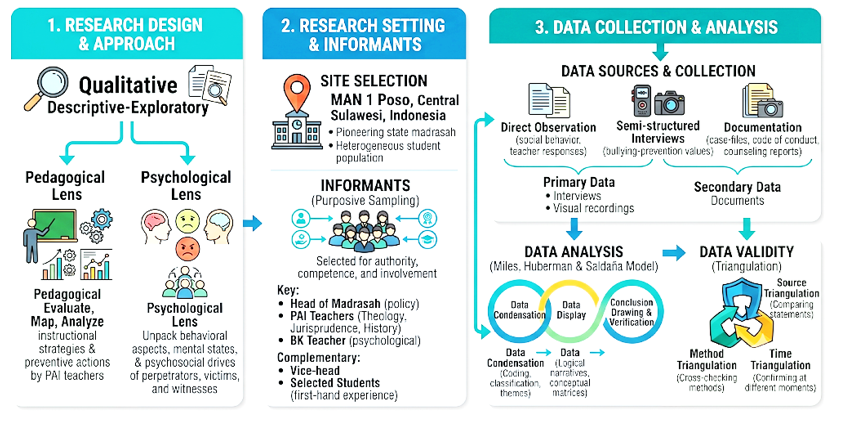
This study examines the strategies employed by Islamic Religious Education (PAI) teachers to prevent bullying at Islamic Secondary School 1 Poso, Poso Regency, Central Sulawesi Province, Indonesia. Bullying remains one of the most pressing problems in contemporary educational settings, generating substantial adverse consequences for students' mental health and social development. This study aimed to describe the forms of bullying occurring in the research site, identify their contributing factors, and analyze the strategies implemented by Islamic Religious Education teachers to prevent them. A qualitative descriptive-exploratory design was employed, combining pedagogical and psychological perspectives. Data were collected through direct observation, in-depth interviews with the head of madrasah, Islamic Religious Education teachers, guidance and counseling teachers, the vice-head for student affairs, and students, together with documentation studies, and were analyzed using the interactive model of Miles, Huberman, and Saldaña. The findings indicate that verbal bullying is the most prevalent form encountered, driven by family disharmony, the school environment, and social media exposure. The prevention strategies adopted by Islamic Religious Education teachers encompass sustained moral guidance and character coaching, the integration of Islamic values into classroom instruction, personalized approaches to students, cross-unit collaboration within the madrasah, and the application of educative rather than punitive sanctions. These findings underscore the strategic potential of religious education teachers as proactive psycho-spiritual agents of character transformation in mitigating bullying within Islamic secondary education.
References
Abdurrohim, A., Fitriani, E., Akbari, M. Y. A., Bachtiyar, M., Fuad, A. Z., & Syaifudin, M. (2024). Exploring anti-bullying strategies in Islamic boarding schools: A comparative study of Indonesia and Malaysia. Al-Ishlah: Jurnal Pendidikan, 16(3), 3704-3715. https://journal.staihubbulwathan.id/index.php/alishlah/article/view/5448
Ahmed, O. S., Hasan, H. A., Bazool, S. D. S., Mirzaeva, A., & Al-Musawi, O. Y. S. (2025). Fitnah in the Digital Age: Regulating Social Media Misuse Through Islamic Criminal Principles. Al-Istinbath: Jurnal Hukum Islam, 10(2), 535-562. https://doi.org/10.29240/jhi.v10i2.13369
Akhyar, M., Zukdi, I., & Deliani, N. (2024). Value-based leadership of Islamic education teachers and its role in disciplinary religious practice formation: A qualitative case study in an Indonesian public school. Jurnal Pendidikan Islam, 13(2), 97-105. https://doi.org/10.14421/jpi.2024.132.97-105
Anam, S., & Mendez, S. (2025). Strategies of Islamic Religious Education in Shaping the Religious Character of Students at Pondok Pesantren Ruqoba Al-Atsary. International Journal of Post Axial: Futuristic Teaching and Learning, 230-239. https://doi.org/10.59944/postaxial.v3i4.520
Arif, M., Aziz, M. K. N. A., & Abdurakhmonovich, Y. A. (2024). Trend strategy to prevent bullying in Islamic boarding schools (pesantren). Jurnal Ilmiah Peuradeun, 12(2), 639-670.
Azizah, M. A., Hasan, M. S. R., & Syarkun, M. B. (2025). Collaborative Management Model for Bullying Prevention in Islamic Boarding Schools: A Multi-Stakeholder Approach. Nidhomul Haq: Jurnal Manajemen Pendidikan Islam, 10(3), 617-629. https://doi.org/10.31538/ndhq.v10i3.246
Beatty, A., Berkhout, E., Bima, L., Pradhan, M., & Suryadarma, D. (2021). Schooling progress, learning reversal: Indonesia’s learning profiles between 2000 and 2014. International Journal of Educational Development, 85, 102436. https://doi.org/10.1016/j.ijedudev.2021.102436
Fauzan, H., & Sulaeman, D. (2024). Overcoming bullying in the educational environment: prevention and intervention strategies in schools. Journal of English Language and Education, 9(4), 12-26. https://doi.org/10.31004/jele.v9i2.489
Fasya, A., Darmayanti, N., & Arsyad, J. (2023). The Influence of Learning Motivation and Discipline on Learning Achievement of Islamic Religious Education in State Elementary Schools. Nazhruna: Jurnal Pendidikan Islam, 6(1), 1-12. https://e-journal.uac.ac.id/index.php/NAZHRUNA/article/view/2711
Fitriyana, R., & Fahrudin, A. (2026). Growing Pains: How Social Problems Shape the Lives of Today’s Youth. The Palgrave Handbook of Global Social Problems (pp. 1-23). Cham: Springer Nature Switzerland. https://doi.org/10.1007/978-3-030-68127-2_825-1
Gaffney, H., Ttofi, M. M., & Farrington, D. P. (2021). What works in anti-bullying programs? Analysis of effective intervention components. Journal of school psychology, 85, 37-56. https://doi.org/10.1016/j.jsp.2020.12.002
Hakim, A. R., Hasyim, M., Budiyono, A., & Wijono, H. A. (2025). Islamic Religious Education Teachers in Building Anti-Bullying School Culture. Dirasah International Journal of Islamic Studies, 3(2), 289-301. https://dirasah.pdtii.org/index.php/i/article/view/108
Hammarén, N. (2022). Are bullying and reproduction of educational inequality the same thing? Towards a multifaceted understanding of school violence. Power and education, 14(1), 35-49. https://doi.org/10.59373/drs.v3i2.108
Hensums, M., De Mooij, B., Kuijper, S. C., Fekkes, M., & Overbeek, G. (2023). What works for whom in school-based anti-bullying interventions? An individual participant data meta-analysis. Prevention science, 24(8), 1435-1446. https://doi.org/10.1177/17577438211052650
Hishnuddin, A. A., & Jazilurrahman, J. (2025). Transformative Islamic education: The role of Qur’anic value internalization in building santri’s religious character. Journal of Educational Management Research, 4(5), 1858-1870. https://doi.org/10.61987/jemr.v4i5.1153
Kostakopoulou, D., & Mahmoudi, M. (2024). Academic bullying and human rights: is it time to take them seriously?. Human Rights Review, 25(1), 25-46. https://doi.org/10.1007/s12142-024-00713-y
Lohmeyer, B., & Threadgold, S. (2023). Bullying affects: The affective violence and moral orders of school bullying. Critical studies in education, 64(5), 479-496. https://doi.org/10.1080/17508487.2023.2193421
Marolla-Gajardo, J., & Lozano Mas, M. Y. (2025). Anti-bullying in the digital age: How cyberhate travels from social media to classroom climate in pre-service teacher programmes. Societies, 15(10), 284. https://doi.org/10.3390/soc15100284
Mukhlis, M., Sabda, S., Yaqin, H., & Hamdan, H. (2026). Reorientation of Islamic Religious Education in the Global Era in Facing the Challenges of Globalization, Multiculturalism, and Radicalism. AL GHAZALI: Jurnal Pendidikan Dan Pemikiran Islam, 6(1), 170-200. https://www.jurnal.staialjami.ac.id/index.php/AL_GHAZALI/article/view/517
Mulyana, R. (2023). Religious moderation in Islamic religious education textbook and implementation in Indonesia. HTS Teologiese Studies/Theological Studies, 79(1), 8592. https://doi.org/10.4102/hts.v79i1.8592
Nabi, G., Walmsley, A., Mir, M., & Osman, S. (2025). The impact of mentoring in higher education on student career development: a systematic review and research agenda. Studies in Higher Education, 50(4), 739-755. https://doi.org/10.1080/03075079.2024.2354894
Nasirudin, N., Sudjai, S., Siswayanti, N., Miftah, M., & Nasikhin, N. (2026). Building a Safe Islamic Boarding School Environment from Bullying: The Role of Islamic Education in Supervision and Internalization of Values. Nazhruna: Jurnal Pendidikan Islam, 9(1), 296-311. https://doi.org/10.31538/nzh.v9i1.167
Ng, E. D., Chua, J. Y. X., & Shorey, S. (2022). The effectiveness of educational interventions on traditional bullying and cyberbullying among adolescents: A systematic review and meta-analysis. Trauma, Violence, & Abuse, 23(1), 132-151. https://doi.org/10.1177/1524838020933867
Nickerson, A. B., Breese, A., & Alberti, J. M. (2023). Bullying as a form of abuse: Conceptualization and prevention. School violence and primary prevention, 487-512. https://doi.org/10.1007/978-3-031-13134-9_21
Pang, G., Wang, C., & Kang, C. (2025). The relationship between parental phubbing and bullying behavior in middle school students: the mediating role of family closeness and negative emotions. BMC psychology, 13(1), 364. https://doi.org/10.1186/s40359-025-02671-7
Polanin, J. R., Espelage, D. L., Grotpeter, J. K., Ingram, K., Michaelson, L., Spinney, E., ... & Robinson, L. (2022). A systematic review and meta-analysis of interventions to decrease cyberbullying perpetration and victimization. Prevention Science, 23(3), 439-454. https://doi.org/10.1007/s11121-021-01259-y
Samsuddin, V. R., & Khilmiyah, A. (2025). The Influence of Family Support, Social Media, and Religiosity on Bullying Behavior of Junior High School Students. Tadrib: Jurnal Pendidikan Agama Islam, 11(1), 336-346. https://doi.org/10.19109/tadrib.v11i1.30645
Sharife, K. (2025). Qur’anic ecological ontology, poverty, and the climate crisis: Ecological and economic correctives. Journal of Academics Stand Against Poverty, 6(1), 70-85. https://doi.org/10.5281/zenodo.17590919
Syafaq, H., Musyafa’ah, N. L., Al Banna, A. H., & Rosyidah, U. (2026). ‘Santri without pesantren’and the sectarian violence on Indonesian Muslim social media. Cogent Arts & Humanities, 13(1), 2612046. https://doi.org/10.1080/23311983.2025.2612046
Tuna, M. H. (2022). The professionalisation of Islamic religious education teachers. British Journal of Religious Education, 44(2), 188-199. https://doi.org/10.1080/01416200.2021.1999905
Xing, J., Peng, M., Deng, Z., Chan, K. L., Chang, Q., & Ho, R. T. H. (2023). The prevalence of bullying victimization and perpetration among the school-aged population in Chinese communities: A systematic review and meta-analysis. Trauma, Violence, & Abuse, 24(5), 3445-3460. https://doi.org/10.1177/15248380221129595
Zahid, R. A. (2024). Bullying prevention strategies through the foster guardian program in pesantren. Intelektual: Jurnal Pendidikan Dan Studi Keislaman, 14(2), 281-292. https://doi.org/10.33367/ji.v14i2.5923
Downloads
Published
How to Cite
Issue
Section
License
Copyright (c) 2026 Ummul Khaer, Mansur Mansur, Baso Syafaruddin

This work is licensed under a Creative Commons Attribution-ShareAlike 4.0 International License.