Faith-Integrated Environmental Education in a Muslim-Majority Rural Community: A Qualitative Case Study South Sulawesi, Indonesia

https://doi.org/10.51574/ijrer.v5i4.5349
Keywords:
Environmental Learning, ESD, Islamic Ecotheology, Pro-Environmental Behavior, Rural IndonesiaAbstract
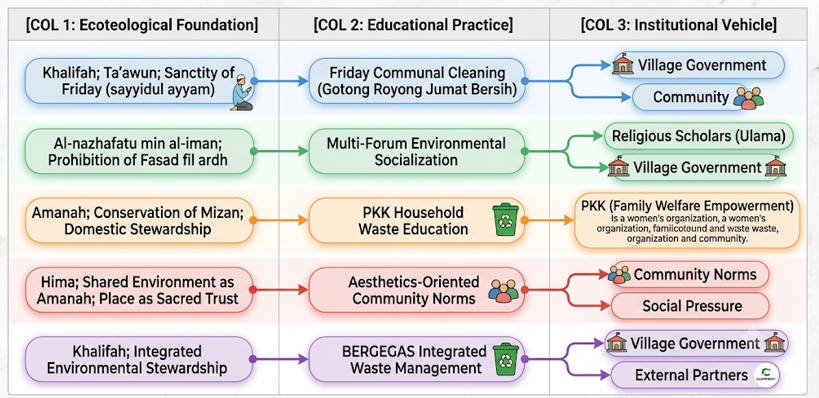
Education for Sustainable Development increasingly recognizes that durable environmental behavior is rooted in intrinsic motivation rather than information provision alone. In Muslim-majority communities, Islamic ecotheology offers a culturally authentic foundation for environmental education, yet empirical research on its operationalization in real community settings remains limited. This qualitative case study investigates how Islamic ecotheological values function as a framework for non-formal and informal environmental education in Ganra Village, South Sulawesi, Indonesia, examining the factors sustaining community-wide environmental learning. Data were collected through purposive semi-structured interviews, participatory observation, and document analysis, then analyzed using the Miles, Huberman, and Saldaña interactive model. Three principal findings emerged: first, environmental awareness is grounded in Islamic faith, framing environmental care as ibadah (worship) through khalifah (vicegerency) and mizan (balance); second, ecotheological values are operationalized through five structured educational channels, including communal rituals and the BERGEGAS waste management program; third, six interdependent factors sustain learning, notably strong leadership, village regulations, and a deep Islamic heritage. The Ganra Village case demonstrates that faith-integrated environmental education, when institutionally scaffolded, produces highly persistent pro-environmental outcomes. This ProKlim-awarded model offers a replicable template for faith-based environmental education globally, advancing scholarship by demonstrating how ecotheology functions as a pedagogically coherent framework.
References
Adams, S., Farrelly, T., & Holland, J. (2020). Non-formal education for sustainable development: A case study of the ‘children in the wilderness’ eco-club programme in the Zambezi region. Journal of Education for Sustainable Development, 14(2), 117-139. https://doi.org/10.1177/0973408220980871
Anwar, S., & bin Ali, M. H. (2025). Islamic Ecotheology, Green Radicalism, and SDGs: Ecological Ideology in the Political Islam Movement in Indonesia. Profetika: Jurnal Studi Islam, 26(02), 667-678. https://doi.org/10.23917/profetika.v26i02.11893
Baldwin, E., Thiel, A., McGinnis, M., & Kellner, E. (2024). Empirical research on polycentric governance: Critical gaps and a framework for studying long‐term change. Policy Studies Journal, 52(2), 319-348. https://doi.org/10.1111/psj.12518
Basri, S., Adnan, Y., Widiastuty, L., Syamsul, M. A., & Indar, I. (2025). Islamic environmental ethics: A cultural framework for sustainable resource management and global ecological stewardship. Diversity: Disease Preventive of Research Integrity, 86-93.
Bensaid, B., & Bensaıd, B. (2023). An overview of Muslim spiritual eco-education. Journal of Dharma, 48(4), 465-494.
Boeve-de Pauw, J., Gericke, N., Olsson, D., & Berglund, T. (2015). The effectiveness of education for sustainable development. Sustainability, 7(11), 15693-15717. https://doi.org/10.3390/su71115693
Cheema, A. M. (2025). Exploring the Islamic Eco-Theology to Address Environmental Crisis: A Pathway to Global Sustainability. Al-Tabyeen. https://journals.uol.edu.pk/al-tabyeen/article/view/4055
Gatto, A. (2022). Polycentric and resilient perspectives for governing the commons: Strategic and law and economics insights for sustainable development. Ambio, 51(9), 1921-1932. https://doi.org/10.1007/s13280-022-01719-x
Gelderblom, D. (2018). The limits to bridging social capital: Power, social context and the theory of Robert Putnam. The Sociological Review, 66(6), 1309-1324. https://doi.org/10.1177/0038026118765360
Gnyawali, B., Sapkota, K., & Paudel, D. (2024). Place-Based Education: A Critical Review. The Geographic Base, 11(01), 84-95. https://nepjol.info/index.php/tgb/article/view/88628
Gulzar, A., Islam, T., Hamid, M., & Haq, S. M. (2021). Environmental ethics towards the sustainable development in Islamic perspective: A Brief Review. Ethnobotany Research and Applications, 22, 1-10. https://ethnobotanyjournal.org/index.php/era/article/view/3231
Hajar, A. (2024). Transforming Islamic education for environmental and social sustainability. Sinergi International Journal of Islamic Studies, 2(2), 82-95. https://doi.org/10.61194/ijis.v2i2.601
Hakim, B. R., Beck, H. L., & Makruf, J. (2026). From Spiritual Crisis to Ecological Ethics: Ecosufism, Religious Authority, and Environmental Governance in Indonesia. Teosofi: Jurnal Tasawuf dan Pemikiran Islam, 16(1), 166-195. https://doi.org/10.15642/teosofi.2026.16.1.114-143
Hamdan, H. (2026). Islamic education with an ecological perspective: Quranic foundations, environmental ethics, and pathways toward sustainable development. Jurnal Pendidikan Islam, 16(1), 91-106. https://doi.org/10.38073/jpi.4545
Hidayat, M. (2023). Islamic Eco-theology: Religious narratives in the climate crisis in Indonesia. Bulletin of Indonesian Islamic Studies, 2(2), 197-212. https://doi.org/10.51214/biis.v2i2.678
Jordan, A., & Huitema, D. (2023). Polycentric governance. In Routledge Handbook of Environmental Policy (pp. 55-67). Routledge. https://doi.org/10.4324/9781003043843-6
Karim, A. (2022). Integration of religious awareness in environmental education. QIJIS (Qudus International Journal of Islamic Studies), 10(2), 415-442. http://dx.doi.org/10.21043/qijis.v10i2.14404
Kopnina, H. (2014). Revisiting education for sustainable development (ESD): Examining anthropocentric bias through the transition of environmental education to ESD. Sustainable development, 22(2), 73-83. https://doi.org/10.1080/13504622.2013.802159
Mariyono, D., & Wiyono, D. F. (2026). Transformative islamic education as a resource for religious education in the anthropocene: an eco-social synthesis. British Journal of Religious Education, 1-24. https://doi.org/10.1080/01416200.2026.2691221
Marouli, C. (2021). Sustainability education for the future? Challenges and implications for education and pedagogy in the 21st century. Sustainability, 13(5), 2901. https://doi.org/10.3390/su13052901
Marshall, H. (2025). Integrating sustainability into religious education. Journal of Beliefs & Values, 1-20. https://doi.org/10.1080/13617672.2025.2504983
Meng, L., & Si, W. (2022). Pro-environmental behavior: Examining the role of ecological value cognition, environmental attitude, and place attachment among rural farmers in China. International Journal of Environmental Research and Public Health, 19(24), 17011. https://doi.org/10.3390/ijerph192417011
Mohamed, N. (2014). Islamic education, eco-ethics and community. Studies in Philosophy and Education, 33(3), 315-328. https://doi.org/10.1007/s11217-013-9387-y
Morselli, D., & Kakouris, A. (2022). Teaching entrepreneurship to undergraduates: a Vygotskian perspective. Theorising undergraduate entrepreneurship education: Reflections on the development of the entrepreneurial mindset (pp. 49-68). Cham: Springer International Publishing. https://doi.org/10.1007/978-3-030-87865-8_4
Munawar-Rachman, B., Aminulloh, A., Nopasari, D., & Nisak, K. (2026). Islamic ecotheology in education: Institutional practice and contestation at Ma’had Al-Zaytun. Focus, 7(1), 23-38. https://doi.org/10.26593/8hby5d02
Shiferaw, A., Hebo, M., & Senishaw, G. (2023). The spiritual ecology of sacred landscapes: Evidence from sacred forests of the Sebat Bête Gurage, Central-South Ethiopia. Cogent Social Sciences, 9(1), 2210900. https://doi.org/10.1080/23311886.2023.2210900
Singer-Brodowski, M. (2025). The potential of transformative learning for sustainability transitions: moving beyond formal learning environments. Environment, Development and Sustainability, 27(9), 20621-20639. https://doi.org/10.1007/s10668-022-02444-x
Suárez-Perales, I., Valero-Gil, J., Leyva-de la Hiz, D. I., Rivera-Torres, P., & Garces-Ayerbe, C. (2021). Educating for the future: How higher education in environmental management affects pro-environmental behaviour. Journal of Cleaner Production, 321, 128972. https://doi.org/10.1016/j.jclepro.2021.128972
Stein, S., Andreotti, V., Suša, R., Ahenakew, C., & Čajková, T. (2022). From “education for sustainable development” to “education for the end of the world as we know it”. Educational philosophy and theory, 54(3), 274-287. https://doi.org/10.1080/00131857.2020.1835646
Sterling, S. (2011). Transformative learning and sustainability: Sketching the conceptual ground. Learning and teaching in higher education, 5(11), 17-33.
Sterling, S. (2025). Truly transformative? Why ESD falls short in epochal times. Journal of Education for Sustainable Development, 19(2), 235-247. https://doi.org/10.1177/09734082251336543
Syafaruddin, B. (2025). Ecotheology in the perspective of Islamic education: A conceptual review. ETDC: Indonesian Journal of Research and Educational Review, 4(3), 720-731. https://doi.org/10.51574/ijrer.v4i3.3253
United Nations Educational, Scientific and Cultural Organization (UNESCO). (2020). Education for sustainable development: A roadmap.
Vahlepi, S., Soleh, W., & binti Aliudin, N. S. U. (2025). Green Spirituality in The Qur'an: Integration of Spiritual Values and Environmental Conservation Education. Jurnal Progress: Wahana Kreativitas dan Intelektualitas, 13(1), 91-107.
Wals, A. E. (2012). Shaping the education of tomorrow: 2012 full-length report on the UN decade of education for sustainable development.
Wani, N. H., & Azhar, A. (2024). Islamic environmental ethics: Preserving the sacred balance. International Journal for Multidisciplinary Research (IJFMR), 6(3), 1-8.
Watoni, M. S., & Rasyidi, A. H. (2025). Faith-Based Environmental Stewardship as Informal Education: Lessons from Rural Muslim Communities in Lombok, Indonesia. Journal of Educational Studies, 3(1). https://doi.org/10.58218/jes.v3i1.3357
Yemini, M., Engel, L., & Ben Simon, A. (2025). Place-based education–a systematic review of literature. Educational Review, 77(2), 640-660. https://doi.org/10.1080/00131911.2023.2177260
Zikargae, M. H., Woldearegay, A. G., & Skjerdal, T. (2022). Empowering rural society through non-formal environmental education: An empirical study of environment and forest development community projects in Ethiopia. Heliyon, 8(3). https://doi.org/10.1016/j.heliyon.2022.e09127
Downloads
Published
How to Cite
Issue
Section
License
Copyright (c) 2026 Rudhi Rudhi, Herianti Herianti, Nurdin Nurdin, Nursyamsidar Nursyamsidar, Nurhaliza Nurhaliza, Nia Kartika Putri, Sita Damayantih, Indo Aco, Rahman Rahman, Naufal Fajrul Ihsan, Agung Setia Budi Wahid

This work is licensed under a Creative Commons Attribution-ShareAlike 4.0 International License.