Visual and Auditory Learning Styles in Mathematics Learning in the Digital Era for College Students

https://doi.org/10.51574/ijrer.v5i3.5003
Keywords:
Auditory Learning Style, Digital Age, Higher Education, Mathematics Learning, Visual Learning StyleAbstract
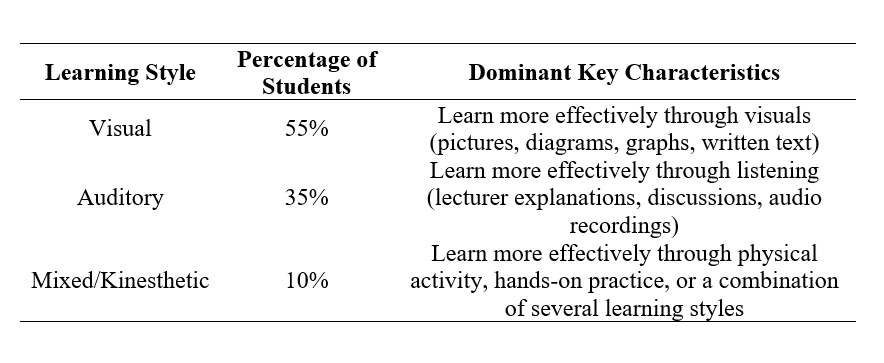
In the digital era, higher education mathematics faces challenges in aligning complex material with diverse student learning styles. The mismatch between traditional teaching methods and students' sensory preferences often hinders the understanding of abstract concepts within dominant digital platforms. This study aims to analyze and describe the tendencies of visual and auditory learning styles among mathematics education students at Muhammadiyah University of Makassar within digital learning contexts. Employing a qualitative descriptive approach, data were gathered through a Visual-Auditory-Kinaesthetic (VAK) questionnaire, observations of digital learning activities, and in-depth interviews. The data analysis process—comprising data reduction, data presentation, and conclusion drawing—mapped how these learning styles influence student interaction with digital media. The results revealed that students' learning styles are dominated by visual (55%) and auditory (35%) tendencies. Visual learners excelled in interacting with dynamic mathematical software simulations and structured instructional videos, while auditory learners processed concepts more effectively through synchronous discussions on video conferencing platforms and educational podcasts to construct procedural logic. Furthermore, the findings indicate a significant behavioral shift toward multimodal adaptability, where students independently leverage technological features to overcome the limitations of unipolar material. Theoretically, this research contributes to developing adaptive mathematics pedagogical strategies in higher education. Practically, these insights recommend the implementation of Differentiated Learning strategies and a Universal Design for Learning (UDL)-based curriculum that integrates interactive visual elements and clear auditory narratives to minimize cognitive barriers, thereby optimizing students' mathematical literacy.
References
Abu Mansor, S. N., & Abu Mansor, K. A. (2025). Understanding learning style: Visual, Auditory, Reading/Writing, and Kinesthetic (VARK) in mathematics learning. The New Frontiers Of E-Learning: Shaping The Future Of Education, 10, 140-146. https://doi.org/10.29333/aje.2019.426a
Alenezi, M., Wardat, S., & Akour, M. (2023). The need of integrating digital education in higher education: Challenges and opportunities. Sustainability, 15(6), 4782. https://doi.org/10.3390/su15064782 DOI: https://doi.org/10.3390/su15064782
Alotaibi, N. S. (2024). The impact of AI and LMS integration on the future of higher education: Opportunities, challenges, and strategies for transformation. Sustainability, 16(23), 10357. https://doi.org/10.3390/su162310357 DOI: https://doi.org/10.3390/su162310357
Awang, L. A., Yusop, F. D., & Danaee, M. (2025). Current practices and future direction of artificial intelligence in mathematics education: A systematic review. International Electronic Journal of Mathematics Education, 20(2), em0823. https://doi.org/10.29333/iejme/16006 DOI: https://doi.org/10.29333/iejme/16006
Bechtold, S. W. (2023). The cognitive theory of multimedia learning: The impact of social cues. Learning, Design, and Technology: An International Compendium of Theory, Research, Practice, and Policy (pp. 561-574). Cham: Springer International Publishing. https://doi.org/10.1007/978-3-319-17461-7_60 DOI: https://doi.org/10.1007/978-3-319-17461-7_60
Behrendt, S., Altenmüller, T., May, M. C., Kuhnle, A., & Lanza, G. (2026). Real-to-sim: Automatic simulation model generation for a digital twin in semiconductor manufacturing. Journal of Intelligent Manufacturing, 37(2), 829-848. https://doi.org/10.1007/s10845-025-02572-x DOI: https://doi.org/10.1007/s10845-025-02572-x
Burns, M. K., McCollom, E., & Kanive, R. (2020). Theories of reading, writing, and mathematics. In Theories of School Psychology (pp. 226-253). Routledge. DOI: https://doi.org/10.4324/9781351064941-10
Cirneanu, A. L., & Moldoveanu, C. E. (2024). Use of digital technology in integrated mathematics education. Applied System Innovation, 7(4), 66. https://doi.org/10.3390/asi7040066 DOI: https://doi.org/10.3390/asi7040066
Costa, R. D., Souza, G. F., Valentim, R. A., & Castro, T. B. (2020). The theory of learning styles applied to distance learning. Cognitive Systems Research, 64, 134-145. https://doi.org/10.1016/j.cogsys.2020.08.004 DOI: https://doi.org/10.1016/j.cogsys.2020.08.004
Fokuo, M. O., Opuku-Mensah, N., Asamoah, R., Nyarko, J., Agyeman, K. D., Owusu-Mintah, C., & Asare, S. (2023). The use of visualization tools in teaching mathematics in college of education: A systematic review. Online Journal of Mathematics, Science and Technology Education, 4(1). https://www.ojomste.com/index.php/1/article/view/24
Gangadharan, S., Al Mezeini, K., Gnanamuthu, S. S., & Al Marshoudi, K. A. (2025). The relationship between preferred learning styles and academic achievement of undergraduate health sciences students compared to other disciplines at a Middle Eastern university utilizing the VARK instrument. Advances in Medical Education and Practice, 13-28. https://doi.org/10.2147/AMEP.S491487 DOI: https://doi.org/10.2147/AMEP.S491487
Gkintoni, E., Antonopoulou, H., Sortwell, A., & Halkiopoulos, C. (2025). Challenging cognitive load theory: The role of educational neuroscience and artificial intelligence in redefining learning efficacy. Brain sciences, 15(2), 203. https://doi.org/10.3390/brainsci15020203 DOI: https://doi.org/10.3390/brainsci15020203
Harefa, I. N., Telaumbanua, Y. N., Mendrofa, R. N., & Mendrofa, N. K. (2026). Impact of the Auditory, Intellectually, and Repetition (AIR) Learning Model on Students’ Mathematical Critical Thinking. Kognitif: Jurnal Riset HOTS Pendidikan Matematika, 6(1), 72-83. https://doi.org/10.51574/kognitif.v6i1.3818 DOI: https://doi.org/10.51574/kognitif.v6i1.3818
Hattie, J., & O’Leary, T. (2025). Learning styles, preferences, or strategies? An explanation for the resurgence of styles across many meta-analyses. Educational Psychology Review, 37(2), 31. https://doi.org/10.1007/s10648-025-10002-w DOI: https://doi.org/10.1007/s10648-025-10002-w
Kanchon, M. K. H., Sadman, M., Nabila, K. F., Tarannum, R., & Khan, R. (2024). Enhancing personalized learning: AI-driven identification of learning styles and content modification strategies. International Journal of Cognitive Computing in Engineering, 5, 269-278. https://doi.org/10.1016/j.ijcce.2024.06.002 DOI: https://doi.org/10.1016/j.ijcce.2024.06.002
Kus, M., & Newcombe, N. S. (2025). Facilitation of students’ disembedding in an online visual arts and mathematics education program. International Journal of STEM Education, 12(1), 8. https://doi.org/10.1186/s40594-024-00524-0 DOI: https://doi.org/10.1186/s40594-024-00524-0
Lowrie, T., & Diezmann, C. M. (2007). Solving graphics problems: Student performance in junior grades. The Journal of Educational Research, 100(6), 369-378. https://doi.org/10.3200/JOER.100.6.369-378 DOI: https://doi.org/10.3200/JOER.100.6.369-378
Mayer, R. E. (2024). The past, present, and future of the cognitive theory of multimedia learning. Educational Psychology Review, 36(1), 8. https://doi.org/10.1007/s10648-023-09842-1 DOI: https://doi.org/10.1007/s10648-023-09842-1
Montejo, D. C., Buscay, C. R., & Nasayao, R. A. (2026). Technology-Integrated Problem-Based Learning in Mathematics Education: A Scoping Review of Technological Trajectories, Pedagogy, Learning, and Challenges. Davao Research Journal, 17(1), 30-43. https://doi.org/10.59120/drj.v17i1.490 DOI: https://doi.org/10.59120/drj.v17i1.490
Nurmalisa, Y., Sunyono, S., & Yulianti, D. (2023). An integrative review: Application of digital learning media to developing learning styles preference. International Journal of Information and Education Technology, 13(1), 187-194. DOI: https://doi.org/10.18178/ijiet.2023.13.1.1795
Paivio, A. (2014). Intelligence, dual coding theory, and the brain. Intelligence, 47, 141-158. https://doi.org/10.1016/j.intell.2014.09.002 DOI: https://doi.org/10.1016/j.intell.2014.09.002
Prasanna, A. R. (2022). Mathematics, the Common Base for Science. How to Learn and Practice Science (pp. 59-71). Cham: Springer International Publishing. https://doi.org/10.1007/978-3-031-14514-8_5 DOI: https://doi.org/10.1007/978-3-031-14514-8_5
Puspitarini, Y. D., & Hanif, M. (2019). Using learning media to increase learning motivation in elementary school. Anatolian Journal of Education, 4(2), 53-60. https://doi.org/10.29333/aje.2019.426a DOI: https://doi.org/10.29333/aje.2019.426a
Rahawarin, J. A., Ritiauw, S. P., & Ritiauw, L. (2026). STAD Learning Model and Learning Styles: Learning Outcomes of Fifth-Grade Students at Primary School. ETDC: Indonesian Journal of Research and Educational Review, 5(2), 1342-1355. https://doi.org/10.51574/ijrer.v5i2.4595 DOI: https://doi.org/10.51574/ijrer.v5i2.4595
Schoenfeld, A. H. (2022). Why are learning and teaching mathematics so difficult?. Handbook of cognitive mathematics (pp. 1-35). Cham: Springer International Publishing. https://doi.org/10.1007/978-3-030-44982-7_10-1 DOI: https://doi.org/10.1007/978-3-030-44982-7_10-1
Selwyn, N. (2016). Digital downsides: Exploring university students’ negative engagements with digital technology. Teaching in Higher Education, 21(8), 1006-1021. https://doi.org/10.1080/13562517.2016.1213229 DOI: https://doi.org/10.1080/13562517.2016.1213229
Skulmowski, A., & Xu, K. M. (2022). Understanding cognitive load in digital and online learning: A new perspective on extraneous cognitive load. Educational psychology review, 34(1), 171-196. https://doi.org/10.1007/s10648-021-09624-7 DOI: https://doi.org/10.1007/s10648-021-09624-7
Sweller, J. (2023). Cognitive load theory: What we learn and how we learn. In Learning, design, and technology: An international compendium of theory, research, practice, and policy (pp. 137-152). Cham: Springer International Publishing. https://doi.org/10.1007/978-3-319-17461-7_50 DOI: https://doi.org/10.1007/978-3-319-17461-7_50
Syahri, A. A. (2025). Commognitive and Learning Styles Study of Students' Middle School Understanding of Circles. ETDC: Indonesian Journal of Research and Educational Review, 4(2), 285-297. https://doi.org/10.51574/ijrer.v4i2.2929 DOI: https://doi.org/10.51574/ijrer.v4i2.2929
Szulewski, A., van Gog, T., Paas, F., & Sweller, J. (2022). Cognitive load theory: researching and planning teaching to maximise learning. Researching medical education, 303-314. https://doi.org/10.1002/9781119839446.ch27 DOI: https://doi.org/10.1002/9781119839446.ch27
Thianthai, C., & Tamdee, P. (2022). How ‘digital natives’ learn: Qualitative insights into modern learning styles and recommendations for adaptation of curriculum/teaching development. Journal of Community Development Research (Humanities and Social Sciences), 15(3), 85-93. https://doi.org/10.14456/jcdr-hs.2022.27
Viktor, B., Valeriy, O., & Iryna, T. (2019). Conformity of higher Education with requirements of" digital natives". Вісник Киiвського нацiонального унiверситету iм. Тараса Шевченка. Серiя: Економiка, (1 (202)), 6-13. https://cyberleninka.ru/article/n/conformity-of-higher-education-with-requirements-of-digital-natives DOI: https://doi.org/10.17721/1728-2667.2019/202-1/1
Weigand, H. G., Trgalova, J., & Tabach, M. (2024). Mathematics teaching, learning, and assessment in the digital age. ZDM–Mathematics Education, 56(4), 525-541. https://doi.org/10.1007/s11858-024-01612-9 DOI: https://doi.org/10.1007/s11858-024-01612-9
Xiang, M., Zhang, L., Liu, Y., Wang, X., & Shang, J. (2025). Acquisition of math knowledge in digital and non-digital game-based learning classrooms: Impact of intrinsic motivation and cognitive load. Entertainment Computing, 52, 100869. https://doi.org/10.1016/j.entcom.2024.100869 DOI: https://doi.org/10.1016/j.entcom.2024.100869
Downloads
Published
How to Cite
Issue
Section
License
Copyright (c) 2026 Takdirmin Takdirmin, Agussalim Juhari

This work is licensed under a Creative Commons Attribution-ShareAlike 4.0 International License.