Cognitive Styles and Learning Strategies on Smart Learning Environment Effectiveness in Secondary School Mathematics Achievement

https://doi.org/10.51574/ijrer.v5i2.4626
Keywords:
Cognitive Styles, Learning Strategies, Mathematics Achievement, Secondary School Education, Smart Learning EnvironmentAbstract
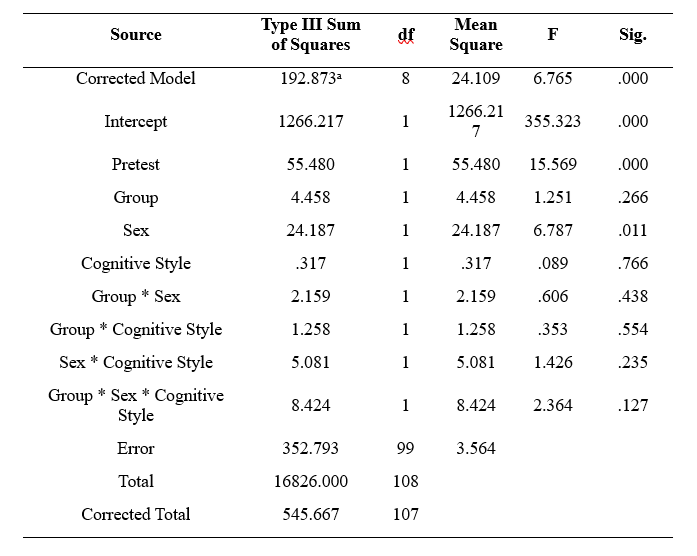
The study investigated the influence of cognitive styles on the effect of locally developed smart learning environment on students' academic achievement in Mathematics in public secondary schools in Osun State, Nigeria. It also investigated the influence of students' learning style preference on the effect of the smart learning environment on students' academic achievement in the subject. The study adopted the pretest posttest control group quasi experimental design. The population of the study comprised all senior secondary school students in Osun State, Nigeria. One hundred and fifty SS II students were selected using a multistage sampling procedure. Mathematics Achievement Test (MAT), Cognitive Style Inventory (CSI), and Learning Style Inventory (LSI) were used for data gathering. Analysis of data showed no significant difference (F (1,107) = 0.06; p = 0.81) in the influence of cognitive styles on the effect of the smart learning environment. The results showed a significant difference in the influence of learning strategies on the effect of the smart learning environment on students' academic achievement in Mathematics (F (2,143) = 4.933; p = 0.008). The study concluded that a well-designed smart learning environment can enhance students' academic achievement in Mathematics irrespective of their cognitive styles, preferred learning style and sex.
References
Abdiraxmonov, A. A. O. G. L. (2024). Mathematical Statistics and Models in digital banking and finance. Oriental renaissance: Innovative, educational, natural and social sciences, 4(6), 295-300.
Agah, M. P., Ibrahim, A. A., & Shuaibu, H. (2024). Effect of activity-based instructional strategy on senior secondary school students’ academic achievement in Mathematics in Numan Education Zone, Adamawa State, Nigeria. BW Academic Journal. https://mail.bwjournal.org/index.php/bsjournal/article/view/2292
Aisyah, N., Degeng, I. N. S., Sumarmi, S., & Toenlioe, T. (2024). The Effect of Hypermedia-Assisted Learning Organizing Strategies and Cognitive Styles on Student Learning Outcomes. Al-Tanzim: Jurnal Manajemen Pendidikan Islam, 8(2), 664-674. https://doi.org/10.33650/al-tanzim.v8i2.8168
Cheung, S. K., Kwok, L. F., Phusavat, K., & Yang, H. H. (2021). Shaping the future learning environments with smart elements: challenges and opportunities. International Journal of Educational Technology in Higher Education, 18(1), 16. https://doi.org/10.1186/s41239-021-00254-1
Daniela, L. (2021). Smart pedagogy as a driving wheel for technology-enhanced learning. Technology, Knowledge and Learning, 26(4), 711-718. https://doi.org/10.1007/s10758-021-09536-z
Debasu, H., & Yitayew, A. (2024). Examining elements of designing and managing of creating inclusive learning environment: Systematic literature review. International Journal of Special Education, 39(1), 33-43. https://doi.org/10.52291/ijse.2024.39.4
Dhouib, A., Fadi Hijab, M. H., Chemnad, K., Al-Thani, D., & Othman, A. (2025). Advancing inclusive smart learning environments: a systematic review of technologies, challenges, and best practices for students with disabilities. Smart Learning Environments, 12(1), 70. https://doi.org/10.1186/s40561-025-00416-y
Dolenc, K., & Aberšek, B. (2015). TECH8 intelligent and adaptive e-learning system: Integration into Technology and Science classrooms in lower secondary schools. Computers & Education, 82, 354-365. https://doi.org/10.1016/j.compedu.2014.12.010
Egara, F. O., & Mosimege, M. (2024). Effect of flipped classroom learning approach on mathematics achievement and interest among secondary school students. Education and Information Technologies, 29(7), 8131-8150. https://doi.org/10.1007/s10639-023-12145-1
García-Tudela, P. A., Prendes-Espinosa, P., & Solano-Fernández, I. M. (2021). Smart learning environments: a basic research towards the definition of a practical model. Smart Learning Environments, 8(1), 9. https://doi.org/10.1186/s40561-021-00155-w
Goyibova, N., Muslimov, N., Sabirova, G., Kadirova, N., & Samatova, B. (2025). Differentiation approach in education: Tailoring instruction for diverse learner needs. MethodsX, 14, 103163. https://doi.org/10.1016/j.mex.2025.103163
Hakkal, S., & Lahcen, A. A. (2025). Addressing the Learning Gap with Adaptive Learning. In Artificial Intelligence and Data Analytics for Innovative Applications in Engineering, Sustainability and Technology (pp. 135-148). Cham: Springer Nature Switzerland. https://doi.org/10.1007/978-3-031-90318-2_15
Halirat, K., Khusnaini, M., Mautang, H. G., Purba, C., & Budiana, M. E. (2025). Study of the Effects of Visual, Auditory and Kinesthetic Learning Styles on Memory of Learning Materials. Gateway for Understanding Research in Education, 1(2), 20-29. https://doi.org/10.69855/guru.v1i2.340
Hardiansyah, F., Armadi, A., AR, M. M., & Wardi, M. (2024). Analysis of field dependent and field independent cognitive styles in solving science problems in elementary schools. Jurnal Penelitian Pendidikan IPA, 10(3), 1159-1166. https://doi.org/10.29303/jppipa.v10i3.5661
Hidajat, D., Hasbi, M., & Fitri, F. (2024). Metacognitive Skills of College Students in Mathematics Problem Solving: Overview by Student's Field Dependent. ETDC: Indonesian Journal of Research and Educational Review, 3(2), 196-206. https://doi.org/10.51574/ijrer.v3i2.1393
Kant, S., & Adula, M. (2025). Sustainable Curriculum Design Effect on Smart Education Development Through Sustainable Learning Environment in Ethiopia. In Smart Education and Sustainable Learning Environments in Smart Cities (pp. 509-532). IGI Global Scientific Publishing. https://doi.org/10.4018/979-8-3693-7723-9.ch029
Kinshuk, Chen, N. S., Cheng, I. L., & Chew, S. W. (2016). Evolution is not enough: Revolutionizing current learning environments to smart learning environments. International Journal of Artificial Intelligence in Education, 26(2), 561-581. https://doi.org/10.1007/s40593-016-0108-x
Lugosi, E., & Uribe, G. (2022). Active learning strategies with positive effects on students’ achievements in undergraduate mathematics education. International Journal of mathematical education in science and technology, 53(2), 403-424. https://doi.org/10.1080/0020739X.2020.1773555
Mamolo, A., Tepylo, D., Ruttenberg-Rozen, R., & Rodney, S. (2022). Learning math through coding and learning coding through math: Two sides of the same coin. Canadian Journal of Science, Mathematics and Technology Education, 22(4), 974-985. https://doi.org/10.1007/s42330-022-00254-x
Muzaini, M., Hasbi, M., & Nasrun, N. (2021). The role of students’ quantitative reasoning in solving mathematical problems based on cognitive style. Vygotsky: Jurnal Pendidikan Matematika dan Matematika, 3(2), 87-98. https://doi.org/10.30736/voj.v3i2.380
Na, J., Grossmann, I., Varnum, M. E., Karasawa, M., Cho, Y., Kitayama, S., & Nisbett, R. E. (2020). Culture and personality revisited: Behavioral profiles and within‐person stability in interdependent (vs. independent) social orientation and holistic (vs. analytic) cognitive style. Journal of Personality, 88(5), 908-924. https://doi.org/10.1111/jopy.12536
Nwachukwu, E. L., Egbue, N. G., & Victor-Nwakaku, I. (2025). Adaptive Learning Systems: Bridging Instructional Technology and Personalized Pedagogy through Design Thinking. Journal of Digital Learning and Distance Education, 4(5), 1689-1703. https://doi.org/10.56778/jdlde.v4i5.588
Obienyem, B. I., & Ugwuanyi, C. C. (2024). Use of flipped classroom instructional approach in teaching and learning of mathematics in secondary schools: Challenges and prospects. Afr. J. Sci. Technol. Math. Educ, 10, 204-210.
Omolafe, E., Okikiayo, A., & Veronica, E. (2024). Effect of Activity-Based Teaching Strategy on Students’ Academic Performance in Mathematics Concept. International Journal of Instructional Technology and Educational Studies, 5(3), 11-21. https://journals.ekb.eg/article_405714.html
Omoniyi, A. A., Jita, L. C., & Jita, T. (2025). Students’ feedback on the implementation of flipped classrooms for senior secondary mathematics instruction. https://doi.org/10.20944/preprints202503.2416.v1
Oteyola, T. A., Oyeniran, O. Afolabi, O. A. & Ireh, S. (2022) Influence of School Location on Teachers’ Acceptance of Whatsapp/Telegram for Online Instruction International Journal of Research in Education and Psychology 8(1) 14 – 33
Oteyola, T., Akintitan, O. & Oyeniran, O. (2023) Application of Locally Developed Smart Learning Environments in the Teaching of Mathematics in Public Secondary Schools in Osun State, Nigeria International Journal of Education and Development using Information and Communication Technology 19 (3) 227 – 235. https://eric.ed.gov/?id=EJ1413409
Pan, R., Zhang, L., & Yang, J. (2022). A systematic review of smart learning environments. In International Conference on Smart Learning Environments (pp. 11-20). Springer, Singapore. https://doi.org/10.1007/978-981-19-5967-7_3
Peng, H., Ma, S., & Spector, J. M. (2019). Personalized adaptive learning: an emerging pedagogical approach enabled by a smart learning environment. Smart learning environments, 6(1), 1-14. https://doi.org/10.1186/s40561-019-0089-y
Pepin, B., Biehler, R., & Gueudet, G. (2021). Mathematics in engineering education: A review of the recent literature with a view towards innovative practices. International Journal of Research in Undergraduate Mathematics Education, 7(2), 163-188. https://doi.org/10.1007/s40753-021-00139-8
Rakhmonov, I. Y. (2025). The role of mathematics in developing intuitive competence among cadets. Web of Teachers: Inderscience Research, 3(5), 320-324.
Sayed, A. R., Khafagy, M. H., Ali, M., & Mohamed, M. H. (2025). Exploring the VAK model to predict student learning styles based on learning activity. Intelligent Systems with Applications, 25, 200483. https://doi.org/10.1016/j.iswa.2025.200483
Selvakumar, P., Hemalatha, C., Indumathy, I., Gandhimathi, S., & Mujra, P. (2025). Smart education and sustainable learning environments. In Smart Education and Sustainable Learning Environments in Smart Cities (pp. 381-402). IGI Global Scientific Publishing. https://doi.org/10.4018/979-8-3693-7723-9.ch023
Singh, A. (2022). Conceptual framework on Smart Learning Environment for the present and new century-An Indian perspective. Revista de educación y derecho= Education and law review, (25), 2.
Zhou, X., Li, X., Wu, W., Zhang, X., English, A. S., & Peng, K. (2023). Fear during pandemic promoted holistic cognitive style: The moderating role of uncertainty. Emotion, 23(7), 1918. https://doi.org/10.3390/ijerph19031540
Downloads
Published
How to Cite
Issue
Section
License
Copyright (c) 2026 Temitope Oteyola, Kehinde Oluyemisi Akintitan

This work is licensed under a Creative Commons Attribution-ShareAlike 4.0 International License.