Quality of Sociology Learning Through Reflection-Embedded STAD Cooperative Learning: An Indonesian Senior High School

https://doi.org/10.51574/ijrer.v5i4.4869
Keywords:
Classroom Action Research, Cooperative Learning, Cooperative Reflection, Sociology Education, STADAbstract
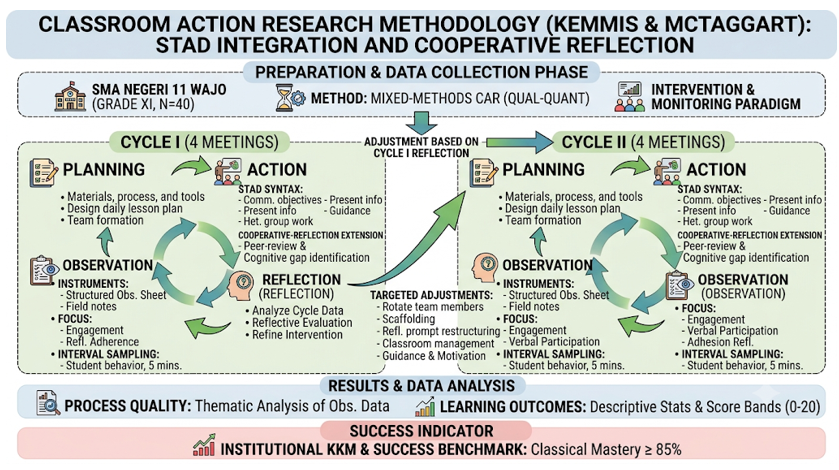
Sociology education in secondary schools is expected to develop critical thinking and sociological reasoning, yet instruction often remains teacher-centred and weakly participatory, limiting both the quality of the learning process and the depth of conceptual understanding. This study examined whether embedding a structured cooperative-reflection phase within the Student Teams–Achievement Divisions (STAD) model could improve the process and outcome quality of sociology learning. Using a two-cycle classroom action research design based on the Kemmis and McTaggart model, the intervention was implemented with 40 Grade XI students at a public senior high school in Wajo, Indonesia. Process quality was monitored through structured observation of individual and group engagement, and learning outcomes were assessed through validated end-of-cycle tests; data were analysed using qualitative thematic coding and descriptive statistics, with classical mastery set at 85% as the success criterion. Classical mastery rose from 92.5% in Cycle I to 100% in Cycle II, and the proportion of students reaching the highest achievement band increased from 85% to 97.5%. More notably, observed engagement indicators—question-asking, volunteering, and contributing to peer groups—were initially low in Cycle I and improved after reflection-informed adjustments such as group rotation and stronger scaffolding in Cycle II. The findings suggest that the gains were driven less by raising bare pass rates, which were already high, than by deepening engagement and consolidating understanding through structured reflection. The study contributes a transferable, reflection-embedded variant of STAD for sociology teaching while acknowledging the limits of single-class action research.
References
Afiah, A., Ramadhan, I., & Zatalini, A. (2025). Enhancing student engagement and cognitive skills in sociology: A qualitative study of quizizz true/false mode in an Indonesian high school. Asatiza: Jurnal Pendidikan, 6(2), 208-222. https://doi.org/10.46963/asatiza.v6i2.2422
Ananda, N. R. (2022). the Effectiveness of Lms Assisted Stad Learning Model on Social Studies Learning Outcomes for Elementary School: Literature Review. EduHumaniora| Jurnal Pendidikan Dasar Kampus Cibiru, 14(1), 59-74.
Arifin, K. (2022). Cooperative learning on the academic achievement of middle-school students based on learning style. ETDC: Indonesian Journal of Research and Educational Review, 1(2), 112-121. https://doi.org/10.51574/ijrer.v1i2.175
Arnudia, R., & Wita, G. (2025). Pengaruh Model Pembelajaran Kooperatif Tipe STAD Berbantuan Zep Quiz terhadap Hasil Belajar Sosiologi. Naradidik: Journal of Education and Pedagogy, 4(4), 591-602. https://doi.org/10.24036/nara.v4i4.412
Cañabate, D., Bubnys, R., Nogué, L., Martínez-Mínguez, L., Nieva, C., & Colomer, J. (2021). Cooperative learning to reduce inequalities: instructional approaches and dimensions. Sustainability, 13(18), 10234. https://doi.org/10.3390/su131810234
Damanik, F. H. S., & Muhammad, G. (2025). Sociology of education analysis on the deep learning approach to teaching. Journal of Sumatera Sociological Indicators, 4(1), 348-357. https://doi.org/10.32734/jssi.v4i1.20020
Gillies, R. M. (2016). Cooperative learning: Review of research and practice. Australian Journal of Teacher Education (Online), 41(3), 39-54. https://doi.org/10.14221/ajte.2016v41n3.3
Iraola, E. A., Romero, G. R., & Millera, M. J. (2024). Dialogue among educators: Rethinking and recreating scenarios of cooperative and inclusive learning. International Journal of Educational Research Open, 6, 100322. https://doi.org/10.1016/j.ijedro.2024.100322
Karmina, S., Dyson, B., Watson, P. W. S. J., & Philpot, R. (2021). Teacher implementation of cooperative learning in Indonesia: A multiple case study. Education Sciences, 11(05), 218. https://doi.org/10.3390/educsci11050218
Kartika, R., Putri, A., Wita, G., & Purnomo, S. (2025). 21st Century Sociology Learning: Integrating Digital Literacy, Collaboration, and Critical Thinking. Juwara Jurnal Wawasan dan Aksara, 5(1), 174-183.
Kyndt, E., Raes, E., Lismont, B., Timmers, F., Cascallar, E., & Dochy, F. (2013). A meta-analysis of the effects of face-to-face cooperative learning. Do recent studies falsify or verify earlier findings?. Educational research review, 10, 133-149. https://doi.org/10.1016/j.edurev.2013.05.001
Mandouit, L., & Hattie, J. (2023). Revisiting “The Power of Feedback” from the perspective of the learner. Learning and Instruction, 84, 101718. https://doi.org/10.1016/j.learninstruc.2022.101718
McTighe, J., & O'Connor, K. (2005). Seven practices for effective learning. Assessment, 63(3), 10-17.
Motwani, R., Kaliappan, A., & Chandrupatla, M. (2022). Student Team Achievement Division as a tool for peer assisted co-operative learning in neuroanatomy. Anatomy & cell biology, 55(4), 452-458. https://doi.org/10.5115/acb.22.122
Nicol, D. J., & Macfarlane‐Dick, D. (2006). Formative assessment and self‐regulated learning: A model and seven principles of good feedback practice. Studies in higher education, 31(2), 199-218. https://doi.org/10.1080/03075070600572090
Normaningsih, Y. (2022). Differences In Class Xi Students'learning Results In Sociology Subjects Using The Word Square Learning Model With The Lecture Learning Model SMA Negeri 4 Jember. Journal of Education Technology and Inovation, 5(1), 120-125. https://jurnal.unipar.ac.id/index.php/jeti/article/view/962
Sharan, Y. (2010). Cooperative learning: A diversified pedagogy for diverse classrooms. Intercultural education, 21(3), 195-203. https://doi.org/10.1080/14675981003760390
Odutayo, A. O., & Fonseca, K. (2024). Making quadratic functions interesting: Students teams-achievement division instructional strategy. Eurasia Journal of Mathematics, Science and Technology Education, 20(1), em2386. https://doi.org/10.29333/ejmste/14092
Purcell, D. (2013). Sociology, teaching, and reflective practice: Using writing to improve. Teaching Sociology, 41(1), 5-19. 10.1177/0092055x12460028
Rahawarin, J. A., Ritiauw, S. P., & Ritiauw, L. (2026). STAD Learning Model and Learning Styles: Learning Outcomes of Fifth-Grade Students at Primary School. ETDC: Indonesian Journal of Research and Educational Review, 5(2), 1342-1355. https://doi.org/10.51574/ijrer.v5i2.4595
Rahman, A. (2025). The Effect of the Implementation of the Cooperative Learning Model Type Student Teams Achievement Division (STAD) on Creativity, Initiative, Motivation and Student Learning Outcomes. Jurnal Iqra': Kajian Ilmu Pendidikan, 10(1), 54-74. https://doi.org/10.25217/ji.v10i1.5026
Ramadanti, D., Widiansyah, S., & Hardianysah, M. A. (2023). Pengaruh Penerapan Model Pembelajaran Kooperatif Tipe STAD terhadap Hasil Belajar Siswa pada Mata Pelajaran Sosiologi Kelas X di SMA Negeri 1 Anyar. Jurnal IKA PGSD (Ikatan Alumni PGSD) UNARS, 13(1), 362-369. https://doi.org/10.36841/pgsdunars.v13i1.3536
Rudolf, R., & Lee, J. (2023). School climate, academic performance, and adolescent well-being in Korea: The roles of competition and cooperation. Child Indicators Research, 16(3), 917-940. https://doi.org/10.1007/s12187-022-10005-x
Shafiee Rad, H., Namaziandost, E., & Razmi, M. H. (2023). Integrating STAD and flipped learning in expository writing skills: Impacts on students’ achievement and perceptions. Journal of Research on Technology in Education, 55(4), 710-726. https://doi.org/10.1080/15391523.2022.2030265
Shimizu, I., Kimura, T., Duvivier, R., & van der Vleuten, C. (2022). Modeling the effect of social interdependence in interprofessional collaborative learning. Journal of Interprofessional Care, 36(6), 820-827. https://doi.org/10.1080/13561820.2021.2014428
Solis Trujillo, B. P., Velarde-Camaqui, D., Gonzales Nuñez, C. A., Castillo Silva, E. V., & Gonzalez Said de la Oliva, M. D. P. (2025). The current landscape of formative assessment and feedback in graduate studies: A systematic literature review. Frontiers in Education (Vol. 10, p. 1509983). Frontiers Media SA. https://doi.org/10.3389/feduc.2025.1509983
Tetiwar, V. R., Rumtutuly, F., & Ratumanan, S. D. (2026). Student Teams Achievement Division Learning Model: Learning Outcomes of Pancasila Education at Primary School. ETDC: Indonesian Journal of Research and Educational Review, 5(3), 1504-1518. https://doi.org/10.51574/ijrer.v5i3.4754
Tran, V. D. (2014). The effects of cooperative learning on the academic achievement and knowledge retention. International journal of higher education, 3(2), 131-140. https://doi.org/10.5430/ijhe.v3n2p131
Trinidad, J. E. (2024). An organizational sociology of education: Using structural, network, and ecological perspectives to study schools. Sociological Inquiry, 94(4), 968-993. https://doi.org/10.1111/soin.12583
Upa, A. T., Sahabuddin, S., Mappaompo, M. A., Suwardi, S., & Hudain, M. A. (2025). Learning Outcomes in Dribbling the Ball Through the STAD Learning Model: Elementary School Students' Football Game Material. ETDC: Indonesian Journal of Research and Educational Review, 4(4), 1415-1425. https://doi.org/10.51574/ijrer.v4i4.3604
Wattanasap, S. (2025). Social Interdependence: Supportive Relationships in Human Coexistence and Enhancement of Human Skills for Social and Economic Sustainability. Journal of Applied Humanities Studies, 3(2), 72-93. https://doi.org/10.65680/jahs.v3i2.7830
Welsh, S. (2024). Reflections on first sociology learnings: the phenomenology of sociology. Reflective Practice, 25(1), 1-10. https://doi.org/10.1080/14623943.2022.2148241
Zhou, T., & Colomer, J. (2024). Cooperative learning promoting cultural diversity and individual accountability: A systematic review. Education Sciences, 14(6), 567. https://doi.org/10.3390/educsci14060567
Downloads
Published
How to Cite
Issue
Section
License
Copyright (c) 2026 Sadri Sadri

This work is licensed under a Creative Commons Attribution-ShareAlike 4.0 International License.