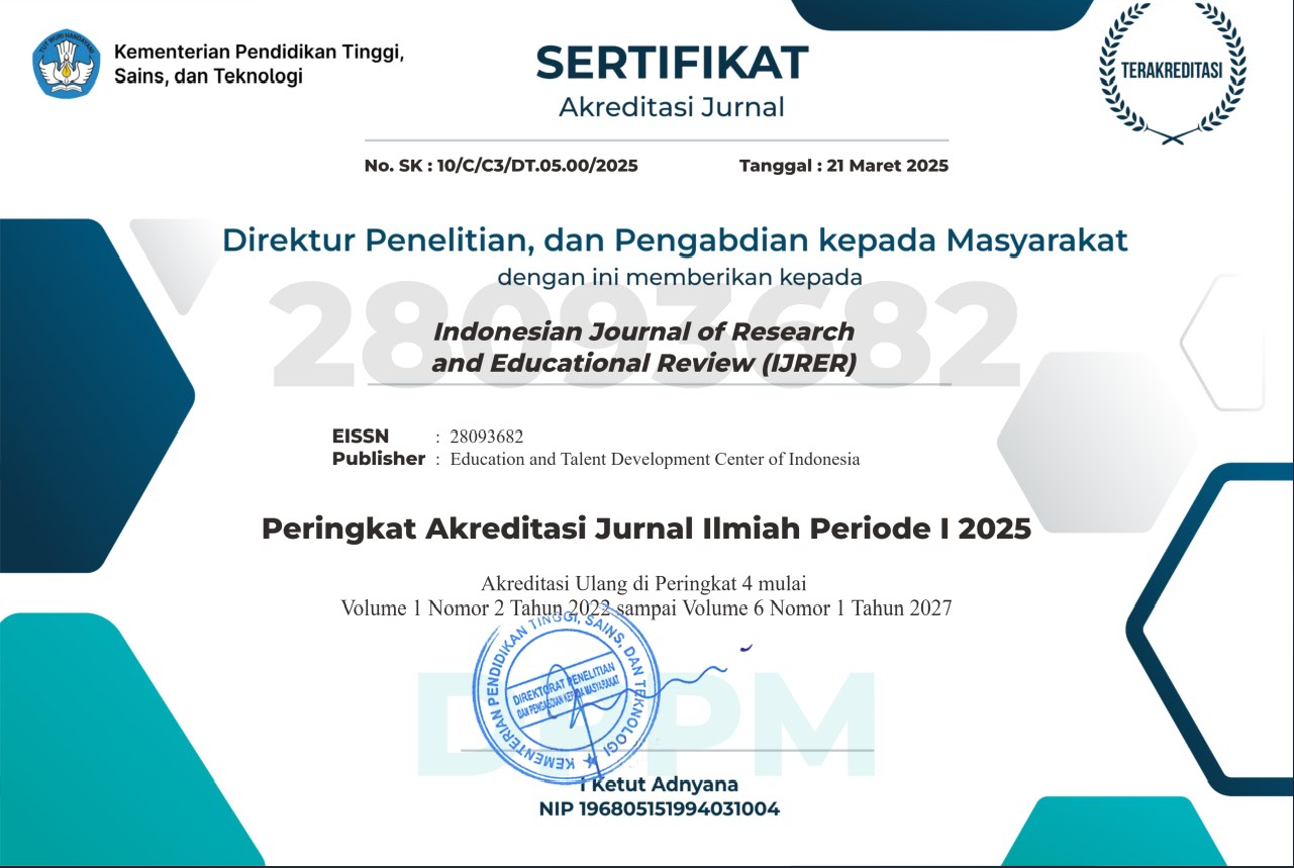
ACREDITATION
AI has rapidly changed English Language Teaching (ELT), notably writing skills. AI has enormous potential, but educators and academics still struggle with its ethical use, over-reliance, and integration into an organized curriculum. This project will thoroughly review AI integration in English writing skills learning. It examines the most used AI technologies, their efficacy in improving writing, and their pedagogical implications. A Systematic Literature Review (SLR) was conducted following the PRISMA (Preferred Reporting Items for Systematic Reviews and Meta-Analyses) guidelines. Data were synthesized from peer-reviewed articles published between 2023 and 2026 across major databases, including Scopus, Web of Science, and Google Scholar. A total of [35] pertinent studies were chosen according to stringent inclusion and exclusion criteria. The findings indicate that AI tools, including Automated Writing Evaluation (AWE) systems, Large Language Models (LLMs) such as ChatGPT, and intelligent grammar checkers (e.g., Grammarly), significantly enhance writing accuracy, coherence, and student motivation by delivering prompt, individualized feedback. However, the review also identifies critical issues, including concerns over academic integrity, potential algorithmic bias, and a "dependency trap" where students may prioritize AI output over the development of their voice. This paper presents a complete framework for educators and policymakers to responsibly integrate AI into writing teaching. The area benefits from perceiving AI as a "collaborative partner" in the writing process rather than a "correction tool" and recognizing the importance of digital literacy and ethical principles in modern English classrooms.
Rahman, W. Z. (2026). Artificial Intelligence (AI) in English Writing Skills Learning: A Systematic Review. ETDC: Indonesian Journal of Research and Educational Review , 5(2), 981–994. https://doi.org/10.51574/ijrer.v5i2.4727
Downloads
Download data is not yet available.
- Adhikari, B., Das, P., & Chakraborty, B. (2025). Comparative Analysis of Different Generative AI Models For Scholarly Articles. International Conference on Data Management, Analytics & Innovation (pp. 1-18). Singapore: Springer Nature Singapore. https://doi.org/10.1007/978-981-96-6534-1_1
- Cai, L., Msafiri, M. M., & Kangwa, D. (2025). Exploring the impact of integrating AI tools in higher education using the Zone of Proximal Development. Education and Information Technologies, 30(6), 7191-7264. https://doi.org/10.1007/s10639-024-13112-0
- Chelghoum, H., & Chelghoum, A. (2025). Artificial Intelligence in education: Opportunities, challenges, and ethical concerns. Journal of Studies in Language, Culture and Society (JSLCS), 8(1), 1-14. https://asjp.cerist.dz/en/article/266929
- Colby, R. S. (2025). Playing the digital dialectic game: Writing pedagogy with generative AI. Computers and Composition, 75, 102915. https://doi.org/10.1016/j.compcom.2025.102915
- Creswell, J. W., & Clark, V. L. P. (2017). Designing and conducting mixed methods research. Sage publications.
- Hooda, M., Rana, C., Dahiya, O., Rizwan, A., & Hossain, M. S. (2022). Artificial intelligence for assessment and feedback to enhance student success in higher education. Mathematical Problems in Engineering, 2022(1), 5215722. https://doi.org/10.1155/2022/5215722
- Hyland, K. (2022). English for specific purposes: What is it and where is it taking us?. ESP Today-Journal of English for Specific Purposes at Tertiary Level, 10(2), 202-220. https://doi.org/10.18485/esptoday.2022.10.2.1
- Jagaiah, T., Olinghouse, N. G., & Kearns, D. M. (2020). Syntactic complexity measures: Variation by genre, grade-level, students’ writing abilities, and writing quality. Reading and Writing, 33(10), 2577-2638. https://doi.org/10.1007/s11145-020-10057-x
- Jamshaid, S. (2025). AI Writing Tools (eg, ChatGPT/Grammarly) in Higher Education: A Catalyst for Learning or a Threat to Integrity?. Research Journal for Social Affairs, 3(4), 419-428. https://rjsaonline.com/journals/index.php/rjsa/article/view/488
- Kuddus, K. (2022). Artificial intelligence in language learning: Practices and prospects. Advanced analytics and deep learning models, 1-17. https://doi.org/10.1002/9781119792437.ch1
- Laari, S., Lorentz, H., Jonsson, P., & Lindau, R. (2023). Procurement's role in resolving demand–supply imbalances: an information processing theory perspective. International Journal of Operations & Production Management, 43(13), 68-100. https://doi.org/10.1108/IJOPM-06-2022-0382
- Li, J., & Li, M. (2022). Assessing L2 writing in the digital age: Opportunities and challenges. Journal of Second Language Writing, 57, 100913. https://doi.org/10.1016/j.jslw.2022.100913
- Ma, H., Ismail, L., & Han, W. (2024). A bibliometric analysis of artificial intelligence in language teaching and learning (1990–2023): evolution, trends and future directions. Education and Information Technologies, 29(18), 25211-25235. https://doi.org/10.1007/s10639-024-12848-z
- Mao, Z., & Lee, I. (2025). Every advantage has its disadvantage: Side effects of teacher feedback in L2 writing. RELC Journal, 00336882251376701. https://doi.org/10.1177/00336882251376701
- Meniado, J. C. (2023). Digital language teaching 5.0: Technologies, trends and competencies. Relc Journal, 54(2), 461-473. https://doi.org/10.1177/00336882231160610
- Murphy, S., & O'Neill, P. (2022). Assessing writing to support learning: Turning accountability inside out. Routledge.
- Raheem, B. R., Anjum, F., & Ghafar, Z. N. (2023). Exploring the profound impact of artificial intelligence applications (Quillbot, Grammarly and ChatGPT) on English academic writing: A systematic review. International Journal of Integrative Research (IJIR), 1(10), 599-622. https://doi.org/10.59890/ijir.v1i10.366
- Raihan, N., Siddiq, M. L., Santos, J. C., & Zampieri, M. (2025). Large language models in computer science education: A systematic literature review. Proceedings of the 56th ACM technical symposium on computer science education V. 1 (pp. 938-944). https://doi.org/10.1145/3641554.3701863
- Saeli, H., & Cheng, A. (2019). Effects of L1 writing experiences on L2 writing perceptions: Evidence from an English as a foreign language context. Reading & Writing Quarterly, 35(6), 509-524. https://doi.org/10.1080/10573569.2019.1579129
- Saputra, I., Kurniawan, A., Yanita, M., Putri, E. Y., & Mahniza, M. (2024). The evolution of educational assessment: How artificial intelligence is shaping the trends and future of learning evaluation. The indonesian journal of computer science, 13(6). https://doi.org/10.33022/ijcs.v13i6.4465
- Selwyn, N. (2024). Digital degrowth: Toward radically sustainable education technology. Learning, Media and Technology, 49(2), 186-199. https://doi.org/10.1080/17439884.2022.2159978
- Sullivan, M., Kelly, A., & McLaughlan, P. (2023). ChatGPT in higher education: Considerations for academic integrity and student learning. Journal of Applied Learning & Teaching, 6(1), 31-40. https://doi.org/10.3316/informit.T2025102700000291759377835
- Vasylyshyna, N., Skyrda, T., Lazorenko, N., & Kravets, I. (2024). Legal perspective on Artificial Intelligence andacademic integrity within university educationprocess participants research activity: Newpossibilities along with new limitations. Scientific Journals of the International Academy of Applied Sciences in Lomza, 96(4), 59-82. https://doi.org/10.58246/xr3thd36
- Warschauer, M., Tseng, W., Yim, S., Webster, T., Jacob, S., Du, Q., & Tate, T. (2023). The affordances and contradictions of AI-generated text for writers of English as a second or foreign language. Journal of Second Language Writing, 62. https://dx.doi.org/10.2139/ssrn.4404380
- Yadav, D. S. (2024). Navigating the landscape of AI integration in education: opportunities, challenges, and ethical considerations for harnessing the potential of artificial intelligence (AI) for teaching and learning. BSSS Journal of Computer, 15(1), 38-48. https://doi.org/10.51767/jc1503
- Yan, C., He, C., & Sheng, H. (2026). ‘Grades alone are insufficient!’Chinese EFL student teachers’ perspectives on teacher written feedback on course essays. Innovations in Education and Teaching International, 63(1), 240-254. https://doi.org/10.1080/14703297.2024.2437116
- Zadenoori, M. A., Dąbrowski, J., Alhoshan, W., Zhao, L., & Ferrari, A. (2025). Large language models (llms) for requirements engineering (re): A systematic literature review. arXiv preprint arXiv:2509.11446. https://doi.org/10.48550/arXiv.2509.11446
- Zhao, D. (2025). The impact of teacher, peer, and automated writing evaluation feedback on developing deep writing skills: a comparative study. Journal of Computing in Higher Education, 1-35. https://doi.org/10.1007/s12528-025-09469-x
Copyright (c) 2026 Wiwiek Zulfiani Rahman

This work is licensed under a Creative Commons Attribution-ShareAlike 4.0 International License.
Similar Articles
- Takdir Tamsilu, Rustan Rustan, Kartini Kartini, Life Skills-Based Leadership Strategy in Improving Madrasah Quality: A Case Study , ETDC: Indonesian Journal of Research and Educational Review : Vol. 4 No. 4 (2025): September
- Jonalyn B. Calis, Rebecca D. Ngolab, Sherilyn B. Pablo, Angel Faith B. Saysayap, John Rey O. Pelila, Effective Strategies for Listening Comprehension: A Focus on Asia , ETDC: Indonesian Journal of Research and Educational Review : Vol. 4 No. 4 (2025): September
- Ariswanto Ariswanto, Ahmad Muktamar, Braille Media in Vocabulary Learning for Blind Students at Special Needs School: A Review of Educational Psychology , ETDC: Indonesian Journal of Research and Educational Review : Vol. 4 No. 4 (2025): September
- Muhajirah Idman, Primary School English Language Policy: Assessing Islamic School Teacher Readiness in Indonesia , ETDC: Indonesian Journal of Research and Educational Review : Vol. 5 No. 4 (2026): September
- Umrati Umrati, Muhsyanur Muhsyanur, Ardianto Ardianto, Hardi Yanti Hardi Yanti, Response of Islamic Education Students at As'adiyah Islamic University Towards the Use of Digital Technology in The Learning Process , ETDC: Indonesian Journal of Research and Educational Review : Vol. 3 No. 1 (2023): December
- Satriani Satriani, Muhsyanur Muhsyanur, Indo Santalia, Optimizing Teaching Workshops to Advance the Competencies of Islamic Religious Education Lecturers in the Integration of Digital Technology , ETDC: Indonesian Journal of Research and Educational Review : Vol. 2 No. 3 (2023): June
- Laili Ramadhani, Uun Widayanti, Hemas Haryas Harja Susetya, Promoting Writing Competence and Autonomy Through Project-Based Autobiography and Digital CV Strategies in Islamic School , ETDC: Indonesian Journal of Research and Educational Review : Vol. 6 No. 1 (2026): September - December
- Vionisa Gassa Langan, Hasanah Nur, Muh. Ma'ruf Idris, Industrial Practice and Communication Skills: Work Readiness of Electronic Engineering Education Students , ETDC: Indonesian Journal of Research and Educational Review : Vol. 5 No. 4 (2026): September
- Muhammad Rizki, Implications of Information Technology Advances on the Development of Students' Islamic Boarding School Learning Process , ETDC: Indonesian Journal of Research and Educational Review : Vol. 4 No. 1 (2024): December
- Baso Syafaruddin, A Quality Management Concept for Educational Facilities and Infrastructure was Developed in the Industrial Revolution 5.0 , ETDC: Indonesian Journal of Research and Educational Review : Vol. 1 No. 3 (2022): June
<< < 1 2 3 4 5 6 7 8 9 10 > >>
You may also start an advanced similarity search for this article.
Dimension Badge
Crossmark Badge

Section
Articles