Project-Based Practical on Students Creativity in the Control System Subject at Vocational School

https://doi.org/10.51574/ijrer.v5i2.4592
Keywords:
Competency-Based Training, Control System, Project-Based Practicum, Student Creativity, Vocational High SchoolAbstract
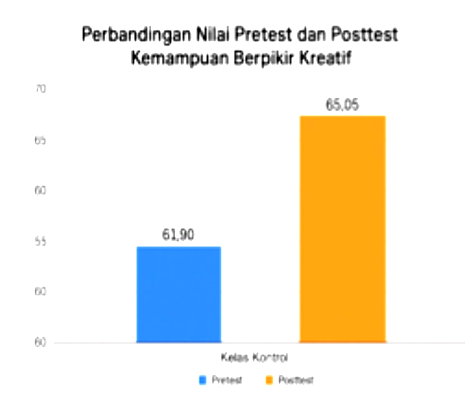
The low level of student creativity in engineering subjects is frequently attributed to monotonous instructional methods, whereas the demands of Industry 4.0 require vocational students to possess high creative competencies to manage complex control systems. This study aims to analyze the effect of project-based practicum implementation on student creativity in the Control Systems subject at Vocational School 5 Makassar. Employing a quantitative approach with a quasi-experimental pretest-posttest control group design, the research involved 44 grade XI students selected through random sampling, divided into experimental (n=23) and control (n=21) groups. Data was collected using a creativity questionnaire covering fluency, flexibility, originality, and elaboration dimensions. Statistical analysis, including Shapiro-Wilk's and Levene’s tests, preceded the hypothesis testing via independent samples t-test. The findings reveal that the experimental group achieved a posttest mean score ( ) of 81.48, significantly outperforming the control group’s score of 65.05. The t-test yielded a significant value of p = 0.000 (p < 0.05), confirming that project-based practicum acts as an effective catalyst in transforming creative potential into applicable innovative competencies. These results align with the vision of Competency-Based Training (CBT), providing a robust reference for vocational educators to implement innovative learning strategies relevant to the modern industrial landscape.
References
Ahmad, A., Saputra, E. E., & Suziman, A. (2025). Integrasi pendekatan teori belajar konstruktivisme melalui model project-based learning pada pembelajaran IPS di sekolah dasar. Sulawesi Tenggara Educational Journal, 5(1), 469-475. https://doi.org/10.54297/seduj.v5i1.1215
Basuki, S. R., & Hidayah, R. (2025). Transformasi Peran Guru Sekolah Dasar pada Pembelajaran Abad 21. In Social, Humanities, and Educational Studies (SHES): Conference Series (Vol. 8, No. 3, pp. 1781-1789). https://doi.org/10.20961/shes.v8i3.107442
Bhardwaj, V., Zhang, S., Tan, Y. Q., & Pandey, V. (2025). Redefining learning: student-centered strategies for academic and personal growth. Frontiers in Education (Vol. 10, p. 1518602). Frontiers Media SA. https://doi.org/10.3389/feduc.2025.1518602
Cropley, D. H. (2015). Promoting creativity and innovation in engineering education. Psychology of Aesthetics, Creativity, and the Arts, 9(2), 161. https://psycnet.apa.org/doi/10.1037/aca0000008
Dada, D., Laseinde, O. T., & Tartibu, L. (2023). Student-centered learning tool for cognitive enhancement in the learning environment. Procedia Computer Science, 217, 507-512. https://doi.org/10.1016/j.procs.2022.12.246
Dilekçi, A., & Karatay, H. (2023). The effects of the 21st century skills curriculum on the development of students’ creative thinking skills. Thinking skills and creativity, 47, 101229. https://doi.org/10.1016/j.tsc.2022.101229
Gannar, S., & Kilani, C. (2025). Contextualized Learning and Social Constructivism: Implementing a Project-Based Approach in Information Systems Development Education. Journal of Science Learning, 8(1), 15-24. https://doi.org/10.17509/jsl.v8i1.72667
Handayani, K. (2024). Strategi adaptif untuk mempertahankan tenaga kerja di era society 5.0: Menghadapi tantangan cobot. Jurnal Penelitian Multidisiplin Bangsa, 1(3), 185-200. https://doi.org/10.59837/jpnmb.v1i3.50
Hasan, M., Arisah, N., & Ahmad, M. I. S. (2023). Experiential learning model for the development of collaborative skills through project based learning practicum. JPI (Jurnal Pendidikan Indonesia), 12(2), 340-349. https://doi.org/10.23887/jpiundiksha.v12i2.57376
Hasbi, M., Latif, F., Lerfiana, E., & Widistari, B. S. (2022). Training to Become Creative English Teachers and Millennials: Teaching and Learning Into The Digital Era. Jurnal Pengabdian Kepada Masyarakat Patikala, 1(3), 161-169. https://doi.org/10.51574/patikala.v1i3.291
Hasbi, M., Sarda, M., & Syafaruddin, B. (2025). Technology and Islamic Perspective: A Study of Ethnomathematics. Jurnal Riset dan Inovasi Pembelajaran, 5(3), 1154-1167. https://doi.org/10.51574/jrip.v5i3.3933
Hazizah, M. S., Aini, H., Zanianti, M. R., & Fauzan, M. M. (2023). Penerapan metode ceramah dan praktik sebagai upaya keberhasilan proses pembelajaran pada mata pelajaran PAI melalui pengelolaan kelas di SMK IPTEK Cilamaya Kabupaten Karawang. HAWARI: Jurnal Pendidikan Agama dan Keagamaan Islam, 4(1), 48-62. https://doi.org/10.35706/hw.v4i1.9482
Higuera Martínez, O. I., Fernández-Samacá, L., & Serrano Cárdenas, L. F. (2021). Trends and opportunities by fostering creativity in science and engineering: A systematic review. European Journal of Engineering Education, 46(6), 1117-1140. https://doi.org/10.1080/03043797.2021.1974350
Jumiarti, J., Sukmawati, S., & Muzaini, M. (2025). Measuring the Mathematical Representation Ability of Vocational High School Students in Solving Geometry Problems. ETDC: Indonesian Journal of Research and Educational Review, 5(1), 636-650. https://doi.org/10.51574/ijrer.v5i1.4511
Kahar, M. I., Cika, H., Afni, N., & Wahyuningsih, N. E. (2021). Pendidikan era revolusi industri 4.0 menuju era society 5.0 di masa pandemi covid 19. Moderasi: Jurnal Studi Ilmu Pengetahuan Sosial, 2(1), 58-78. https://doi.org/10.24239/moderasi.Vol2.Iss1.40
Kayyali, M. (2025). Aligning Vocational Education With Industry Needs: Successful Partnerships and Practices. In Innovative Approaches in Vocational and Regional Education (pp. 1-48). IGI Global Scientific Publishing. https://doi.org/10.4018/979-8-3693-9496-0.ch001
Kerimbayev, N., Umirzakova, Z., Shadiev, R., & Jotsov, V. (2023). A student-centered approach using modern technologies in distance learning: a systematic review of the literature. Smart Learning Environments, 10(1), 61. https://doi.org/10.1186/s40561-023-00280-8
Khamdamovna, K. S. (2025). Enhancing professional readiness in vocational education through an integrative approach aligned with the Sustainable Development Goals (SDGs). ASEAN Journal for Science Education, 4(2), 143-154. https://www.ejournal.bumipublikasinusantara.id/index.php/ajsed/article/view/705
Kovalchuk, V., Maslich, S. V., Tkachenko, N. M., Shevchuk, S. S., & Shchypska, T. P. (2022). Vocational education in the context of modern problems and challenges. Journal of Curriculum and Teaching, 8(11), 329-338. https://doi.org/10.5430/jct.v11n8p329
Lee, J. (2018). The effects of knowledge sharing on individual creativity in higher education institutions: socio-technical view. Administrative Sciences, 8(2), 21. https://doi.org/10.3390/admsci8020021
Lee, M. L. G. (2024). Readiness of technical and vocational education institutions and their industry partners for Fourth Industrial Revolution: Towards theory development. International Journal of Research and Innovation in Social Science, 8, 5701-5723. https://dx.doi.org/10.47772/IJRISS.2024.803427S
Liu, L., & Wan, L. (2024). Innovative models for enhanced student adaptability and performance in educational environments. PloS one, 19(9), e0307221. https://doi.org/10.1371/journal.pone.0307221
Magenes, S., Cancer, A., Curti, S., Pradella, C., & Antonietti, A. (2022). Learning skills, creativity, and self-efficacy in vocational school students. Learning and motivation, 79, 101829. https://doi.org/10.1016/j.lmot.2022.101829
Manuel, M. E. (2017). Vocational and academic approaches to maritime education and training (MET): Trends, challenges and opportunities. WMU Journal of Maritime Affairs, 16(3), 473-483. https://doi.org/10.1007/s13437-017-0130-3
McGrath, S., & Yamada, S. (2023). Skills for development and vocational education and training: Current and emergent trends. International Journal of Educational Development, 102, 102853. https://doi.org/10.1016/j.ijedudev.2023.102853
Muzaini, M., Rahayuningsih, S., Nasrun, N., & Hasbi, M. (2021). Creativity in synchronous and asynchronous learning during the covid-19 pandemic: a case study. AKSIOMA: Jurnal Program Studi Pendidikan Matematika, 10(3), 1722-1735. http://dx.doi.org/10.24127/ajpm.v10i3.3897
Purwanti, P., Mayanty, S., Fitrian, A., Huda, D. N., & Kumala, S. A. (2024). Development of Project Based Learning Based Practicum Modules to Improve High School Students Understanding of Concepts. Journal of Physics: Conference Series (Vol. 2866, No. 1, p. 012100). IOP Publishing. https://doi.org/10.1088/1742-6596/2866/1/012100
Putri, M., Azzahra, N., & Lestari, W. D. (2024). Inovasi Sumber Belajar Berbasis Proyek (Project Based Learning) dalam Meningkatkan Keterampilan Kreatif dan Koloboratif di Salah Satu SDN Kabupaten Bogor. Karimah Tauhid, 3(2), 1466-1478.
Putri, P., Purnawati, P., & Mantasia, M. (2025). Project Based Learning in the Subject of Embedded System Programming: Students' Conceptual Understanding and Learning Outcomes. ETDC: Indonesian Journal of Research and Educational Review, 5(1), 813-823. https://doi.org/10.51574/ijrer.v5i1.4474
Rande, M., Mustamin, M., & Lu’mu, L. M. (2025). Cooperative Learning Model on Group Work Ability of Vocational High School Students: Learning Basic Electronics. ETDC: Indonesian Journal of Research and Educational Review, 5(1), 582-593. https://doi.org/10.51574/ijrer.v5i1.4277
Schunk, D. H., & DiBenedetto, M. K. (2023). Albert Bandura’s legacy in education. Theory Into Practice, 62(3), 205-206. https://doi.org/10.1080/00405841.2023.2226560
Siminto, S., Majdi, M., Hardiansyah, A., Rofi'i, A., & Gazali, A. (2025). Pembelajaran berbasis proyek: mengembangkan kreativitas dan kemampuan kolaboratif. Jurnal Pendidikan Dan Keguruan, 3(4), 308-320. https://jutepe-joln.net/index.php/JURPERU/article/view/52
Sudarsono, B., Tentama, F., Mulasari, S. A., Sukesi, T. W., Sulistyawati, S., Ghozali, F. A., ... & Sofyan, H. (2022). Development of Integrated Project-based (PjBL-T) model to improve work readiness of vocational high school students. Jurnal Pendidikan Vokasi, 12(3), 222-235. https://doi.org/10.21831/jpv.v12i3.53158
Stoica, C., Chaillet, A., Dumur, D., Godoy, E., Font, S., Lhachemi, H., ... & Bourdais, R. (2023). Challenges for control engineering curricula: Motivating 800 students via current trends in industry and research. IFAC-PapersOnLine, 56(2), 4687-4692. https://doi.org/10.1016/j.ifacol.2023.10.987
Syafila, A. E., & A'yun, D. Q. (2024). Analisis eksplorasi konsep pendidikan konstruktivis dalam pembelajaran berbasis proyek. Jurnal Media Akademik (JMA), 2(12). https://doi.org/10.62281/v2i12.1175
Tönnsen, K. C. (2021). The relevance of trial-and-error: Can trial-and-error be a sufficient learning method in technical problem-solving-contexts?. Techne serien-Forskning i slöjdpedagogik och slöjdvetenskap, 28(2), 303-312. https://journals.oslomet.no/techneA/article/view/4391
Wang, X., Ratanaolarn, T., & Sitthiworachart, J. (2025). Integrating project-based blended learning and design thinking to enhance creativity and openness to experience. Cogent Education, 12(1), 2500760. https://doi.org/10.1080/2331186X.2025.2500760
Zajda, J. (2021). Constructivist learning theory and creating effective learning environments. In Globalisation and education reforms: Creating effective learning environments (pp. 35-50). Cham: Springer International Publishing. https://doi.org/10.1007/978-3-030-71575-5_3
Zhai, C., Wibowo, S., & Li, L. D. (2024). The effects of over-reliance on AI dialogue systems on students' cognitive abilities: a systematic review. Smart learning environments, 11(1), 28. https://doi.org/10.1186/s40561-024-00316-7
Downloads
Published
How to Cite
Issue
Section
License
Copyright (c) 2026 Mirnawati Mirnawati, Ummiati Rahmah, Edy Sabara

This work is licensed under a Creative Commons Attribution-ShareAlike 4.0 International License.