Reaction Speed and Blocking Ability in Volleyball Extracurricular Participants at High School

https://doi.org/10.51574/ijrer.v5i2.4494
Keywords:
Blocking Ability, Extracurricular Activities, High School, Reaction Speed, VolleyballAbstract
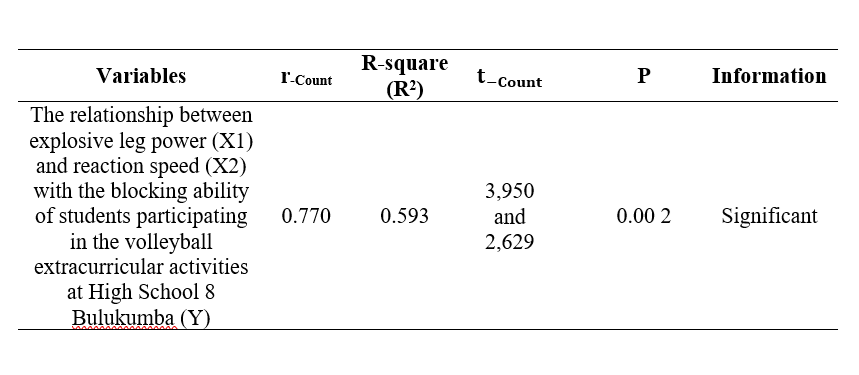
Blocking ability is one of the technical skills that greatly determines a team's success in volleyball. Blocking effectiveness is influenced by various physical components, including lower leg explosiveness and reaction speed. However, empirical studies examining the relationship between these two physical variables in high school volleyball extracurricular participants are still limited. Therefore, this study aims to analyze the relationship between lower leg explosiveness and reaction speed with blocking ability. This study used a quantitative correlational design with a population of 20 volleyball extracurricular participants at High School 8 Bulukumba using a total sampling technique. Lower leg explosiveness was measured using a vertical jump test, reaction speed using a visual reaction test, and blocking ability using a volleyball blocking skills test. Data was analyzed using Pearson Product Moment correlation. The results showed a positive and significant relationship between lower leg explosiveness and reaction speed with blocking ability. The correlation coefficient (r) value of 0.770 indicates a strong relationship, with the simultaneous contribution of both variables amounting to 59.3% of the variation in blocking ability. Leg explosiveness has been shown to play a crucial role in producing an optimal vertical jump, while reaction speed determines the accuracy of timing and hand position when facing an attack. This study concludes that the synergy between explosive and responsive physical components is the primary foundation for technical success in modern volleyball dynamics at the high school level. Increasing explosive power and reaction speed is essential for optimizing blocking performance in high school volleyball extracurricular programs.
References
Amoli, S. M., Ataabadi, P. A., Letafatkar, A., Wilkerson, G. B., & Mansouri, M. B. (2021). Effect of cognitive loading on single-leg jump landing biomechanics of elite male volleyball players. International Journal of Athletic Therapy and Training, 26(3), 161-166. https://doi.org/10.1123/ijatt.2020-0022
Barbosa, B. T., Lima-junior, D. De, Moreira, A., Nakamura, F. Y., Faro, H., & Sousa Fortes, L. de. (2025). Mental fatigue and sleep restriction effects on performance in trained beach volleyball athletes. Frontiers in Psychology, 09(May), 1–11. https://doi.org/10.3389/fpsyg.2025.1537482
Batah, L. A. A. R. A., Hameed, A. L. I. M., & khudair Saleh, A. L. B. (2025). The effect of isolation exercises using the maximum repetition method on some biomotor abilities and the accuracy of the offensive blocking skill in volleyball for young players. European Journal of Sports Science Technology, 15(55), 237-255. https://doi.org/10.58305/ejsst.v15i55.570
Benelguemar, H., Bouabdellah, S., & Mouıssı, F. (2020). The kinematical analysis of blocking skill in volleyball and their relationships with the explosive force of lower limbs. International Journal of Sport Exercise and Training Sciences-IJSETS, 6(2), 73-79. https://doi.org/10.18826/useeabd.731462
Challoumas, D., Stavrou, A., & Dimitrakakis, G. (2017). The volleyball athlete’s shoulder: biomechanical adaptations and injury associations. Sports biomechanics, 16(2), 220-237. https://doi.org/10.1080/14763141.2016.1222629
Deda, N. (2024). The study of technical-tactical and physical parameters of modern volleyball through specific models in the defense element. Interdisciplinary Journal of Research and Development, 11(2), 44-44. https://doi.org/10.56345/ijrdv11n206
Drikos, S., Kouvalias, S., Salomidou, C., Sotiropoulos, K., & Barzouka, K. (2025). Decoding attack performance: The role of spatiotemporal characteristics in volleyball Complex 1. International Journal of Sports Science & Coaching, 20(6), 2498-2511. https://doi.org/10.1177/17479541251345299
Du, H., Liu, S., Li, M., Zhao, K., Jiang, W., You, T., Wang, Z., Zou, D., Shu, J., & Liu, C. (2025). Effects of Nutritional Supplements on Explosive Lower Limb Performance in Volleyball Players: A Systematic Review and Network Meta-Analysis. Nutrients, 17(23). https://doi.org/10.3390/nu17233702
Espoz-Lazo, S., & Hinojosa-Torres, C. (2025). Modern handball: a dynamic system, orderly chaotic. Applied Sciences, 15(7), 3541. https://doi.org/10.3390/app15073541
Gholami, F., Letafatkar, A., Moghadas Tabrizi, Y., Gokeler, A., Rossettini, G., Ghanati, H. A., & Schöllhorn, W. I. (2023). Comparing the effects of differential and visuo-motor training on functional performance, biomechanical, and psychological factors in athletes after ACL reconstruction: A randomized controlled trial. Journal of clinical medicine, 12(8), 2845. https://doi.org/10.3390/jcm12082845
Hackett, D. A., Cobley, S. P., & Halaki, M. (2018). Estimation of Repetitions to Failure for Monitoring Resistance Exercise Intensity: Building a Case for Application. The Journal of Strength & Conditioning Research, 32(5). https://doi.org/10.1519/JSC.0000000000002419
Hanas, M. Y., Suyudi, I., Hudain, M. A., Ihsan, A., & Adil, A. (2024). The Emphasis of Explosive Power, Flexibility, and Motivation Judging from Back Kick Speed on BKMF Athletes. ETDC: Indonesian Journal of Research and Educational Review, 3(2), 146-155. https://doi.org/10.51574/ijrer.v3i2.1487
Idrees, M. T., & Salih, A. F. (2022). The effect of using absolute and relative strength exercises to develop the mechanical abilities of the arms and legs, mechanical rhythm and accuracy of fluctuant smash service and blocking wall skills in volleyball. Revista iberoamericana de psicología del ejercicio y el deporte, 17(6), 413-415.
Issurin, V. B. (2016). Benefits and limitations of block periodized training approaches to athletes’ preparation: a review. Sports medicine, 46(3), 329-338. https://doi.org/10.1007/s40279-015-0425-5
Jariono, G., Nugroho, H., Nugroho, D., Nyatara, S. D., Marganingrum, T., & Setiawati, D. (2021). Determining Factors Of Jump Service Volleyball In The Student Activity Unit Of Volleyball. Kinestetik : Jurnal Ilmiah Pendidikan Jasmani, 5(4), 799–808. https://doi.org/10.33369/jk.v5i4.19771
Jariono, G., Nurhidayat, N., & Indarto, P. (2024). Physical Activity Training Methods to Improve the Physical Condition of Volleyball Players : A Systematic Review. Physical Education Theory and Methodology, 24(1), 118–129. https://doi.org/10.17309/tmfv.2024.1.15
Jariono, G., Nurhidayat, N., Sudarmanto, E., Nugroho, H., Maslikah, U., & Budiman, I. A. (2023). Basic Volleyball Technical Skills for Students: Validity and Reliability. Physical Education Theory and Methodology, 23(5), 747–753. https://doi.org/10.17309/tmfv.2023.5.13
Jiang, W., Chen, C., & Xu, Y. (2024). Muscle structure predictors of vertical jump performance in elite male volleyball players : a cross-sectional study based on ultrasonography. Frontiers in Physiology, July, 1–11. https://doi.org/10.3389/fphys.2024.1427748
Li, Q., Fu, Q., Li, L., & Wang, J. (2026). Cognitive-coordination training: impact on sport-specific physical fitness and technical skill of adolescent basketball athletes. Frontiers in Psychology, 16, 1669608. https://doi.org/10.3389/fpsyg.2025.1669608
Ramirez-Campillo, R., Sortwell, A., Moran, J., Afonso, J., Clemente, F. M., Lloyd, R. S., Oliver, J. L., Pedley, J., & Granacher, U. (2023). Plyometric-Jump Training Effects on Physical Fitness and Sport-Specific Performance According to Maturity: A Systematic Review with Meta-analysis. Sports Medicine - Open, 9(1), 23. https://doi.org/10.1186/s40798-023-00568-6
Rodney, G., Raju, P., & Brull, S. J. (2024). Neuromuscular block management: evidence-based principles and practice. BJA education, 24(1), 13-22. https://doi.org/10.1016/j.bjae.2023.10.005
Wang, J., Qin, Z., Zhang, Q., & Wang, J. (2025). Lower limb dynamic balance, strength, explosive power, agility, and injuries in volleyball players. Journal of Orthopaedic Surgery and Research, 20(1), 211. https://doi.org/10.1186/s13018-025-05566-w
Yang, F., Lu, C., Yun, X., & Qian, C. (2025). Effects of neuromuscular training on stability in volleyball athletes: a systematic review and meta-analysis. Frontiers in Sports and Active Living, 7, 1724934. https://doi.org/10.3389/fspor.2025.1724934
Zećirović, A., Zećirović, R., Čaprić, I., & Mekic, R. (2021). Measuring Instruments for Assessing the Explosive Power of the Lower Limbs in Volleyball Players. American Journal of Sports Science, 9, 98–102. https://doi.org/10.11648/j.ajss.20210904.15
Zhu, R., Zou, D., Wang, K., & Cao, C. (2024). Expert Performance in Action Anticipation: Visual Search Behavior in Volleyball Spiking Defense from Different Viewing Perspectives. In Behavioral Sciences (Vol. 14, Issue 3, p. 163). https://doi.org/10.3390/bs14030163
Downloads
Published
How to Cite
Issue
Section
License
Copyright (c) 2026 Arifuddin Usman, Nafi Basram, Arimbi Arimbi

This work is licensed under a Creative Commons Attribution-ShareAlike 4.0 International License.