Unearthing Talent and Building Character: The Role of Sports Education in Youth Interest and Participation

https://doi.org/10.51574/ijrer.v5i1.4033
Keywords:
Character Building, Sports Education, Sports Participation, Talent Development, Youth InterestsAbstract
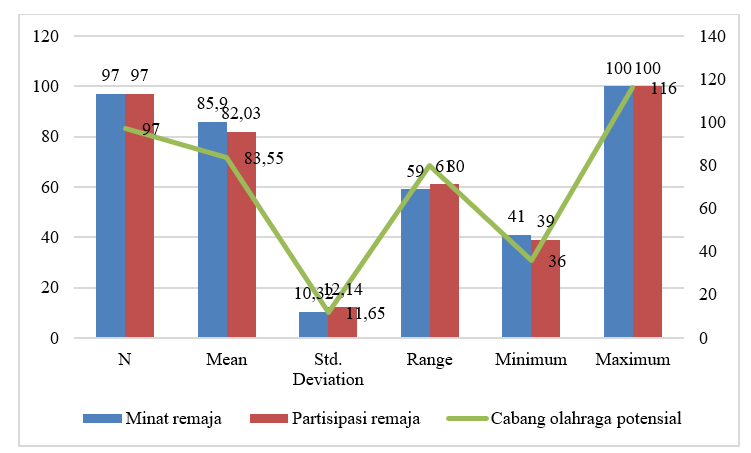
This research is time-sensitive because Sinjai Regency has great potential for establishing leading sports, yet teenage sports participation is low. This study examines adolescents' interest and engagement in potential sports, identifies influencing factors, and compares subjective interest with actual sports participation. This study will also make strategic recommendations for local governments and sports institutions to develop sports based on local potential and teenage preferences. The method used is a descriptive quantitative approach involving adolescent respondents aged 13–18 years in various sub-districts in Sinjai Regency. Data collection techniques were carried out through closed questionnaires and semi-structured interviews distributed to junior high and high school students, and data triangulation was carried out through interviews with physical education teachers, coaches, and local sports figures. Data was analyzed using descriptive statistics and correlation analysis to examine the relationship between levels of interest, participation, and the factors that influence them. The results show that adolescent interest in potential sports such as soccer, volleyball, and athletics is relatively high, but not always followed by a commensurate level of participation. Dominant factors influencing participation include sports facilities, social support, and intrinsic motivation. The alignment between interest and actual involvement still needs to be strengthened through coaching programs and competitive activities at the school and community levels. In conclusion, interest-based strategies, environmental support, and the availability of adequate facilities are necessary to increase youth participation in sports in Sinjai Regency.
References
Alamsyah, F., Pujianto, E., Ma, A., & Nugraha, R. (2025). Youth sport values : A comparative analysis between urban and rural students. Jurnal Keolahragaan, 13(1), 18–28. https://doi.org/https://doi.org/10.21831/jk.v13i1.83947
Andriyani, F. D., Biddle, S. J. H., Arovah, N. I., & Cocker, K. De. (2020). Physical Activity and Sedentary Behavior Research in Indonesian Youth: A Scoping Review. International Journal of Environmental Research and Public Health, 17(20). https://doi.org/10.3390/ijerph17207665
Beacom, A., Ziakas, V., & Trendafilova, S. (2023). Reframing physical activity in sport development: managing Active Partnerships' strategic responses to policy change. Sport, Business and Management: An International Journal, 13(5), 509-529. https://doi.org/10.1108/SBM-12-2022-0110
Duffey, K., Barbosa, A., Whiting, S., Mendes, R., Yordi Aguirre, I., Tcymbal, A., Abu-Omar, K., Gelius, P., & Breda, J. (2021). Barriers and Facilitators of Physical Activity Participation in Adolescent Girls: A Systematic Review of Systematic Reviews. Frontiers in Public Health, 9, 743935. https://doi.org/10.3389/fpubh.2021.743935
Fithroni, H., & Rusdiawan, A. (2023). Community Sports Participation and Its Distribution in East Java (Vol. 1). Atlantis Press SARL. https://doi.org/10.2991/978-2-38476-008-4
Freire, K., Pope, R., Jeffrey, K., Andrews, K., Nott, M., & Bowman, T. (2022). Engaging with children and adolescents: a systematic review of participatory methods and approaches in research informing the development of health resources and interventions. Adolescent Research Review, 7(3), 335-354. https://doi.org/10.1007/s40894-022-00181-w
Goyal, D. (2024). Analysing the socioeconomic barriers to sports participation in urban areas. International Journal of Sports, Exercise and Physical Education, 6(1), 80–82. https://doi.org/10.33545/26647281.2024.v6.i1b.79
Guthold, R., Stevens, G. A., Riley, L. M., & Bull, F. C. (2020). Global trends in insufficient physical activity among adolescents: a pooled analysis of 298 population-based surveys with 1·6 million participants. The Lancet Child & Adolescent Health, 4(1), 23–35. https://doi.org/https://doi.org/10.1016/S2352-4642(19)30323-2
Haug, E. (2025). Adolescents’ screen-based media use and the relationship with moderate-to-vigorous physical activity, sports club participation and active commuting. Scandinavian Journal of Public Health, 53(1_suppl), 42–51. https://doi.org/10.1177/14034948241293603
Jariono, G., Nurhidayat, N., Sudarmanto, E., & Indarto, P. (2024). Can elementary school students ’ physical fitness be improved using circuit training ? The 19th University Research Colloqium, 1–11.
Jariono, G., Nurhidayat, N., Sudarmanto, E., & Yunita, P. (2023). Strategies to Utilize the Home Environment through the Implementation of Sustainable Development Goals ( SDGs ) Strategi Memanfaatkan Lingkungan Rumah Melalui Implementasi Sustainable Development Goals ( SDGs ). Proceeding of The 18th University Research Colloquium 2023: Bidang Kebencanaan, 18, 11–17.
Kovacs, V. A., Starc, G., Brandes, M., Kaj, M., Blagus, R., Leskošek, B., ... & Okely, A. D. (2022). Physical activity, screen time and the COVID-19 school closures in Europe–An observational study in 10 countries. European journal of sport science, 22(7), 1094-1103. https://doi.org/10.1080/17461391.2021.1897166
Lavados-Romo, P., Andrade-Mayorga, O., Morales, G., Muñoz, S., & Balboa-Castillo, T. (2023). Association of screen time and physical activity with health-related quality of life in college students. Journal of American College Health : J of ACH, 71(5), 1504–1509. https://doi.org/10.1080/07448481.2021.1942006
Li, J., & Shao, W. (2022). Influence of Sports Activities on Prosocial Behavior of Children and Adolescents: A Systematic Literature Review. International Journal of Environmental Research and Public Health, 19(11). https://doi.org/10.3390/ijerph19116484
Ljungmann, C. K., Christensen, J. H., Klinker, C. D., Pawlowski, C. S., & Johnsen, H. R. (2022). P03-14 Barriers to sports participation among adolescent girls from deprived neighbourhoods. In The European Journal of Public Health (Vol. 32, Issue Suppl 2). https://doi.org/10.1093/eurpub/ckac095.050
Neil-Sztramko, S. E., Caldwell, H., & Dobbins, M. (2021). School-based physical activity programs for promoting physical activity and fitness in children and adolescents aged 6 to 18. The Cochrane Database of Systematic Reviews, 9(9), CD007651. https://doi.org/10.1002/14651858.CD007651.pub3
Nurhuda, M. N., & Jariono, G. (2022). Student Satisfaction with Learning Facilities and Infrastructure PJOK SMP Muhammadiyah 3 Ampel. Kinestetik : Jurnal Ilmiah Pendidikan Jasmani, 6(3), 447–459. https://doi.org/10.33369/jk.v6i3.22891
Pasquerella, L., Aychman, M. M., Tasnim, N., Piccirillo, A., Holmes, V., & Basso, J. C. (2025). The benefits of chronic sport participation and acute exercise on mental health and executive functioning in adolescents. Scientific Reports, 15, 1–11. https://doi.org/https://doi.org/10.1038/s41598-025-88427-0
Risyanto, A. (2023). Journal of Teaching Physical Education in Elementary School Life Skill Development Through Pencak Silat Activities in The Positive Youth Development Framework. Journal of Teaching Physical Education in Elementary School, 7(1), 1–6. https://doi.org/https://doi.org/10.17509/tegar.v6i2.62500
Saevarsson, E. S., Rognvaldsdottir, V., Stefansdottir, R., & Johannsson, E. (2021). Organized sport participation, physical activity, sleep and screen time in 16-year-old adolescents. International Journal of Environmental Research and Public Health, 18(6), 3162. https://doi.org/10.3390/ijerph18063162
Shao, T., & Zhou, X. (2023). Correlates of physical activity habits in adolescents: A systematic review. Frontiers in Physiology, 14, 1131195. https://doi.org/10.3389/fphys.2023.1131195
Spruijtenburg, G. E., van Abswoude, F., Platvoet, S., de Niet, M., Bekhuis, H., & Steenbergen, B. (2022). Factors Related to Adolescents’ Participation in Organized Sports. International Journal of Environmental Research and Public Health, 19(23). https://doi.org/10.3390/ijerph192315872
Throuvala, M. A., Griffiths, M. D., Rennoldson, M., & Kuss, D. J. (2021). The role of recreational online activities in school-based screen time sedentary behaviour interventions for adolescents: A systematic and critical literature review. International Journal of Mental Health and Addiction, 19(4), 1065-1115. https://doi.org/10.1007/s11469-019-00213-y
Twenge, J. M., & Campbell, W. K. (2019). Media Use Is Linked to Lower Psychological Well-Being: Evidence from Three Datasets. The Psychiatric Quarterly, 90(2), 311–331. https://doi.org/10.1007/s11126-019-09630-7
van Sluijs, E. M., Ekelund, U., Crochemore-Silva, I., Guthold, R., Ha, A., Lubans, D., ... & Katzmarzyk, P. T. (2021). Physical activity behaviours in adolescence: current evidence and opportunities for intervention. The Lancet, 398(10298), 429-442. https://doi.org/10.1016/S0140-6736(21)01259-9
Varghese, M., Ruparell, S., & LaBella, C. (2022). Youth athlete development models: a narrative review. Sports Health, 14(1), 20-29. https://doi.org/10.1177/19417381211055396
Wang, J., Wu, S., Chen, X., Xu, B., Wang, J., Yang, Y., ... & Zhuang, J. (2024). Impact of awareness of sports policies, school, family, and community environmental on physical activity and fitness among children and adolescents: a structural equation modeling study. BMC Public Health, 24(1), 2298. https://doi.org/10.1186/s12889-024-19795-x
Yadnya, I., & Warastuti, D. (2023). Dampak Penggunaan Media Sosial terhadap Perilaku Konsumtif dan Persepsi Diri Remaja di Jakarta: Studi Mengenai Interaksi Online, Pengaruh Endorsement, dan Dampak Psikologis. Jurnal Psikologi Dan Konseling West Science, 1, 250–260. https://doi.org/10.58812/jpkws.v1i05.852
Downloads
Published
How to Cite
Issue
Section
License
Copyright (c) 2025 Arifuddin Usman, Muhammad Tauhid Al Islamy Arifuddin, Muh Adnan Hudain

This work is licensed under a Creative Commons Attribution-ShareAlike 4.0 International License.