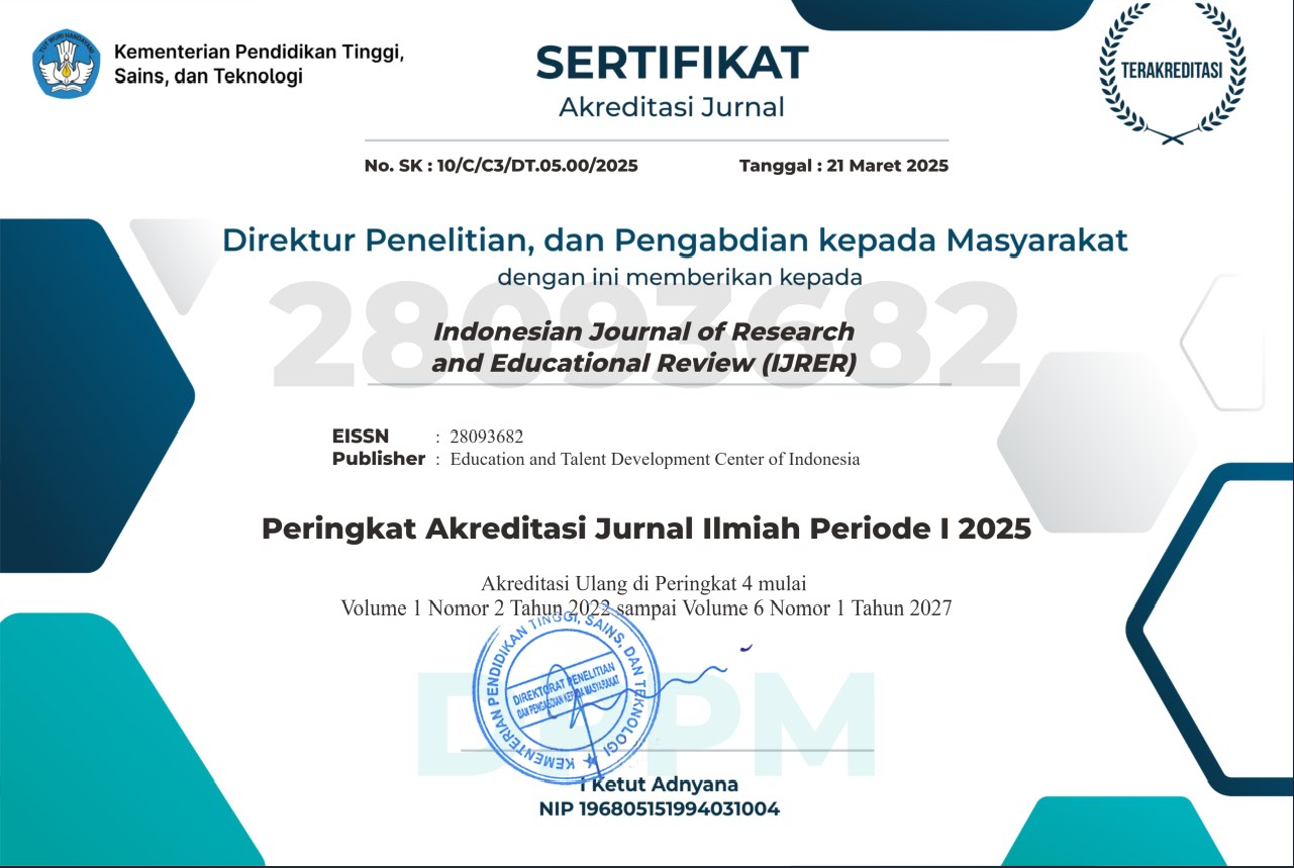
ACREDITATION
The problem identified in this study stemmed from the condition of science learning, which remained limited to the learning model and media used, resulting in less effectiveness in developing creativity. Therefore, this study was conducted to test the effectiveness of the Project Based Learning (PjBL) model integrated with the Science, Technology, Engineering, Arts, and Mathematics (STEAM) approach using Geospatial Information System Artificial Intelligence (GeoAI) media in improving students' creative thinking skills. This study used a mixed-methods design with an embedded experimental model, where the data collection techniques were carried out through pre-research interviews, pretests and posttests, questionnaires, and interviews after the intervention. The research sample consisted of second-semester students from class VIII at Public Junior High School 1 Weru. We processed the data using normality tests, homogeneity tests, paired sample t-tests, independent sample t-tests, and N-Gain tests. The results showed a significant increase in creative thinking skills in the experimental class. The improvement was evidenced by the results of the average pretest score of 66.32, then the posttest increased to 90.44, with a very significant difference compared to the control class. The N-Gain test also recorded improvements, with an average score of 0.69 in the moderate category. This finding is reinforced by qualitative data from questionnaires and interviews, which showed a very positive response from students to the GeoAI-assisted PjBL-STEAM model, achieving an average score of 75.99% out of a maximum score of 100%.
Ajeng, A., Rinto, R., & Fatnah, N. (2025). The Effectiveness of PjBL-STEAM Using GeoAI Media: Junior High School Students’ Creative Thinking Skills. ETDC: Indonesian Journal of Research and Educational Review , 4(4), 1308–1322. https://doi.org/10.51574/ijrer.v4i4.3788
Downloads
Download data is not yet available.
- Afifah, S., Mudzakir, A., & Nandiyanto, A. B. D. (2022). How to calculate paired sample t-test using SPSS software: From step-by-step processing for users to the practical examples in the analysis of the effect of application anti-fire bamboo teaching materials on student learning outcomes. Indonesian Journal of Teaching in Science, 2(1), 81-92. https://ejournal.upi.edu/index.php/ijotis/article/view/45895
- Ardiyansah, E., Rinto, R., & Fatnah, N. (2024). Pengaruh model pjbl-stem menggunakan algodoo terhadap pembelajaran ipa dalam peningkatan keterampilan berpikir kritis dan keterampilan berpikir kreatif. Inkuiri: Jurnal Pendidikan IPA, 13(2), 160-167. https://doi.org/10.20961/inkuiri.v13i2.91876
- Baidal-Bustamante, E., Mora, C., & Alvarez-Alvarado, M. S. (2023). STEAM project-based learning approach to enhance teaching-learning process in the topic of pascal’s principle. IEEE Transactions on Education, 66(6), 632-641. https://doi.org/10.1109/TE.2023.3283850
- Braun, V., & Clarke, V. (2021). Thematic analysis: A practical guide to a rigorous method. Journal of Qualitative Research, 26(1), 22–38. https://www.torrossa.com/it/resources/an/5282292
- Chen, S. Y., Lai, C. F., Lai, Y. H., & Su, Y. S. (2022). Effect of project-based learning on development of students’ creative thinking. The International Journal of Electrical Engineering & Education, 59(3), 232-250. https://doi.org/10.1177/0020720919846808
- Chistyakov, A. A., Zhdanov, S. P., Avdeeva, E. L., Dyadichenko, E. A., Kunitsyna, M. L., & Yagudina, R. I. (2023). Exploring the characteristics and effectiveness of project-based learning for science and STEAM education. Eurasia Journal of Mathematics, Science and Technology Education, 19(5), em2256. https://doi.org/10.29333/ejmste/13128
- Cohen, L., Manion, L., & Morrison, K. (2017). Mixed methods research. In Research methods in education (pp. 31-50). Routledge. https://doi.org/10.4324/9781315456539-2
- Creswell, J. W., & Creswell, J. D. (2017). Research design: Qualitative, quantitative, and mixed methods approaches. Sage publications.
- de Souza, R. R., Toebe, M., Mello, A. C., & Bittencourt, K. C. (2023). Sample size and Shapiro-Wilk test: An analysis for soybean grain yield. European Journal of Agronomy, 142, 126666. https://doi.org/10.1016/j.eja.2022.126666
- Diana, N., & Sukma, Y. (2021). The effectiveness of implementing project-based learning (PjBL) model in STEM education: A literature review. In Journal of Physics: Conference Series (Vol. 1882, No. 1, p. 012146). IOP Publishing.
- González-Pérez, L. I., & Ramírez-Montoya, M. S. (2022). Components of Education 4.0 in 21st century skills frameworks: systematic review. Sustainability, 14(3), 1493. https://doi.org/10.3390/su14031493
- Indahwati, S. D., Rachmadiarti, F., & Hariyono, E. (2023). Integration of PJBL, STEAM, and learning tool development in improving students' critical thinking skills. IJORER: International Journal of Recent Educational Research, 4(6), 808-818. https://doi.org/10.46245/ijorer.v4i6.434
- Jannah, D. R. N., & Atmojo, I. R. W. (2022). Media digital dalam memberdayakan kemampuan berpikir kritis abad 21 pada pembelajaran IPA di sekolah dasar. Jurnal Basicedu, 6(1), 1064–1074. https://doi.org/10.31004/basicedu.v6i1.2124
- Janowicz, K., Gao, S., McKenzie, G., Hu, Y., & Bhaduri, B. (2020). GeoAI: spatially explicit artificial intelligence techniques for geographic knowledge discovery and beyond. International Journal of Geographical Information Science, 34(4), 625-636. https://doi.org/10.1080/13658816.2019.1684500
- Lee, J. (2023). Beyond geospatial inquiry—How can we integrate the latest technological advances into geography education?. Education Sciences, 13(11), 1128. https://doi.org/10.3390/educsci13111128
- Lou, S. J., Chou, Y. C., Shih, R. C., & Chung, C. C. (2017). A study of creativity in CaC2 steamship-derived STEM project-based learning. Eurasia Journal of Mathematics, Science and Technology Education, 13(6), 2387-2404. https://doi.org/10.12973/eurasia.2017.01231a
- Lu, S. Y., Lo, C. C., & Syu, J. Y. (2022). Project-based learning oriented STEAM: The case of micro–bit paper-cutting lamp. International Journal of Technology and Design Education, 32(5), 2553-2575. https://doi.org/10.1007/s10798-021-09714-1
- Mufida, S. N., Sigit, D. V., & Ristanto, R. H. (2020). Integrated project-based e-learning with science, technology, engineering, arts, and mathematics (PjBeL-STEAM): its effect on science process skills. Biosfer: Jurnal Pendidikan Biologi, 13(2), 183-200. https://doi.org/10.21009/biosferjpb.v13n2.183-200
- Pérez Torres, M., Couso Lagarón, D., & Marquez Bargalló, C. (2023). Evaluation of STEAM project-based learning (STEAM PBL) instructional designs from the STEM practices perspective. Education Sciences, 14(1), 53. https://doi.org/10.3390/educsci14010053
- Retno, R. S., Purnomo, P., Hidayat, A., & Mashfufah, A. (2025). Conceptual framework design for STEM-integrated project-based learning (PjBL-STEM) for elementary schools. Asian Education and Development Studies, 14(3), 579-604. https://doi.org/10.1108/AEDS-08-2024-0188
- Stkipsubang. (2022). Kompetensi 4C dalam implementasi Kurikulum Merdeka di sekolah dasar. Jurnal Didaktik: Jurnal Ilmiah Pendidikan, 6(2), 114-122. https://journal.stkipsubang.ac.id/index.php/didaktik/article/download/1136/1045
- Sukackė, V., Guerra, A. O. P. D. C., Ellinger, D., Carlos, V., Petronienė, S., Gaižiūnienė, L., ... & Brose, A. (2022). Towards active evidence-based learning in engineering education: A systematic literature review of PBL, PjBL, and CBL. Sustainability, 14(21), 13955. https://doi.org/10.3390/su142113955
- Sukmawati, E., Imanah, N. D. N., & Rantauni, D. A. (2023). Implementation and challenges of project-based learning of STEAM in the university during the pandemic: A systematic literature review. JINoP (Jurnal Inovasi Pembelajaran), 9(1), 128-139. https://doi.org/10.22219/jinop.v9i1.25177
- Thornhill-Miller, B., Camarda, A., Mercier, M., Burkhardt, J. M., Morisseau, T., Bourgeois-Bougrine, S., ... & Lubart, T. (2023). Creativity, critical thinking, communication, and collaboration: Assessment, certification, and promotion of 21st century skills for the future of work and education. Journal of Intelligence, 11(3), 54. https://doi.org/10.3390/jintelligence11030054
- Usery, E. L., Arundel, S. T., Shavers, E., Stanislawski, L., Thiem, P., & Varanka, D. (2022). GeoAI in the US Geological Survey for topographic mapping. Transactions in GIS, 26(1), 25–40. https://doi.org/10.1111/tgis.12830
- VoPham, T., Hart, J. E., Laden, F., & Chiang, Y. Y. (2018). Emerging trends in geospatial artificial intelligence (geoAI): potential applications for environmental epidemiology. Environmental Health, 17(1), 40. https://doi.org/10.1186/s12940-018-0386-x
- Yang, K. K., Lee, L., Hong, Z. R., & Lin, H. S. (2016). Investigation of effective strategies for developing creative science thinking. International Journal of Science Education, 38(13), 2133-2151. https://doi.org/10.1080/09500693.2016.1230685
- Zayyinah, Z., Erman, E., Supardi, Z. A., Hariyono, E., & Prahani, B. K. (2022). STEAM-integrated project based learning models: Alternative to improve 21st century skills. In Eighth Southeast Asia Design Research (SEA-DR) & the Second Science, Technology, Education, Arts, Culture, and Humanity (STEACH) International Conference (SEADR-STEACH 2021) (pp. 251-258). Atlantis Press.
Copyright (c) 2025 Ajeng Ajeng, Rinto Rinto, Nurwanti Fatnah

This work is licensed under a Creative Commons Attribution-ShareAlike 4.0 International License.
Similar Articles
- Habil Eka Setiawan, Students' Learning Interests with Audio-Visual Media in PJOK Subjects , ETDC: Indonesian Journal of Research and Educational Review : Vol. 4 No. 2 (2025): March
- Umrati Umrati, Muhsyanur Muhsyanur, Ardianto Ardianto, Hardi Yanti Hardi Yanti, Response of Islamic Education Students at As'adiyah Islamic University Towards the Use of Digital Technology in The Learning Process , ETDC: Indonesian Journal of Research and Educational Review : Vol. 3 No. 1 (2023): December
- Siti Nur'anisa, Chairil Anwar Korompot, Nurdiana Nawir, The Application of Problem-Based Learning Methods to Increase Learning Outcomes in News Item Text Material , ETDC: Indonesian Journal of Research and Educational Review : Vol. 3 No. 2 (2024): March
- Nur Indah Atifah Anwar, Alimin Hamzah, Muh. Ilham Aksir, Fitness Education Model to Improve Learning Achievement of PJOK Subjects: A Focus Senior High School Students , ETDC: Indonesian Journal of Research and Educational Review : Vol. 3 No. 4 (2024): September
- Nelsa Saragih, Adriana Y. D. Lumban Gaol, Think-Pair-Share Model on High Secondary School Students' Academic Outcomes in Human Reproduction , ETDC: Indonesian Journal of Research and Educational Review : Vol. 6 No. 1 (2026): September - December
- Muhammad Ikram, Marufi Marufi, Suriani Canne, Design of an RME-Based Fractions Textbook in the Luwu Tourism Context to Stimulate Students’ Reasoning Skills , ETDC: Indonesian Journal of Research and Educational Review : Vol. 3 No. 4 (2024): September
- Eka Nana Susanti, Interest in Local Wisdom-Based Entrepreneurship among High School Students , ETDC: Indonesian Journal of Research and Educational Review : Vol. 5 No. 1 (2025): December
- Saiful Saiful, Speaking Up with Confidence: Affect Perseverance Theory as Pedagogical Tool at High School , ETDC: Indonesian Journal of Research and Educational Review : Vol. 4 No. 3 (2025): June
- Khaerunnisa Khaerunnisa, Baso Intang Sappaile, Syafruddin Side, Students' Mathematical Representation in PISA Space and Shape Tasks Across Gregorc's Thinking Styles , ETDC: Indonesian Journal of Research and Educational Review : Vol. 5 No. 4 (2026): September
- Ishak Ishak, Rusli Rusli, Muh. Adnan Hudain, Pull-Back Turns, Outside Stops, and Inside Stops Training on Dribbling Skills: Extracurricular Team of State High School , ETDC: Indonesian Journal of Research and Educational Review : Vol. 5 No. 3 (2026): June
<< < 18 19 20 21 22 23 24 25 26 27 > >>
You may also start an advanced similarity search for this article.
Dimensions Badge
Crossmark Badge

Section
Articles