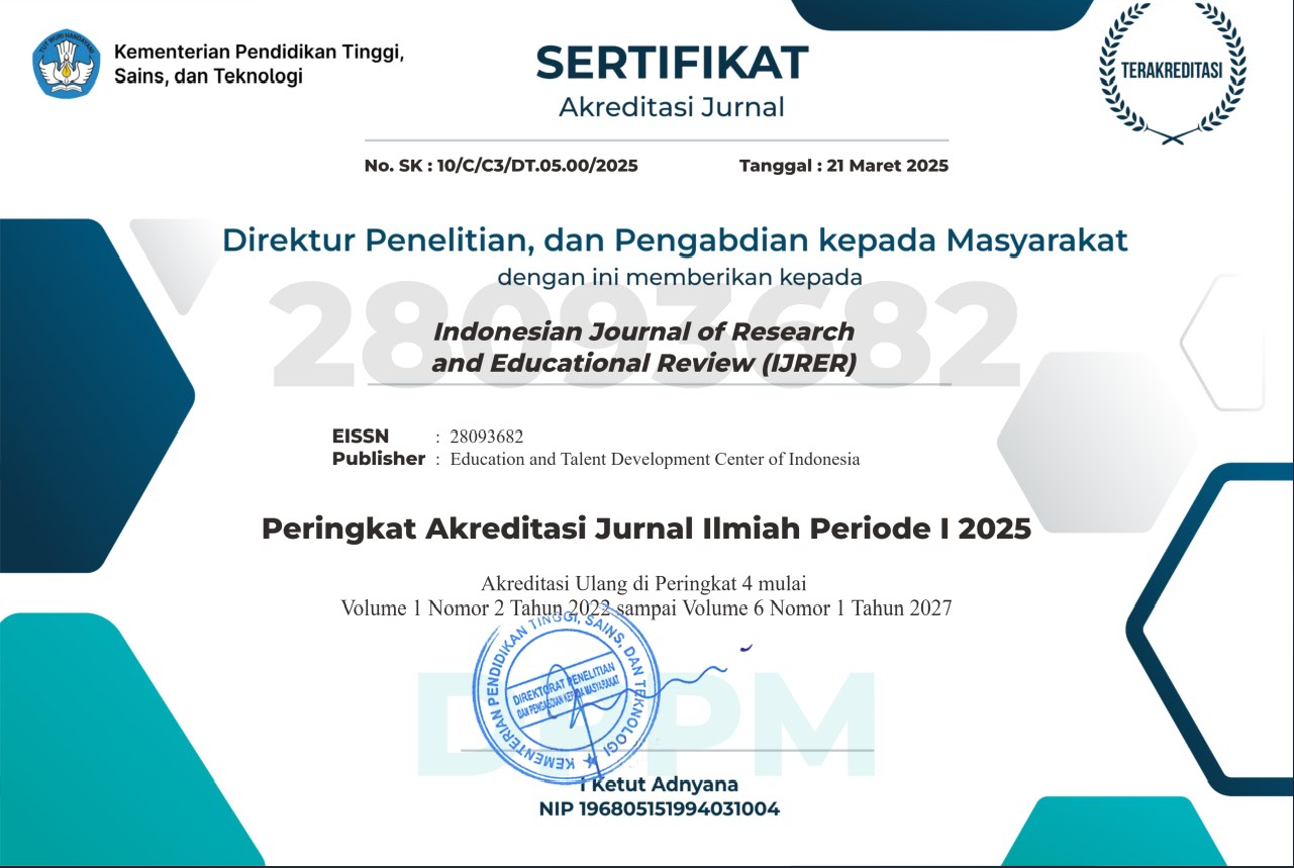
ACREDITATION
This study aims to explore the effect of technology utilization on increasing fourth-grade students' interest and motivation in learning social studies. The research method used was qualitative with a phenomenological approach, involving 22 students at elementary school 2 Tomohon. Data was collected through semi-structured interviews, classroom observations, and group discussions. The results showed that the use of technology, such as tablet devices and interactive educational applications, significantly increased students' interest and motivation. As many as 85% of students stated that technology made learning more interesting, while 78% felt more motivated to learn. In addition, student participation in discussions also increased, and they developed useful digital skills. However, challenges such as limited access and unstable internet connections need to be addressed. These findings suggest that integrating technology in social studies learning can create a more interactive and effective learning environment and provide recommendations for the development of better educational practices. Based on the results of the research conducted, it can be concluded that the use of technology in social studies learning makes a significant contribution to increasing students' interest and motivation to learn, where 85% of students stated that the use of technology makes social studies lessons more interesting, while 78% of students feel more motivated to learn when technology is used in learning activities.
Ester, K., Kertih, I. W., & Lasmawan, I. W. (2025). The Role of Information Technology in Improving the Quality of Social Studies Learning in Elementary Education. ETDC: Indonesian Journal of Research and Educational Review , 4(4), 992–1002. https://doi.org/10.51574/ijrer.v4i4.3606
Downloads
Download data is not yet available.
- Balalle, H. (2024). Exploring student engagement in technology-based education in relation to gamification, online/distance learning, and other factors: A systematic literature review. Social Sciences & Humanities Open, 9, 100870. https://doi.org/10.1016/j.ssaho.2024.100870
- Bansal, S. K. (2023). Significance and advancement of the educational technology: Holistic development of learners in the digital age. Available at SSRN 4863716.
- Baser, D., Ozden, M. Y., & Karaarslan, H. (2017). Collaborative project-based learning: An integrative science and technological education project. Research in Science & Technological Education, 35(2), 131-148. https://doi.org/10.1080/02635143.2016.1274723
- Belolutskaya, A., Bukhalenkova, D., Krasheninnikov-Khait, E., Shiyan, I., Shiyan, O., & Veraksa, A. (2022). Constructivism and social constructivism in the study of relationship between early childhood education quality and executive function at 5–6 years old. In Piaget and Vygotsky in XXI century: Discourse in early childhood education (pp. 145-164). Cham: Springer International Publishing.
- Bouton, E., Tal, S. B., & Asterhan, C. S. (2021). Students, social network technology and learning in higher education: Visions of collaborative knowledge construction vs. the reality of knowledge sharing. The internet and higher education, 49, 100787.
- Çeken, B., & Taşkın, N. (2022). Multimedia learning principles in different learning environments: A systematic review. Smart Learning Environments, 9(1), 19. https://doi.org/10.1186/s40561-022-00200-2
- Cooner, T. S. (2010). Creating opportunities for students in large cohorts to reflect in and on practice: Lessons learnt from a formative evaluation of students' experiences of a technology‐enhanced blended learning design. British Journal of Educational Technology, 41(2), 271-286.
- Ertl, S., Steinmair, D., & Löffler-Stastka, H. (2021). Encouraging communication and cooperation in e-learning: solving and creating new interdisciplinary case histories. GMS Journal for Medical Education, 38(3), Doc62.
- García-Pérez, L., García-Garnica, M., & Olmedo-Moreno, E. M. (2021). Skills for a working future: How to bring about professional success from the educational setting. Education sciences, 11(1), 27.
- Hadiyanto, H., Failasofah, F., Armiwati, A., Abrar, M., & Thabran, Y. (2021). Students' practices of 21st century skills between conventional learning and blended learning. Journal of University Teaching and Learning Practice, 18(3), 1-21. https://doi.org/10.53761/1.18.3.7
- Haleem, A., Javaid, M., Qadri, M. A., & Suman, R. (2022). Understanding the role of digital technologies in education: A review. Sustainable operations and computers, 3, 275-285. https://doi.org/10.1016/j.susoc.2022.05.004
- Hanafiah, H., Kushariyadi, K., Wakhudin, W., Rukiyanto, B. A., Wardani, I. U., & Ahmad, A. (2024). Character Education's Impact On Student Personality: Curriculum And School Practices Review. At-Ta'dib, 19(1), 51-69. https://doi.org/10.21111/attadib.v19i1.12047
- Hendricks, G. P. (2019). Connectivism as a learning theory and its relation to open distance education. Progressio, 41(1), 1-13.
- Kurt, S., & Tuncer, H. (2021). The Impact of Technology Integration in Social Studies Education: Current Trends and Future Directions. Journal of History and Education, 9(2), 100-116.
- Maheshwari, G., Kha, K. L., & Arokiasamy, A. R. A. (2023). Factors affecting students’ entrepreneurial intentions: a systematic review (2005–2022) for future directions in theory and practice. Management Review Quarterly, 73(4), 1903-1970. https://doi.org/10.1007/s11301-022-00289-2
- Maksum, A., Widiana, I. W., & Marini, A. (2021). Path Analysis of Self-Regulation, Social Skills, Critical Thinking and Problem-Solving Ability on Social Studies Learning Outcomes. International Journal of Instruction, 14(3), 613-628.
- Navrátilová, J., & Jurčík, M. (2025). Analysing the intersection between teachers ‘peer learning strategies and students’ perspectives in inclusive classrooms. Education Inquiry, 1-21.
- Nel, L. (2017). Students as collaborators in creating meaningful learning experiences in technology‐enhanced classrooms: An engaged scholarship approach. British Journal of Educational Technology, 48(5), 1131-1142.
- Petersen, G. B., Petkakis, G., & Makransky, G. (2022). A study of how immersion and interactivity drive VR learning. Computers & Education, 179, 104429.
- Rusticus, S. A., Pashootan, T., & Mah, A. (2023). What are the key elements of a positive learning environment? Perspectives from students and faculty. Learning environments research, 26(1), 161-175. https://doi.org/10.1007/s10984-022-09410-4
- Serrano, D. R., Dea‐Ayuela, M. A., Gonzalez‐Burgos, E., Serrano‐Gil, A., & Lalatsa, A. (2019). Technology‐enhanced learning in higher education: How to enhance student engagement through blended learning. European Journal of Education, 54(2), 273-286. https://doi.org/10.1111/ejed.12330
- Silalahi, R. A., Siahaan, T. M., & Tambunan, L. O. (2023). Pengaruh Model Pembelajaran Problem Based Learning (PBL) terhadap Kemampuan Pemahaman Konsep Matematis Siswa Kelas XI SMA Swasta Kampus Nommensen Pematangsiantar. Journal on Education, 5(4), 14264-14275.
- Singer, E. (2022). Piaget and Vygotsky: Powerful inspirators for today’s students in early education and developmental psychology. In Piaget and Vygotsky in XXI century: Discourse in early childhood education (pp. 129-143). Cham: Springer International Publishing.
- Tang, J. (2024). The impact of smart learning technologies on students’ cognitive competence: enhancing critical thinking. Education and Information Technologies, 1-17. https://doi.org/10.1007/s10639-024-13250-5
- Taranto, E., Colajanni, G., Gobbi, A., Picchi, M., & Raffaele, A. (2024). Fostering students' modelling and problem-solving skills through operations research, digital technologies and collaborative learning. International Journal of Mathematical Education in Science and Technology, 55(8), 1957-1998.
- Vodă, A. I., Cautisanu, C., Grădinaru, C., Tănăsescu, C., & de Moraes, G. H. S. M. (2022). Exploring digital literacy skills in social sciences and humanities students. Sustainability, 14(5), 2483. https://doi.org/10.3390/su14052483
- Wannapiroon, N., & Pimdee, P. (2022). Thai undergraduate science, technology, engineering, arts, and math (STEAM) creative thinking and innovation skill development: a conceptual model using a digital virtual classroom learning environment. Education and Information Technologies, 27(4), 5689-5716.
- Wang, Y. H. (2020). Design-based research on integrating learning technology tools into higher education classes to achieve active learning. Computers & Education, 156, 103935.
- Wulandari, A., & Husain, A. P. (2025). Utilizing Technology to Enhance the Effectiveness of Social Studies Learning in Elementary Schools/MI. Jurnal Ilmiah Teunuleh, 6(2), 111-121. https://doi.org/10.51612/teunuleh.v6i2.184
- Zhao, Y., Zhao, M., & Shi, F. (2024). Integrating moral education and educational information technology: A strategic approach to enhance rural teacher training in universities. Journal of the Knowledge Economy, 15(3), 15053-15093. https://doi.org/10.1007/s13132-023-01693-z
Copyright (c) 2025 Kartini Ester, I Wayan Kertih, I Wayan Lasmawan

This work is licensed under a Creative Commons Attribution-ShareAlike 4.0 International License.
Similar Articles
- Amiruddin Amiruddin, Satriani Satriani, Yusuf Razaq, Suci Asyurah, Nurhidayanti Nurhidayanti, Improving Students’ Speaking Skills Through Continuous Story Technique With Pictures , ETDC: Indonesian Journal of Research and Educational Review : Vol. 1 No. 2 (2022): March
- Amiruddin Amiruddin, Syahrun Adzim, Anwar Sadat Malik, Nurhidayanti Badru, Interactional Feedback on English Proficiency: Grammatical Awareness , ETDC: Indonesian Journal of Research and Educational Review : Vol. 1 No. 3 (2022): June
- Sri Wahyuni, Productive Waqf-Based Educational Resource Management: A Case Study at As’adiyah Sengkang Islamic Boarding School , ETDC: Indonesian Journal of Research and Educational Review : Vol. 4 No. 4 (2025): September
- Fathrul Arriah, Ilhamuddin Ilhamuddin, Leveling Up Junior High School Students' Critical Thinking Skills: Mathematical Thinking Patterns through Polya's Theory , ETDC: Indonesian Journal of Research and Educational Review : Vol. 5 No. 2 (2026): March
- Chinyere S Ecoma, Nweke Pearl Iheoma, Ngang Bassey Ngang, Vocational Education-Based Acquisition of Skills to Curb Youth Restiveness: The Internet of Skills Approach , ETDC: Indonesian Journal of Research and Educational Review : Vol. 1 No. 4 (2022): September
- Muhammad Tang, Hasriadi Hasriadi, Analysis of Rabbit Farming Business and Marketing in Increasing Family Income from a Sharia Economic Perspective , ETDC: Indonesian Journal of Research and Educational Review : Vol. 2 No. 4 (2023): September
- Ishak Umar, Syamsu Qamar Badu, Putri Ekawaty Kobandaha, Analysis of Students' Mathematical Reasoning Abilities on Matrix Material at Senior High School , ETDC: Indonesian Journal of Research and Educational Review : Vol. 3 No. 4 (2024): September
- Amiruddin Amiruddin, Satriani Satriani, Enhancing Students' Vocabulary Ability Through Matching Picture By Word , ETDC: Indonesian Journal of Research and Educational Review : Vol. 1 No. 2 (2022): March
- Djatmiko Hidajat, Muhammad Hasbi, Fitri Fitri, Metacognitive Skills of College Students in Mathematics Problem Solving: Overview by Student's Field Dependent , ETDC: Indonesian Journal of Research and Educational Review : Vol. 3 No. 2 (2024): March
- A. Musdalifah, Muhammad Kamal, Muh. Said Hasan, Impact of Half Squat Jumps and Resistance Band Exercises on High School Students' Basketball Shooting Accuracy , ETDC: Indonesian Journal of Research and Educational Review : Vol. 5 No. 2 (2026): March
<< < 48 49 50 51 52 53 54 55 > >>
You may also start an advanced similarity search for this article.
Dimensions Badge
Crossmark Badge

Section
Articles
Keywords