Leveling Up Junior High School Students' Critical Thinking Skills: Mathematical Thinking Patterns through Polya's Theory

https://doi.org/10.51574/ijrer.v5i2.4384
Keywords:
Mathematical Critical Thinking, Mindset, Polya's Theory, Problem Solving, Qualitative DescriptiveAbstract
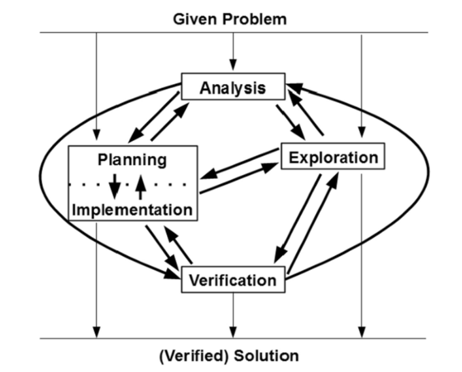
This research is prompted by junior high school pupils' low mathematical critical thinking skills in tackling non-routine situations. Students generally struggle with solution formulation and planning, indicating poor systematic and logical thinking. This study examines Junior High School 1 Bulukumba students' mathematical critical thinking skills in solving mathematical problems using Polya's Theory's four steps: Understanding the Problem, Planning a Solution, Implementing the Plan, and Looking Back. Grade VIII pupils of Junior High School 1 Bulukumba are the participants of this qualitative descriptive study. The study collects data through problem-solving tests based on non-routine issues, observation, and in-depth interviews. The results of the study indicate that most research subjects have been able to carry out Stage 1 (Understanding the Problem) well. However, significant weaknesses were identified in Stage 2 (Planning a Solution), where students have not been able to formulate appropriate and coherent strategies, and Stage 4 (Looking Back), where students tend to ignore validation and rechecking answers. A mechanistic approach without reflection still dominates students' critical mathematical thinking. This research helps teachers and schools diagnose pupils' critical thinking skills. These findings can be utilized to construct learning interventions that improve strategic planning and self-evaluation (reflection) skills in problem-solving contexts to "level up" students' mathematical thinking according to Polya's Theory.
References
Agustina, P., & Imami, A. I. (2022). Analisis Kemampuan Pemecahan Masalah Matematis Siswa Kelas IX dalam Menyelesaikan Soal Pisa Berdasarkan Langkah Polya. EduMatSains: Jurnal Pendidikan, Matematika Dan Sains, 7(1), 39-50.
Alam, A., & Mohanty, A. (2023). Cultural beliefs and equity in educational institutions: exploring the social and philosophical notions of ability groupings in teaching and learning of mathematics. International Journal of Adolescence and Youth, 28(1), 2270662. https://doi.org/10.1080/02673843.2023.2270662
Arfiana, A., & Wijaya, A. (2018). Problem solving skill of students of senior high schools and Islamic high schools in Tegal Regency in solving the problem of PISA based on Polya's stage. Jurnal Riset Pendidikan Matematika, 5(2), 211-222. https://doi.org/10.21831/jrpm.v5i2.15783
Boadu, S. K., & Bonyah, E. (2024). The role of philosophy of mathematics education in mathematics teacher education. Cogent Education, 11(1), 2433832. https://doi.org/10.1080/2331186X.2024.2433832
Haryati, E., & Warmi, A. (2021). Analisis Kemampuan Pemecahan Masalah Matematis Siswa SMP pada Materi Sistem Persamaan Linear Dua Variabel dengan Pembelajaran Daring. Jurnal Pendidikan Tambusai, 5(3), 6661-6670.
Khoerunnisa, G. M., & Imami, A. I. (2020). Analisis Kemampuan pemecahan masalah matematis siswa smp pada materi spldv. Prosiding Sesiomadika, 2(1b). https://journal.unsika.ac.id/index.php/sesiomadika/article/view/2750
Leong, Y. H., Toh, T. L., Tay, E. G., Quek, K. S., & Dindyal, J. (2012). Relooking ‘Look Back’: a student's attempt at problem solving using Polya's model. International Journal of Mathematical Education in Science and Technology, 43(3), 357-369. https://doi.org/10.1080/0020739X.2011.618558
Likourezos, V., & Kalyuga, S. (2017). Instruction-first and problem-solving-first approaches: Alternative pathways to learning complex tasks. Instructional Science, 45(2), 195-219. https://doi.org/10.1007/s11251-016-9399-4
Loibl, K., Roll, I., & Rummel, N. (2017). Towards a theory of when and how problem solving followed by instruction supports learning. Educational psychology review, 29(4), 693-715. https://doi.org/10.1007/s10648-016-9379-x
Miles, M. B., Huberman, A. M., & Saldaña, J. (2014). Qualitative data analysis: A methods sourcebook. 3rd.
Ni, Y., Zhou, D. H. R., Cai, J., Li, X., Li, Q., & Sun, I. X. (2018). Improving cognitive and affective learning outcomes of students through mathematics instructional tasks of high cognitive demand. The Journal of Educational Research, 111(6), 704-719. https://doi.org/10.1080/00220671.2017.1402748
Nilimaa, J. (2023). New examination approach for real-world creativity and problem-solving skills in mathematics. Trends in Higher Education, 2(3), 477-495. https://doi.org/10.3390/higheredu2030028
Piñeiro, J. L., Castro-Rodríguez, E., & Castro, E. (2022). What problem-solving knowledge is required in mathematical teaching? A curricular approach. Curriculum Perspectives, 42(1), 1-12. https://doi.org/10.1007/s41297-021-00152-6
Pradana, L. N. (2024). Problem-solving Strategy: Mathematical Problem-solving Model Within the Polya'Framework. KnE Social Sciences, 728-740.
Pratikno, H., & Retnowati, E. (2018). How Indonesian students use the Polya’s general problem solving steps. Southeast Asian Mathematics Education Journal, 8(1), 39-48. https://doi.org/10.46517/seamej.v8i1.62
Rahayu, I. F., & Aini, I. N. (2021). Analisi Kemampuan Pemecahan Masalah Matematis Siwa Smp Pada Materi Bilangan Bulat. Maju, 8(2), 60-66.
Royani, M., & Agustina, W. (2019). Junior high school students ability to use the Polya’s Step to solve Mathematical problems through problem based learning. International Journal of Trends in Mathematics Education Research, 2(2), 86-90. https://doi.org/10.33122/ijtmer.v2i2.112
Saputri, J. R., & Mampouw, H. L. (2018). Kemampuan pemecahan masalah dalam menyelesaikan soal materi pecahan oleh siswa SMP ditinjau dari tahapan Polya. Math Didactic: Jurnal Pendidikan Matematika, 4(2), 146-154.
Szabo, Z. K., Körtesi, P., Guncaga, J., Szabo, D., & Neag, R. (2020). Examples of problem-solving strategies in mathematics education supporting the sustainability of 21st-century skills. Sustainability, 12(23), 10113. https://doi.org/10.3390/su122310113
Ventistas, G., Ventista, O. M., & Tsani, P. (2025). The impact of realistic mathematics education on secondary school students’ problem-solving skills: a comparative evaluation study. Research in Mathematics Education, 27(3), 437-461. https://doi.org/10.1080/14794802.2024.2306633
Wang, M., Mohd Matore, M. E. E., & Rosli, R. (2025). A systematic literature review on analytical thinking development in mathematics education: trends across time and countries. Frontiers in Psychology, 16, 1523836. https://doi.org/10.3389/fpsyg.2025.1523836
Widiana, I. W., Japa, I. G. N., Suarjana, I. M., & Diputra, K. S. (2018). The students’ ability to solve realistic mathematical problems through Polya type problem solving learning model. Journal of Education and Learning (EduLearn), 12(3), 399-405. https://doi.org/10.11591/edulearn.v12i3.4526
Wu, H., & Molnár, G. (2022). Analysing complex problem-solving strategies from a cognitive perspective: The role of thinking skills. Journal of Intelligence, 10(3), 46. https://doi.org/10.3390/jintelligence10030046
Yazdi, M. (2024). Integration of computational mathematics in industrial decision-making. In Advances in Computational Mathematics for Industrial System Reliability and Maintainability (pp. 105-120). Cham: Springer Nature Switzerland. https://doi.org/10.1007/978-3-031-53514-7_6
Zhang, Q. (2022). Understanding Chinese mathematics teaching: How secondary mathematics teachers’ beliefs and knowledge influence their teaching in mainland China. ZDM–Mathematics Education, 54(3), 693-707. https://doi.org/10.1007/s11858-022-01336-8
Zhang, L., Cai, J., Song, N., Zhang, H., Chen, T., Zhang, Z., & Guo, F. (2022). Mathematical problem posing of elementary school students: The impact of task format and its relationship to problem solving. ZDM–Mathematics Education, 54(3), 497-512. https://doi.org/10.1007/s11858-021-01324-4
Downloads
Published
How to Cite
Issue
Section
License
Copyright (c) 2026 Fathrul Arriah, Ilhamuddin Ilhamuddin

This work is licensed under a Creative Commons Attribution-ShareAlike 4.0 International License.