Culturally Adaptive Religious Leadership and Islamic Education Development in Muslim Minority Communities from Eastern Indonesia

https://doi.org/10.51574/ijrer.v5i4.5396
Keywords:
Cultural Integration, Eastern Indonesia, Islamic Education, Local Wisdom, Social CohesionAbstract
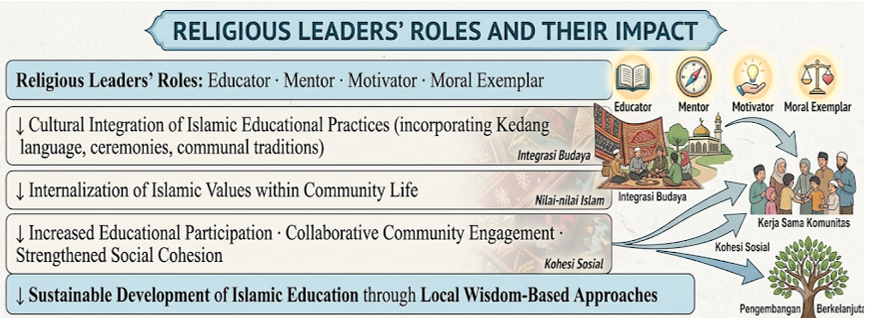
Religious leaders occupy a pivotal role in sustaining Islamic education within remote, heterogeneous Muslim minority communities, yet their specific mechanisms remain undertheorized. This study investigated the roles of religious leaders in strengthening Islamic education through cultural integration in Buyasuri District, Lembata, East Nusa Tenggara, Indonesia, alongside its socio-cultural implications. Employing a descriptive qualitative design, this study selected 15 participants across three villages via purposive sampling, including religious, educational, and community figures. Data were gathered through semi-structured interviews, participant observation, and document analysis over a three-month period. Analysis followed the Miles–Huberman–Saldaña interactive model, ensuring trustworthiness through triangulation and member checking. The findings revealed that religious leaders execute four interrelated roles—educator, mentor, motivator, and moral exemplar—across formal and nonformal settings. Cultural integration is enacted by embedding Islamic teachings within indigenous Kedang linguistic conventions, ceremonies, and communal gatherings. This culturally adaptive approach significantly enhances community participation, social solidarity, and religious engagement. Principal enablers include high community trust and institutional legitimacy, whereas structural deficits and geographical remoteness present major barriers. Ultimately, this study proposes a conceptual model linking religious leadership, cultural integration, value internalization, and community empowerment, advancing the theoretical understanding of religiously embedded education in multicultural contexts.
References
Abdullah, A., Asdam, M., & Alimbagu, A. (2025). The Reciprocal Acculturation of Islamic Culture and Local Culture in the Nusantara: A Historical Review. Jawi, 8(1), 77-90. https://doi.org/10.24042/00202582704000
Arifin, Z., & Maunah, B. (2020). Efforts to build a culture of transformational leadership in Islamic education institutions. Indonesian Journal of Islamic Education Studies (IJIES), 3(2), 127-140. https://ejournal.uit-lirboyo.ac.id/index.php/ijies/article/view/1204
Berry, J. W. (2023). The search for some general psychological principles for improving intercultural living in plural societies. Psychology and Developing Societies, 35(2), 278-301. https://doi.org/10.1177/09713336231178368
Creswell, J. W., & Poth, C. N. (2016). Qualitative inquiry and research design: Choosing among five approaches. Sage publications.
Efendi, D. R., & Rifa'i, A. A. (2025). Transformational leadership of school principals in the development of Islamic education. Nidhomiyyah: Jurnal Manajemen Pendidikan Islam, 6(2), 240-252. https://doi.org/10.38073/nidhomiyyah.v6i2.2719
Enworo, O. C. (2023). Application of Guba and Lincoln's parallel criteria to assess trustworthiness of qualitative research on indigenous social protection systems. Qualitative research journal, 23(4), 372-384. https://doi.org/10.1108/QRJ-08-2022-0116
Fahmi, I., Ningsih, T., & Yahya, M. S. (2026). Rural Communities as Agents Forming Religious Character in Education: A Socio-Cultural Perspective. Al Qalam: Jurnal Ilmiah Keagamaan dan Kemasyarakatan, 20(1), 46-69. https://doi.org/10.35931/aq.v20i1.5773
Fani, A. A., Suryana, E., & Zulhijra, Z. (2026). Sociocultural Theory and Its Implications for Islamic Education (PAI) Learning in Elementary Schools. Journal of Educational Sciences, 10(3), 40-51. https://doi.org/10.31258/jes.10.3.p.40-51
Fatmawati, A. I. (2022). Multicultural education in the concept of the philosophy of Islamic education. International Journal of Research and Review (IJRER), 1(3). https://doi.org/10.51574/ijrer.v1i3.437
Gano, A. A., Abdullahi, N., Adam, Z. L., & Setyawan, C. E. (2024). Integrating Islamic principles into human resource management: Advancing organizational success through Islamic education and ethical practices. Tadibia Islamika, 4(2), 62-74. https://doi.org/10.28918/tadibia.v4i2.9125
Gelderblom, D. (2018). The limits to bridging social capital: Power, social context and the theory of Robert Putnam. The Sociological Review, 66(6), 1309-1324. https://doi.org/10.1177/0038026118765360
Hamidalloh, A. S., Muhid, A., Rofiq, A. A., Permadi, M. S. S., & Saifullah, D. A. (2026). From the Cognitive Stage to the Zone of Proximal Development: A Theoretical Synthesis of Piaget and Vygotsky in the Perspective of Educational Psychology. Edusoshum: Journal of Islamic Education and Social Humanities, 6(1), 593-604. https://doi.org/10.52366/edusoshum.v6i1.339
Huda, M. (2024). Strengthening religious moderation through the core values of Islamic boarding school education. Al-Hayat: Journal of Islamic Education, 8(1), 59-71. https://doi.org/10.35723/ajie.v8i1.458
Ladkin, D., & Patrick, C. B. (2022). Whiteness in leadership theorizing: A critical analysis of race in Bass’ transformational leadership theory. Leadership, 18(2), 205-223. https://doi.org/10.1177/17427150211066442
Li, D. (2025). Cultural Centers as Agents of Educational Enhancement in Urban Schools. Education and Urban Society, 57(9), 859-901. https://doi.org/10.1177/00131245251338228
Makki, M., Najib, K. H., & Hakim, M. (2025). Connections between religious leaders and communities: The role of Tuan Guru in mobilizing community participation in Indonesia. Fikri: Jurnal Kajian Agama, Sosial Dan Budaya, 10(1), 15-29. https://doi.org/10.25217/jf.v10i1.5617
Miles, M. B., Huberman, A. M., & Saldana, J. (2014). Qualitative data analysis. sage.
Moffatt, K., Oxhandler, H. K., Polson, E. C., Currier, J. M., Perry, S., & Singletary, J. (2026). Religion and spirituality in personal and professional development opportunities for faculty across the mental health professions: A conceptual review. Journal of Spirituality in Mental Health, 28(2), 226-247. https://doi.org/10.1080/19349637.2025.2541364
Nordin, Z. S., Ruslan, I., Yusriadi, Y., Hamzah, N., & Darmadi, D. (2025). Integrating Islamic Law and Customary Law: Codification and Religious Identity in the Malay Buyan Community of Kapuas Hulu. J. Islamic L., 6, 89. https://doi.org/10.24260/jil.v6i1.3410
Nugroho, M. A. (2024). Religious tolerance model in Salatiga: Analysis of the implementation of religious moderation concept in a multicultural city. International Journal on Advanced Science, Education, and Religion, 7(4), 27-43. https://doi.org/10.33648/ijoaser.v7i4.732
Ok, A. H., Al-Farabi, M., & Firmansyah, F. (2022). Internalization of Multicultural Islamic Education Values In High School Students. Munaddhomah: Jurnal Manajemen Pendidikan Islam, 3(3), 221-228. https://doi.org/10.31538/munaddhomah.v3i3.265
O’Dwyer, E. P., Sparks, J. R., & Nabors Olah, L. (2023). Enacting a process for developing culturally relevant classroom assessments. Applied Measurement in Education, 36(3), 286-303. https://doi.org/10.1080/08957347.2023.2214652
Paisun, P., Maskuri, M., & Mistar, J. (2025). The Kiai’s Leadership in Harmonizing Chinese-Muslim Relations through Multicultural Islamic Education. Munaddhomah: Jurnal Manajemen Pendidikan Islam, 6(2), 329-344. https://doi.org/10.31538/munaddhomah.v6i2.1897
Pasulle, S., Pirol, A., & Nawas, M. Z. A. (2024). Acculturation of Aluk Todolo Culture and its Implications for Child Education in Muslim Rural Families. Al-Hayat: Journal of Islamic Education, 8(2), 446-456. https://doi.org/10.35723/ajie.v8i2.479
Patton, M. Q. (2015). Qualitative research & evaluation methods: Integrating theory and practice. SAGE Publications.
Rahman, N. A., & Azzahra, A. (2024). The role of Islamic education in preserving cultural identity amidst global modernity. Sinergi International Journal of Islamic Studies, 2(4), 257-271. https://doi.org/10.61194/ijis.v2i4.707
Rumjaun, A., & Narod, F. (2025). Social learning theory—albert bandura. In Science education in theory and practice: An introductory guide to learning theory (pp. 65-82). Cham: Springer Nature Switzerland. https://doi.org/10.1007/978-3-031-81351-1_5
Sabililhaq, I., Nursiah, A., & Munir, M. (2024). Analysis of Albert Bandura’s Social Cognitive Theory and Its Development in Islamic Religious Education. Religion Education Social Laa Roiba Journal, 6(12), 5498-5512. https://doi.org/10.47476/reslaj.v6i12.4642
Sahin, A. (2018). Critical issues in Islamic education studies: Rethinking Islamic and Western liberal secular values of education. Religions, 9(11), 335. https://doi.org/10.3390/rel9110335
Sandora, L. (2025). Integrating Cultural Perspectives in Education: An Anthropological Approach to Modern Pedagogy. International Journal for Science Review, 2(1), 42-53. https://doi.org/10.71364/ijfsr.v2i1.17
Setyaningtyas, N. A., & Alwiyah, N. (2022). Peran tokoh agama dalam menanamkan nilai pendidikan Islam pada karyawan Sritex di Perum Sri Sejahtera Kenep Sukoharjo. Jurnal Hurriah: Jurnal Evaluasi Pendidikan Dan Penelitian, 3(2), 59-70. https://academicareview.com/index.php/jh/article/view/87
Siregar, M. T. N., & Surya, M. A. (2025). The Contribution of Islamic Religious Leaders to the Spiritual and Social Life of the Community in Ledong Timur Village. Abrahamic Religions: Jurnal Studi Agama-Agama, 5(2), 240-249. https://doi.org/10.22373/arj.v5i2.32196
Sukman, S., & Bustami, M. R. (2025). Empowering Marginalized Indigenous Muslim Communities Through Islamic Education. Jurnal Pendidikan Islam, 11(1), 204-15.
Ullah, A. A., & Ming Yit Ho, H. (2021). Globalisation and cultures in Southeast Asia: Demise, fragmentation, transformation. Global Society, 35(2), 191-206. https://doi.org/10.1080/13600826.2020.1747992
Zalli, E. (2024). Globalization and education: exploring the exchange of ideas, values, and traditions in promoting cultural understanding and global citizenship. Interdisciplinary Journal of Research and Development, 11(1 S1), 55-55. https://doi.org/10.56345/ijrdv11n1s109
Downloads
Published
How to Cite
Issue
Section
License
Copyright (c) 2026 Fitrah Fauziah, Muhaemin Muhaemin, Fatmaridah Sabani

This work is licensed under a Creative Commons Attribution-ShareAlike 4.0 International License.