Enhancing Mathematical Representation Ability through ClassPoint-Assisted Situation-Based Learning

https://doi.org/10.51574/kognitif.v5i4.4314
Keywords:
Situation Based-Learning, ClassPoint , Mathematical RepresentationAbstract
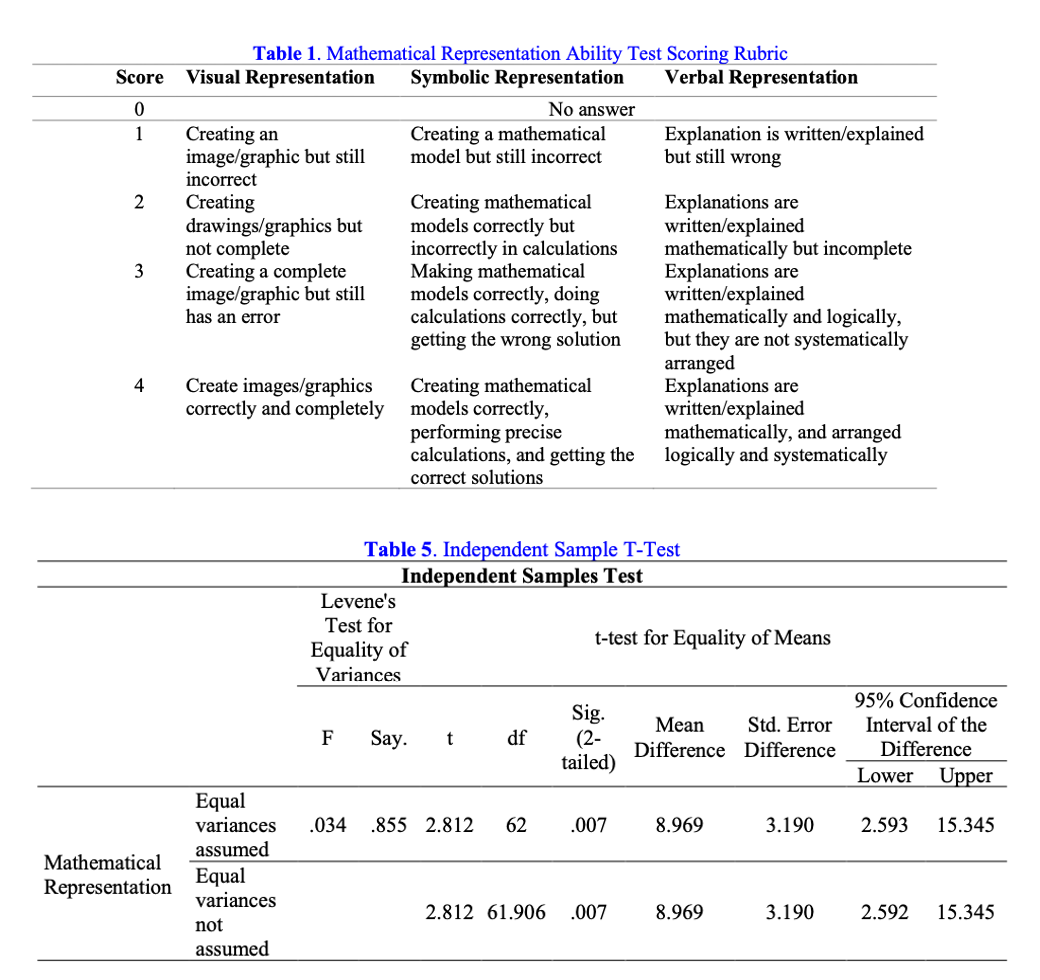
Mathematical representation skills are an important aspect in supporting students' success in mathematics learning. This study aims to determine the influence of ClassPoint-assisted Situation-Based Learning (SBL) learning model on students' mathematical representation skills. The results of the pre-research show that students' mathematical representation skills are still relatively low in presenting real-situation problems in visual, symbolic, and verbal forms. This condition shows that there is a gap between the demands of mathematics learning that emphasizes the ability to represent and learning practices that are still conventional. This study uses a quantitative method with a quasi-experimental design in the form of a posttest only control group design. The research sample consisted of two classes selected using cluster random sampling. The research instrument is in the form of a test of mathematical representation ability on equation material and quadratic functions. Data analysis used the Independent Sample T-Test at a significance level of 5%. The results of the study showed that the value of sig. 0.007 < 0.05, which indicates a significant influence of the application of the ClassPoint-assisted SBL learning model on students' mathematical representation skills. These findings provide an empirical contribution that ClassPoint-media-supported situation-based learning is effectively used as an alternative to mathematics learning to develop mathematical representation skills.
Downloads
References
Afni, N. N., Astawan, I. G., & Asril, N. M. (2024). The Effect of the Situation Based Learning (SBL) Learning Model on Numeracy Skills and Self-Efficacy Levels of Grade V Students at SDN I Baktiseraga. BADA'A: Scientific Journal of Basic Education, 6(1), 139–149. https://doi.org/10.37216/badaa.v6i1.1561
Apriliana, A. C., Hartati, T., & Sunendar, D. (2024). The Effect of Picture Word Inductive Classpoint and Wordwall-assisted Models on Reading Comprehension Ability is reviewed from Students' Reading Interests. Journal of Elementary Education, 7(1), 2431–2448. https://doi.org/10.31949/jee.v7i1.8916
Azmi, S., Sripatmi, Wulandari, N. P., Primajati, G., & Putri, B. E. D. (2025). The Effectiveness of Classpoint-Based Interactive Media to Improve Mathematical Communication Skills of Mathematics Education Students. Mandalika Mathematics and Education Journal, 7(September), 1417–1431.
Bibah, H., Maulidiyah, E. C., Fitri, R., & Mas'udah, M. (2023). The use of the hypnoteaching method using a great card game on the confidence of children aged 5-6 years. Kumarottama: Journal of Early Childhood Education, 2(2), 93–115. https://doi.org/10.53977/kumarottama.v2i2.689
Duval, R. (2006). A cognitive analysis of problems of comprehension in a learning of mathematics. Educational Studies in Mathematics, 61(1–2), 103–131.
Fajriah, N., Utami, C., & Mariyam. (2020). Analysis of Students' Mathematical Representation Ability in Statistical Materials. JOURNAL OF EDUCATIONAL REVIEW AND RESEARCH, 3(1), 14–24. https://doi.org/10.55606/jurrimipa.v1i1.160
Goldin, G. A. (2002). Representation in mathematical learning and problem solving. In L. D. English (Ed.), Handbook of international research in mathematics education (pp. 197–218).
Gravemeijer, K., & Doorman, M. (1999). Context problems in realistic mathematics education: A calculus course as an example. Educational Studies in Mathematics, 39(1–3), 111–129.
Hardianti, S. R., & Effendi, K. N. S. (2021). Analysis of Mathematical Representation Capability of High School Students in Class XI. Journal of Innovative Mathematical Learning, 4(5), 1093–1104. https://doi.org/10.22460/jpmi.v4i5.1093-1104
Isrok'atun. (2014). Development of Situation-Based Learning Model in Science Materials in Elementary Schools. National Seminar: University of Education Indonesia Sumedang Campus, 1(2), 69–77.
Isrok'atun, & Rosmala, A. (2018). Mathematical Learning Models (B. S. Fatmawati (ed.)). PT Bumi Askara.
Larawati, I., Isrok'atun, & Gusrayani, D. (2016). Application of the Situation-Based Learning Model to Properties and Simple Space Building Networks in Class IV SDN Paseh 1 Sumedang. Journal of Scientific Pen, 1(1).
Lesh, R., Post, T., & Behr, M. (1987). Representations and translations among representations in mathematics learning and problem solving. In J. Hiebert (Ed.), Problems of representation in the teaching and learning of mathematics (pp. 33–40). Lawrence Erlbaum Associates.
Lestari, I., Seruni, & Andinny, Y. (2024). Mathematical Representation Ability in the Variable Calculus Course through the Situation Based Learning Model. Lemma, 11(1), 14–24.
Rahman, F., Zulfikar, R. N., Aba, M. M., & Ralmugiz, U. (2024). Analysis of students' mathematical representation abilities in Pythagorean theorem material using the collaborative problem solving model. 5(2). https://doi.org/https://doi.org/10.32332/1dgt2k56
Sabrina, K. A., & Effendi, K. N. S. (2022). Students' Mathematical Representation Ability in Building Materials. Journal of Educatio FKIP UNMA, 8(1), 219–228. https://doi.org/10.31949/educatio.v8i1.1969
Sholehah, N. A., Yulianti, K., Gulvara, M. A., Kurniawan, S., & Rofi'ah, N. (2023). Students' Mathematical Representation Abilities: A Systematic Review. Journal of Innovative Mathematics Learning, 6(4), 1391–1408. https://doi.org/10.22460/jpmi.v6i4.17821
Siagian, M. D. (2017). Mathematics Learning in the Perspective of Constructivism. NIZHAMIYAH: Journal of Islamic Education and Educational Technology, VII(2), 61–73. https://doi.org/http://dx.doi.org/10.30821/niz.v7i2.188
Sianturi, R. (2022). Homogeneity test as a condition of analysis testing. 8(1), 386–397. https://doi.org/https://doi.org/10.53565/pssa.v8i1.507
Sugiyono. (2013). Quantitative, Qualitative and R&D Research Methodologies. ALPHABET.
Sundari, D. H., Iskandar, & Muhlis. (2021). The Application of Classpoint Presentation Media to Improve Student Learning Outcomes in MAN 19 Jakarta English Subjects. Journal of Learning Thought and Development, 3(3), 1–9.
Utari, W., Diningrat, R. B. S. N., & Azis, A. C. K. (2023). Interactive quiz media with the Classpoint app. Journal of INDOPEDIA (Innovation in Learning and Education), 1(2), 397–406.
Verina, I. (2023). Mathematical Representation Ability of Junior High School Students in Building Spatial Materials. Journal on Mathematics Education Research, 04(02), 38–53. https://doi.org/http://dx.doi.org/10.xxxxx/ijost.v2i2
Wicaksono, Buchori, A., & Nugroho, A. and. (2023). The Effectiveness of the Media Math-Assisted Probem Based Learning Model to Improve the Critical and Creative Thinking Skills of Elementary School Students. PGSD Scientific Journal FKIP Mandiri University, 09 (September), 1441–1456.
Yunita, W., Merliza, P., Loviana, S., & Mustika, J. (2021). Mathematical Ability for Teachers and Prospective Mathematics Teachers (Y. Yunarti & E. W. S. Wahyuni (eds.)). Idea Press Yogyakarta.
Zulfa, K., Muryani, S., & Dewi, N. R. (2023). The Application of the Number Head Together Cooperative Model assisted by Classpoint to Increase the Learning Interest of Class VIII Students of SMP Negeri 19 Semarang on Pressure Materials. National Seminar on Science XIII, 359–366.
Downloads
Published
How to Cite
Issue
Section
License
Copyright (c) 2025 Lulu Indah Lestari, Farida, Sri Purwanti Nasution

This work is licensed under a Creative Commons Attribution-ShareAlike 4.0 International License.
Education and Talent Development Center of Indonesia (ETDC Indonesia)
e-mail: kognitif@gmail.com, website : https://etdc-indonesia.com

Kognitif: Jurnal Riset HOTS Pendidikan Matematika dengan Situs: https://etdci.org/journal/kognitif berlisensi Creative Commons Attribution-ShareAlike 4.0 International License






.png)