Impact of the Outdoor Mathematical Modelling Model Within Differentiated Learning on Students’ Mathematical Literacy Skills

https://doi.org/10.51574/kognitif.v5i4.3926
Keywords:
Outdoor Modelling Mathematics, Differentiated Instruction, Mathematical Literacy SkillsAbstract
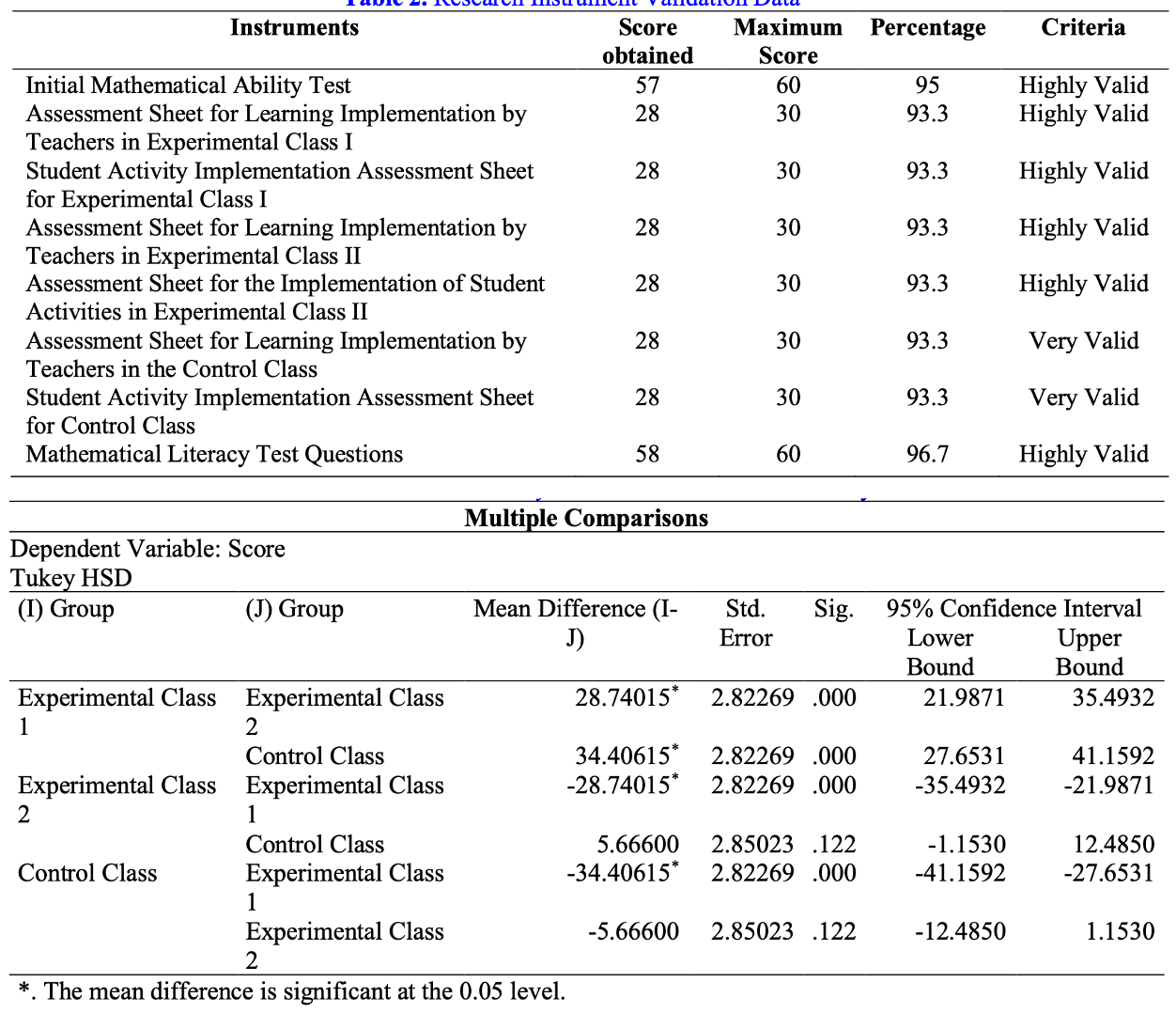
This study was motivated by the low mathematical literacy skills of students at SMP Negeri 17 Batanghari. Based on interview results, this condition occurs because the learning process is still teacher-centered and tends to be conventional, without considering differences in students' readiness and learning characteristics. One way to overcome this is by applying the outdoor modeling mathematics model combined with differentiated learning to accommodate differences in student abilities. This study aims to determine the effect of applying the outdoor modeling mathematics model in differentiated learning on students' mathematical literacy skills. This study uses an experimental design with a Posttest-Only Control Group Design. The research population consisted of all seventh-grade students at SMPN 17 Batanghari, comprising five classes. The research subjects involved three seventh-grade classes selected by simple random sampling. These were experiment class I, which applied the outdoor modeling mathematics model in differentiated learning; experiment class II, which applied the direct instruction model in differentiated learning; and the control class, which applied the direct instruction model. The instruments used in this study were a mathematical ability test, an observation sheet on the implementation of learning by teachers and students, and a posttest in the form of a student mathematical literacy test sheet. All instruments were validated through content validity by experts, namely mathematics education lecturers, to ensure the suitability of the instruments with mathematical literacy indicators and learning objectives. In addition, the test instruments were piloted on students with characteristics similar to the research subjects to obtain empirical validity using Product Moment correlation. The reliability of the test instruments was analyzed using Cronbach's Alpha coefficient so that the test instruments were declared reliable and suitable for use in the study. The analysis method applied was one-way ANOVA, followed by a post hoc Tukey test to process the data obtained. The research findings indicate that the use of the outdoor modeling mathematics model in differentiated learning is better at improving students' mathematical literacy skills, while the direct instruction model in differentiated learning does not show significant results when compared to the direct instruction model. In the three sample classes, the implementation of learning by teachers and students was very good. These findings recommend that mathematics teachers apply the outdoor modeling mathematics model in differentiated learning as an alternative to to improve their mathematical literacy skills.
Downloads
References
Arifani, H., Wardono, W., & Cahyono, A. N. (2021). Mathematics literacy skill based on self-directed learning on meaningful instructional design based outdoor learning. Unnes Journal of Mathematics Education Research, 10 (1), 26–31. https://journal.unnes.ac.id/sj u/index.php/ujmer/article/view/34281
Badriyana, S., Maidiyah, E., & Zubaidah, T. (2023). The Application of Outdoor Learning to Improve Student Learning Outcomes in Statistics at SMPN 8 Satu Atap Cekal. 8(1), 62–70. https://jurnalp4i.com/index.php/educator
Danuri, Waluya, S., Sugiman, & Sukestiyarno, Y. (2023). Differentiated Learning Model for Inclusive Elementary Schools.. http://repository.upy.ac.id/id/eprint/7144
Faiz, A., Pratama, A., & Kurniawaty, I. (2022). Differentiated Learning in the Teacher Activator Program in Module 2.1. Basicedu Journal, 6(2), 2846–2853. https://jbasic.org/index.php/basicedu
Fitriani, D., Rahman, F. R., Fauzi, A. D., Salamah, A. U., & Saefullah, A. (2023). Implementation of Differentiated Learning Based on Student Readiness Aspects in Senior High Schools. Genta Mulia Journal, 14 (2), 1–12. https://doi.org/10.61290/gm.v14i2.358
Fitriani, N. (2021). Analysis of Difficulty Level, Discrimination Power, and Effectiveness of Distractors. Paedagoria: Journal of Educational Studies, Research, and Development, 12(2), 199. http://journal.ummat.ac.id/index.php/paedagoria prefix doi: 10.31764
Hanum, A., Mujib, A., & Firmansyah, F. (2020). Students' Mathematical Literacy Using Gordang Sambilan Ethnomathematics. JIPMat, 5 (2), 173–184. https://doi.org/10.26877/jipmat.v5i2.6777
Hikmah, A., Prayitno, A., & Damayanti, N. W. (2020). Application of Outdoor Mathematics Learning with Manipulative Media to Improve Learning Outcomes. Journal of Student Research and Scientific Studies (JPPIM), 1(1), 10–20. https://www.wisnuwardhana.ac.id/jppim/index.php/jppim/article/view/4
Jauhari, M. N., Aulia Dwi Shanty, Alsyah Asfarina Subekti, & Adi Syahrul Romadlon. (2024). Merdeka Curriculum: Differentiated Learning Centered on Students. Kanigara, 4 (2), 113–118. https://doi.org/10.36456/kanigara.v4i2.9402
Juniansyah, J., Mariyam, M., & Buyung, B. (2023). Mathematical Literacy Skills of Grade VIII Students in Terms of Independent Learning. Cendekia Journal: Journal of Mathematics Education, 7 (2), 1167–1181. https://doi.org/10.31004/cendekia.v7i2.2224
Karim, N. (2025). Implementation of Outdoor Learning in Mathematics Education. Journal of Innovation in Education and Teaching Staff, 5(2), 84–93. https://doi.org/10.51878/educator.v5i2.5795
Ministry of Education, Culture, Research, and Technology. (2023). Reading Literacy, Indonesia's Ranking in PISA 2022. PISA Report by the Ministry of Education, Culture, Research, and Technology, 1–25. https://balaibahasaprovinsintb.kemendikdasmen.go.id/up loads/PPID_KvjKvBe20231206001241.pdf
Khasanah, R. U., & Fitriani. (2022). Analysis of Factors Affecting the Decision to Enroll at Muhammadiyah Metro University (Case Study of FEB Students Class of 2020). Journal of Diversification Management, 2(8.5.2017), 2003–2005. https://doi.org/10.24127/diversifikasi.v2i4.1355
Khristiani, H., Susanti, E. I., Purnamasari, N., Purba, M., Saad, M. Y., & Anggaeni. (2021). Model for Developing Differentiated Learning. https:// kurikulum.kemdikbud.go.id/wp-content/uploads/2022/03/Buku-Model-Pengembangan-Pembelajaran-Berdiferensiasi-SMPN-20-Tangsel-_5-Maretisbn.pdf
Kurniawati, L., Miftah, R., Kadir, & Muin, A. (2021). Mathematical Literacy in an Islamic Context. Insan Cendekia Mandiri. https://repository.uinjkt.ac.id/dspace/bitstream/123456789/704 95/1/Buku%20%20Referensi%20Literasi%20Konteks%20Keislaman.pdf
Kurnila, V. S., Juniati, D., & Lukito, A. (2025). Implementation, Principles and Stages of Differentiated Instruction in Mathematics Learning: A Systematic Literature Review. TEM Journal, 14 (1), 727–740. https://doi.org/10.18421/TEM141-65
Kusumawati, I., Lestrari, N. C., Sihombing, C., Purnawanti, F., Soemarsono, D. W. P., Kamadi, L., Latuheru, R. V., & Hanafi, S. (2023). Introduction to Education. CV. Rey Media Grafika. https://books.google.co.id/books?id=ZqrUEAAAQBAJ&lpg=PR2&hl= id&pg=PR2#v=onepage&q&f=false
Lestari, R. D., & Effendi, K. N. S. (2022). Analysis of Junior High School Students' Mathematical Literacy Skills in Flat Shapes. Biormatika : Scientific Journal of the Faculty of Teacher Training and Education, 8 (1), 63–73. https://doi.org/10.35569/biormatika.v8i1.1221
. Lubis, K. N., Nurmala, S., & Gusmaneli, G. (2024). Basic concepts of direct instruction . Guruku: Journal of Education and Social Humanities., 2(2), 60–70.
Manik, K. B., & Mohidin, A. D. (2024). Mathematical Literacy Skills of Students in Gorontalo. Scimadly, 3 (2), 67–73. https://doi.org/10.55657/rmns.v3 i2.77
Maulana, M. R. (2020). The Effect of Outdoor-Modeling Mathematics Based on the School Environment on Literacy Skills in Geometry Material in Grade IX of SMP 14 Kota Jambi. https://repository.unja.ac.id/13913/
Ningsih, A. D., Nurhasanah, & Fadillah, L. (2019). The Effectiveness of Outdoor Learning in Building Students' Self-Confidence in Science Subjects in Grade V of SDN 190 Cenning. Journal of Primary Education and Teaching, 4 (2), 1–12. https://doi.org/10.47435/jpdk.v4i2.314
Nugraha, A. A., Rizal, N., & Cahyono, A. N. (2023). Mathematical Modelling Ability in Outdoor Learning with Mobile Math Trails. International Journal on Emerging Mathematics Education, 7 (1), 1. https://doi.org/10.12928/ijeme.v7i1.24771
OECD. (2023). Program For International Student (PISA) 2022 Assessment and Analytical Framework. In OECD (Organisation for Economic Co-operation and Development) Publishing. https://www.oecd-ilibrary.org/education/pisa-2022-assessment-and-analytical
Palupi, R., & Prasetya, A. E. (2022). The Effect of Content Management System Implementation on Performance Speed Using One Way Anova. Scientific Journal of Informatics, 10 (01), 74–79. https://doi.org/10.33884/ji f.v10i01.4445
Pasinggi, Y. S., M, S. M., & Mursyida, C. (2023). Application of the Outdoor Learning Mathematics to Improve Mathematics Learning Outcomes of Fifth Grade Students at Uptd SD Negeri 59 Parepare. 6(2). https://ojs.unm.ac.id/pir/article/view/46669
Pitaloka, H., & Arsanti, M. (2022). Differentiated Learning in the Merdeka Curriculum. Sultan National Education Seminar ..., November, 2020–2023. http://jurnal.unissula. ac.id/index.php/sendiksa/article/view/27283
Purba, M., Purnamasari, N., Soetantyo, S., Suwarna, I. R., & Susanti, E. I. (2021). Academic Paper: Principles of Developing Differentiated Instruction. https://kurikulum.kemdikbud.go.id/wp-content/uploads/2022/arsip/Buku-Nasmik-ISBN.pdf
Putri, G. M. (2024). The Application of Outdoor Learning as an Effort to Improve Student Literacy at SDN 2 Songgon: Implementation of the Merdeka Curriculum. Mengabdi: Journal of Community Service Activities, 2 (2), 12–19. https://doi.org/10.61132/mengabdi.v2i2.491
Riyadi, Rintayati, P., Kamsiyati, S., Kurniawan, S., & Surya, A. (2023). Development of Differentiated Learning as the Actualization of the Teacher Education Program for Elementary School Teachers. 1–23. https://repository.penerbiteureka.com/publications/559527/ pengembangan-pembelajaran-berdiferensiasi-sebagai-aktualisasi-program-pendidikan
Riyanto, O. R., Yustitia, V., Husnah, N., Sari, M., Sukmaangara, B., & Indartiningsih, D. (2024). Mathematical Ability (Saluky (ed.)). Cv. Zenius Publisher. https://repository.ubharajaya.ac.id/31261/1/FULL%20BOOK%20CHAPTER%20KEMAMPUAN%20MATEMATIS%202024.pdf
Rohendi. (2022). Analysis of Mathematical Literacy Skills of Grade VIII Junior High School Students in Statistics. Science: Journal of Innovation in Mathematics and Science Education, 2 (3), 398–404. https://doi.org/10.51878/science.v2i3.1591
Rokhmawati, Mahmawati, D., & Yuswandari, K. D. (2023). Learning Planning (Improving Educator Quality). 02(01). https://ejournal.stitmiftahulmidad.ac.id/index. php/joedu
Sabila, Aisyah Q., Darmawanti, E., Aulia, U., & Gusmaneli. (2024). Implementation of Direct Learning Strategies in Improving Student Achievement at SMP Pertiwi 2 Padang in Islamic Education. Ihsanika: Journal of Islamic Education, 2 (3), 17–25. https://doi.org/10.59841/ihsanika.v2i2.1358
Shidqiya, A. I., & Indraswari, T. (2023). Differentiated Learning Using the Problem-Based Learning Model to Improve Mathematical Literacy and Student Engagement at SMPN 1 Semarang. 1–9. https://proceeding.unnes.ac.id/wpcgp/article/view/ 3342/2785
Sofnidar, Kamid, & Anwar, K. (2017). Syntactic Design of Outdoor Learning Model Based on Mathematical Modeling. EDUMATICA | Journal of Mathematics Education, 7 (02), 1–10. https://doi.org/10.22437/edumatica.v7i02.4211
Sofnidar, Kamid, & Khairul Anwar. (2019). Analysis of Junior High School Students' Learning Motivation in Outdoor-Modeling Mathematics Learning Based on Learning Styles. Talenta Conference Series: Science and Technology (ST), 2 (2). https://doi.org/10.32734/st.v2i2.549
Susilawati, S. A., & Sochiba, S. L. (2022). Outdoor study learning in Geography subjects: Systematic review. Journal of Geography Education, 27 (1), 51–62. https://doi.org/ 10.17977/um017v27i12022p51-62
Uhud, K., Listyarini, I., Saputra, B. A., & Alfiyah, S. (2024). The Effect of Differentiated Instruction on Mathematical Literacy Skills in Fifth Grade Students at SDN Pedurungan Tengah 02. Tambusai Education Journal, 8(2), 36334–36340. https://jptam.org/index.php/jptam/article/view/19418
Yuniarti, T., Patmawati, H., & Setialesmana, D. (2025). Improving Mathematical Literacy Skills Through Differentiated Instruction Based on Logical-Mathematical Intelligence. PHI: Journal of Mathematics Education, 9 (1), 104. https://doi.org/10.33087/phi.v9i1.459
Downloads
Published
How to Cite
Issue
Section
License
Copyright (c) 2025 Safitri Fatima Ningsih, Sofnidar, Dewi Iriani

This work is licensed under a Creative Commons Attribution-ShareAlike 4.0 International License.
Education and Talent Development Center of Indonesia (ETDC Indonesia)
e-mail: kognitif@gmail.com, website : https://etdc-indonesia.com

Kognitif: Jurnal Riset HOTS Pendidikan Matematika dengan Situs: https://etdci.org/journal/kognitif berlisensi Creative Commons Attribution-ShareAlike 4.0 International License






.png)