Analysis of Students’ Thinking Processes in Solving Mathematical Problems Based on Bruner’s Theory in Pythagorean Theorem Tasks

https://doi.org/10.51574/kognitif.v5i4.3916
Keywords:
Thinking Processes , Mathematical Problem Solving , Bruner's Theory , Pythagorean TheoremAbstract
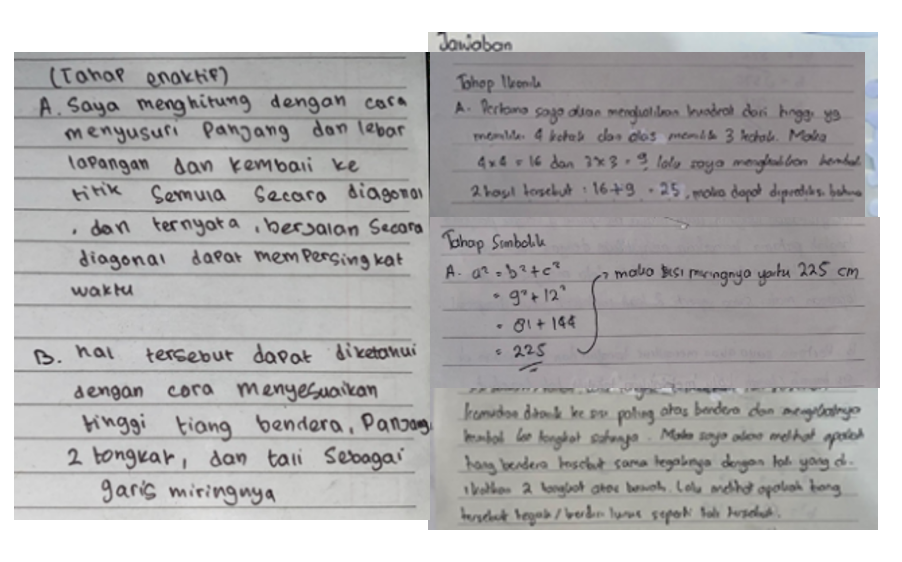
This study aims to describe and analyze the thinking processes of junior high school students in solving mathematical problems based on Bruner's theory in the context of the Pythagorean theorem. The study was conducted at SMP Negeri 7 Kota Jambi in May 2025. Data were collected through classroom observations as preliminary data, followed by questionnaires and problem-solving tests as primary data, and interviews as supporting data. All data were analyzed qualitatively. The findings show that at the enactive stage, most students demonstrated low performance; four students were categorized as poor, one as excellent, and one as good. At the iconic stage, student performance ranged from low to adequate, with one student rated excellent, two rated adequate, and three rated poor. At the symbolic stage, most students demonstrated high performance, with three students rated excellent, two rated good, and one rated poor. These results indicate that although students generally succeed at the symbolic stage, weaknesses at the enactive and iconic stages suggest that their understanding remains predominantly procedural rather than conceptual. Teachers are encouraged to apply learning strategies that intentionally strengthen all three of Bruner’s representational stages, rather than moving directly to symbolic reasoning without first providing concrete experiences and visual representations. Teachers should also consider students’ diverse thinking processes when designing instruction. Future studies should include larger samples and more diverse methods, such as quantitative or mixed-methods approaches, to further examine how representation-based strategies influence students’ mathematical problem-solving performance.
Downloads
References
Agustiani, N., Setiani, A., & Lukman, H. S. (2022). Development of PLSV Test Instruments Based on Critical Thinking and Problem-Solving Indicators. Jambura Journal of Mathematics Education, 3(2), 107–119. https://doi.org/10.34312/jmathedu.v3i2.15837
Amaliyah, A., & Rahmat, A. (2021). Developing Students' Self-Potential Through the Education Process. At-Ta`Dib, 5(1), 28–45. https://doi.org/10.32832/at-tadib.v5i1.19598
Andriani, U. T. (2023). Application of the Make A Match Cooperative Learning Model in Improving Mathematics Learning Activities on Simple Fractions Material for Class III Students of SD Negeri Banjarsari 1 Academic Year 2022/2023. Doctoral Dissertation, Universitas Panca Marga.
Astutiani, R., & Hidayah, I. (2019). Mathematical Problem-Solving Ability in Solving Word Problems Based on Polya's Steps. 297–308. Research and Development in Education (RaDEn), 5(1), 195–208. https://doi.org/10.22219/raden.v5i1.39567
Dewi, P., Nasution, T. A., Ahmad, W., & Nasution, F. (2023). Thinking Skills as Part of Students' Complex Cognitive Processes. Jurnal Dirosah Islamiyah, 5(2), 544-552. Jurnal Dirosah Islamiyah, 5(2), 544-552. https://doi.org/10.47467/jdi.v5i2.3072
Farid, M. (2024). History of Greek Mathematics. Darussalam: Jurnal Ilmiah Islam Dan Sosial, 25(02). https://doi.org/10.58791/drs.v25i02.135
Gaol, B. K. L., Silaban, P. J., & Sitepu, A. (2022). The Influence of Critical Thinking Ability on Student Learning Outcomes in the Theme of Our Environment Friends in Class V SD. Jurnal Pajar (Pendidikan Dan Pengajaran), 6(3), 767-782. https://www.semanticscholar.org/paper/PENGARUH-KEMAMPUAN-BERPIKIR-KRITIS-TERHADAP-HASIL-V-Gaol-Silaban/a710d13d4169befeb027c7c9a0c9e35a9f06c0ec
Halid, A. (2024). Prospects of Islamic religious education: an analytical study of law number 20 of 2003 concerning the Indonesian national education system. FAJAR Jurnal Pendidikan Islam, 4(1), 5-20. https://conferences.uin-malang.ac.id/index.php/icied/article/view/2626/1308
Hatip, A., & Setiawan, W. (2021). Bruner's cognitive theory in mathematics learning. PHI: Jurnal Pendidikan Matematika, 5(2), 87-97. https://phi.unbari.ac.id/index.php/phi/article/view/141/0
Khoiriyah, B. K., & Murni, M. (2021). The Role of Jerome Bruner's "Discovery Learning" Theory in Islamic Religious Education Learning. Thawalib: Jurnal Kependidikan Islam, 2(2), 67-80.
Kholid, M. N., Fakar, A. Z., Swastika, A., & Maharani, S. (2021). What are the Problem-solvers Thinking Types in Solving Analytical Geometry Problems? AKSIOMA: Jurnal Program Studi Pendidikan Matematika, 10(3), 1579-1588. http://dx.doi.org/10.24127/ajpm.v10i3.3790
Kurniawan, J., Hartoto, H., Fahmi, A. Z., Ahyani, H., Hikmah, H., Ridwan, M., & Hozairi, H. (2023). Data Analysis and Visualization. Https://Repository.Penerbitwidina.Com/Id/
Limbach, B., & Waugh, W. (2020). Developing higher level thinking. Journal of Instructional Pedagogies, 3(1), 1–9. https://eric.ed.gov/?id=EJ1097083
Mailani, O., Nuraeni, I., Syakila, S. A., & Lazuardi, J. (2022). Language as a communication tool in human life. Kampret Journal, 1(2), 1-10.https://doi.org/10.58471/justi.v10i02.91
Mulyasa, E. (2017). Mental Revolution in Education to Revitalize Pancasila Values and Develop National Insight. Proceedings of the National Seminar 20 Postgraduate Program, PGRI Palembang University, November 25, 2017, November, 188–192. https://jurnal.univpgri-palembang.ac.id/index.php/Prosidingpps/article/view/1330
Nur, A., & Utami, F. Y. (2022). Anthropological research process and steps: A literature review. Ad-Dariyah: Jurnal Dialektika, Sosial Dan Budaya, 3(1), 44-68. https://doi.org/10.55623/ad.v3i1.109
Purba, G. F. (2022). Implementation of the Indonesian Realistic Mathematics Education (PMRI) Approach on the Merdeka Belajar concept. Sepren, 4(01), 23-33. https://doi.org/10.36655/sepren.v4i01.732
Qudsiyah, B., Laila, F., Munir, B., Suprianto, W. D., & Nurhayati, N. (2023). The nature of education and education management in schools. Jurnal Multidisiplin Indonesia, 2(6), 1297-1303. file:///Users/muhammadikram/Downloads/Aizzatin_EDUMAN)FINALVERSION_2024.pdf
Rahman, et al., 2022. (2022). Pengertian_Pendidikan_Ilmu_Pendidikan_Da. L-Urwatul Wutsqa: Kajian Pendidikan Islam, 2(1), 1–8. https://journal.unismuh.ac.id/index.php/alurwatul/article/view/7757
Rosyidah, E., & Masykuroh, E. (2024). Strategies and Overcoming Challenges in Quantitative Method Research. Syntax Idea, 6(6), 2787-2803. https://spires.co/online-quantitative-methods-tutors/undergraduate/overcoming-quantitative-methods-challenges-common-problems-and-solutions
Safitri., E., Hartoyo., A., & Bistari. (2020). Mathematical Representation Ability of Area and Circumference of Circles Based on Bruner's Theory at SMPN 9 Pontianak. Pendidikan Dan Pembelajaran Khatulistiwa, 3, 1–11. https://doi.org/10.26418/jppk.v4i4.9734
Sansena, M. A. (2022). Application of mathematics learning process in accordance with Jean Piaget's cognitive development theory. Jurnal Ilmiah Penelitian Dan Kependidikan, 6(4), 39-46. https://doi.org/10.24042/00202472230200
Saputra, H. (2024). Development of mathematical thinking in elementary school-aged children. JEMARI (Jurnal Edukasi Madrasah Ibtidaiyah), 6(2), 53-64. https://doi.org/10.1080/00220272.2014.979233
Sugiyono. (2015). Quantitative, qualitative, and R&D research methods. Bandung: Alfabeta.
Sukmawati, N. I., & Rakhmawati, N. I. S. (2023). The Influence of STEAM (Science, Technology, Engineering, Art, And Mathematic) Learning to Improve Higher-Order Thinking Skills (Critical Thinking And Problem Solving) in Early Childhood. Concept: Journal of Social Humanities and Education, 2(1), 127-141. https://journal.unm.ac.id/index.php/icoesm/article/view/5933
Waruwu, M. (2024). Qualitative research approach: Concepts, procedures, advantages and role in education. Afeksi: Jurnal Penelitian Dan Evaluasi Pendidikan, 5(2), 198-211. https://idr.uin-antasari.ac.id/473/1/kualitatifrisetEDUCATION.pdf
Wibowo, A. (2024). Critical thinking ability. Penerbit Yayasan Prima Agus Teknik, 1-473.
Downloads
Published
How to Cite
Issue
Section
License
Copyright (c) 2025 M. Eza Wiranugraha, Roseli Theis, Dewi Iriani

This work is licensed under a Creative Commons Attribution-ShareAlike 4.0 International License.
Education and Talent Development Center of Indonesia (ETDC Indonesia)
e-mail: kognitif@gmail.com, website : https://etdc-indonesia.com

Kognitif: Jurnal Riset HOTS Pendidikan Matematika dengan Situs: https://etdci.org/journal/kognitif berlisensi Creative Commons Attribution-ShareAlike 4.0 International License






.png)