Analysis of Students' Computational Thinking Abilities Based on Self-esteem

https://doi.org/10.51574/kognitif.v6i3.5249
Keywords:
Analysis, Computational Thinking, Mathematics Education, Self-esteemAbstract
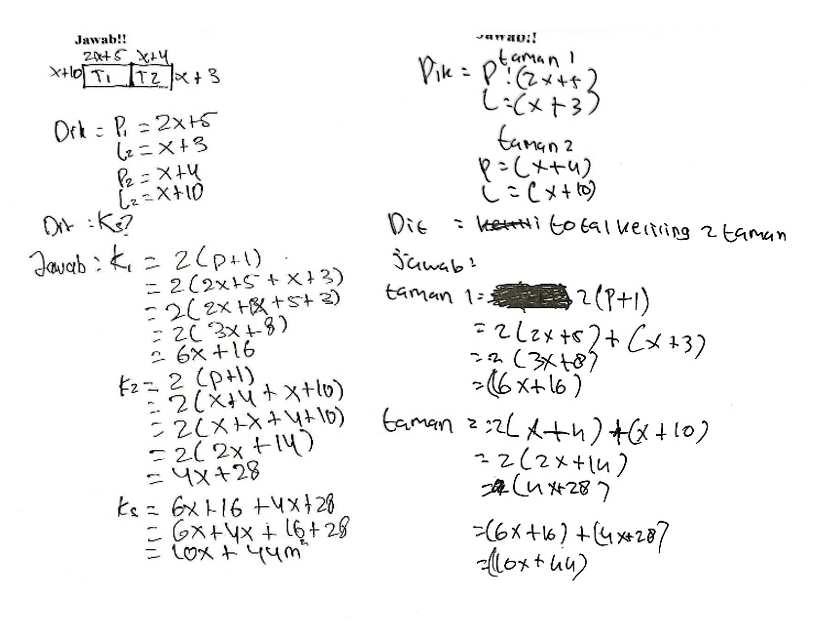
Computational Thinking (CT) skills are a fundamental 21st-century skill that is essential in solving mathematical problems, but its success is inseparable from affective factors such as Self-esteem. This research is important because there are still few in-depth qualitative studies that analyze the CT thinking process from the characteristics of Self-esteem. Restriction on categories only Self-esteemhigh and low (without medium category) are based on theory Rosenberg (1965). The purpose of this study is to describe the CT ability of students reviewed from Self-esteem high and low. The method used was qualitative exploratory with the subjects of four students of class IX C SMP Negeri 5 Tasikmalaya who were selected purposively (two with Self-esteem high and two with Self-esteem low) and able to meet all four CT indicators. Instruments include questionnaires Self-esteem Guttman scale, written tests on algebraic form stories, and semi-structured interview guidelines. Data collection was carried out through questionnaire distribution, CT tests, and in-depth interviews, while data analysis used the Miles & Huberman analysis framework (reduction, presentation, conclusion drawn) with triangulation techniques. The results showed that cognitively all subjects were able to meet all four CT indicators, but the tendency of their thought processes to differ qualitatively. Students with Self-esteem high tends to indicate a systematic, structured, and efficient thought process (for example, students tend to understand the problem immediately with confidence without difficulty simplifying algebra or tend to be more careful by double-checking). In contrast, students withSelf-esteemtend to be nervous, afraid of making mistakes, read questions repeatedly, and hesitating in determining patterns, and tend to panic at the beginning, forget formulas, and have time to ask friends. Implications, Self-esteemplays more role in shaping the quality of computational thinking experiences than simply determining the achievement of cognitive indicators
Downloads
References
Adu‐Gyamfi, K., Chandler, K., & Thompson, A. (2025). Algebra story problem: The nature of students' obstacles. School Science and Mathematics, 125(2), 140–153. https://doi.org/10.1111/ssm.12659
Anistyasari, Y., Ekohariadi, E., Buditjahjanto, I. G. P. A., & Hidayati, S. C. (2021). Exploring the psychometric properties of computational thinking assessment in introductory programming. 2021 International E-Engineering Education Services Conference (e-Engineering), 88–93. https://doi.org/10.1109/e-Engineering47629.2021.9470593
Asbell-Clarke, J., Rowe, E., Almeda, V., Edwards, T., Bardar, E., Gasca, S., Baker, R. S., & Scruggs, R. (2021). The development of students' computational thinking practices in elementary- and middle-school classes using the learning game, Zoombinis. Computers in Human Behavior, 115, 106587. https://doi.org/10.1016/j.chb.2020.106587
Azzahra, L. (2024). Pengembangan Multimedia Interaktif untuk Meningkatkan Kemampuan Pemecahan Masalah dan Self Confidence Siswa. DESIMAL: JOURNAL OF MATHEMATICS. 7(2), 359–372. https://doi.org/10.24042/djm.v7i2.22675
Bandura, A. (1986). Social foundations of thought and action. Englewood Cliffs, NJ, 1986(23–28), 2.
Benites, R. M., Díaz, G. M. F., Fonseca, D. G. B., & Fonseca, D. A. B. (2025). Influence of self-concept and self-esteem on academic achievement. Health, Science and Technology-Conference Series, 4, 632. https://doi.org/10.56294/sctconf2025632
Christi, S. R. N., & Rajiman, W. (2023). The Importance of Computational Thinking in Mathematics Learning. 05(04), 12590–12598. https://doi.org/10.31004/joe.v5i4.2246
Demir, K., Çaka, C., Yaman, N. D., İslamoğlu, H., & Kuzu, A. (2022). Examining the current definitions of computational thinking. In Research anthology on computational thinking, programming, and robotics in the classroom (pp. 224–252). IGI Global Scientific Publishing. https://doi.org/10.4018/978-1-6684-2411-7.ch011
Haniifah, S., & Nugraheni, E. A. (2024). Mathematical Computational Thinking Ability Reviewed from the Self Efficacy of Grade VIII Junior High School Students. 11(2), 188–202. https://doi.org/10.31316/jderivat.v11i2
Kumar, I., & Mohd, N. (2024). Ways of using computational thinking to improve students' ability to think critically. In Infrastructure Possibilities and Human-Centered Approaches With Industry 5.0 (pp. 253–266). IGI Global Scientific Publishing. https://doi.org/10.4018/979-8-3693-0782-3.ch015
Lee, S. W.-Y., Liang, J.-C., Hsu, C.-Y., & Tsai, M.-J. (2024). Students' beliefs about computer programming predict their computational thinking and computer programming self-efficacy. Interactive Learning Environments, 32(8), 4088–4108. https://doi.org/10.1080/10494820.2023.2194929
López-Caudana, E. O., George-Reyes, C. E., Glasserman-Morales, L. D., & Niedermeier, F. (2024). Computational Thinking Platform for Energy Education: Facilitating the Achievement of SDG 7 in Guatemala. International Conference on Technological Ecosystems for Enhancing Multiculturality, 964–973. https://doi.org/10.1007/978-981-96-5658-5_95
Maharani, P. P., Juandi, D., & Nurlaelah, E. (2024). Analysis of Computational Thinking Abilities of Junior High School Students in Solving Mathematical Problems Reviewed from Mathematical Habits of Mind. Sigma Didaktia: Journal of Mathematics Education, 12(1), 1–20. https://doi.org/10.17509/sigmadidaktika.v12i1.72518
Mendrofa, N. K. (2024). Computational Thinking Skills in 21st Century Mathematics Learning. 7, 792–801. https://doi.org/10.54371/jiip.v7i1.3780
Molero, M., Pérez-fuentes, M. C., & Martínez, A. M. (2022). Emotional intelligence and self-esteem : Personal competencies necessary for physicians. https://doi.org/10.3389/fmed.2022.965417
Nugraha, L. A., & Hajaroh, Y. S. (2025). Analyzing Students' Autonomy And Critical Thinking In Blended Learning Environments: A Case Study Of Edu Global High School. [EOS]2(1), 25–32. [EOS]https://doi.org/10.15575/educater.v2i1.2057
Nurwita, F., Kusumah, Y. S., & Priatna, N. (2022). Exploring students' mathematical computational thinking ability in solving pythagorean theorem problems. Al-Jabar: Journal of Mathematics Education, 13(2), 273–287. https://doi.org/10.24042/ajpm.v13i2.12496
Nuvitalia, D., Saptaningrum, E., Ristanto, S., & Putri, M. R. (2022). Profile of computational thinking ability of public junior high school students in Semarang City in 2022. Journal of Physics Learning Research, 13(2), 211–218. https://doi.org/10.26877/jp2f.v13i2.12794
Ogegbo, A. A., & Ramnarain, U. (2023). Computational thinking in science teaching and learning. In Fostering Science Teaching and Learning for the Fourth Industrial Revolution and Beyond (pp. 86–104). IGI Global Scientific Publishing. https://doi.org/10.4018/978-1-6684-6932-3.ch004
Pasterk, S., & Benke, G. (2024). Computational Thinking for Self-Regulated Learning. In Proceedings of the 2024 Innovation and Technology in Computer Science Education V. 1 (ITiCSE 2024), July 8â•fi10, 2024, Milan, Italy (Vol. 1, Issue 1). Association for Computing Machinery. https://doi.org/10.1145/3649217.3653565
Proctor, C. (2023). Computational thinking. In R. J. Tierney, F. Rizvi, & K. Ercikan (Eds.), International Encyclopedia of Education (Fourth Edition) (Fourth Edition, pp. 88–95). Elsevier. https://doi.org/10.1016/B978-0-12-818630-5.13078-7
Rahmatika Diah Silvia, Agnita Siska Pramasdyahsari, N. (2023). Analysis of students' computational thinking abilities in algebra materials reviewed from mathematical problem solving in Mathematics Education, University of PGRI Semarang From the PISA study in 2018, it is known that of the 79 countries that were used as the object of study, the. Prismatika: Journal of Mathematics Education and Research, 5(2), 176–190. 10.33503/prismatika.v5i2.2659
Rosenberg, M. (1965). Society and the adolescent self-image. Society and the adolescent self-image, 1–326. https://doi.org/10.2307/2575639
Saig, R., & Hershkovitz, A. (2024). Expanding digital literacies beyond the digital: Infusing computational thinking into unplugged pedagogical tools-Two case studies from mathematics education. International Journal of Child-Computer Interaction, 42, 100703. https://doi.org/10.1016/j.ijcci.2024.100703
Srinivasa, K. G., Kurni, M., & Saritha, K. (2022). Computational thinking. In Learning, teaching, and assessment methods for contemporary learners: Pedagogy for the digital generation (pp. 117–146). Springer. https://doi.org/10.1007/978-981-19-6734-4
Sugiyono. (2022). Metode Penelitian Kuantitatif, Kualitatif, dan R&D (Ed. 3). Alfabeta.
Tang, W. C., Kong, H., & Administrative, S. (2025). Innovative Mathematics Pedagogy: Evidence-Based Strategies for Enhancing Student Learning. Journal of Integrative Education Studies, 30–35. https://doi.org/10.64229/2q2ck886
Wing, J. M. (2008). Computational thinking and thinking about computing. Philosophical Transactions of the Royal Society A: Mathematical, Physical and Engineering Sciences, 366(1881), 3717–3725. https://doi.org/10.1098/rsta.2008.0118
Yasin, M., & Nusantara, T. (2023). Characteristics of pattern recognition to solve mathematical problems in computational thinking. AIP Conference Proceedings, 2569(1), 40009. https://doi.org/10.1063/5.0112171
Downloads
Published
How to Cite
Issue
Section
License
Copyright (c) 2026 This is an open-access under the CC-BY-SA license

This work is licensed under a Creative Commons Attribution-ShareAlike 4.0 International License.
Education and Talent Development Center of Indonesia (ETDC Indonesia)
e-mail: kognitif@gmail.com, website : https://etdc-indonesia.com

Kognitif: Jurnal Riset HOTS Pendidikan Matematika dengan Situs: https://etdci.org/journal/kognitif berlisensi Creative Commons Attribution-ShareAlike 4.0 International License






.png)