Improving Students’ Mathematical Reasoning Ability through the Use of the Joyful Learning Model Assisted by GeoGebra

https://doi.org/10.51574/kognitif.v6i1.1755
Keywords:
Improvement , Mathematical Reasoning Skills , Joyful Learning Model , GeogebraAbstract
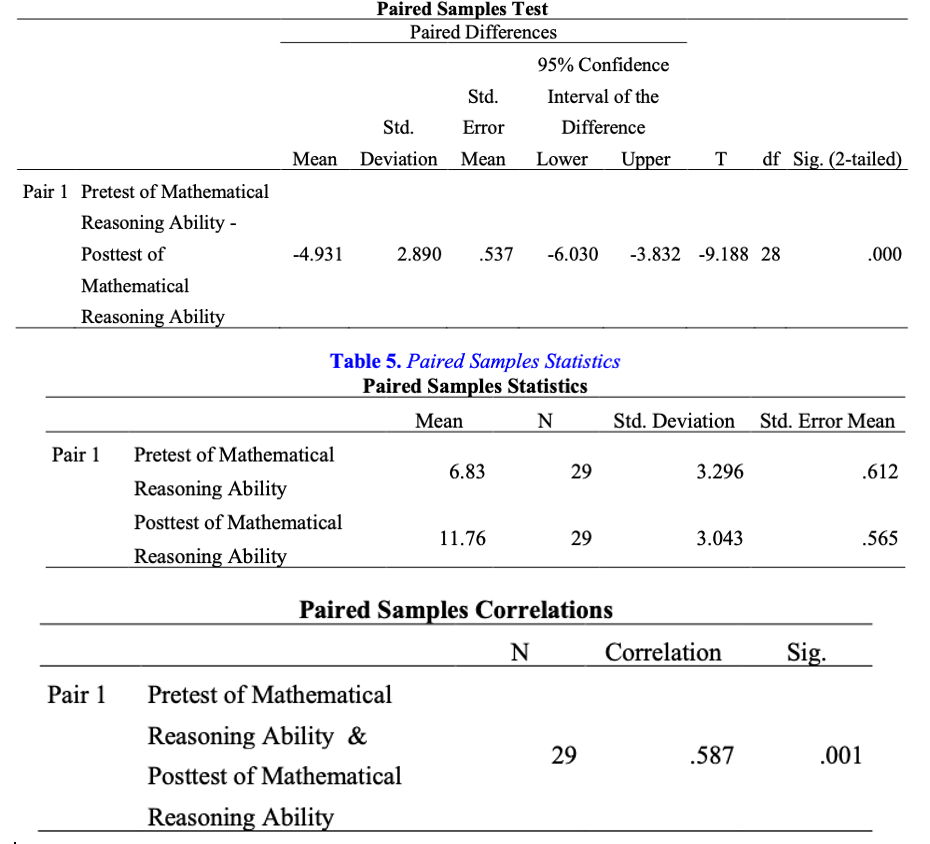
The mathematics learning process in schools often faces challenges such as low student engagement, limited conceptual understanding, and the dominance of less interactive teaching approaches. These conditions hinder the development of higher-order thinking skills, particularly students’ mathematical reasoning ability. Therefore, innovative and technology-assisted learning models are required to improve the effectiveness of mathematics instruction. This study aims to examine the improvement of students’ mathematical reasoning ability through the implementation of the Joyful Learning model assisted by GeoGebra. The research employed an experimental method using a One Group Pretest–Posttest Design. The population consisted of all seventh-grade students of SMP 3 Al-Muhajirin, while the sample comprised 29 students from Class VII E selected using a simple random sampling technique. Data were collected using an essay-based test designed to measure mathematical reasoning ability and administered before and after the learning intervention. Statistical analysis was conducted using normality testing and the Wilcoxon signed-rank test with the support of IBM SPSS Statistics 24. The results indicate a statistically significant difference between pretest and posttest scores, showing an improvement in students’ mathematical reasoning ability after the implementation of the Joyful Learning model assisted by GeoGebra. This improvement reflects students’ enhanced ability to propose conjectures, identify patterns, apply mathematical manipulation, and draw logical conclusions. These findings suggest that the integration of the Joyful Learning model and GeoGebra is an effective instructional approach for fostering mathematical reasoning ability and creating a more engaging mathematics learning environment.
Downloads
References
Akhmad, G. P. A. (2014). Efektivitas Pembelajaran Matematika Dengan Pendekatan Model-Eliciting Activities (MEAs) Pada Materi Persamaan Dan Pertidaksamaan Linear Satu Variabel Di Kelas VII-A SMP Negeri 1 Lamongan. Jurnal Ilmiah Pendidikan Matematika, 3(2), 97–102. https://doi.org/10.26740/mathedunesa.v3n2.p%25p
Akuba, S. F., Purnamasari, D., & Firdaus, R. (2020). Pengaruh Kemampuan Penalaran, Efikasi Diri dan Kemampuan Memecahkan Masalah Terhadap Penguasaan Konsep Matematika. JNPM (Jurnal Nasional Pendidikan Matematika), 4(1), 44. https://doi.org/10.33603/jnpm.v4i1.2827
Aprilianti, Y., & Zanthy, L. S. (2022). Analisis Kemampuan Penalaran Matematik Siswa SMP pada Materi Segiempat dan Segitiga. Journal on Education, 8(1), 524–532. https://doi.org/10.31004/joe.v1i2.167
Dewi, K. C., & Prihatnani, E. (2022). Penerapan Joyful Learning untuk Meningkat Hasil Belajar pada Materi Bilangan Bulat Kelas VII SMP Negeri 3 Pati. Jurnal PTK dan Pendidikan, 8(2). https://doi.org/10.18592/ptk.v8i2.5991
Fitriani, Maifa, T. S., & Bete, H. (2019). Pemanfaatan Software Geogebra dalam Pembelajaran Matematika. Jurnal Pendidikan dan Pengabdian Masyarakat, 2(4), 2614–7947. https://doi.org/10.29303/jppm.v2i4.1507
Istiqomah, U., & Prihatnani, E. (2019). Peningkatan Hasil Belajar dan Sikap Siswa terhadap Matematika melalui Joyful Learning. Mosharafa: Jurnal Pe, 8(September), 471–482. http://journal.institutpendidikan.ac.id/index.php/mosharafa%0Amenarik,
Japa, N., Suarjana, I., & Widiana, W. (2017). Media Geogebra Dalam Pembelajaran Matematika. International Journal of Natural Science and Engineering, 1(2), 40–47. https://doi.org/10.23887/ijnse.v1i2.12467
Maf’ulah, S., Wulandari, S., Jauhariyah, L., & Ngateno. (2021). Pembelajaran Matematika dengan Media Software GeoGebra Materi Dimensi Tiga. Mosharafa: Jurnal Pendidikan Matematika, 10(3), 449–460. http://journal.institutpendidikan.ac.id/index.php/mosharafa
Mokotjo, L. G., & Mokhele, M. L. (2021). Challenges of Integrating GeoGebra in the Teaching of Mathematics in South African High Schools. Universal Journal of Educational Research, 9(5), 963–973. https://doi.org/10.13189/ujer.2021.090509
Nurfalaq, M., Wahyuni, N., Prasetyo, M. M., Sitti Wirda, & Nurhidayah, N. (2022). Penerapan Model Pembelajaran Menyenangkan (Joyfull Learning) dalam Meningkatkan Hasil Belajar IPA. Jurnal Biotek, 10(1), 102–116. https://doi.org/10.24252/jb.v10i1.29297
Nurhasanah, S., Jayadi, A., Sa’diyah, R., & Syafrimen. (2019). Strategi Pembelajaran (A. R. Sophe (ed.); Pertama). Edu Pustaka.
Pamungkas, A. S., & Yuhana, Y. (2016). Pengembangan Bahan Ajar untuk Peningkatan Kemampuan Penalaran Matematis Mahasiswa Calon Guru Matematika. Jurnal Penelitian dan Pembelajaran Matematika (JPPM), 9(2), 177–182. https://jurnal.untirta.ac.id/index.php/JPPM/article/view/995
Peraturan Menteri Pendidikan dan Kebudayaan Nomor 58 Tahun 2014 Tentang Kurikulum 2013 Sekolah Menengah Pertama/Madrasah Tsanawiyah, Pub. L. No. 58, 51 (2014).
Praharsini, A., & Ahsani, E. L. (2023). Pembelajaran Joyfull Learning dengan Puzzle Game Berbasis Eksperimen: Meningkatkan Minat Siswa Mata Pelajaran IPA. Fashluna, 4(1), 25–39. https://doi.org/https://doi.org/10.47625/fashluna.v4i1.440
Rachmatika, A. R., & Wardono. (2019). Peran Kemampuan Berpikir Kritis Siswa Pada Pembelajaran Matematika Dengan Pemecahan Masalah. Prosiding Seminar Nasional Matematika, 2(1), 441. https://journal.unnes.ac.id/sju/index.php/prisma/ ISSN
Rahmawati, K. D., & Astuti, D. (2022). Kemampuan Penalaran Matematis Siswa SMA pada Materi Pertidaksamaan Dua Variabel. Plusminus: Jurnal Pendidikan Matematika, 2(2), 187–200. https://doi.org/10.31980/plusminus.v2i2.1763
Sari, Y., & Prihatnani, E. (2017). Penerapan Metode Joyful Learning untuk Meningkatkan Hasil Belajar Matematika dan Mengurangi Kecemasan Belajar Matematika pada Siswa Kelas VIIIA SMP Kristen 2 Salatiga. Universitas Satya Wacana. http://repository.uksw.edu/handle/123456789/14614
Silalahi, U. (2018). Metodologi Analisi Data dan Interpretasi Hasil untuk Penelitian Sosial Kuantitatif (N. F. Stif (ed.); kesatu). PT. Refika Aditama.
Sufiani, & Marzuki. (2021). Joyful Learning: Strategi Alternatif menuju Pembelajaran Menyenangkan. Zawiyah: Jurnal Pemikiran Islam, 7(1), 121–141. https://doi.org/http://dx.doi.org/10.31332/zjpi.v7i1.2892
Sugiyono. (2019). Metode Penelitian & Pengembangan (Reseach and Development) (Vol. 67). Alfabeta.
Suprihatin, T. R., Maya, R., & Senjayawati, E. (2018). Analisis Kemampuan Penalaran Matematis Siswa SMP pada Materi Segitiga dan Segiempat. JKPM: Jurnal Kajian Pembelajaram Matematika, 2(1), 9–13. https://doi.org/10.31004/cendekia.v2i1.36
Suwarsih, S. (2018). Meningkatkan Hasil Belajar Siswa Tentang Perkalian dan Pembagian Bilangan Cacah Melalui Alat Peraga. Mosharafa: Jurnal Pe, 7(September), 433–444. https://doi.org/http://dx.doi.org/10.31980/mosharafa.v7i3.155
Wiryana, R., & Alim, J. A. (2023). Permasalahan Pembelajaran Matematika Di Sekolah Dasar. Jurnal Kiprah Pendidikan, 2(3), 271–277. https://doi.org/10.33578/kpd.v2i3.187
Downloads
Published
How to Cite
Issue
Section
License
Copyright (c) 2026 Silpa Rahmawati, Ipah Muzdalipah, Siska Ryane Muslim

This work is licensed under a Creative Commons Attribution-ShareAlike 4.0 International License.
Education and Talent Development Center of Indonesia (ETDC Indonesia)
e-mail: kognitif@gmail.com, website : https://etdc-indonesia.com

Kognitif: Jurnal Riset HOTS Pendidikan Matematika dengan Situs: https://etdci.org/journal/kognitif berlisensi Creative Commons Attribution-ShareAlike 4.0 International License






.png)