Integration of Artificial Intelligence in Microteaching and it’s Impact on Self-Confidence and Anxiety in Teaching Students

https://doi.org/10.51574/kognitif.v6i2.4892
Keywords:
Artificial Intelligence, Microteaching, Teaching Anxiety, Teacher Education, Teaching Self-ConfidenceAbstract
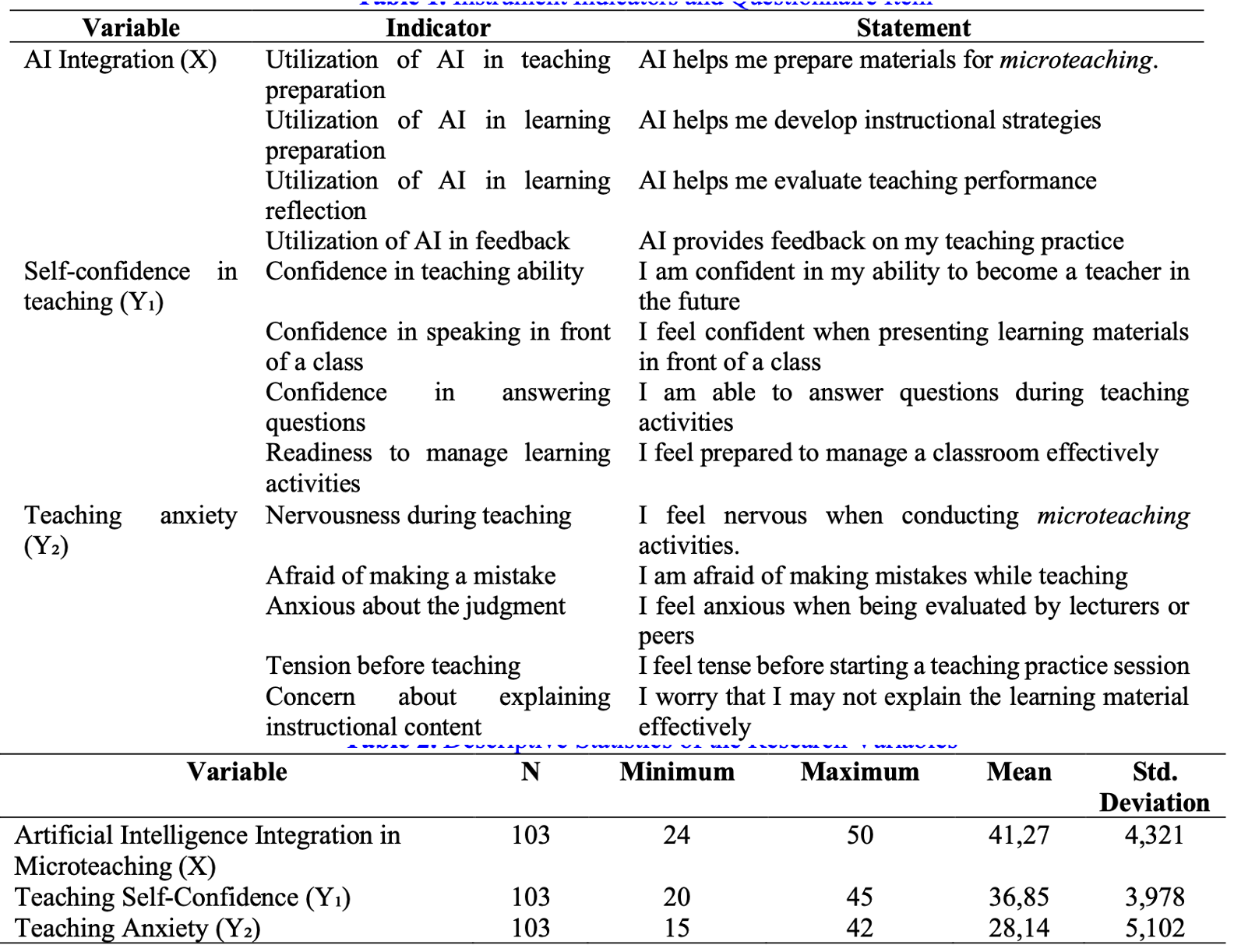
In this study, the integration of AI in microteaching was operationalized through the use of AI-based technologies in lesson planning, instructional material development, teaching practice simulations, and automated feedback provision. However, mathematics education students still face psychological challenges, particularly related to self-confidence and teaching anxiety during teaching practice. This study aimed to analyze the relationship between AI integration in microteaching and the teaching self-confidence and teaching anxiety of mathematics education students. The research employed a quantitative approach with an ex post facto design and involved 103 students from the Mathematics Education Study Program at UIN Raden Intan Lampung as respondents. Data were collected through questionnaires and analyzed using statistical software through two separate simple linear regression models, namely to examine the relationship between AI integration (X) and teaching self-confidence (Y₁), and between AI integration (X) and teaching anxiety (Y₂). The results showed that AI integration had a positive and significant relationship with teaching self-confidence, with a coefficient of determination of R² = 0.414. In contrast, AI integration demonstrated a negative and significant relationship with teaching anxiety, with a coefficient of determination of R² = 0.088. The novelty of this study lies in its examination of AI integration in microteaching by simultaneously investigating the aspects of teaching self-confidence and teaching anxiety among prospective mathematics teachers. The findings imply that the utilization of AI in microteaching can support the pedagogical and psychological readiness of prospective teachers in the context of 21st-century education.
Downloads
References
Amobi, B. F. A. (2005). Preservice Teachers ’ Reflectivity on the Sequence and Consequences of Teaching Actions in a Microteaching Experience.32(1), 115–130. https://www.jstor.org/stable/23478692
Bandura, A. (1997). . Self-efficacy: The exercise of control.New York: Freeman.
Chen, L., & Chen, P. (2020). Artificial Intelligence in Education : A Review. 8. https://doi.org/10.1109/ACCESS.2020.2988510
Darling-Hammond, L., & Hyler, M. E. (202 C.E.). Preparing educators for the time of COVID and beyond. European Journal of Teacher Education, 43(4), 457–465. https://doi.org/10.1080/02619768.2020.1816961
Dede, C. (2010). Comparing frameworks for 21st century skills. In J. Bellanca & R. Brandt (Eds.), 21st century skills (pp. 51–76).Blomington: Solution Tree Press.
Fadel, C., Holmes, W., & Bialik, M. (2019). Artificial intelligence in education: Promises and implications for teaching and learning. Boston: Center for Curriculum Redesign.
Fraenkel, J. R., Wallen, N. E., & Hyun, H. H. (2012). How to design and evaluate research in education (8th ed.). New York: McGraw-Hill.
Goleman, D. (1995). Emotional intelligence.New York: Bantam Books.
Gwo-Jen Hwang, Xie, H., Wah, B. W., & Gašević, D. (2020). Vision, challenges, roles and research issues of artificial intelligence in education. Computers and Education: Artificial Intelligence, 1. https://doi.org/10.1016/j.caeai.2020.100001
Hair, J. F., Black, W. C., Babin, B. J., & Anderson, R. E. (2019). Multivariate data analysis (8th ed.). Hampshire: Cengage Learning.
Hama, H. Q., & Osam, Ü. V. (2021). Revisiting Microteaching in Search of Up-to-Date Solutions to Old Problems. SAGE Open,. 11(4). https://doi.org/10.1177/21582440211061534
Holmes, W., Bialik, M., & Fadel, C. (n.d.). Artificial Intelligence In Education:Promises and implications for teaching and learning. Boston: Center for Curriculum Redesign.
Horwitz, E. K., Horwitz, M. B., & Cope, J. (1986). Foreign language classroom anxiety. The Modern Language Journal, 70(2), 125–132. https://www.jstor.org/stable/327317
Kauchak, D., & Eggen, P. (2017). Learning and teaching: Research-based methods (7th ed.). Boston: Pearson.
Kerlinger, F. N., & Lee, H. B. (2000). Foundations of behavioral research (4th ed.). Belmont: Wadsworth.
Mulyasa, E. (2013). Menjadi guru profesional. Remaja Rosdakarya.
Nasution, S. (n.d.). Berbagai pendekatan dalam proses belajar dan mengajar. Bumi Aksara.
OECD. (2021). AI and the future of skills. . OECD Publishing.
Pajares, F. (2001). Overview of social cognitive theory and self-efficacy. Theory Into Practice, ,. 41(2), 1–10.
Prensky, M. (2010). Teaching digital natives: Partnering for real learning.California: Corwin Press .
Rahmawati, F., Nuraini, S., Fitriani, N., & Afriyanto, V. N. (2024). Virtual Reality Assisted Microteaching For Improving Teaching Skills of Prospective Teachers. Economic Education and Entrepreneurship Journal, 7(2), 230–234. http://dx.doi.org/10.23960/E3J/v7.i2.230-234
Scherer, R., Howard, S. K., Tondeur, J., & Siddiq, F. (2021). Profiling teachers’ readiness for online teaching and learning in higher education. https://doi.org/. https://doi.org/10.1016/j.chb.2020.106675
Schunk, D. H., & DiBenedetto, M. K. (2020). Motivation and social cognitive theory. Contemporary Educational Psychology, , 60. https://doi.org/101832. https://doi.org/10.1016/j.cedpsych.2019.101832
Seo, K., Tang, J., Roll, I., Fels, S., & Yoon, D. (2021). The impact of artificial intelligence on learner–instructor interaction in online learning. International Journal of Educational Technology in Higher Education, 18(54), 1–23. https://doi.org/10.1186/s41239-021-00292-9
Seters, V. (2020). Computers and Education : Arti fi cial Intelligence. 1, 1–5. https://doi.org/10.1016/j.caeai.2020.100001
Sugiyono. (2022). . Metode penelitian kuantitatif, kualitatif, dan R&D. Bandung: Alfabeta..
Suharsimi, A. (2019). Prosedur penelitian: Suatu pendekatan praktik. Rineka Cipta.
Viberg, O.,Khalil, M., & Baars, M. (2020). Pembelajaran Mandiri dan Analisis Pembelajaran dalam Lingkungan Pembalajaran Dring: Tinjauan Penelitian Empiris. 524–533. https://doi.org/10.1145/3375462.3375483
Vygotsky, L. S. (1987). Mind in society: The development of higher psychological processes. Cambridge: Harvard University Press.
Xuesong Zhai, Chu, X., Chai, C. S., Jong, M. S. Y., & Li, Y. (2021). A review of artificial intelligence (AI) in education from 2010 to 2020. Complexity, ,. 1–18. https://doi.org/10.1155/2021/8812542
Zimmerman, B. J. (2000). Self-efficacy: An essential motive to learn. Contemporary Educational Psychology,. 25(1), 82–91. https://doi.org/10.1006/ceps.1999.1016
Downloads
Published
How to Cite
Issue
Section
License
Copyright (c) 2026 This is an open-access under the CC-BY-SA license

This work is licensed under a Creative Commons Attribution-ShareAlike 4.0 International License.
Education and Talent Development Center of Indonesia (ETDC Indonesia)
e-mail: kognitif@gmail.com, website : https://etdc-indonesia.com

Kognitif: Jurnal Riset HOTS Pendidikan Matematika dengan Situs: https://etdci.org/journal/kognitif berlisensi Creative Commons Attribution-ShareAlike 4.0 International License






.png)