Mathematics in the Tradition of Nusantara Architecture: An Effort to Improve Students’ Problem-Solving Skills

https://doi.org/10.51574/kognitif.v5i4.4083
Keywords:
Nusantara Architecture , Contextual Learning , Number Patterns , Problem SolvingAbstract
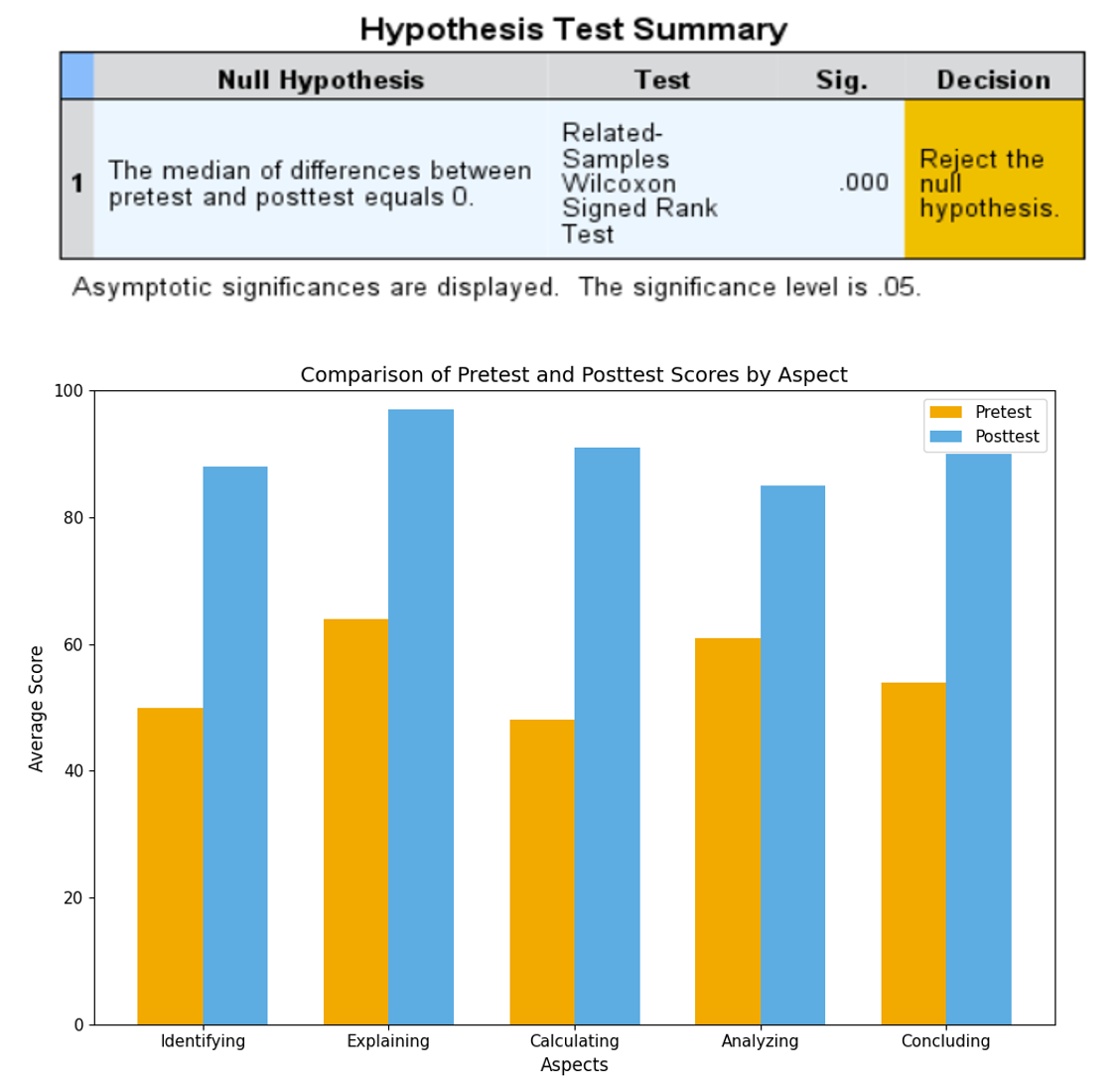
Previous research has explored students' problem-solving abilities, yet few studies have incorporated elements of Nusantara architecture into the mathematics learning process. This study aims to examine the changes in students’ problem-solving skills following the implementation of Nusantara architecture-based learning in the topic of number patterns. This approach is operationalized through the utilization of carving motifs, symmetrical structures of traditional buildings, and construction rhythms as concrete representations of number pattern concepts. The research employed a one-group pretest–posttest design, involving 33 eighth-grade students from SMP Negeri 7 Bandar Lampung as participants. The research instruments consisted of a problem-solving ability test and a student response questionnaire, while the learning process was conducted over four meetings. Because the data did not meet the assumption of normality, the analysis was conducted using the Wilcoxon Signed Rank Test and N-gain calculations to determine the magnitude of improvement in learning outcomes. The results of the analysis showed a significance value of 0.000 < 0.05, indicating a significant difference between the scores before and after the treatment. The N-gain value of 0.7700 falls into the high category, indicating that Nusantara architecture–based learning is able to improve students’ mathematical problem-solving abilities. In addition, the questionnaire results showed that most students gave positive responses to the implementation of this learning approach. Overall, Nusantara architecture–based learning has been proven effective in strengthening students’ understanding of mathematical concepts and providing a more contextual, creative, and culturally grounded learning experience.
Downloads
References
Afifah, N., Setiawani, S., Prihandini, R. M., & Berliana, A. (2025). Aplikasi Uji Wilcoxon Signed Rank untuk Menganalisis Pengaruh COVID-19 pada Prestasi Belajar Wilcoxon Signed Rank Test to Analyze COVID-19 ’ s Impact on Learning Achievement. 10(2). https://doi.org/10.56013/axi.v10i2.3668
Agustian, L., & Sastrawati, E. (2025). Eksplorasi Exploration of Ethnomathematics in the Architecture of Traditional Houses of the Komering Tribe for Geometry Learning. 13(2), 172–182. https://doi.org/10.21831/jpms.v13i1.85335
Aiken, L. R. (1985). Three Coefficients for Analyzing the Reliability and Validity of Ratings.
Bagis, F., Faridli, E. M., & Hasanah, U. (2025). Mental Health Evaluation As A Preventive Measure For Student Academic Disorders. 6(1), 21–30. EDUCATION JOURNAL OF INDONESIA, 6(1). https://doi.org/10.30596/eji.v6i1.4645
Bedewy, S. El, Lavicza, Z., & Lyublinskaya, I. (2024). STEAM practices connecting mathematics , arts , architecture , culture and history in a non-formal learning environment of a museum. 3472. https://doi.org/10.1080/17513472.2024.2321563
Chen, W. H., & Ja’Faruddin. (2021). Traditional Houses and Projective Geometry: Building Numbers and Projective Coordinates. Journal of Applied Mathematics, 2021. https://doi.org/10.1155/2021/9928900
Creswell, J. w. (2013). Research Design: Qualitative, Quantitative, and Mixed Methods Approaches (4th ed.). SAGE Publications.
Creswell, J. W. & J. D. C. (2018). Research Design: Qualitative, Quantitative, and Mixed Methods Approaches.
Diana Isrianti, & Yulina Ismiyanti. (2025). Influence of Project Based Learning Model Assisted by Interactive Digital Media on Students’ Critical Thinking Skill in Social Science and Science Subjects at Elementary School. JIP Jurnal Ilmiah PGMI, 11(1), 1–12. https://doi.org/10.19109/jip.v11i1.27297
Dirma, E., Pratiwi, R. W., & Adel, A. M. (2024). Bilangan peserta didik kelas viii smp negeri 5 kota solok. 9(1).
Ended, O., & Masalah, P. (2018). Matematis dan adversity quotient siswa. 2(1), 109–118.
Fraenkel, J. (2011). How to Design and Evaluate Research in Education (8th ed.). McGraw-Hill Publishing.
Hattie, J. A. C. (2009). Visible Learning: A Synthesis of Over 800 Meta-Analyses Relating to Achievement.
Hayati, R., & Nidiasari, H. (2023). Efektivitas Pemberian Challenging Mathematical Task Terhadap Higher Order Thinking Skills ( Hots ) Siswa Sekolah Dasar. Journal on Education, 6(1), 10633-10638. https://doi.org/10.31004/joe.v6i1.4835
I G P Sudiarta, I. W. W. (2019). Increasing mathematical proficiency and students character: lesson from the implementation of blended learning in junior high school in Bali. https://iopscience.iop.org/article/10.1088/1742-6596/1317/1/012118
Ince, E. (2018). An Overview of Problem Solving Studies in Physics Education. 7(4), 191–200. https://doi.org/10.5539/jel.v7n4p191
Iraratu, M. K., Urath, S., Srue, O., & Nifanngelyau, J. (2021). Kajian Etnomatematika pada Rumah Adat Desa Lorulun Kecamatan Wertamrian Kabupaten Kepulauan Tanimbar Sebagai Sumber Belajar Matematika. Jurnal Pendidikan Indonesia, 2(12), 2119–2133. https://doi.org/10.59141/japendi.v2i12.394
Jack R. Fraenkel, N. E. W. (2009). How to Design and Evaluate Research in Education. Beth Mejia.
Johnson, E. B. (2002). Contextual Teaching and Learning: What It Is and Why It’s Here to Stay.
Keller, J. M. (2010). Motivational Design for Learning and Performance: The ARCS Model Approach.
L. R. Gay, G. E. M. P. A. (2012). Educational Research: Competencies Analysis and Applications.
Mailani, E., Brigita, A., Saragih, C., & Purba, E. J. (2024). Konsep Matematika dalam Kearifan Lokal Arsitektur Rumah Adat Batak Toba. 5. https://doi.org/10.62383/bilangan.v2i5.264
McHugh, M. (2012). Interrater reliability: The kappa statistic. Biochemia Medica : Časopis Hrvatskoga Društva Medicinskih Biokemičara / HDMB, 22, 276–282. https://doi.org/10.11613/BM.2012.031
Morshead, R. W. (1965). Taxonomy of Educational Objectives Handbook II: Affective Domain. Studies in Philosophy and Education, 4(1), 164–170. https://doi.org/10.1007/BF00373956
Naufal, M. A., Ja’faruddin, Satrina, Latif, L. A., Novianti, G. E., Risaldi, Muhammad, F., & Hassan, M. N. (2025). Ethnomathematics in Architecture: Exploring Geometry and Patterns in the We Tenri Olle Tomb. Barekeng, 19(4), 2481–2494. https://doi.org/10.30598/barekengvol19iss4pp2481-2494
Polya, G. (2004). How To Solve It A New Aspect of Mathematical Method. Princeton University Press.
Rakhmawati, R. (2016). Aktivitas Matematika Berbasis Budaya pada Masyarakat Lampung. Al-Jabar : Jurnal Pendidikan Matematika, 7(2), 221–230. https://doi.org/10.24042/ajpm.v7i2.37
Sari, A. K., Budiarto, M. T., & Ekawati, R. (2022). Ethnomathematics study : cultural values and geometric concepts in the traditional “ tanean-lanjang ” house in Madura - Indonesia. 7(1), 46–54. https://doi.org/10.23917/jramathedu.v7i1.15660
Sarwoedi, Marinka, D. O., Febriani, P., & Wirne, I. nyoman. (2018). Efektifitas Etnomatematika dalam Meningkatkan Kemampuan Pemahaman Matematika Siswa. Jurnal Pendidikan Matematika Raflesia, 03(02), 171–176. https://ejournal.unib.ac.id/index.php/jpmr
Sugengriadi, R. M., Pramudita, R. J., & Setiawan, A. (2024). Analisis Pengaruh Kepuasan Kerja terhadap Turnover Intention Mahasiswa Magang di PT . XYZ Teaching Factory STT Texmaco. 3(1), 137–146. https://ojs.stttexmaco.ac.id/index.php/infotex/article/view/120
Sugiyono. (2019). Metode Penelitian Kuantitatif, Kualitatif, dan R&D. Bandung: Alfabeta.
Sulistyaningsih, D., Waluya, B., Isnarto, I., & Sugiman, S. (2015). Pengembangan E-Modul Berbasis Etnomatematika Materi Pola Bilangan Untuk Meningkatkan Kemampuan Pemecahan Masalah Siswa. 1006–1012.
Sumarmo, U., Hidayat, W., & Zukarnaen, R. (2011). Kemampuan dan disposisi berpikir logis, kritis, dan kreatif matematik. Jurnal Pengajaran Matematika Dan Ilmu Pengetahuan Alam, 17(1), 17-33. https://ejournal.upi.edu/index.php/jpmipa/article/view/36048
Tavakol, M., & Dennick, R. (2011). Making sense of Cronbach ’ s alpha. 53–55. https://doi.org/10.5116/ijme.4dfb.8dfd
Yuliani, N., Mania, S., Magfirah, D., & Nur, F. (2021). Pengembangan Instrumen Tes untuk Mengukur Kemampuan Problem Solving Siswa pada Materi Aritmatika Sosial. 3(6), 3905–3918. EDUKATIF : JURNAL ILMU PENDIDIKAN. https://edukatif.org/edukatif/article/view/1226
Downloads
Published
How to Cite
Issue
Section
License
Copyright (c) 2025 Netriwati, Ita Dwi Lestari, Wulan Emilia, Al Qausar Mulani, Fadly Nendra

This work is licensed under a Creative Commons Attribution-ShareAlike 4.0 International License.
Education and Talent Development Center of Indonesia (ETDC Indonesia)
e-mail: kognitif@gmail.com, website : https://etdc-indonesia.com

Kognitif: Jurnal Riset HOTS Pendidikan Matematika dengan Situs: https://etdci.org/journal/kognitif berlisensi Creative Commons Attribution-ShareAlike 4.0 International License







.png)