Learning Design for Translation Concepts Using Bola Kasti Games

https://doi.org/10.51574/kognitif.v6i1.4383
Keywords:
Learning Design, Hypothetical Learning Trajectory (HLT), Translation, PMRIAbstract
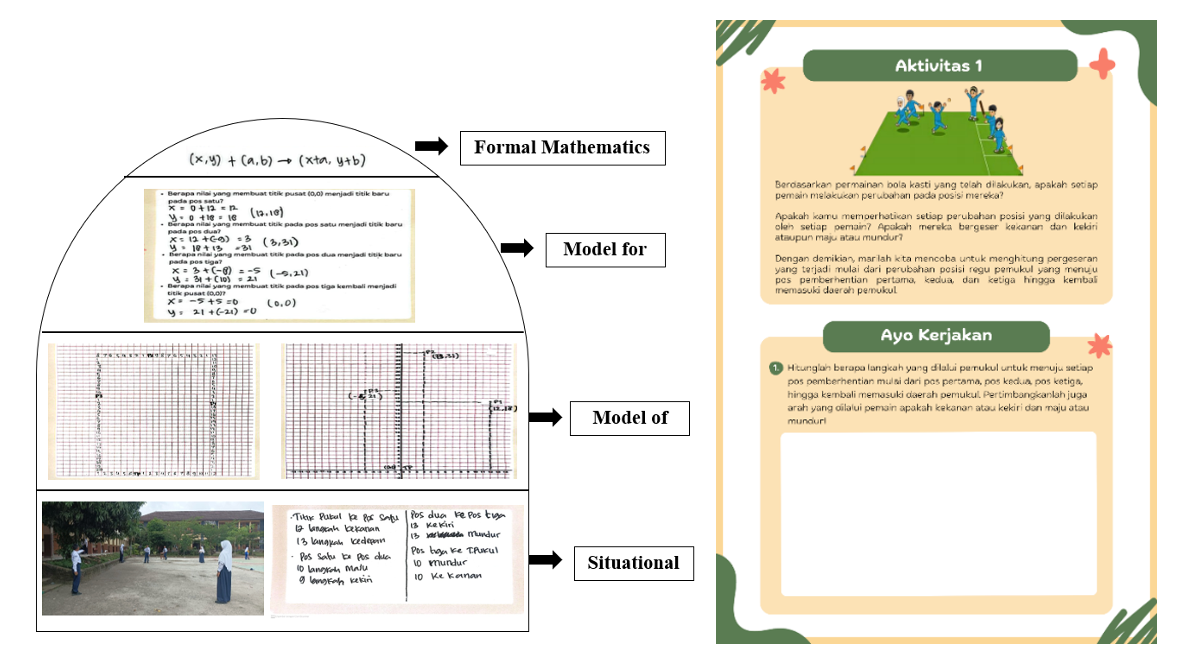
Students often struggle to grasp geometric transformation concepts, particularly translation. Although some students can recognize object movement visually, conceptual misconceptions persist in interpreting the meaning of displacement, along with difficulties in representing movement visually using Cartesian diagrams. This condition indicates the need for a more contextually and meaningfully grounded learning approach that connects mathematical concepts with activities familiar to students. In this study, the traditional game of bola kasti is employed as an effective learning medium, serving as a cultural activity that is relevant and closely related to students’ experiences. The traditional bola kasti game functions not merely as a contextual illustration but is systematically designed as a conceptual transition tool that bridges physical activities and formal coordinate representations in the concept of translation. This research aims to develop a learning trajectory using the PMRI approach, incorporating the context of the bola kasti game to support students in constructing a deep understanding of the concept of translation. The research employed a design research methodology with a validation study type, involving 32 ninth-grade students from SMP Negeri 52 Palembang. Data collection techniques included student activity sheets, classroom observations, and interviews, which were analyzed descriptively using a qualitative approach. The findings indicate that the Actual Learning Trajectory (ALT) aligns with the designed Hypothetical Learning Trajectory (HLT). Therefore, the developed HLT is considered successful and contributes to the development of a Local Instructional Theory (LIT) in enhancing students’ conceptual understanding progressively, as demonstrated by students’ ability to identify the direction and magnitude of translation and to represent translations using Cartesian diagrams through the PMRI approach with the context of the bola kasti game in translation learning.
Downloads
References
Doorman, M. (2019). Design and research for developing local instruction theories. Avances de Investigación En Educación Matemática, (15), 29–42. https://doi.org/10.35763/aiem.v0i15.266
Faiza Izzati Mufti, & Tian Abdul Aziz. (2024). Desain Pembelajaran Matematika Topik Transformasi Geometri dengan Pendekatan Realistic Mathematics Education Berbasis Etnomatematika. Algoritma : Jurnal Matematika, Ilmu Pengetahuan Alam, Kebumian Dan Angkasa, 2(4), 115–129. https://doi.org/10.62383/algoritma.v2i4.102
Fajria Septiani, P. Y. (2024). Pembelajaran Dengan Etnomatematika Dalam Meningkatkan Pemahaman Konsep Matematika Abstrak. Inovasi Pendidikan, 11(1). https://doi.org/10.31869/ip.v11i1.5649
Fauziah, A., Putri, R. I. I., Zulkardi, Z., & Somakim. (2020). Pembelajaran PMRI Melalui Lesson Study (Cetakan I). Bening.
Fitra, D. (2018). Penerapan Pendidikan Matematika Realistik Indonesia (PMRI) dalam Pembelajaran Matematika. JURNAL INOVASI EDUKASI, 1(1), 1–7. https://doi.org/10.35141/jie.v1i1.27
Gravemeijer, K., & Cobb, P. (2006). Educational Design Research (J. Van den Akker, K. Gravemeijer, S. McKenney, & N. Nieveen, Eds.). Routledge. https://doi.org/10.4324/9780203088364
Hamidah, I., Zulkardi, Z., Putri, R. I. I., Susanti, E., & Nusantara, D. S. (2024). Hypothetical Learning Trajectory Design In Reflection Learning Using The Context Of The Cirebon Red Mosque. Jurnal Pendidikan Matematika (JUPITEK), 7(1), 1–10. https://doi.org/10.30598/jupitekvol7iss1pp1-10
Lestari, A. A. P., Nugroho, A. A., & Nursyahidah, F. (2021). Desain Pembelajaran Refleksi dan Translasi Berkonteks Klenteng Sam Poo Kong Semarang. Jurnal Elemen, 7(2), 381–393. https://doi.org/10.29408/jel.v7i2.3400
Luvy Sylviana Zanthy, F. I. M. (2020). Analisis Kesulitan Siswa Dalam Menyelesaikan Soal Materi Transformasi Geometri. Gammath : Jurnal Ilmiah Program Studi Pendidikan Matematika, 5(1), 16–25. https://doi.org/10.32528/gammath.v5i1.3189
Ni’matul Ula, V., & Hadi, S. (2023). Kemampuan Translasi Representasi Siswa pada Materi Aljabar Berdasarkan Tingkat Kemampuan Matematis Kelas VIII MTs PSM Tanen. Jurnal Penelitian Pendidikan Dan Pengajaran Matematika, 9(1), 69–80. https://doi.org/10.37058/jp3m.v7i1.5487
Nizar Rangkuti, A., & Ibrahim Siregar, A. (2019). Lintasan Belajar Teorema Pythagoras dengan Pendekatan Pendidikan Matematika Realistik. In Jurnal Ilmu-ilmu Pendidikan dan Sains (Vol. 7). https://doi.org/10.24952/logaritma.v7i02.2112
Novianti, I., Dimpudus, A., & Azainil. (2025). Transformasi Geometri dalam Pola Lantai Tari Dayak (Flying High). Jurnal Pemikiran Dan Penelitian Pendidikan Matematika (JP3M), 8(1), 120–134. https://doi.org/10.36765/jp3m.v8i1.770
Nur, M. A. (2025). Meta Analisis Pengaruh Permainan Tradisional terhadap Hasil Belajar Matematika Siswa Sekolah Dasar di Indonesia. Kognitif: Jurnal Riset HOTS Pendidikan Matematika, 5(2), 494–505. https://doi.org/10.51574/kognitif.v5i2.2921
Nurmaya, R. (2021). Pengembangan Bahan Ajar Berbasis Etnomatematika Pada Materi Transformasi Geometri. RANGE: Jurnal Pendidikan Matematika, 2(2), 123–129. https://doi.org/10.32938/jpm.v2i2.941
Nursyahidah, F., Saputro, B. A., & Albab, I. U. (2020). Learning reflection through the context of Central Java historical building. Journal of Physics: Conference Series, 1567(2), 022095. https://doi.org/10.1088/1742-6596/1567/2/022095
Plomp, Tj., & Nieveen, Nienke. (2013). Educational design research. Part A : an introduction. SLO.
Putri, R. I. I., Dolk, M., & Zulkardi, Z. (2015). Professional Development Of Pmri Teachers For Introducing Social Norms. Journal on Mathematics Education, 6(1), 11–19. https://doi.org/10.22342/jme.6.1.1900.11-19
Rosyada, A., Zulkardi, Z., Susanti, E., & Meryansumayeka, M. (2025). Learning Design in Translation Topic with Cinema Context for 9th Grade Students. SJME (Supremum Journal of Mathematics Education), 9(2), 215–231. https://doi.org/10.35706/sjme.v9i2.194
Rusdi, Fauzan, A., Arnawa, I. M., & Lufri. (2020). Designing Mathematics Learning Models Based on Realistic Mathematics Education and Literacy. Journal of Physics: Conference Series, 1471(1), 012055. https://doi.org/10.1088/1742-6596/1471/1/012055
Sam, F., Alam, S., & Patmaniar, P. (2025). Developing an Ethnomathematics-Based Transformational Geometry Textbook to Enhance Students’ Mathematical Literacy. Kognitif: Jurnal Riset HOTS Pendidikan Matematika, 5(4), 1653–1664. https://doi.org/10.51574/kognitif.v5i4.3860
Samaran, M., Ratuanik, M., & Kewilaa, D. M. (2024). Analisis Kemampuan Representasi Matematis Peserta Didik Pada Materi Translasi Di Kelas Xi Sma Negeri 2 Kepulauan Tanimbar. In Sora Journal of Mathematics Education Mei. https://doi.org/10.30598/sora.5.1.65-76
Sari, D. I., & Sari, N. (2019). Pengembangan Perangkat Pembelajaran Berbasis Realistic Mathematics Education Pada Materi Aritmatika Sosial. AKSIOMA: Jurnal Program Studi Pendidikan Matematika, 8(2), 310. https://doi.org/10.24127/ajpm.v8i2.1954
Sembiring, R. K., Hadi, S., & Dolk, M. (2008). Reforming mathematics learning in Indonesian classrooms through RME. ZDM, 40(6), 927–939. https://doi.org/10.1007/s11858-008-0125-9
Surgandini, A., Sampoerno, P. D., & Noornia, A. (2019). Pengembangan pembelajaran dengan pendekatan pmri berbantuan geogebra untuk membangun pemahaman konsep transformasi geometri. Prima: Jurnal Pendidikan Matematika, 3(2), 85. https://doi.org/10.31000/prima.v3i2.932
Surya, S., Ikram, M., & Jumarniati, J. (2021). Kegagalan Dan Kesalahan Siswa Dalam Melakukan Translasi Antar Representasi Untuk Masalah Laju Perubahan. LINEAR: Journal of Mathematics Education, 57. https://doi.org/10.32332/linear.v2i2.3737
Tamimi, H., Syawahid, M., & Nasrullah, A. (2025). Pengaruh Model Pembelajaran Realistic Mathematics Education (RME) terhadap Kemampuan Literasi Matematis Siswa pada Materi Statistika. Kognitif: Jurnal Riset HOTS Pendidikan Matematika, 5(3), 1066–1077. https://doi.org/10.51574/kognitif.v5i3.3540
Van Zanten, M., & Van den Heuvel-Panhuizen, M. (2021). Mathematics Curriculum Reform and Its Implementation in Textbooks: Early Addition and Subtraction in Realistic Mathematics Education. Mathematics, 9(7), 752. https://doi.org/10.3390/math9070752
Walid, A., Ilma Indra Putri, R., Susanti, E., Mulyono, B., & Sulthan Thaha Saifuddin Jambi, U. (2025). Designing a PMRI-Based Learning Trajectory for Algebraic Forms Using the Iftar Context. Jurnal Pendidikan Matematika, 15. https://doi.org/10.22437/edumatica.vl5i2.44218
Wasilah Wasilah, Iltavia Iltavia, & Meli Amelia. (2023). Analisis Kesulitan Siswa Dalam Menyelesaikan Soal Materi Transformasi Di Kelas Xi Mipa Sman 1 Kecamatan Kapur IX. ALFIHRIS : Jurnal Inspirasi Pendidikan, 1(1), 177–189. https://doi.org/10.59246/alfihris.v1i1.130
Zaini, A., & Marsigit, M. (2014). Perbandingan Keefektifan Pembelajaran Matematika Dengan Pendekatan Matematika Realistik Dan Konvensional Ditinjau Dari Kemampuan Penalaran Dan Komunikasi Matematik Siswa. Jurnal Riset Pendidikan Matematika, 1(2), 152. https://doi.org/10.21831/jrpm.v1i2.2672
Zulkardi, & Putri, R. I. I. (2019). New School Mathematics Curricula, PISA and PMRI in Indonesia (pp. 39–49). https://doi.org/10.1007/978-981-13-6312-2_3
Downloads
Published
How to Cite
Issue
Section
License
Copyright (c) 2026 This is an open-access under the CC-BY-SA license

This work is licensed under a Creative Commons Attribution-ShareAlike 4.0 International License.
Education and Talent Development Center of Indonesia (ETDC Indonesia)
e-mail: kognitif@gmail.com, website : https://etdc-indonesia.com

Kognitif: Jurnal Riset HOTS Pendidikan Matematika dengan Situs: https://etdci.org/journal/kognitif berlisensi Creative Commons Attribution-ShareAlike 4.0 International License







.png)