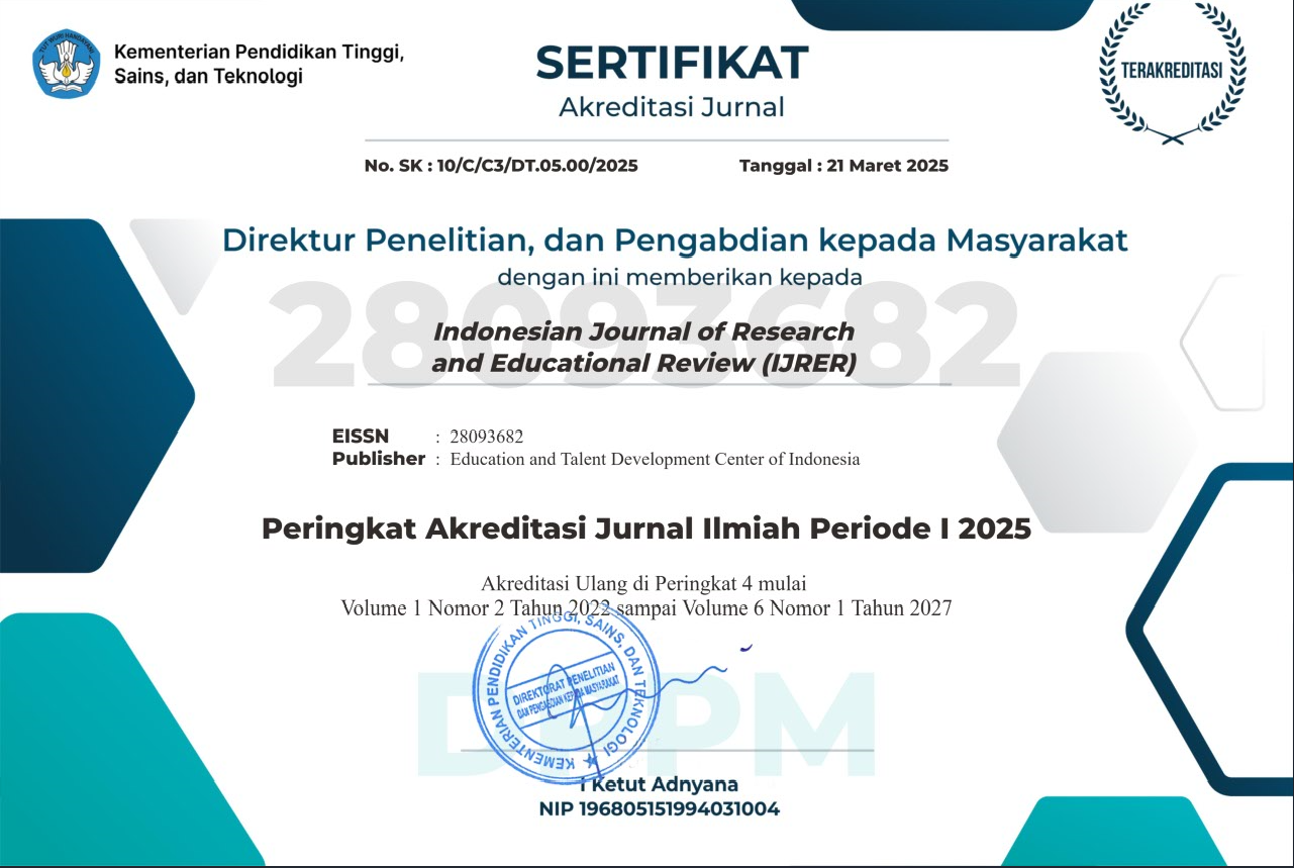
ACREDITATION
This research is a descriptive study with a qualitative approach that aims to describe the ability of students' mathematical problem-solving classes. The instruments in this study were a logical-mathematical intelligence test, a problem-solving ability test, and an interview guide. Data collection in this study was carried out using test, interview, and observation techniques. Checking the validity of the data carried out in this study was a technical triangulation. The results of this study indicate students' ability to solve mathematical problems based on Polya's problem-solving steps: (1) Understanding the problem, subjects who are able to correctly determine what is known and asked about the problem are subjects with high and moderate logical-mathematical intelligence, whereas subjects with low logical-mathematical intelligence are only able to determine things that are known in the problem and have not been able to determine what is being asked in the problem; (2) Develop a problem-solving plan, subjects who are able to develop relevant problem-solving plans to solve problems appropriately and find relationships between things that are known to find things needed in solving problems are subjects with high logical-mathematical intelligence, then for subjects with moderate logical-mathematical intelligence are only able to find connections between things that are known, whereas subjects with low logical-mathematical intelligence are not yet able to devise relevant problem-solving plans and find relationships between things that are known; (3) Carry out the plan, subjects who are able to carry out the steps of the problem solving plan correctly, are skilled in performing arithmetic operations, and find the right solution to the problem are subjects with high logical-mathematical intelligence, while subjects with moderate logical-mathematical intelligence and low ability to carry out a solution plan that is made even though it is not relevant to solving problems and less skilled in performing arithmetic operations, so that the right solution to the problem cannot be found; and (4) Re-checking, subjects who are able to interpret the solutions to the problems that have been obtained and re-examine the steps and calculation results are subjects with high, medium, and low logical-mathematical intelligence.
Sapri, H. A. (2023). Analysis of Mathematics Problem Solving Ability Based on Polya Problem Solving Steps. ETDC: Indonesian Journal of Research and Educational Review , 2(2), 01–10. https://doi.org/10.51574/ijrer.v2i2.755
Downloads
Download data is not yet available.
- Aslan, S. A., & Duruhan, K. (2021). The effect of virtual learning environments designed according to problem-based learning approach to students’ success, problem-solving skills, and motivations. Education and Information Technologies, 26(2), 2253-2283. DOI: https://doi.org/10.1007/s10639-020-10354-6
- Azinar, J. A., & Munzir, S. (2020). Students’ logical-mathematical intelligence through the problem-solving approach. In Journal of Physics: Conference Series (Vol. 1460, No. 1, p. 012024). IOP Publishing. DOI: https://doi.org/10.1088/1742-6596/1460/1/012024
- Brijlall, D. (2015). Exploring the stages of Polya’s problem-solving model during collaborative learning: A case of fractions. International Journal of Educational Sciences, 11(3), 291-299. https://doi.org/10.1080/09751122.2015.11890401 DOI: https://doi.org/10.1080/09751122.2015.11890401
- Creswell, J. W., & Creswell, J. D. (2017). Research design: Qualitative, quantitative, and mixed methods approaches. Sage publications.
- Dayo, N. A., Alvi, U., & Asad, M. M. (2020). Mechanics of digital mathematics games for learning of problem-solving: An extensive literature review. In 2020 International Conference on Emerging Trends in Smart Technologies (ICETST) (pp. 1-6). IEEE. DOI: https://doi.org/10.1109/ICETST49965.2020.9080715
- Fabby, C. (2015). Examining the relationship of scientific reasoning with physics problem solving. Journal of STEM Education, 16(4). DOI: https://doi.org/10.1119/perc.2013.pr.023
- Hasbi, M., Lukito, A., & Sulaiman, R. (2019). Mathematical connection middle-school students 8th in realistic mathematics education. In Journal of Physics: Conference Series (Vol. 1417, No. 1, p. 012047). IOP Publishing. DOI: https://doi.org/10.1088/1742-6596/1417/1/012047
- Hasibuan, S. A., & Fauzi, K. M. A. (2019). Development of PISA mathematical problem model on the content of change and relationship to measure students mathematical problem-solving ability. International Electronic Journal of Mathematics Education, 15(2), em0570. DOI: https://doi.org/10.29333/iejme/6274
- Hensberry, K. K., & Jacobbe, T. (2012). The effects of Polya’s heuristic and diary writing on children’s problem solving. Mathematics Education Research Journal, 24, 59-85. https://doi.org/10.1007/s13394-012-0034-7 DOI: https://doi.org/10.1007/s13394-012-0034-7
- Jaelani, A. K., Hasbi, M., & Baharullah, B. (2023). A Critical Thinking Profile of Mathematics Education Students in Solving Ill-Structured Problem based on Mathematical Ability. JTAM (Jurnal Teori dan Aplikasi Matematika), 7(2), 545-559. DOI: https://doi.org/10.31764/jtam.v7i2.13378
- Kaiser, G. (2020). Mathematical modelling and applications in education. Encyclopedia of mathematics education, 553-561. https://doi.org/10.1007/978-3-030-15789-0_101 DOI: https://doi.org/10.1007/978-3-030-15789-0_101
- Masrurotullaily, M., Hobri, H., & Suharto, S. (2013). Analisis kemampuan pemecahan masalah matematika keuangan berdasarkan model polya siswa smk negeri 6 jember. KadikmA, 4(2).
- Prastika, V. Y. A., Riyadi, R., & Siswanto, S. (2021). Discovery and Core Learning Model toward Creative Thinking Viewed from Logical Mathematical Intelligence. AKSIOMA: Jurnal Program Studi Pendidikan Matematika, 10(1), 308-317. DOI: https://doi.org/10.24127/ajpm.v10i1.3429
- Osman, S., Yang, C. N. A. C., Abu, M. S., Ismail, N., Jambari, H., & Kumar, J. A. (2018). Enhancing students’ mathematical problem-solving skills through bar model visualisation technique. International Electronic Journal of Mathematics Education, 13(3), 273-279. DOI: https://doi.org/10.12973/iejme/3919
- Rahayuningsih, S., Hasbi, M., Mulyati, M., & Nurhusain, M. (2021). The effect of self-regulated learning on students’ problem-solving abilities. AKSIOMA: Jurnal Program Studi Pendidikan Matematika, 10(2), 927-939. DOI: https://doi.org/10.24127/ajpm.v10i2.3538
- Rokhataliyeva, A. N. (2022). Teaching of mathematics on the basis of advanced international experiences. Web of Scientist: International Scientific Research Journal, 3(7), 50-55. https://doi.org/10.17605/OSF.IO/QF384
- Son, A. L., & Fatimah, S. (2020). Students' Mathematical Problem-Solving Ability Based on Teaching Models Intervention and Cognitive Style. Journal on Mathematics Education, 11(2), 209-222. DOI: https://doi.org/10.22342/jme.11.2.10744.209-222
- Szabo, Z. K., Körtesi, P., Guncaga, J., Szabo, D., & Neag, R. (2020). Examples of problem-solving strategies in mathematics education supporting the sustainability of 21st-century skills. Sustainability, 12(23), 10113. https://www.mdpi.com/2071-1050/12/23/10113 DOI: https://doi.org/10.3390/su122310113
- Tambychik, T., & Meerah, T. S. M. (2010). Students’ difficulties in mathematics problem-solving: What do they say?. Procedia-Social and Behavioral Sciences, 8, 142-151. DOI: https://doi.org/10.1016/j.sbspro.2010.12.020
- Tanjung, D. F., Syahputra, E., & Irvan, I. (2020). Problem based learning, discovery learning, and open ended models: An experiment on mathematical problem solving ability. JTAM (Jurnal Teori dan Aplikasi Matematika), 4(1), 9-16. DOI: https://doi.org/10.31764/jtam.v4i1.1736
- Utaminingsih, S. (2022). The Effectiveness of Guided Inquiry on Understanding Mathematical Concepts. ANP Journal of Social Science and Humanities, 3, 70-76.
- Xin, X., Shu-Jiang, Y., Nan, P., ChenXu, D., & Dan, L. (2022). Review on A big data-based innovative knowledge teaching evaluation system in universities. Journal of Innovation & Knowledge, 7(3), 100197. https://doi.org/10.1016/j.jik.2022.100197 DOI: https://doi.org/10.1016/j.jik.2022.100197
Similar Articles
- Rafa Adilla Azhari, Nurul Hidayah, Rahma Diani, Diah Rizki Nur Kalifah, Bibliometric Analysis of Problem-Based Learning Model with STEM Approach: Critical Thinking Skills of Elementary School Students , ETDC: Indonesian Journal of Research and Educational Review : Vol. 5 No. 1 (2025): December
- Suwardi Suwardi, Meter Running Speed of University Students: Basketball Dribbling Ability , ETDC: Indonesian Journal of Research and Educational Review : Vol. 3 No. 4 (2024): September
- Fitriani Fitriani, Ana Muliana Musli, Aprisal Aprisal, Dominant Factors Cause Students with Special Needs (Deaf) in Solving Mathematics Problems , ETDC: Indonesian Journal of Research and Educational Review : Vol. 3 No. 2 (2024): March
- Dwi Anggaini, Tri Sutrisno, Critical Thinking Skills of College Students in Solving Linear Algebra Problems Using the Problem-Based Learning Model , ETDC: Indonesian Journal of Research and Educational Review : Vol. 5 No. 1 (2025): December
- Muhammad Hasbi, Fitri Fitri, Pre-Service Teachers with Courses in Problem-Based Learning in Mathematics , ETDC: Indonesian Journal of Research and Educational Review : Vol. 2 No. 2 (2023): March
- Khoerul Umam, Mathematics Learning Experience: Students' Perspectives on Teachers' Teaching Approaches in the Classroom , ETDC: Indonesian Journal of Research and Educational Review : Vol. 4 No. 3 (2025): June
- Takdirmin Takdirmin, Agusalim Juhari, Visual and Auditory Learning Styles in Mathematics Learning in the Digital Era for College Students , ETDC: Indonesian Journal of Research and Educational Review : Vol. 5 No. 3 (2026): June
- Arifuddin Usman, Nafi Basram, Arimbi Arimbi, Reaction Speed and Blocking Ability in Volleyball Extracurricular Participants at High School , ETDC: Indonesian Journal of Research and Educational Review : Vol. 5 No. 2 (2026): March
- Andi Ihsan, The Impact of Leg Press Training and Squat Training on the Weapon Attack Ability of Fencing Athletes in South Sulawesi , ETDC: Indonesian Journal of Research and Educational Review : Vol. 3 No. 2 (2024): March
- Muhammad Ikram, Marufi Marufi, Suriani Canne, Design of an RME-Based Fractions Textbook in the Luwu Tourism Context to Stimulate Students’ Reasoning Skills , ETDC: Indonesian Journal of Research and Educational Review : Vol. 3 No. 4 (2024): September
<< < 1 2 3 4 5 6 7 8 9 10 > >>
You may also start an advanced similarity search for this article.
Dimension Badge
Crossmark Badge

Section
Articles
Keywords