Bibliometric Analysis of Problem-Based Learning Model with STEM Approach: Critical Thinking Skills of Elementary School Students

https://doi.org/10.51574/ijrer.v5i1.4069
Keywords:
Bibliometric Analysis, Critical Thinking Skills, Elementary School, Problem-Based Learning, STEMAbstract
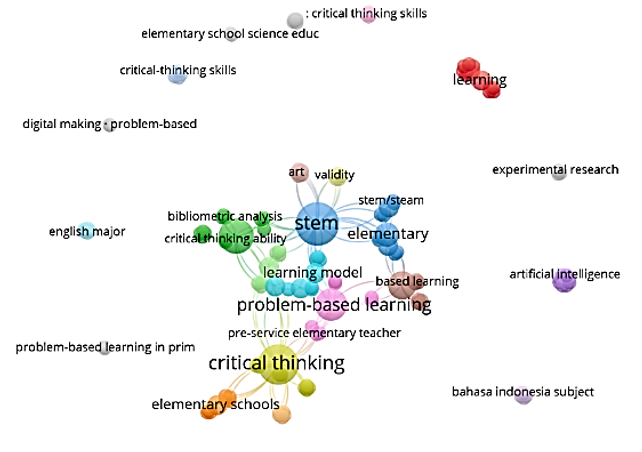
Elementary schools must creatively develop critical thinking abilities to equip students with 21st-century competencies. Analyzing previous research on integrating learning models for this purpose is necessary. This study will bibliometrically analyze the research on integrating the Problem-Based Learning (PBL) model with the Science, Technology, Engineering, and Mathematics (STEM) approach to improve elementary school critical thinking. VOSviewer software was used to conduct a systematic literature review and bibliometric analysis of 52 Scopus-indexed articles from 2020–2024. Publish or Perish (PoP), linked to Scopus, collected publication data using "problem-based learning," "STEM," "critical thinking," and "elementary school." The literature review found that the STEM-integrated PBL model in elementary schools improves critical thinking and student learning by providing real-world problems to solve. Indonesia contributed 30 articles, followed by the US (5 articles) and Hong Kong (3 articles). The study's five-year collaboration network includes 69 researchers. Bibliometric analysis indicated a high association between "STEM" and "critical thinking" and "learning model," showing that STEM influences critical thinking skills. The association between "problem-based learning," "learning model," and "critical thinking" showed that PBL strongly impacts these skills. But network visualization revealed a research gap in the weak and narrow connections between "STEM," "Problem-Based Learning," and "Elementary School." The first co-occurrence analysis showed "critical thinking," followed by "problem-based learning" and "STEM." The rise of "bibliometric analysis" and "elementary school" suggests elementary education research is digitizing. In conclusion, STEM-integrated PBL has worked, but further research is needed to apply it to elementary school pupils.
References
Abu Khurma, O., Al Darayseh, A., & Alramamneh, Y. (2022). A framework for incorporating the “learning how to learn” approach in teaching STEM education. Education Sciences, 13(1), 1. https://doi.org/10.3390/educsci13010001
Ammar, M., Al-Thani, N. J., & Ahmad, Z. (2024). Role of pedagogical approaches in fostering innovation among K-12 students in STEM education. Social Sciences & Humanities Open, 9, 100839. https://doi.org/10.1016/j.ssaho.2024.100839
Ananda, Y., Rizal, E., & Rohman, A. S. (2025). Pemetaan pengetahuan terhadap perkembangan penelitian kebutuhan informasi pada database Scopus menggunakan VOSViewer. Informatio: Journal of Library and Information Science, 5(1), 49–66. https://jurnal.unpad.ac.id/informatio/article/view/59622
Angga, A. (2022). Penerapan Problem Based Learning Terintegrasi STEAM untuk Meningkatkan Kemampuan 4C Siswa. Jurnal Didaktika Pendidikan Dasar, 6(1), 281–294. https://doi.org/10.26811/didaktika.v6i1.541
Anggraeni, D. M., Prahani, B. K., Suprapto, N., Shofiyah, N., & Jatmiko, B. (2023). Systematic review of problem based learning research in fostering critical thinking skills. Thinking Skills and Creativity, 49, 101334. https://doi.org/10.1016/j.tsc.2023.101334
Aprina, E. A., Fatmawati, E., & Suhardi, A. (2024). Penerapan model problem based learning untuk mengembangkan keterampilan berpikir kritis pada muatan IPA sekolah dasar. Didaktika: Jurnal Kependidikan, 13(1), 981-990. https://doi.org/10.58230/27454312.496
Ariadila, S. N., Silalahi, Y. F. N., Fadiyah, F. H., Jamaludin, U., & Setiawan, S. (2023). Analisis pentingnya keterampilan berpikir kritis terhadap pembelajaran bagi siswa. Jurnal Ilmiah Wahana Pendidikan, 9(20), 664-669. https://doi.org/10.5281/zenodo.8436970
Arici, F., & Yilmaz, M. (2023). An examination of the effectiveness of problem‐based learning method supported by augmented reality in science education. Journal of Computer Assisted Learning, 39(2), 446-476. https://doi.org/10.1111/jcal.12752
Arisa, S., & Sitinjak, D. S. (2022). Implementation of the STEM-PBL approach in online chemistry learning and its impact on students' critical thinking skills. Jurnal Pendidikan Kimia Indonesia, 6(2), 88-96. https://doi.org/10.23887/jpki.v6i2.44317
Arthamena, V. D., Ayubi, M., Atun, S., & Putri, S. E. (2025). Effectiveness of a problem-based learning model integrated with socio-scientific issues to improve science process skills of high school students. JKPK (Jurnal Kimia dan Pendidikan Kimia), 10(1), 203-219. https://doi.org/10.20961/jkpk.v10i1.97608
Astuti, M. L. (2024). The Role of 6C Skills in 21st Century Learning of Elementary School Students. DIDAKTIKA: Jurnal Pendidikan Sekolah Dasar, 7(2), 154-161.
Awaludin, R., Aripin, A., & Makiyah, Y. S. (2025). The Effect of the PBL-STEM on Students’ Critical Thinking Skills. Jurnal Pendidikan Fisika dan Teknologi, 11(1a), 110-116. https://doi.org/10.29303/jpft.v11i1a.6819
Azzahrawaani, Z., Riche Cynthia Johan, & Ardiansah. (2023). Analisis Bibliometrik Tren Penelitian Literasi Pada Lansia dengan Menggunakan VOSviewer. BACA: Jurnal Dokumentasi Dan Informasi, 44(2), 125–140. https://doi.org/10.55981/baca.2023.1679
Dare, E. A., Keratithamkul, K., Hiwatig, B. M., & Li, F. (2021). Beyond content: The role of STEM disciplines, real-world problems, 21st century skills, and STEM careers within science teachers’ conceptions of integrated STEM education. Education Sciences, 11(11), 737. https://doi.org/10.3390/educsci11110737
Diani, R., Khotimah, H., Khasanah, U., & Syarlisjiswan, M. R. (2019). Scaffolding dalam pembelajaran fisika berbasis problem based instruction (PBL): efeknya terhadap pemahaman konsep dan self efficacy. Indonesian Journal of Science and Mathematics Education, 2(3), 310-319. https://doi.org/10.24042/ijsme.v2i3.4356
Diani, R., Latifah, S., Jamaluddin, W., Pramesti, A., Susilowati, N. E., & Diansah, I. (2020). Improving students’ science process skills and critical thinking skills in physics learning through fera learning model with savir approach. In Journal of Physics: Conference Series (Vol. 1467, No. 1, p. 012045). IOP Publishing. https://doi.org/10.1088/1742-6596/1467/1/012045
Diani, R., Saregar, A., & Ifana, A. (2016). Perbandingan model pembelajaran problem based learning dan inkuiri terbimbing terhadap kemampuan berpikir kritis peserta didik. Jurnal Penelitian Pembelajaran Fisika, 7(2). https://doi.org/10.26877/jp2f.v7i2.1310
Diani, R., Susanti, A., Widiawati, N., & Velina, Y. (2024). Enhancing Computational Thinking in Physics Labs: Synergizing STEM Multimedia with Islamic Literacy Integration. Kasuari: Physics Education Journal (KPEJ), 7(2), 371-383. https://doi.org/10.37891/kpej.v7i2.728
Diani, R., Yanti, Y., Hartati, N. S., Fujiani, D., & Hasanah, I. F. (2021). Islamic literacy-based physics e-module with STEM (science, technology, engineering, and mathematics) approach. In Journal of Physics: Conference Series (Vol. 1796, No. 1, p. 012098). IOP Publishing. https://doi.org/10.1088/1742-6596/1796/1/012098
Diani, R., Yuberti, Y., & Syarlisjiswan, M. R. (2018). Web-enhanced course based on problem-based learning (PBL): Development of interactive learning media for basic physics II. Jurnal Ilmiah Pendidikan Fisika Al-Biruni, 7(1), 105-116. https://doi.org/10.24042/jipfalbiruni.v7i1.2849
Donthu, N., Kumar, S., Mukherjee, D., Pandey, N., & Lim, W. M. (2021). How to conduct a bibliometric analysis: An overview and guidelines. Journal of business research, 133, 285-296. https://doi.org/10.1016/j.jbusres.2021.04.070
Funa, A. A., Roleda, L. S., & Prudente, M. S. (2024). Integrated science, technology, engineering, and mathematics—problem-based learning—education for sustainable development (I-STEM-PBL-ESD) framework. In A diversity of pathways through science education (pp. 151-172). Singapore: Springer Nature Singapore. https://doi.org/10.1007/978-981-97-2607-3_9
Hafizah, M., Solin, S., Purba, C. T., Sihotang, M. M., Rahmad, R., & Wirda, M. A. (2024). Meta-analysis: The impact of problem-based learning (PBL) models on students' critical thinking skills. Journal of Digital Learning and Education, 4(3), 167-179. https://doi.org/10.52562/jdle.v4i3.1393
Hasbi, M., & Fitri, F. (2023). Pre-Service Teachers with Courses in Problem-Based Learning in Mathematics. ETDC: Indonesian Journal of Research and Educational Review, 2(2), 51-60. https://doi.org/10.51574/ijrer.v2i2.588
Hassan, W., & Duarte, A. E. (2024). Bibliometric analysis: a few suggestions. Current problems in cardiology, 49(8), 102640. https://doi.org/10.1016/j.cpcardiol.2024.102640
Hidayatullah, N. M., Bani, B., Angelia, C., Nurhidayati, H., & Ningrum, S. A. R. (2024). Analisis bibliometrik: Penelitian technology acceptance model tahun 2014-2023 menggunakan Bibliometrik dan Vosviewer. Comdent: Communication Student Journal, 2(1), 138–158. https://doi.org/10.24198/comdent.v2i1.58290
Hitchcock, D. (2017). Critical thinking as an educational ideal. In On reasoning and argument: Essays in informal logic and on critical thinking (pp. 477-497). Cham: Springer International Publishing. https://doi.org/10.1007/978-3-319-53562-3_30
Ikhsan, M., Buhera, R., Abiabdillah, L. H., Nurohman, S., & Natadiwijaya, I. F. (2025). STEM-PBL Based Learning: Digital Student Worksheet Simulation aided by PhET to Improve Students' Critical Thinking Skills in Science Learning. Journal of Education and Teaching (JET), 6(1), 196-214. https://doi.org/10.51454/jet.v6i1.469
Iriyani, S. A., Patty, E. N. ., Rahim, A., Awaliyah, M., & Ria, R. R. P. (2023). Tren Manajemen Pendidikan: Analisis Bibliometrik Menggunakan Aplikasi Vosviewer. Edu Cendikia: Jurnal Ilmiah Kependidikan, 3(01), 93–100. https://doi.org/10.47709/educendikia.v3i01.2281
Jaelani, A. K., Hasbi, M., & Baharullah, B. (2023). A critical thinking profile of mathematics education students in solving ill-structured problem based on mathematical ability. JTAM (Jurnal Teori dan Aplikasi Matematika), 7(2), 545-559.
Joyce, B., Calhoun, E., & Hopkins, D. (2008). Models of learning, tools for teaching. McGraw-Hill Education (UK).
Juškevičienė, A., Dagienė, V., & Dolgopolovas, V. (2021). Integrated activities in STEM environment: Methodology and implementation practice. Computer Applications in Engineering Education, 29(1), 209-228. https://doi.org/10.1002/cae.22324
Khoirunnissa, R., Suwarma, I. R., & Muslim, M. (2024). The Implementation of STEM-PBL Learning to Enhance Students' Critical Thinking Skills. Jurnal Pendidikan Fisika dan Teknologi, 10(1), 175-185. https://doi.org/10.29303/jpft.v10i1.6879
Klarin, A. (2024). How to conduct a bibliometric content analysis: Guidelines and contributions of content co‐occurrence or co‐word literature reviews. International Journal of Consumer Studies, 48(2), e13031. https://doi.org/10.1111/ijcs.13031
Larsson, K. (2017). Understanding and teaching critical thinking—A new approach. International Journal of Educational Research, 84, 32-42. https://doi.org/10.1016/j.ijer.2017.05.004
Le, H. C., Nguyen, V. H., & Nguyen, T. L. (2023). Integrated STEM approaches and associated outcomes of K-12 student learning: A systematic review. Education Sciences, 13(3), 297. https://doi.org/10.3390/educsci13030297
Loyens, S. M., Van Meerten, J. E., Schaap, L., & Wijnia, L. (2023). Situating higher-order, critical, and critical-analytic thinking in problem-and project-based learning environments: A systematic review. Educational Psychology Review, 35(2), 39. https://doi.org/10.1007/s10648-023-09757-x
Maričić, M., & Lavicza, Z. (2024). Enhancing student engagement through emerging technology integration in STEAM learning environments. Education and Information Technologies, 29(17), 23361-23389. https://doi.org/10.1007/s10639-024-12710-2
Martins, J., Gonçalves, R., & Branco, F. (2024). A bibliometric analysis and visualization of e-learning adoption using VOSviewer. Universal Access in the Information Society, 23(3), 1177-1191. https://doi.org/10.1007/s10209-022-00953-0
Monika, P. S., Suharno, S., & Rahmasari, L. (2023). Effectiveness of science technology engineering mathematics problem based learning (STEM PBL) and science technology engineering mathematics project based learning (STEM PjBL) to improve critical thinking ability. Jurnal Penelitian Pendidikan IPA, 9(11), 9593-9599. https://jppipa.unram.ac.id/index.php/jppipa/article/view/4910
Muzaini, M., Hasbi, M., Ernawati, E., & Kristiawati, K. (2022). The empowerment of problem-based learning models to improve students’ quantitative reasoning. Formatif: Jurnal Ilmiah Pendidikan MIPA, 12(1), 11-24. http://dx.doi.org/10.30998/formatif.v12i1.8502
Nurazmi, & Bancong, H. (2021). Model Problem Based Learning Terintegrasi STEM: Pengaruhnya Terhadap Keterampilan Berpikir Kritis Peserta Didik. Kasuari: Physics Education Journal (KPEJ), 4(2), 70–77. https://doi.org/10.47709/educendikia.v4i03.
Nur, S., & Ikhsan, J. (2024). Implementation of STEM Integrated Problem Based Learning Model to Improve Problem Solving Skills and Learning Motivation of Grade X Vocational High School Students on the Material of Substances and Their Changes. Jurnal Penelitian Pendidikan IPA, 10(11), 8882-8891. https://doi.org/10.29303/jppipa.v10i11.9121
Öztürk, O., Kocaman, R., & Kanbach, D. K. (2024). How to design bibliometric research: an overview and a framework proposal. Review of managerial science, 18(11), 3333-3361. https://doi.org/10.1007/s11846-024-00738-0
Passas, I. (2024). Bibliometric analysis: the main steps. Encyclopedia, 4(2). https://doi.org/10.3390/encyclopedia4020065
Pessin, V. Z., Yamane, L. H., & Siman, R. R. (2022). Smart bibliometrics: an integrated method of science mapping and bibliometric analysis. Scientometrics, 127(6), 3695-3718. https://doi.org/10.1007/s11192-022-04406-6
Plummer, K. J., Kebritchi, M., Leary, H. M., & Halverson, D. M. (2022). Enhancing critical thinking skills through decision-based learning. Innovative Higher Education, 47(4), 711-734. https://doi.org/10.1007/s10755-022-09595-9
Rahayu, S. P., & Christiani, L. (2020). Kolaborasi dan Produktivitas Penulis Artikel Imiah Pada Jurnal Lentera Pustaka. Jurnal Ilmu Perpustakaan, 9(1), 83–91. https://ejournal3.undip.ac.id/index.php/jip/article/view/29973
Roehrig, G. H., Dare, E. A., Ellis, J. A., & Ring-Whalen, E. (2021). Beyond the basics: A detailed conceptual framework of integrated STEM. Disciplinary and Interdisciplinary Science Education Research, 3(1), 11. https://doi.org/10.1186/s43031-021-00041-y
Siregar, R. L. (2021). Memahami tentang model, strategi, metode, pendekatan, teknik, dan taktik. Hikmah: Jurnal Pendidikan Islam, 10(1), 63-75. https://ojs.staituankutambusai.ac.id/index.php/hikmah/article/view/251
Talib, S., Alias, B. S., Matore, M. E. E. M., & Abdullah, A. H. (2025). Empowering STEM education through the role of principals: a systematic literature review. Journal of Education and Learning (EduLearn), 19(1), 570-578. https://doi.org/10.11591/edulearn.v19i1.21889
van Der Vleuten, C. P., & Schuwirth, L. W. (2019). Assessment in the context of problem-based learning. Advances in Health Sciences Education, 24(5), 903-914. https://doi.org/10.1007/s10459-019-09909-1
Varas, D., Santana, M., Nussbaum, M., Claro, S., & Imbarack, P. (2023). Teachers’ strategies and challenges in teaching 21st century skills: Little common understanding. Thinking Skills and Creativity, 48, 101289. https://doi.org/10.1016/j.tsc.2023.101289
Wiratman, A., Bungawati, B., & Rahmadani, E. (2023). Project-based learning integrated with science, technology, engineering, and mathematics (STEM) to the critical thinking skills of students in elementary school. SITTAH: Journal of Primary Education, 4(2), 167-180. https://doi.org/10.30762/sittah.v4i2.1828
Xu, E., Wang, W., & Wang, Q. (2023). The effectiveness of collaborative problem solving in promoting students’ critical thinking: A meta-analysis based on empirical literature. Humanities and Social Sciences Communications, 10(1), 1-11. https://doi.org/10.1057/s41599-023-01508-1
Zakiyyah, F. N., Winoto, Y., & Rohanda, R. (2022). Pemetaan bibliometrik terhadap perkembangan penelitian arsitektur informasi pada Google Scholar menggunakan VOSviewer. Informatio: Journal of Library and Information Science, 2(1), 43. https://doi.org/10.24198/inf.v2i1.37766
Downloads
Published
How to Cite
Issue
Section
License
Copyright (c) 2025 Rafa Adilla Azhari, Nurul Hidayah, Rahma Diani, Diah Rizki Nur Kalifah

This work is licensed under a Creative Commons Attribution-ShareAlike 4.0 International License.