Effect of Inquiry Learning and Culturally Responsive Teaching and Mathematical Problem Solving

https://doi.org/10.51574/kognitif.v6i1.4741
Keywords:
Inquiry Learning Model, Culturally Responsive Teaching, Mathematical Problem-Solving Ability, System of Linear EquationsAbstract
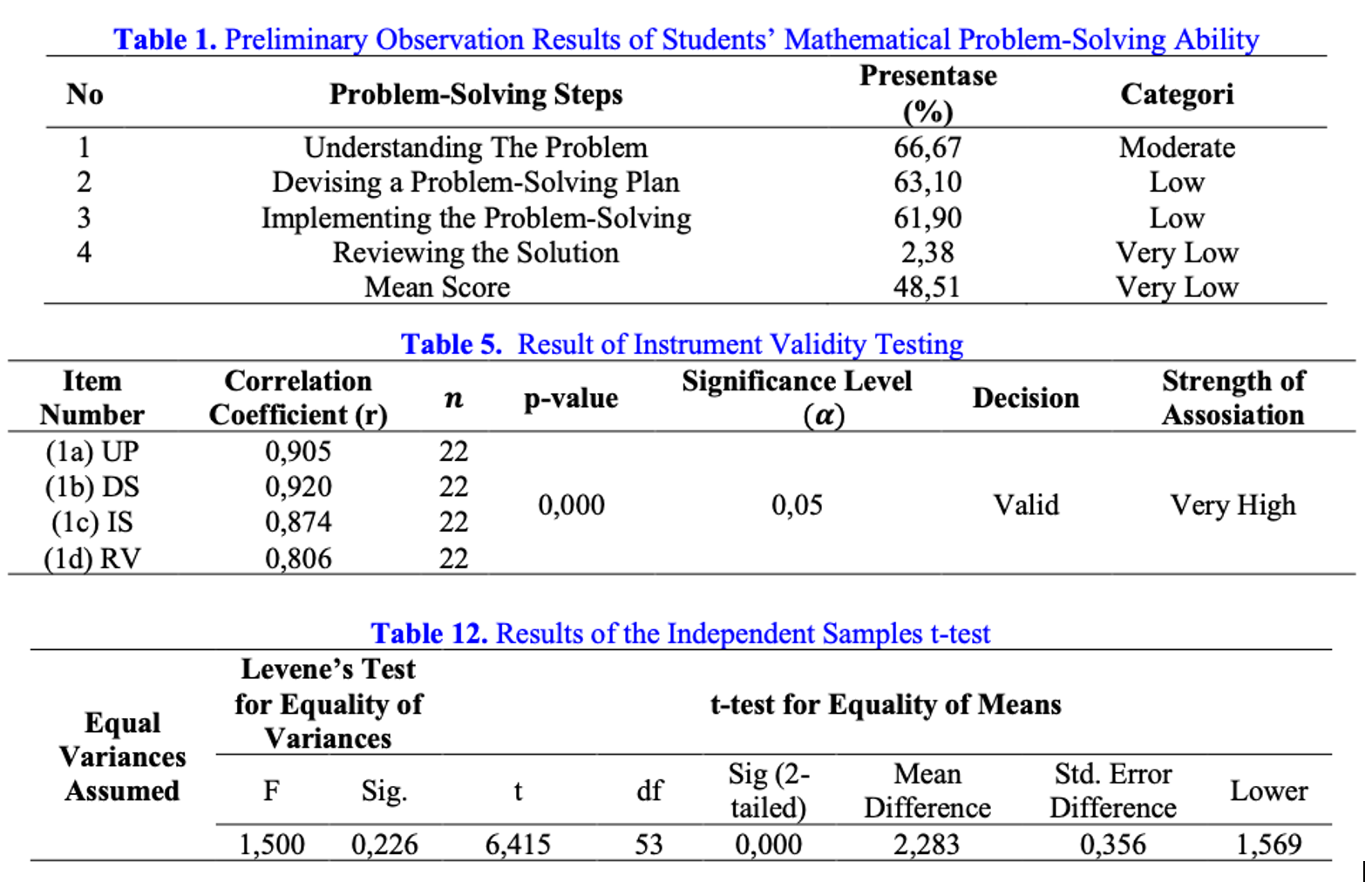
The low level of students’ mathematical problem-solving ability remains a major issue in mathematics learning, particularly when instructional practices fail to actively engage students and to integrate cultural contexts relevant to their daily lives. This study was motivated by the limited integration of the Inquiry Learning Model with the Culturally Responsive Teaching (CRT) approach, especially within Islamic boarding school settings, and by the suboptimal achievement in solving problems related to the System of Linear Equations in Three Variables. This research aimed to examine (1) whether there is a significant effect of the Inquiry Learning Model integrated with CRT on students’ mathematical problem-solving ability, and (2) the magnitude of such an effect. A quasi-experimental method with a posttest-only control group design was employed. The population consisted of all tenth-grade female students of SMA Terpadu Riyadlul ‘Ulum in the 2025/2026 academic year. Samples were selected through purposive sampling and cluster random sampling, resulting in class X-1 as the experimental group and class X-4 as the control group. The instrument was an essay test constructed based on Polya’s four problem-solving indicators and validated by experts. Data were analyzed using the Shapiro–Wilk normality test, Levene’s homogeneity test, Independent Samples t-test, and coefficient of determination. The findings revealed a significant difference between the experimental and control groups (p = 0.000 < 0.05). The coefficient of determination (R² = 0.436) indicates that 43.6% of the variance in mathematical problem-solving ability was explained by the applied learning model, which falls into a moderate effect category. Thus, the integration of the Inquiry Learning Model with the CRT approach significantly enhances students’ mathematical problem-solving ability and is recommended as an effective contextual learning alternative in mathematics education.
Downloads
References
Abdulrahim, N. A., & Orosco, M. J. (2020). Culturally Responsive Mathematics Teaching: A Research Synthesis. Urban Review, 52(1), 1–25. https://doi.org/10.1007/s11256-019-00509-2
Allimin, M. U., Ajaran, T., Mu, M., & Tahun, A. (2024). Pemetaan Gaya Berpikir Siswa Kelas VIII Reguler Madrasah. May. https://doi.org/10.12928/admathedust.v11i1.28616
Andelia, I. S. K., Setianingsih, R., & Jannah, F. (2024). Penerapan Problem-Based Learning dan Pendekatan Culturally Responsive Teaching pada Materi Segi Empat untuk Meningkatkan Hasil Belajar Peserta Didik Kelas VII. Jurnal Cendekia : Jurnal Pendidikan Matematika, 8(2), 1552–1531. https://doi.org/10.31004/cendekia.v8i2.3242
Ardani, D. A. P. (2024). Peningkatan Kemampuan Pemecahan Masalah Matematika Melalui Pembelajaran Berbasis Masalah di Kelas 7F SMPN 1 Tarik. Postulat : Jurnal Inovasi Pendidikan Matematika, 4(2), 248. https://doi.org/10.30587/postulat.v4i2.7081
Astuti, N. V. (2020). Pengaruh Penggunaan Model Pembelajaran Inkuiri dengan Menggunakan Media POP-UP BOOK terhadap Hasil Belajar Siswa Kelas IV di SDN 07 Bengkulu Tengah. Otonomi, 20, 396–406.
Ernawati, T., Rosana, D., Atun, S., & . S. (2024). Exploration of Culturally Responsive Teaching and Problem-Based Learning in The Diverse Learning of Prospective Science Teachers. International Journal of Religion, 5(3), 353–365. https://doi.org/10.61707/t1bg2083
Gay, G. (2018). Culturally Responsive Teaching: Theory, Research, and Practice, Third Edition. Teachers College Press. https://books.google.co.id/books?id=uD9qDwAAQBAJ
Haq, V. A. (2022). Menguji Validitas dan Reliabilitas pada Mata. An-Nawa: Jurnal Studi Islam, 04(01), 11–24.
Hasanah, J., & Amir, Z. (2024). Pengaruh Penerapakn Pembelajaran Inquiry Based Learning Terhadap Kemampuan Berpikir Kritis Matematis ditinjau dari Self Confidence Siswa. Journal for Research in Mathematics Learning) P, 7(1). http://dx.doi.org/10.24014/juring.v7i1.25997
Mahmud, R. (2022). Dasar-Dasar Ilmu Pendidikan: Hakikat Ilmu Pendidikan.
Mu’awanah, N., Riani, D. K., Mampouw, H. L., & Wacana, K. S. (2024). Penggunaan pendekatan CRT ( Culturally Responsive Teaching ) pada materi bilangan bulat untuk meningkatkan hasil belajar siswa kelas VII SMP Negeri 3 Salatiga. 6(6), 265–273.
Murtadho, C. (2024). Pengaruh Model Pembelajaran Inkuiri terhadap Hasil Belajar IPAS Siswa Kelas IV SDN 01 Semuli Raya. 167–186. https://repository.metrouniv.ac.id/id/eprint/10543/
Nazmihaolah, H., Hidayat, E., Natalliasari, I., & Siliwangi, U. (2025). Pengaruh Pendekatan Culturally Responsive Teaching terhadap Literasi Matematis pada Materi Aritmetika Sosial. 730–741. https://doi.org/10.31537/laplace.v8i2.2707
Novia Uma Khoirunnisa, M.Isbatul Haqi, & Mohammad Sayful Anam. (2024). Enhancing Problemsolving Skills in Mathematics Through Inquirybased Learning: A Case Study in High School Education. International Journal of Mathematics and Science Education, 1(2), 26–32. https://doi.org/10.62951/ijmse.v1i2.89
Nuha, K. U., Riani, D. K., & Mampouw, H. L. (2025). Peningkatan Hasil Belajar Melalui Pendekatan Culturally Responsive Teaching Pada Peserta Didik Kelas VIII Materi Bilangan Berpangkat. 7(1), 28–38. https://journal.upgris.ac.id/index.php/imajiner/article/view/20066/9860
Nurfadillah, Ahmad Talib, & Hisyam Ihsan. (2025). Pengaruh Penerapan Model Pembelajaran Inkuiri terhadap Kemampuan Pemecahan Masalah Matematis Siswa Kelas VIII UPT SPF SMP Negeri 13 Makassar. Issues in Mathematics Education (IMED), 9(1), 51–63. https://doi.org/10.35580/imed.v9i1.6693
Putri, N. S., Firmansyah, E., Chairy, B., Bustaren, R., & Rahmawati, F. (2024). Peningkatan Kemampuan Berpikir Kritis Matematis Melalui Model Problem Based Learning dengan Pendekatan Culturally Responsive Teaching dan Teaching at the Right Level. 5(2), 83–96. https://vm36.upi.edu/index.php/JMER/article/viewFile/78906/31819
Setiawati, D., Safira, D., & Kartika, Y. (2023). Penerapan Model Pembelajaran Kooperatif Tipe Teams Games Tournament Untuk Meningkatkan Kemampuan Komunikasi Matematis Siswa. Asimetris: Jurnal Pendidikan Matematika Dan Sains, 4(1), 51–58. https://doi.org/10.51179/asimetris.v4i1.1990
Syamsinar, S., K, G., Asmawati, A., & Ahmad, A. K. (2023). Model Pembelajaran Problem Based Learning (Pbl) Terhadap Kemampuan Pemecahan Masalah Matematika Siswa. Al-Irsyad Journal of Mathematics Education, 2(2), 91–102. https://doi.org/10.58917/ijme.v2i2.71
Tanjung, Y. I., Festiyed, Diliarosta, S., Asrizal, Arsih, F., Fadillah, M. A., & Makrooni, G. (2025). Culturally Responsive Teaching in Science Education and its Relationship with Technopreneurship. APTISI Transactions on Technopreneurship, 7(2), 387–399. https://doi.org/10.34306/att.v7i2.563
Yulitya, A., & Samosir, K. (2024). Penerapan Model Pembelajaran Inkuiri untuk Meningkatkan Kemampuan Pemecahan Masalah Siswa. Kognitif: Jurnal Riset HOTS Pendidikan Matematika, 4(1), 225–245. https://doi.org/10.51574/kognitif.v4i1.1359
Downloads
Published
How to Cite
Issue
Section
License
Copyright (c) 2026 Wiska Adhwaa Budiarsih, Hetty Patmawati, Sri Tirto Madawistama

This work is licensed under a Creative Commons Attribution-ShareAlike 4.0 International License.
Education and Talent Development Center of Indonesia (ETDC Indonesia)
e-mail: kognitif@gmail.com, website : https://etdc-indonesia.com

Kognitif: Jurnal Riset HOTS Pendidikan Matematika dengan Situs: https://etdci.org/journal/kognitif berlisensi Creative Commons Attribution-ShareAlike 4.0 International License






.png)