Development of Android-Based Interactive Learning Media to Facilitate the Flipped Classroom Learning Model

https://doi.org/10.51574/kognitif.v6i1.3281
Keywords:
Development, Interactive Learning Media , Android , Flipped ClassroomAbstract
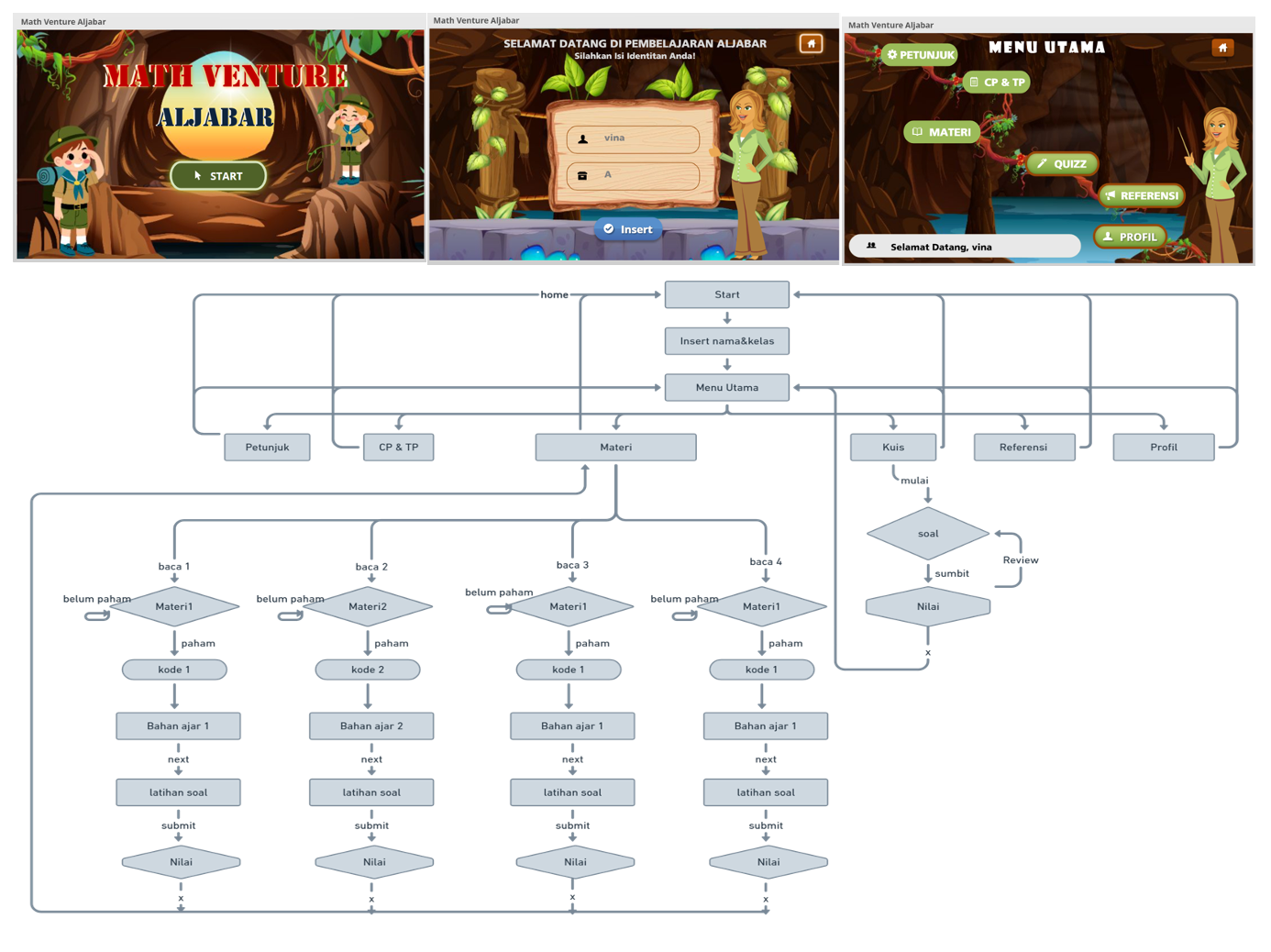
The urgency of developing learning media in the flipped classroom lies in the need for digital tools that can facilitate pre-class independent learning, as existing media are generally linear and lack interactivity. This study aims to develop interactive Android-based learning media called Math Venture Algebra to support ninth-grade junior high school algebra learning through the flipped classroom model. The development was carried out using an R&D approach based on the ADDIE model (Analysis, Design, Development, Implementation, Evaluation), which is relevant because it provides a systematic process for designing interactive Android-based media. Data was collected through semi-structured interviews and questionnaires validated by two subject matter experts and two media experts, and tested on 30th grade students at Tasikmalaya State Junior High School 5. The instrument uses a Likert scale that has been tested for validity and reliability, while the data is analyzed descriptively. Math Venture Algebra media is designed with key features such as instructional videos, interactive exercises, quizzes, and adaptive navigation that support the pre-class flipped classroom phase, so that students can learn independently before face-to-face discussions. The results of the study show that this media is in the “highly feasible” category according to expert assessment, as well as “very practical” according to students with a practicality level of 87%. These findings confirm that Android-based interactive media integrated with the flipped classroom contributes to increased independence, engagement, and quality of mathematics learning, while enriching 21st-century technology-based educational practices.
Downloads
References
Aditya, PT (2018). Development of Web-Based Mathematics Learning Media on Circles for Grade VIII Students. Journal of Mathematics, Statistics & Computer Science, 15(1), 64–74. https://doi.org/10.20956/jmsk.v15i1.4425
Azrillia, W., Oktaviyanthi, R., Khotimah, K., & Garcia, MLB (2024). Feasibility Test of Articulate Storyline 3 Learning Media Based on Local Wisdom for Optimizing Students' Algebraic Thinking Skills. PAEDAGOGIA, 27(1), 1. https://doi.org/10.20961/paedagogia.v27i1.84145
Baig, M. I., & Yadegaridehkordi, E. (2023). Flipped classroom in higher education: a systematic literature review and research challenges. In International Journal of Educational Technology in Higher Education (Vol. 20, Issue 1). Springer Science and Business Media Deutschland GmbH. https://doi.org/10.1186/s41239-023-00430-5
Branch, R. M. (2009). Instructional design: The ADDIE approach. Instructional Design: The ADDIE Approach. New York: Springer US. https://doi.org/ 10.1007/978-0-387-09506-6
Fina Fitriya, F., & Faizah, S. (2021). Development of Android-Based Mathematics Learning Media for Trigonometry Material. Cognitive: HOTS Research Journal of Mathematics Education, 1(2), 104–114. https://doi.org/10.51574/kognitif.v1i2.108
Habsyi, R., RM Saleh, R., & Isman M. Nur. (2022). Development of E-LKPD Based on Guided Discovery Learning to Improve Students' Critical Thinking Skills. Cognitive: HOTS Research Journal of Mathematics Education, 2(1), 1–18. https://doi.org/10.51574/kognitif.v2i1.385
Heliawati, L., Lidiawati, L., & Pursitasari, ID (2022). Articulate Storyline 3 Multimedia Based On Gamification to Improve Critical Thinking Skills and Self-Regulated Learning. International Journal of Evaluation and Research in Education, 11(3), 1435–1444. https://doi.org/10.11591/ijere.v11i3.22168
Hodiyanto, H., Darma, Y., & Putra, SRS (2020). Development of Macromedia Flash-Based Learning Media Containing Problem Posing on Mathematical Problem-Solving Ability. Mosharafa: Journal of Mathematics Education, 9(2), 323–334. https://doi.org/10.31980/mosharafa.v9i2.652
Inayah, Y., & Prasetyo, T. (2025). Improving Learning Quality Through Technology as a Learning Medium for Children with Special Needs. https://doi.org/10.55352/mudir
Mahuda, I., Meilisa, R., & Nasrullah, A. (2021). Development of Android-Based Mathematics Learning Media Assisted by Apps Creator to Improve Problem-Solving Skills. AKSIOMA: Journal of Mathematics Education Study Program, 10(3), 1745. https://doi.org/10.24127/ajpm.v10i3.3912
Mairani, U., Enawaty, E., Putra Sartika, R., Muharini, R., & Rasmawan, R. (2022). Development of Electronic Student Worksheets (E-Lkpd) Based on Problem Based Learning (PBL) on Hydrocarbon Material. Journal of Education and Development, 10(3), 117–121. https://doi.org/10.37081/ed.v10i3.3848
Marta, A., Zen, Z., Hidayati, A., & Rahmi, U. (2025). Development of Android-based interactive learning media to improve student learning outcomes in class XII MIPA SMA. Journal of Science Education Research, 11(5), 514–524. https://doi.org/10.29303/jppipa.v11i5.10961
Mayer, R.E. (2009). Multimedia Learning. In Psychology of learning and motivation (Vol. 41, pp. 85-139). Academic Press.
Munawir, Rofiqoh, A., & Khairani, I. (2024). The Role of Interactive Media in Increasing Student Learning Motivation in SKI Subjects in Elementary Madrasahs. AL-AZHAR INDONESIA HUMANIORA SERIES Journal, 9(1), 63–71. https://doi.org/ http://dx.doi.org/10.36722/sh.v9i1.2828
Niswati, Z., Irawan, A., Syamsiah, Febriyanti, C., Kencanawaty, G., & Rangka, IB (2020, September 2). The Design and Development of Android-Based “Puzzle Games” Mathematics Learning Media. https://doi.org/10.2991/assehr.k.200824.133
Nurhayati, E., Dewi, SV, Mulyani, E., & Nurjamil, D. (2024). Interactive Media Development with Articulate Storyline Based on Rater Test Using PPE Model on Pythagoras Theorem. AKSIOMA: Journal of Mathematics Education Study Program, 13(2), 364. https://doi.org/10.24127/ajpm.v13i2.8871
Pilu, R., Jabu, B., & Sulaiman, I. (2025). Flipped learning and its challenges: understanding students' struggles in Indonesian EFL contexts from teachers' viewpoint. Frontiers in Education, 10. https://doi.org/10.3389/feduc.2025.1575385
Riska, FM, Nur, S., Asmara, A., Sadiyah, Vitalocca, D., Fadjarajani, S., Sampe, F. (2024). Learning strategy 5.0. (A. Asari, Ed.). Solok, West Sumatra: MAFY MEDIA LITERACY INDONESIA.
Santika, A., Nisa, RK, Nasrullah, A., Alfiyanti, F., Aminah, M., & Dwiyanti, W. (2025). Development of Articulate Storyline 3 Learning Media for Mathematical Computational Thinking Skills. International Journal of Applied Learning and Research in Algebra, 35–48. https://doi.org/10.56855/algebra.v2i1.1355
Sapitri, D., & Bentri, A. (2020). Development of Learning Media Based on the Articulate Storyline Application for Economics Subjects for Grade X. https://doi.org/ https://doi.org/10.24036/inovtech.v2i01.115
Sarifah, I., Rohmaniar, A., Marini, A., Sagita, J., Nuraini, S., Safitri, D., Maksum, A., Suntari, Y., & Sudrajat, A. (2022). Development of Android Based Educational Games to Enhance Elementary School Student Interests in Learning Mathematics. International Journal of Interactive Mobile Technologies, 16(18), 149–161. https://doi.org/10.3991/ijim.v16i18.32949
Sugiyono. (2022). Qualitative Research Methods (For research that is: exploratory, enterprising, interactive and constructive). Yogyakarta,: ALFABETA Bandung.
Tavakol, M., & Dennick, R. (2011). Making sense of Cronbach's alpha. In International journal of medical education (Vol. 2, pp. 53–55). https://doi.org/10.5116/ijme.4dfb.8dfd
Yusuf, Ilyas, Ma'rufi, & Nurdin. (2022). STEM Approach to Improve Students' Critical Thinking Skills and Learning Motivation in Mathematics Learning. Cognitive: HOTS Research Journal of Mathematics Education, 2(1), 26–40. https://doi.org/10.51574/kognitif.v2i1.404
Downloads
Published
How to Cite
Issue
Section
License
Copyright (c) 2026 Vina Cahya Farhani , Satya Santika, Eva Mulyani

This work is licensed under a Creative Commons Attribution-ShareAlike 4.0 International License.
Education and Talent Development Center of Indonesia (ETDC Indonesia)
e-mail: kognitif@gmail.com, website : https://etdc-indonesia.com

Kognitif: Jurnal Riset HOTS Pendidikan Matematika dengan Situs: https://etdci.org/journal/kognitif berlisensi Creative Commons Attribution-ShareAlike 4.0 International License







.png)