Competence, Tech Innovation, and Islamic Work Culture: Driving Performance and Its Implications for Quality in Islamic School

https://doi.org/10.51574/ijrer.v5i3.4966
Keywords:
Competence, Educational Quality, Islamic Work Culture, Performance, Technological InnovationAbstract
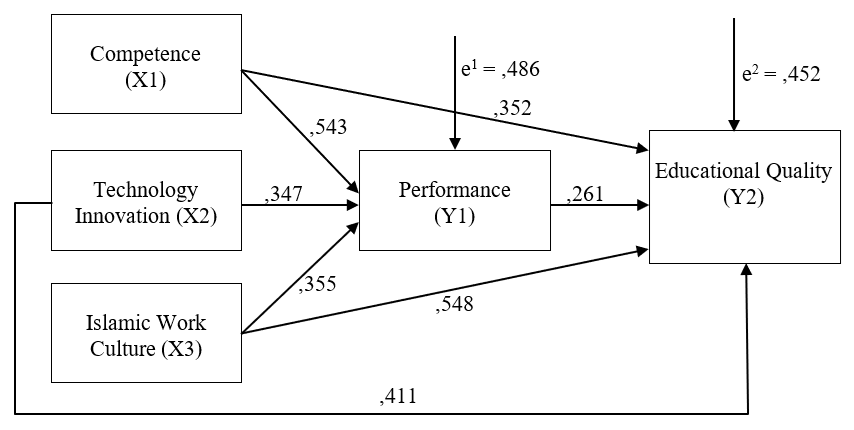
This study examines the influence of competence, technological innovation, and Islamic work culture on educators’ performance and its implications for educational quality in madrasahs. The research employs a quantitative explanatory approach with a survey method. The population consists of Islamic School teachers in Makassar City, including Madrasah Ibtidaiyah, Tsanawiyah, and Aliyah, with a sample of 88 respondents selected using the Slovin formula. Data was collected through questionnaires and analyzed using multiple linear regression and path analysis with SPSS. The structural model analysis shows that competence, technological innovation, and Islamic work culture simultaneously contribute 76.4% to the performance of teaching and education staff, with technological innovation as the most dominant determinant, underscoring the importance of digital adaptation for work efficiency in the modern era. Furthermore, the integration of these three independent variables with performance provides a significant simultaneous contribution of 79.6% to the quality of education, where Islamic work culture emerges as the most dominant factor, confirming that the internalization of spiritual values is the main foundation in realizing quality education services. Through path analysis, performance is proven to play a significant role as a mediating (intervening) variable, indicating that the acceleration of achieving educational quality in madrasahs cannot stand alone but must be realized gradually through optimizing the actual performance of teachers and staff first.
References
Abidin, J., Hilmiyati, F., & Zohriah, A. (2024). Unravelling the Dynamics of Madrasah Principal Performance and Teacher Quality: A Literature Review. Tarbawi: Jurnal Keilmuan Manajemen Pendidikan, 10(01), 89-102. https://doi.org/10.32678/tarbawi.v10i01.9337
Aditya, R. Q., & Suranto, S. (2024). The role of educational transformation in the digital era in improving student quality. Al Qalam: Jurnal Ilmiah Keagamaan dan Kemasyarakatan, 18(3), 1756-1772. http://dx.doi.org/10.35931/aq.v18i3.3301
Al Smadi, A. N., Amaran, S., Abugabah, A., & Alqudah, N. (2023). An examination of the mediating effect of Islamic Work Ethic (IWE) on the relationship between job satisfaction and job performance in Arab work environment. International Journal of Cross-Cultural Management, 23(1), 59-77. https://doi.org/10.1177/14705958221120343
Arifin, I., Juharyanto, Mustiningsih, & Taufiq, A. (2018). Islamic crash course as a leadership strategy of school principals in strengthening school organizational culture. Sage Open, 8(3), 2158244018799849. https://doi.org/10.1177/2158244018799849
Asmarani, A., Sukarno, S., & El Widdah, M. (2021). The relationship of professional competence with teacher work productivity in Madrasah Aliyah. Nidhomul Haq: Jurnal Manajemen Pendidikan Islam, 6(2), 220-235. https://doi.org/10.31538/ndh.v6i2.1365
Chatterjee, S., Chaudhuri, R., Vrontis, D., & Thrassou, A. (2025). Revisiting the resource-based view (RBV) theory: from cross-functional capabilities perspective in post COVID-19 period. Journal of Strategic Marketing, 33(6), 822-837. https://doi.org/10.1080/0965254X.2023.2182447
Darling-Hammond, L. (2020). Accountability in teacher education. Action in teacher Education, 42(1), 60-71. https://doi.org/10.1080/01626620.2019.1704464
Darmaji, D., Mustiningsih, M., & Arifin, I. (2019). Quality management education in the industrial revolution era 4.0 and society 5.0. 5th International Conference on Education and Technology (ICET 2019) (pp. 565-570). Atlantis Press. https://doi.org/10.2991/icet-19.2019.141
Day, C. W., Simpson, A., Li, Q., Bi, Y., & He, F. (2023). Teacher professionalism: Chinese teachers' perspectives. Journal of Professional Capital and Community, 8(2), 65-89. https://doi.org/10.1108/JPCC-01-2022-0004
Gosain, K., & Rajendran, M. (2022). Evaluation of a conceptualised learning design for the development of techno-pedagogic competencies among pre-service teachers. Journal of Information & Knowledge Management, 21(Supp02), 2240026. https://doi.org/10.1142/S0219649222400263
Grassinger, R., Landberg, M., Määttä, S., Vasalampi, K., & Bieg, S. (2024). Interplay of intrinsic motivation and well-being at school. Motivation and Emotion, 48(2), 147-154. https://doi.org/10.1007/s11031-024-10057-2
Han, J. H., & Sa, H. J. (2022). Acceptance of and satisfaction with online educational classes through the technology acceptance model (TAM): The COVID-19 situation in Korea. Asia Pacific Education Review, 23(3), 403-415. https://doi.org/10.1007/s12564-021-09716-7
Helfat, C. E., Kaul, A., Ketchen Jr, D. J., Barney, J. B., Chatain, O., & Singh, H. (2023). Renewing the resource‐based view: New contexts, new concepts, and new methods. Strategic Management Journal, 44(6), 1357-1390. https://doi.org/10.1002/smj.3500
Hendricks, J. L., Call, M. L., & Campbell, E. M. (2023). High performer peer effects: A review, synthesis, and agenda for future research. Journal of Management, 49(6), 1997-2029. https://doi.org/10.1177/01492063221138225
Ikhwan, M., Fuadi, M., Mailizar, M., & Jannah, M. (2023). The Utilization of Information Technology for the Professional Development of Islamic Education Teachers in Indonesia. Progresiva: Jurnal Pemikiran Dan Pendidikan Islam, 12(02), 209-222. https://doi.org/10.22219/progresiva.v12i02.31169
Jeong, Y. H., Healy, L. C., & McEwan, D. (2023). The application of goal setting theory to goal setting interventions in sport: A systematic review. International review of sport and exercise psychology, 16(1), 474-499. https://doi.org/10.1080/1750984X.2021.1901298
Kim, L. E., Fields, D., & Asbury, K. (2023). ‘It feels like I'm back to being a teacher’: A longitudinal trajectory analysis of teachers' experiences during the first 8 months of COVID‐19 in England. British Journal of Educational Psychology, 93(4), 1105- https://doi.org/1122. 10.1111/bjep.12622
Kraus, S., Jones, P., Kailer, N., Weinmann, A., Chaparro-Banegas, N., & Roig-Tierno, N. (2021). Digital transformation: An overview of the current state of the art of research. Sage Open, 11(3), 21582440211047576. https://doi.org/10.1177/21582440211047576
Lubis, N. W. (2022). Resource based view (RBV) in improving company strategic capacity. Research Horizon, 2(6), 587-596. https://doi.org/10.54518/rh.2.6.2022.85
Maskin, M., Riadi, B., Saidina, S., Marlina, L., & Febriyanti, F. (2025). Digital Transformation in Islamic Education Management: Strategies of Madrasah Principals in Improving the Quality of Technology-Based Learning. International Journal of Education and Literature, 4(3), 319-328. https://doi.org/10.55606/ijel.v4i3.302
Maulidin, S., Rohman, M., Nawawi, M. L., & Andrianto, D. (2024). Quality management in improving competitiveness in the digital era at madrasa. Journal of Advanced Islamic Educational Management, 4(1), 57-70. https://ejournal.radenintan.ac.id/index.php/JAIEM/article/view/22594
Molina-Moreno, P., Molero-Jurado, M. D. M., Pérez-Fuentes, M. D. C., & Gázquez-Linares, J. J. (2024). Analysis of personal competences in teachers: a systematic review. Frontiers in Education (Vol. 9, p. 1433908). Frontiers Media SA. https://doi.org/10.3389/feduc.2024.1433908
Nurkamiden, U. D., & Mokodompit, A. (2024). Evaluation Of Teacher Performance From The Perspective Of Islamic Education Management. Tadbir: Jurnal Manajemen Pendidikan Islam, 12(2), 356-364. https://doi.org/10.30603/tjmpi.v12i2.5657
Oktaviani, E. T., Nugraha, M. S., & Azmy, M. N. T. (2026). Establishing an Organizational Culture Rooted in Islamic Values in Madrasah: A Pathway to Educational Excellence. At-Tahsin: Jurnal Manajemen Pendidikan, 6(1), 20-38. https://doi.org/10.59106/attahsin.v6i1.383
Osorio Vanegas, H. D., Segovia Cifuentes, Y. D. M., & Sobrino Morrás, A. (2025). Educational technology in teacher training: A systematic review of competencies, skills, models, and methods. Education Sciences, 15(8), 1036. https://doi.org/10.3390/educsci15081036
Prasetyo, M. A. M., & Rahmatullah, R. (2024). Pesantren Effectiveness: The Role of Organizational Culture in Enhancing Performance in Pesantren Institutions. Evaluasi: Jurnal Manajemen Pendidikan Islam, 8(1), 47-59. https://e-journal.staima-alhikam.ac.id/evaluasi/article/view/1888
Rahman, A., Pisol, M. I. M., Sari, M. N., & Nuryana, Z. (2024). Madrasah education quality reform: Improving teacher quality post pandemic in Indonesia. AL-ISHLAH: Jurnal Pendidikan, 16(1), 54-66. https://doi.org/10.35445/alishlah.v16i1.3899
Reams, L. C. (2026). Fred Fiedler’s Contingency Theory of Leadership. In The Palgrave Encyclopedia of Leadership and Organizational Change (pp. 1-10). Cham: Springer Nature Switzerland. https://doi.org/10.1007/978-3-031-51650-4_262-1
Sabariah, S., Rufi'i, R. I., Nadiroh, A., Lestari, D., Sulistiami, S., & Baidowi, A. (2025). Integrating Technological Innovations in Teacher Professional Development: A Case Study on Enhancing Learning Outcomes. Tafkir: Interdisciplinary Journal of Islamic Education, 6(1), 263-276. https://doi.org/10.31538/tijie.v6i1.1687
Siswanto, M. (2024). Digital Revolution in Madrasah Aliyah: Adaptation and Innovation in the Implementation of the Independent Curriculum. TEKILA: Journal of Language Teaching and Literature, 1(4), 285-296. http://tekilaojs.com/index.php/jltl/article/view/23
Sitthiworachart, J., Joy, M., King, E., Sinclair, J., & Foss, J. (2022). Technology-supported active learning in a flexible teaching space. Education Sciences, 12(9), 634. https://doi.org/10.3390/educsci12090634
Skantz-Åberg, E., Lantz-Andersson, A., Lundin, M., & Williams, P. (2022). Teachers’ professional digital competence: An overview of conceptualisations in the literature. Cogent Education, 9(1), 2063224. https://doi.org/10.1080/2331186X.2022.2063224
Stumbrienė, D., Jevsikova, T., & Kontvainė, V. (2024). Key factors influencing teachers’ motivation to transfer technology-enabled educational innovation. Education and information technologies, 29(2), 1697-1731. https://doi.org/10.1007/s10639-023-11891-6
Succarie, A. (2024). Examining the implications of Islamic teacher education and professional learning: Towards professional identity renewal in Islamic schools. Education Sciences, 14(11), 1192. https://doi.org/10.3390/educsci14111192
Supriandi, S., Al Haddar, G., Saputri, D. Y., & Halim, C. (2024). Application of Educational Technology and Teachers' Competence in Improving Teaching Effectiveness in Islamic Education Curriculum in Madrasah Aliyah in Indonesia. The Eastasouth Journal of Learning and Educations, 2(02), 84-96. https://doi.org/10.58812/esle.v2i02.299
Syafaruddin, B. (2024). Modernization and renewal Islamic education in the era of Society 5.0: A systematic review. ETDC: Indonesian Journal of Research and Educational Review, 3(3), 105-117. https://doi.org/10.51574/ijrer.v3i3.1802
Tambrin, M., Wasliman, I., Hanafiah, H., & Mudrikah, A. (2021). Implementation and evaluation of teachers’ performance supervision at Madrasah Aliyah (Islamic Senior High School). Journal of Education Research and Evaluation, 5(4), 645-655. https://doi.org/10.23887/jere.v5i4.32941
Timotheou, S., Miliou, O., Dimitriadis, Y., Sobrino, S. V., Giannoutsou, N., Cachia, R., ... & Ioannou, A. (2023). Impacts of digital technologies on education and factors influencing schools' digital capacity and transformation: A literature review. Education and information technologies, 28(6), 6695-6726. https://doi.org/10.1007/s10639-022-11431-8
Umami, I. O. N., & Yasin, M. (2024). Integrating Islamic ethical values into human resource development: Enhancing educational quality in Indonesian Islamic schools. Dirosatuna: Journal of Islamic Studies, 7(2), 99-110. https://doi.org/10.31538/dirosatuna.v7i2.7683
Wafa, A. (2022). Total quality management (TQM) in Islamic educational institutions. Tadibia Islamika, 2(2), 87-94. https://doi.org/10.28918/tadibia.v2i2.6448
Wang, C., Chen, X., Yu, T., Liu, Y., & Jing, Y. (2024). Education reform and change driven by digital technology: A bibliometric study from a global perspective. Humanities and Social Sciences Communications, 11(1), 1-17. https://doi.org/10.1057/s41599-024-02717-y
Widiyan, T., Nasution, J. E., Fitrianti, L., & Hidayah, F. N. (2026). The Role of Madrasah Principal Leadership in Enhancing Institutional Quality in Islamic Senior High Schools. Journal of Educational Management Research, 5(1), 281-292. https://doi.org/10.61987/jemr.v5i1.1624
Downloads
Published
How to Cite
Issue
Section
License
Copyright (c) 2026 Syamsul Bahri, Ansar Amir

This work is licensed under a Creative Commons Attribution-ShareAlike 4.0 International License.