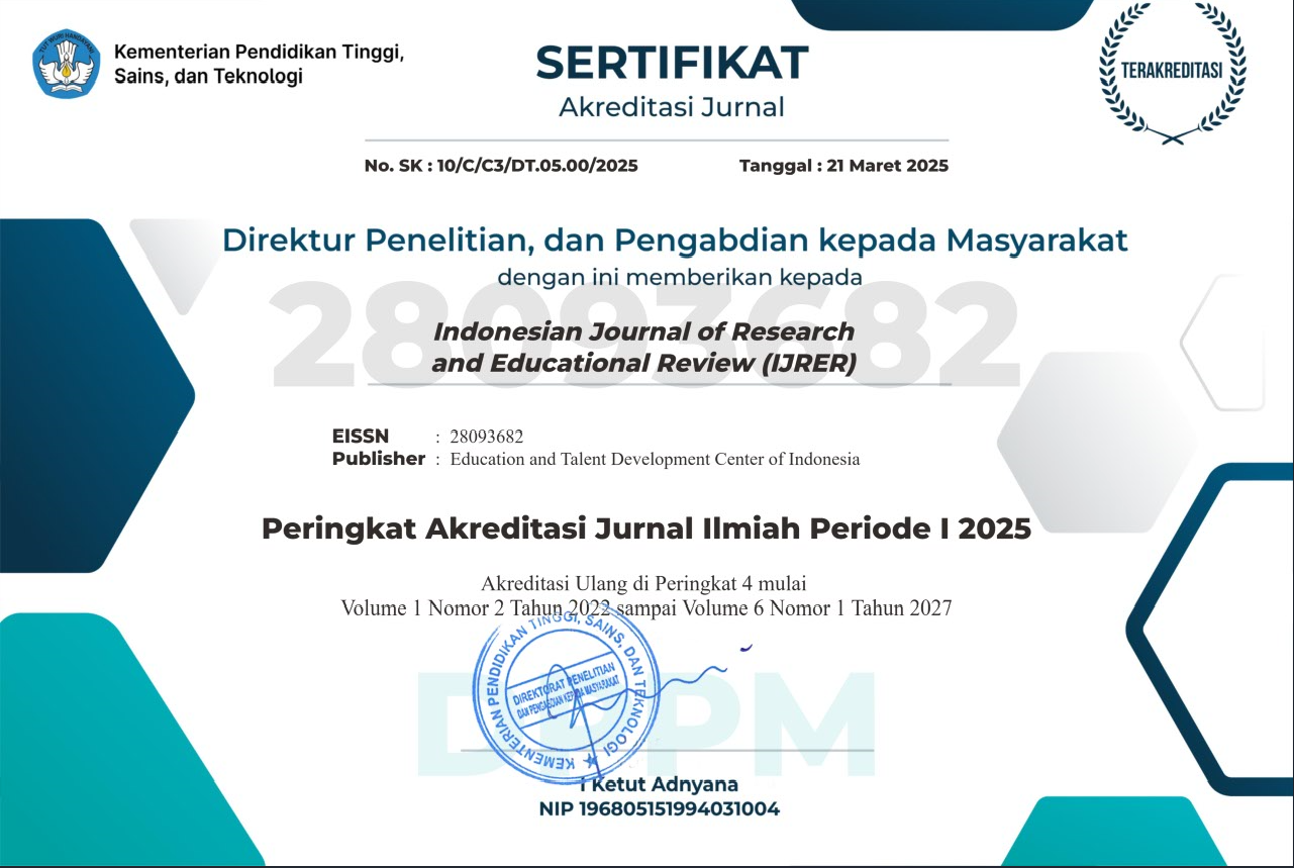
ACREDITATION
Google Docs is a free web-based application for creating, editing, and collaborating. This systematic review showed that using some Google documents resulted in developing English language learning and teaching. The writing was the biggest language skill investigated. Google Docs is a version of Microsoft Word that offers collaborative features that can be used to facilitate the teaching and learning process in the language classroom. The method used in writing this paper was a literature review based on collecting data and information that related to teachers' perceptions towards the use of Google Docs in the teaching and learning process. This paper has indicated the teachers’ perception toward the use of Google documents in the teaching and learning process in the classroom. In fact, Google Docs, while nearly all of them perceive that this learning tool is easy to use in the teaching and learning process and very helpful for teachers in the teaching and learning process.
Noviska, D. W., Aisyah, S., Yuniarti, Y., & Ihsan, M. T. (2021). Teachers’ Perception Towards The Use Of Google Document in Teaching and Learning Process. ETDC: Indonesian Journal of Research and Educational Review , 1(1), 1–8. https://doi.org/10.51574/ijrer.v1i1.43
Downloads
Download data is not yet available.
- Aaron, L. S., & Roche, C. M. (2011). Teaching, learning, and collaborating in the cloud: Applications of cloud computing for educators in post-secondary institutions. Journal of Educational Technology Systems, 40(2), 95-111. https://doi.org/10.2190/ET.40.2.b
- Blumenfeld, P., Fishman, B. J., Krajcik, J., Marx, R. W., & Soloway, E. (2000). Creating usable innovations in systemic reform: Scaling up technology-embedded project-based science in urban schools. Educational psychologist, 35(3), 149-164. https://doi.org/10.1207/S15326985EP3503_2
- Bodenhausen, G. V., & Hugenberg, K. (2009). Attention, perception, and social cognition. Social cognition: The basis of human interaction, 1-22.
- Boyes, N. (2016). Building autonomy through collaborative writing with Google Docs. CUE Journal, 9(3), 228-238.
- Burrus, J., Jackson, T., Xi, N., & Steinberg, J. (2013). Identifying the most important 21st century workforce competencies: An analysis of the Occupational Information Network (O* NET). ETS Research Report Series, 2013(2), i-55. https://doi.org/10.1002/j.2333-8504.2013.tb02328.x
- Cope, C., & Ward, P. (2002). Integrating learning technology into classrooms: The importance of teachers' perceptions. Journal of Educational Technology & Society, 5(1), 67-74. https://www.jstor.org/stable/jeductechsoci.5.1.67
- Demirci, N. (2010). Web-based vs. paper-based homework to evaluate students’ performance in introductory physics courses and students’ perceptions: two years experience. International Journal on E-learning, 9(1), 27-49. https://www.learntechlib.org/p/28175/
- Denton, D. W. (2012). Enhancing instruction through constructivism, cooperative learning, and cloud computing. TechTrends, 56(4), 34-41. https://link.springer.com/content/pdf/10.1007/s11528-012-0585-1.pdf
- Ertmer, P. A., Ottenbreit-Leftwich, A., & York, C. S. (2006). Exemplary technology-using teachers: Perceptions of factors influencing success. Journal of computing in teacher education, 23(2), 55-61. https://www.tandfonline.com/doi/abs/10.1080/10402454.2006.10784561
- Foulger, T. S., Wetzel, K., & Buss, R. R. (2019). Moving toward a technology infusion approach: Considerations for teacher preparation programs. Journal of Digital Learning in Teacher Education, 35(2), 79-91. https://doi.org/10.1080/21532974.2019.1568325
- Greenhow, C., Robelia, B., & Hughes, J. E. (2009). Response to comments: Research on learning and teaching with Web 2.0: Bridging conversations. Educational Researcher, 38(4), 280-283. https://journals.sagepub.com/doi/abs/10.3102/0013189X09336675
- Himsworth, J. B. (2007). Why resistance? Elementary teachers' use of technology in the classroom (pp. 1-205). Teachers College, Columbia University.
- Jackson, B. C. (2013). Teachers' Preparation Needs for Integrating Technology in the Classroom. ProQuest LLC. 789 East Eisenhower Parkway, PO Box 1346, Ann Arbor, MI 48106.
- Jahedizadeh, S., Ghanizadeh, A., & Ghonsooly, B. (2016). The role of EFL learners’ demotivation, perceptions of classroom activities, and mastery goal in predicting their language achievement and burnout. Asian-Pacific Journal of Second and Foreign Language Education, 1(1), 1-17. https://doi.org/10.1186/s40862-016-0021-8
- Khalil, Z. M. (2018). EFL students’ perceptions towards using Google Docs and Google Classroom as online collaborative tools in learning grammar. Applied Linguistics Research Journal, 2(2), 33-48.
- Lane, C., & Lyle, H. (2009). The differing technology support needs of beginner and expert users: Survey findings from the University of Washington. In EdMedia+ Innovate Learning (pp. 2431-2436). Association for the Advancement of Computing in Education (AACE).
- Loveless, A. M. (2003). The interaction between primary teachers' perceptions of ICT and their pedagogy. Education and Information Technologies, 8(4), 313-326. https://doi.org/10.1023/B:EAIT.0000008674.76243.8f
- Lyle, K. E. (2009). Teachers' perceptions of their technology education curricula (Doctoral dissertation, Immaculata College).
- McCannon, M., & Crews, T. B. (2000). Assessing the technology training needs of elementary school teachers. Journal of Technology and Teacher Education, 8(2), 111-121. https://www.learntechlib.org/primary/p/8030/
- Namaziandost, E., & Nasri, M. (2019). The impact of social media on EFL learners’ speaking skill: a survey study involving EFL teachers and students. Journal of Applied Linguistics and Language Research, 6(3), 199-215.
- Ragupathi, K., & Hubball, H. (2015). Scholarly Approaches to Learning Technology Integration in a Research-Intensive University Context. Transformative Dialogues: Teaching and Learning Journal, 8(1).
- Roach, B. (2010). Educational technology in the classroom from the teacher's perspective. Fielding Graduate University.
- Storch, N. (2011). Collaborative writing in L2 contexts: Processes, outcomes, and future directions. Annual review of applied linguistics, 31, 275-288. https://doi.org/10.1017/S0267190511000079
- Sudrajat, W. N. A., & Purnawarman, P. (2019). Students’ Perceptions on the Use of Google Docs as an Online Collaborative Tool in Translation Class. Lingua Cultura, 13(3), 209-216. https://doi.org/10.21512/lc.v13i3.5969
- Tamimi, M. H. (2017). Integrating Web 2.0 technologies in learning: Using Facebook group and BYKI in English language courses. International Journal of Arabic-English Studies, 17(1), 85-108. https://ijaes.net/article/fulltext/view?volume=17&issue=1&id=5
- Zheng, B., Lawrence, J., Warschauer, M., & Lin, C. H. (2015). Middle school students’ writing and feedback in a cloud-based classroom environment. Technology, Knowledge and Learning, 20(2), 201-229.
Similar Articles
- Fitri Fitri, Muhammad Hasbi, Bio-Math Synergy: Creating Relevant Cross-Disciplinary Learning in the Digital Age , ETDC: Indonesian Journal of Research and Educational Review : Vol. 5 No. 1 (2025): December
- Wimansya Gombah, Sumarno Ismail, Khardiyawan Pauweni, Development of Learning Media at Junior High School: Comic Reading Applications Using Software Ispring Suite , ETDC: Indonesian Journal of Research and Educational Review : Vol. 4 No. 4 (2025): September
- Nurul Laeli, Pradika Adi Wijayanto, The Effectiveness of the PjBL Model Assisted by Story Maps Media: The Creative Thinking Skills of High School Students , ETDC: Indonesian Journal of Research and Educational Review : Vol. 4 No. 4 (2025): September
- Nelson F. Padchonga, Novelyn L. Alitan, Cecil G. Abilang, Ceria Mae G. Simalong, Development and Validation of the SELFIE Scale for English Pre-Service Teachers' Instructional Self-Efficacy , ETDC: Indonesian Journal of Research and Educational Review : Vol. 6 No. 1 (2026): September - December
- Nurul Fachriyah, Abdul Wahid, Syarifah Nur Fajrin, Self-Directed Learning Model: Communication, Collaboration, Critical Thinking, Creativity (4C) Skills for Elementary School Students , ETDC: Indonesian Journal of Research and Educational Review : Vol. 5 No. 3 (2026): June
- Nur Sofiah, Wiryanto Wiryanto, Neni Mariana, Development of Interactive Mathematics E-Modules to Improve Elementary School Students' Learning Outcomes and Critical Thinking Skills , ETDC: Indonesian Journal of Research and Educational Review : Vol. 4 No. 3 (2025): June
- Siti Wakhidatul Jannah, Deden Makbuloh, M. Indra Saputra, Focus-Explore-Reflect-Apply (FERA) Learning Model: Aqidah Akhlaq Learning Outcomes at Islamic Lower Secondary School , ETDC: Indonesian Journal of Research and Educational Review : Vol. 5 No. 4 (2026): September
- Sirjon Sirjon, Diana Setyaningsih, Rr Retno Handasah, Solicha Solicha, Strategies to Improve Children's Ability to Recognize Shapes through Geometry Games , ETDC: Indonesian Journal of Research and Educational Review : Vol. 4 No. 3 (2025): June
- Suwardi Suwardi, Upgrade Dribbling Learning Achievement Through Differentiated Learning for Middle School Students , ETDC: Indonesian Journal of Research and Educational Review : Vol. 3 No. 4 (2024): September
- Hamzah Alias, Problem-Based Learning Model to Improve English Learning Achievement , ETDC: Indonesian Journal of Research and Educational Review : Vol. 2 No. 4 (2023): September
<< < 13 14 15 16 17 18 19 20 21 22 > >>
You may also start an advanced similarity search for this article.
Dimension Badge
Crossmark Badge

Section
Articles