Systematic Literature Review (SLR): The Effectiveness of the ICARE Learning Model on Students’ Mathematical Critical Thinking Skills

https://doi.org/10.51574/kognitif.v6i2.4922
Keywords:
Critical Thinking , ICARE Learning Model, PRISMA, Systematic Literature ReviewAbstract
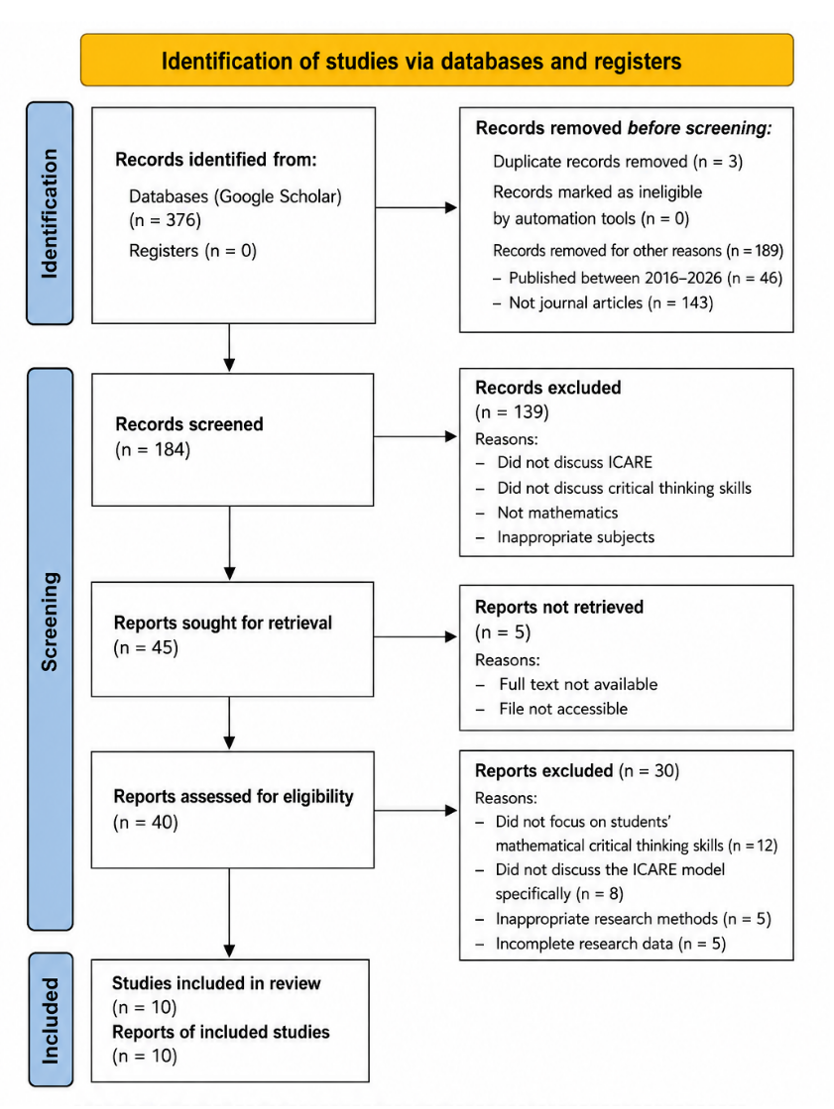
The low level of students’ mathematical critical thinking skills remains a significant challenge in 21st-century mathematics education. This condition highlights the need for instructional models that actively engage students in processes of analysis, evaluation, and reflection. One instructional model considered to have the potential to foster these skills is the ICARE model (Introduction, Connection, Application, Reflection, and Extension). This study aimed to review and synthesize research findings regarding the effectiveness of the ICARE learning model in improving students’ mathematical critical thinking skills. The study employed a Systematic Literature Review (SLR) approach based on the PRISMA guidelines. Articles were identified through the Google Scholar database using the Publish or Perish application with the keywords (“ICARE”) AND (“Critical Thinking”) AND (“matematika”). The final search was conducted in May 2026 and covered publications from 2016 to 2026. The articles were screened according to inclusion and exclusion criteria, including document type, topic relevance, full-text availability, research participants, and the alignment of research variables. Of the 376 articles initially identified, 10 studies met the eligibility criteria and were included in the review. Data were analyzed through coding, categorization, comparison, and synthesis of the research findings. The results indicate that most studies reported positive effects of the ICARE learning model on students’ mathematical critical thinking skills. Improvements were consistently observed in students’ abilities to analyze, interpret, evaluate, infer, and draw conclusions. Furthermore, the effectiveness of ICARE was supported by learning activities that promote active participation, reflection, and contextual understanding. These findings suggest that the ICARE model has considerable potential as an alternative instructional approach in mathematics education to enhance students’ mathematical critical thinking skills.
Downloads
References
Aryani, E., Huda, N., & Anwar, K. (2024). Analisis Berpikir Kritis Siswa Berdasarkan Gaya Kognitif dalam Menyelesaikan Masalah. Kognitif: Jurnal Riset HOTS Pendidikan Matematika, 4(4), 1554–1565. https://doi.org/10.51574/kognitif.v4i4.2195
Astagisa, R., & Malik, A. (2025). Systematic Literature Review (SLR): Pengembangan Asesmen Formatif untuk Mendukung Pembelajaran Fisika dalam Kerangka Kurikulum Merdeka. Risalah Fisika, 5(2), 97–105. https://doi.org/10.35895/rf.v5i2.36
Haryadi, R., & Pujiastuti, H. (2022). Enhancing Pre-service Physics Teachers’ Higher-Order Thinking Skills Through STEM-PjBL Model. International Journal of STEM Education for Sustainability, 2(2), 156–171. https://doi.org/10.53889/ijses.v2i2.38
Hikmatuprilla, A. W. I., Ambarwati, L., & Wijayanti, D. A. (2021). The Effect of the ICARE Learning Model in Distance Learning on the Mathematical Problem Solving Ability of SMK Negeri 2 Karawang Students. Journal of Medives : Journal of Mathematics Education IKIP Veteran Semarang, 5(2), 317–328. https://doi.org/10.31331/medivesveteran.v5i2.1706
Intani, A. H., Febriyanti, R., & Prafianti, R. A. (2024). Pengaruh Model Pembelajaran Discovery Learning Terhadap Kemampuan Berpikir Kritis Siswa Materi Persamaan Lingkaran. LIPS: Jurnal Pendidikan Matematika, 5(1), 19–28. https://doi.org/10.47650/elips.v5i2.1185
Jasmi, L., & Yulkifli. (2024). Development of Natural Science E-Module Based on ICARE Model Integrated with SETS Approach to Improve Students’ Critical Thinking Skills. Jurnal Penelitian Pendidikan IPA, 10(SpecialIssue), 89–99. https://doi.org/10.29303/jppipa.v10ispecialissue.7817
Khairani, P., & Nisa, S. (2024). Systematic Literature Review (SLR): Peran Lingkungan dalam Meningkatkan Keterampilan Siswa Berbahasa Indonesia. MASALIQ : Jurnal Pendidikan Dan Sains, 4(3), 742–749. https://doi.org/10.58578/masaliq.v4i3.3064
Liani, A. M. (2025). A Systematic Review of Mathematics Learning Strategies for Developing Students’ 4C Skills: Creativity, Critical Thinking, Communication, and Collaboration. Proceedings of International Conference on Educational Studies in Mathematics, 2(1), 1–8. https://journal.unm.ac.id/index.php/icoesm/article/view/10789
Maryanto, B. P. A., Rachmawati, L. N., Muhammad, I., & Sugianto, R. (2023). Literature Review: Problems of Mathematics Learning in Schools. Deltha-Phi: Jurnal Pendidikan Matematika, 1(1), 65–71. https://doi.org/10.61650/dpjpm.v1i1.94
Nasution, Y., Susanta, A., Zamzaili, Z., & Haji, S. (2023). Pengaruh Model Pembelajaran Introduction Connection Application Reflection Dan Extension (ICARE) Terhadap Kemampuan Pemecahan Masalah Dan Kemampuan Berpikir Kritis Siswa Pada Materi Aritmatika Sosial Di Kelas Vii Smpit Darul Fikri Bengkulu Utara. Lebesgue : Jurnal Ilmiah Pendidikan Matematika, Matematika Dan Statistika, 4(2), 872–878. https://doi.org/10.46306/lb.v4i2.349
Nurmalita, R., & Zulkarnaen, R. (2023). Kemampuan Berpikir Kritis Matematis Siswa Pada Materi Sistem Persamaan Linear Dua Variabel. Jurnal Educatio, 10(1), 1–7. https://doi.org/10.31949/educatio.v10i1.6463
OECD. (2019). PISA 2018 Results (Volume I): What Students Know and Can Do. OECD Publishing. https://doi.org/10.1787/5f07c754-en
OECD. (2023). PISA 2022 Results (Volume I): The State of Learning and Equity in Education. OECD Publishing. https://doi.org/10.1787/53f23881-en
Oktaviani, D., Sabil, H., & Junita, R. (2025). Pengembangan Video Pembelajaran Berbantuan Edpuzzle Berbasis STEM untuk Meningkatkan Kemampuan Berpikir Kritis Siswa SMP. Kognitif: Jurnal Riset HOTS Pendidikan Matematika, 5(3), 1121–1131. https://doi.org/10.51574/kognitif.v5i3.2566
Pelle, Y. Y., Ali, U., & Weny, N. A. (2024). Pengaruh Kemampuan Berpikir Kritis dan Keterampilan Komunikasi Bagi Siswa dalam Menjawab Soal Higher Order Thinking Skills (HOTS ) di Sekolah Menengah Teologi Kristen Rote Timur. Apostolos: Journal of Theology and Christian Education, 4(2), 101–107. https://doi.org/10.52960/a.v4i2.327
Prianto, M. H., Haris, A., & Fadhilah, I. (2025). Penerapan Model Pembelajaran ICARE Dalam Kemampuan Berpikir. El-Miaz Jurnal Pemikiran Dan Pendidikan Dasar, 4(2), 35–41. https://jurnal.mialazhar.sch.id/index.php/el-miaz/article/view/182
Pujiastuti, H., Haryadi, R., & Solihati, E. (2021). Pengembangan Modul Matematika Berbasis Kontekstual pada Materi Aljabar. AKSIOMA: Jurnal Program Studi Pendidikan Matematika, 10(1), 63–72. https://doi.org/10.24127/ajpm.v10i1.3392
Rahmadhani, S., Siahaan, A., & Jaya, I. (2022). Analisis Penerapan Model Pembelajaran ICARE untuk Meningkatkan Kemampuan Berfikir Kritis Siswa di Era Pandemi Covid.19. Relevan : Jurnal Pendidikan Matematika, 2(2), 239–245. https://ejournal.yana.or.id/index.php/relevan/article/view/291
Rahmi, D. F., Satrio, M. T. J., Azmy, D. S., & Septian, A. (2023). Penerapan Model ICARE Berbasis Media Powtoon untuk Meningkatkan Kemampuan Berpikir Kritis Matematis Siswa. Prisma, 12(2), 486–493. https://doi.org/10.35194/jp.v12i2.3758
Sa’diyah, L. H., Siahaan, P., Samsudin, A., Suhendi, E., Riani, V. R., & Fatima, W. O. (2021). Promoting the model introducing, connecting, applying reflecting, and extending using Rasch analysis (ICARE-R) to improve students’ critical thinking skills on physics concepts. Journal of Physics: Conference Series, 1806(1), 1–6. https://doi.org/10.1088/1742-6596/1806/1/012032
Samudra, D. A., Mahfudy, S., & Negara, H. R. P. (2025). Kemampuan Berpikir Kritis Mahasiswa Calon Guru Matematika dalam Menyelesaikan Masalah Geometri ditinjau dari Gaya Kognitif. Kognitif: Jurnal Riset HOTS Pendidikan Matematika, 5(2), 522–540. https://doi.org/10.51574/kognitif.v5i2.3260
Saputri, M., Elisa, E., & Nurlianti, S. (2022). Effectiveness of ICARE Learning Model in Improving Students’ Critical Thinking Skills and Collaboration Skills. Jurnal Penelitian Pendidikan IPA, 8(3), 1128–1134. https://doi.org/10.29303/jppipa.v8i3.1360
Sari, A. (2025). Pengaruh Penerapan Model ICARE terhadap Kemampuan Berpikir Kritis ditinjau dari Self Efficacy Siswa SMA/MA. Phytagoras: Jurnal Pendidikan Matematika, 2(1), 89–95. https://doi.org/10.70692/ec13vr71
Sastypratiwi, H., & Nyoto, R. D. (2020). Analisis Data Artikel Sistem Pakar Menggunakan Metode Systematic Review. Jurnal Edukasi Dan Penelitian Informatika (JEPIN), 6(2), 250–257. https://doi.org/10.26418/jp.v6i2.40914
Sihotang, M. A. I., Sembiring, R. K., & Sitepu, I. (2023). Implementasi Model Pembelajaran Berbasis Masalah untuk Meningkatkan Kemampuan Berpikir Kritis Siswa SMP Negeri 30 Medan. Cartesius: Jurnal Pendidikan Matematika, 6(2), 64–69. https://ejournal.ust.ac.id/index.php/CARTESIUS/article/view/3273
Subro, M. H., & Fawaid, A. (2025). Penerapan Pembelajaran Abad 21 dalam Meningkatkan Kemampuan Berpikir Kritis Siswa. JIIP - Jurnal Ilmiah Ilmu Pendidikan, 8(6), 6344–6348. https://doi.org/10.54371/jiip.v8i6.8243
Yenni, R. P., Siahaan, P., & Suwarma, I. R. (2022). ICARE-U Learning Model to Improve Critical Thinking Skills of High School Students in Indonesia. Jurnal Pendidikan MIPA, 23(2), 585–594. https://doi.org/10.23960/jpmipa/v23i2.pp585-594
Yulianto, D., Umami, M. R., & Anwar, S. (2024). Mengoptimalkan Kemampuan Pemecahan Masalah Matematis dan Berpikir Kritis melalui Pembelajaran CORE dan I-CARE dengan Aplikasi Geometryx di Sekolah Menengah Pertama di Lebak, Banten. Symmetry: Pasundan Journal of Research in Mathematics Learning and Education, 9(1), 1–26. https://doi.org/10.23969/symmetry.v9i1.12757
Zainal, N. F., Arismunandar, A., & Suardi, S. (2025). Keterampilan Berpikir Kritis Dalam Pembelajaran Matematika: Literature Review. JP2M (Jurnal Pendidikan Dan Pembelajaran Matematika), 11(1), 337–348. https://doi.org/10.29100/jp2m.v11i1.6993
Downloads
Published
How to Cite
Issue
Section
License
Copyright (c) 2026 This is an open-access under the CC-BY-SA license

This work is licensed under a Creative Commons Attribution-ShareAlike 4.0 International License.
Education and Talent Development Center of Indonesia (ETDC Indonesia)
e-mail: kognitif@gmail.com, website : https://etdc-indonesia.com

Kognitif: Jurnal Riset HOTS Pendidikan Matematika dengan Situs: https://etdci.org/journal/kognitif berlisensi Creative Commons Attribution-ShareAlike 4.0 International License






.png)