Effects of Direct Instruction Supported by Algebrator on Learning Outcomes in Linear Equation Systems

https://doi.org/10.51574/kognitif.v5i4.3391
Keywords:
Direct Instruction , Algebrator , Student Learning Outcomes , Linear Equation SystemsAbstract
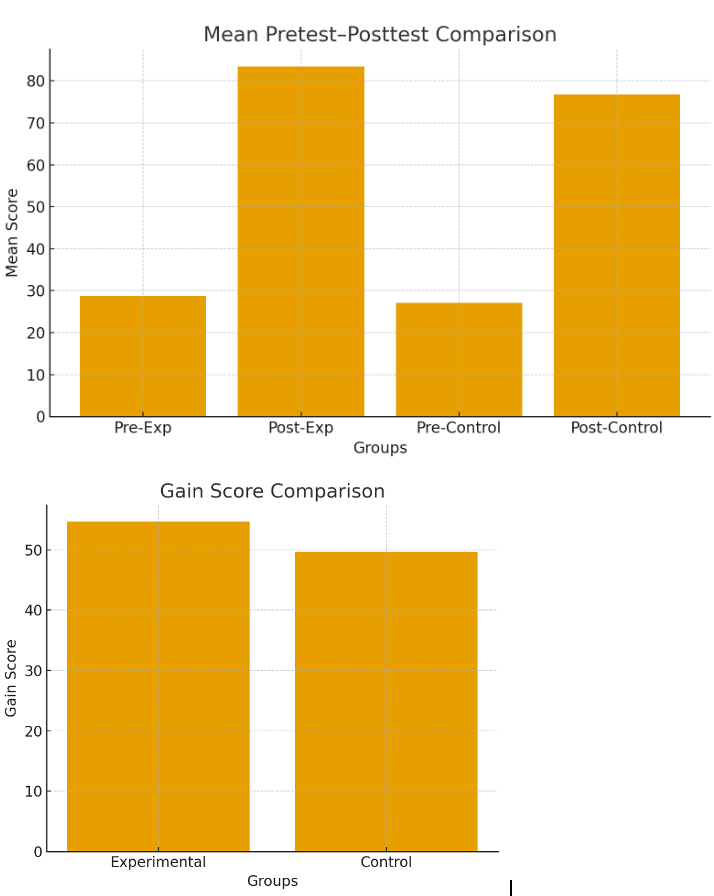
Students’ understanding of systems of linear equations in two variables is often limited due to the abstract nature of the topic and the requirement for logical and systematic reasoning skills. To address this issue, an appropriate instructional model supported by effective learning media is needed. This study aimed to examine the effect of the Direct Instruction learning model supported by Algebrator on students’ learning outcomes in systems of linear equations. This study employed a quasi-experimental method using a control group pretest–posttest design. The participants were eighth-grade students at a public Islamic junior high school. The sample consisted of two classes, with 25 students in the experimental group and 25 students in the control group. The experimental group was taught using the Direct Instruction model supported by Algebrator, while the control group received conventional instruction without technological media. Data were analyzed using descriptive statistics and an independent samples t-test at a significance level of 0.05. The results showed that the mean posttest score of the experimental group was 83.44, which was higher than that of the control group, which obtained a mean score of 76.76. The t-test results indicated a significant difference between the two groups (t = 2.35, p < 0.05). These findings demonstrate that students taught using the Direct Instruction model supported by Algebrator achieved significantly better learning outcomes than those taught using conventional methods. This study indicates that the integration of technological learning media such as Algebrator can effectively enhance students’ understanding and learning outcomes in mathematics, particularly in systems of linear equations. The findings provide empirical support for the use of technology-assisted Direct Instruction in mathematics classrooms.
Downloads
References
Agterberg, D. A., Oostdam, R. J., & Janssen, F. J. J. M. (2022). From speck to story: relating history of mathematics to the cognitive demand level of tasks. Educational Studies in Mathematics, 110(1), 49–64. https://doi.org/10.1007/s10649-021-10093-6
Björklund, C., & Palmér, H. (2022). Teaching toddlers the meaning of numbers—connecting modes of mathematical representations in book reading. Educational Studies in Mathematics, 110(3), 525–544. https://doi.org/10.1007/s10649-022-10147-3
De Chenne, A., & Lockwood, E. (2022). A task to connect counting processes to lists of outcomes in combinatorics. Journal of Mathematical Behavior, 65(February 2021), 100932. https://doi.org/10.1016/j.jmathb.2021.100932
Fredriksdotter, H., Norén, N., & Bråting, K. (2022). Investigating grade-6 students’ justifications during mathematical problem solving in small group interaction. Journal of Mathematical Behavior, 67(January). https://doi.org/10.1016/j.jmathb.2022.100972
Fuchs, L., Fuchs, D., Seethaler, P. M., & Barnes, M. A. (2020). Addressing the role of working memory in mathematical word-problem solving when designing intervention for struggling learners. ZDM - Mathematics Education, 52(1), 87–96. https://doi.org/10.1007/s11858-019-01070-8
Habsyi, R., R. M. Saleh, R., & Isman M. Nur. (2022). Pengembangan E-LKPD Berbasis Guided Dicovery Learning untuk Meningkatkan Kemampuan Berpikir Kritis Siswa. Kognitif: Jurnal Riset HOTS Pendidikan Matematika, 2(1), 1–18. https://doi.org/10.51574/kognitif.v2i1.385
Harris, D., Logan, T., & Lowrie, T. (2023). Spatial visualization and measurement of area: A case study in spatialized mathematics instruction. Journal of Mathematical Behavior, 70(May 2022), 101038. https://doi.org/10.1016/j.jmathb.2023.101038
Kontorovich, I. (2020). Theorems or procedures? Exploring undergraduates’ methods to solve routine problems in linear algebra. Mathematics Education Research Journal, 32(4), 589–605. https://doi.org/10.1007/s13394-019-00272-3
Koskinen, R., & Pitkäniemi, H. (2022). Meaningful Learning in Mathematics: A Research Synthesis of Teaching Approaches. International Electronic Journal of Mathematics Education, 17(2). https://doi.org/10.29333/iejme/11715
Kosko, K. W. (2020). The multiplicative meaning conveyed by visual representations. Journal of Mathematical Behavior, 60(January), 100800. https://doi.org/10.1016/j.jmathb.2020.100800
Öçal, M. F., Şen, C., Güler, G., & Kar, T. (2020). The investigation of prospective mathematics teachers’ non-algebraic solution strategies for word problems. International Journal of Mathematical Education in Science and Technology, 51(4), 563–584. https://doi.org/10.1080/0020739X.2019.1597936
Patahuddin, S. M., Ramful, A., Lowrie, T., & Bholoa, A. (2022). Subtleties in spatial visualization maneuvers: Insights from numerical solutions. Journal of Mathematical Behavior, 67(June 2021), 100988. https://doi.org/10.1016/j.jmathb.2022.100988
Pepin, B. (2021). Connectivity in support of student co design of innovative mathematics curriculum trajectories. ZDM – Mathematics Education, 53(6), 1221–1232. https://doi.org/10.1007/s11858-021-01297-4
Remillard, J. T., Van Steenbrugge, H., Machalow, R., Koljonen, T., Krzywacki, H., Condon, L., & Hemmi, K. (2021). Elementary teachers’ reflections on their use of digital instructional resources in four educational contexts: Belgium, Finland, Sweden, and U.S. ZDM - Mathematics Education, 53(6), 1331–1345. https://doi.org/10.1007/s11858-021-01295-6
Sand, O. P., Lockwood, E., Caballero, M. D., & Mørken, K. (2022). Three cases that demonstrate how students connect the domains of mathematics and computing. Journal of Mathematical Behavior, 67(May 2021). https://doi.org/10.1016/j.jmathb.2022.100955
Sindy Mustika Sari, Aldi Firmansyah, & Reza Lestari. (2022). Analisis Kesulitan Siswa Dalam Menyelesaikan Soal Matematika Problem Solving Berdasarkan Tahapan Heuristik Polya Siswa Kelas XI Ipa. Seminar Nasional Pendidikan Guru Sekolah Dasar Universitas Kuningan, 2(1), 109–114. https://doi.org/10.25134/prosidingsemnaspgsd.v2i1.32
Sormunen, K., Juuti, K., & Lavonen, J. (2020). Maker-Centered Project-Based Learning in Inclusive Classes: Supporting Students’ Active Participation with Teacher-Directed Reflective Discussions. International Journal of Science and Mathematics Education, 18(4), 691–712. https://doi.org/10.1007/s10763-019-09998-9
Street, K. E. S., Malmberg, L. E., & Stylianides, G. J. (2022). Changes in students’ self-efficacy when learning a new topic in mathematics: a micro-longitudinal study. Educational Studies in Mathematics, 111(3), 515–541. https://doi.org/10.1007/s10649-022-10165-1
Tondorf, A., & Prediger, S. (2022). Connecting characterizations of equivalence of expressions: design research in Grade 5 by bridging graphical and symbolic representations. Educational Studies in Mathematics, 111(3), 399–422. https://doi.org/10.1007/s10649-022-10158-0
Turan, M. B., & Koç, K. (2018). The impact of self-directed learning readiness on critical thinking and self-efficacy among the students of the school of physical education and sports. International Journal of Higher Education, 7(6). https://doi.org/10.5430/ijhe.v7n6p98
Wilkie, K. J., & Hopkins, S. (2024). Primary students’ relational thinking and computation strategies with concrete-to-symbolic representations of subtraction as difference. Journal of Mathematical Behavior, 73(April 2023), 101121. https://doi.org/10.1016/j.jmathb.2023.101121
Yilmaz, R. (2020). Prospective Mathematics Teachers ’ Cognitive Competencies on Realistic Mathematics Education. Journal on Mathematics Education, 11(1), 17–44.
Zandieh, M., & Andrews-Larson, C. (2019). Symbolizing while solving linear systems. ZDM - Mathematics Education, 51(7), 1183–1197. https://doi.org/10.1007/s11858-019-01083-3
Downloads
Published
How to Cite
Issue
Section
License
Copyright (c) 2025 Suci Nurjanna Sultan Marajo, Murni Sulistyaningsih, Sylvia Jane Annatje Sumarauw

This work is licensed under a Creative Commons Attribution-ShareAlike 4.0 International License.
Education and Talent Development Center of Indonesia (ETDC Indonesia)
e-mail: kognitif@gmail.com, website : https://etdc-indonesia.com

Kognitif: Jurnal Riset HOTS Pendidikan Matematika dengan Situs: https://etdci.org/journal/kognitif berlisensi Creative Commons Attribution-ShareAlike 4.0 International License






.png)