Cultivating Civic Virtue in Early Education: The Implementation of Pancasila Values in Primary School Students' Daily Behavior

https://doi.org/10.51574/ijrer.v5i4.5414
Keywords:
Character Education, Elementary School, Pancasila Values, Qualitative Research, Student BehaviorAbstract
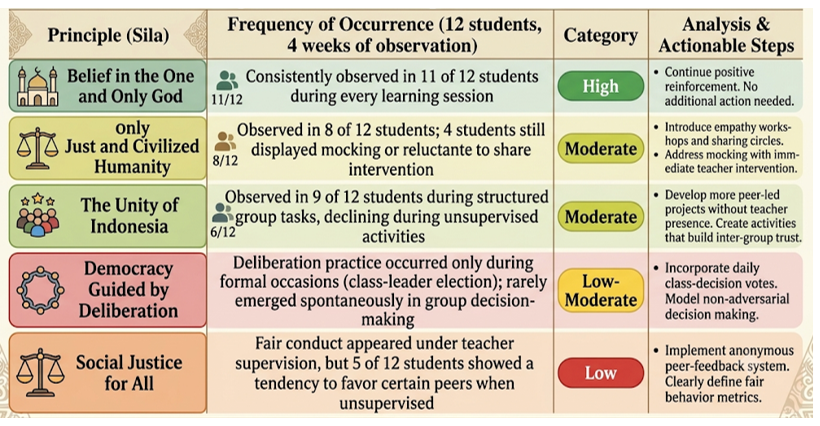
The suboptimal implementation of Pancasila values among elementary school students, manifested in rising bullying, low discipline, and weak environmental responsibility, demands systemic investigation. This study examines how the five core Pancasila principles are integrated into students' daily behavior at a public primary school in South Tangerang City, while identifying key supporting and inhibiting factors. Employing a descriptive qualitative single case-study design, data was gathered over a four-week period via participant observation, structured teacher interviews, and extensive documentation. Analysis followed the classic Miles and Huberman framework (data reduction, display, and conclusion drawing), with trustworthiness rigorously ensured through source, technique, and time triangulation strategies. Findings reveal highly uneven implementation across the five principles: divinity values are most consistently practiced due to established daily routines, while unity and humanity values thrive primarily within structured activities. Conversely, democratic deliberation and social justice values weaken significantly once students operate outside direct teacher supervision. Crucial systemic facilitators include consistent teacher role-modeling, routine habituation, and active parental support. Meanwhile, primary barriers include a scarcity of explicit fairness-building activities, student over-dependence on external oversight, and unmonitored digital media influences. This study concludes that successful moral internalization depends heavily on sustained behavioral habituation rather than conceptual instruction alone, offering vital theoretical and practical implications for refining primary-level character-education policies.
References
Adnan, I. M., Hanif, D., & Fahmi, A. F. (2026). Integrating Thomas Lickona’s Character Education Theory with Islamic Moral Values: A Reflective Framework for Student Character Formation in Indonesia. JURNAL ILMIAH DETUBUYA, 3(3), 113-125. https://doi.org/10.64581/jid.v3i3.182 DOI: https://doi.org/10.64581/jid.v3i3.182
Afifah, R., & Fadilah, N. R. (2023). Implementation of Pancasila Values in Students in Everyday Life. The Easta Journal Law and Human Rights, 1(02), 51-57. https://doi.org/10.58812/eslhr.v1i02.55 DOI: https://doi.org/10.58812/eslhr.v1i02.55
Anisah, A. (2023). Implementation strengthening education character student school Al-anwar's foundations through school culture. Assyfa Journal of Islamic Studies, 1(2), 121-129. https://doi.org/10.61650/ajis.v1i2.296 DOI: https://doi.org/10.61650/ajis.v1i1.296
Aurora, N. S. I. I., Meiranny, A., & Susilowati, E. (2024). Faktor yang Mempengaruhi Sosial-Emosional Anak Usia Dini: Literature Review. Media Publikasi Promosi Kesehatan Indonesia (MPPKI), 7(4), 768-777. https://doi.org/10.56338/mppki.v7i4.4940 DOI: https://doi.org/10.56338/mppki.v7i4.4940
Azizah, M., Deliani, N., & Batubara, J. (2023). Dampak penggunaan media sosial TikTok terhadap perilaku anak usia sekolah dasar. Indo-MathEdu Intellectuals Journal, 4(3), 2512-2522. DOI: https://doi.org/10.54373/imeij.v4i3.536
Bahri, S., Fauzi, A., & Zaini, B. (2025). Strengthening Character Education Through Behaviorist Approaches: Strategic Management in Shaping Students’ Ethics and Morality. Journal of Educational Management Research, 4(5), 2142-2154. https://doi.org/10.61987/jemr.v4i5.1203 DOI: https://doi.org/10.61987/jemr.v4i5.1203
Cholifah, S. (2024). Educational environment in the implementation of character education. Journal of Scientific Research, Education, and Technology (JSRET), 3(2), 816-825. https://doi.org/10.58526/jsret.v3i2.418 DOI: https://doi.org/10.58526/jsret.v3i2.418
Harianja, A. P., & Sinaga, R. S. (2025). Pancasila as the basis and ideology of the state: Implementation in national and state life. Journal of Social, Justice and Policy, 4(2), 20-24. https://doi.org/10.56015/sjp.v4i2.46 DOI: https://doi.org/10.56015/sjp.v4i2.46
Hasbi, M., Fitri, F., & Muktamar, A. (2023). Character building profile of Pancasila students as an effort to realize national character. ETDC: Indonesian Journal of Research and Educational Review, 2(4), 70-83. https://doi.org/10.51574/ijrer.v2i4.938 DOI: https://doi.org/10.51574/ijrer.v2i4.938
Hasriani, H., Hamim, U., & Mahmud, R. (2025). Strengthening scouting character values through a moral integrated approach for elementary school students. Indonesian Journal of Innovation Studies, 26(3), 10-21070. https://doi.org/10.21070/ijins.v26i3.1463 DOI: https://doi.org/10.21070/ijins.v26i3.1463
Hermawan, A. (2021). Hubungan Penggunaan Gadget Dengan Kemampuan Interaksi Sosial Pada Siswa Di Sekolah Dasar. MAHESA: Malahayati Health Student Journal, 1(1), 53-62. https://doi.org/10.33024/mahesa.v1i1.3320 DOI: https://doi.org/10.33024/mahesa.v1i1.3320
Khaerunnisa, K., & Syarif, A. (2024). Analisis pengaruh penggunaan media sosial TikTok terhadap perilaku remaja pada lingkungan masyarakat. Jurnal Komunikasi Dan Organisasi (J-KO), 6(1), 45-54. DOI: https://doi.org/10.26618/jko.v6i1.15877
Kusumamurti, D., Sari, E. L., Zubaidi, M. M., Wati, S., & Zuhri, S. (2025). Dampak Media Sosial'tiktok'terhadap Nilai-Nilai Kebngsaan Pada Gen Z. JSSTEK-Jurnal Studi Sains dan Teknik, 3(1), 141-153. https://doi.org/10.3342/jsstek.v2i2.38
Lumapuy, O., Gaite, T., & Abdurrachman, O. (2026). The Role of Civic and Pancasila Education Teachers in Enhancing Student Learning Motivation at Primary School. ETDC: Indonesian Journal of Research and Educational Review, 5(2), 1215-1230. https://doi.org/10.51574/ijrer.v5i2.4528 DOI: https://doi.org/10.51574/ijrer.v5i2.4528
Maarif, M. A., Muqorrobin, F. M., Kartiko, A., Sirojuddin, A., & Rofiq, A. (2024). Developing Islamic Character Values Through Student Habituation. Al-Hayat: Journal of Islamic Education, 8(1), 337-349. https://doi.org/10.35723/ajie.v8i1.501 DOI: https://doi.org/10.35723/ajie.v8i1.501
Maulidian, M., & Sativa, F. E. (2025). Perubahan Perilaku Sosial Anak Usia Dini Sebagai Dampak Pembatasan Gadget Oleh Orangtua Di Lombok Timur. Jurnal Psimawa: Diskursus Ilmu Psikologi Dan Pendidikan, 8(1), 114-122.
Nuha, U., & Fithriyah, N. N. (2025). Bridging Theory and Classroom Practice: Examining the Influence of Behaviorist Learning Theory on Student Conduct and Teaching Strategy. Journal of Studies in Elementary Education, 1(1), 15-25. https://doi.org/10.64268/jsee.v1i1.31 DOI: https://doi.org/10.64268/jsee.v1i1.31
Nurdyansyah, F., Muflihati, I., Ujianti, R. M. D., Novita, M., Kusumo, H., & Ryan, J. C. (2022). Indonesian Character Building Strategy: Planning the Pancasila Student Profile Strengthening Project in Kurikulum Merdeka. KnE Social Sciences. https://doi.org/10.18502/kss.v7i19.12456 DOI: https://doi.org/10.18502/kss.v7i19.12456
Pangestu, W. T., & Sumadi, C. D. (2024). Student habituation program in elementary school: The orientation of cocurricular activities in developing characters of pancasila students. BIO Web of Conferences (Vol. 146, p. 01072). EDP Sciences. https://doi.org/10.1051/bioconf/202414601072 DOI: https://doi.org/10.1051/bioconf/202414601072
Purnomo, A., & Kurniawan, G. F. (2025). Unearthing the Intellectual Roots of the Name ‘Indonesia’: Construction of National Identity Among High School Students in Indonesia. Social and Education History, 14(3), 209-228. https://doi.org/10.17583/hse.18214 DOI: https://doi.org/10.17583/hse.18214
Pusparini, D., Khulsum, U., & Mediyana, M. (2025). The Role of Teachers in Implementing Pancasila Values to Form the Nationalistic Character of Early Childhood. ATTAQWA: Jurnal Pendidikan Islam dan Anak Usia Dini, 4(3), 178-187. DOI: https://doi.org/10.58355/attaqwa.v4i3.172
Rosyad, A. M., & Mahamood, S. F. (2025). A Systematic Literature Review of Pancasila Education in Higher Education: Trends, Pedagogical Innovations, and Learner Competencies. International Journal of Science Education and Cultural Studies, 4(2), 28-46. https://doi.org/10.58291/ijsecs.v4i2.459 DOI: https://doi.org/10.58291/ijsecs.v4i2.459
Salam, R. (2021). Implementation of Pancasila Values in the new order era and post-reformation. Budapest International Research and Critics Institute-Journal (BIRCI-Journal), 4(2), 3177-3185. https://doi.org/10.33258/birci.v4i2.2050 DOI: https://doi.org/10.33258/birci.v4i2.2050
Siti, N., Ratno Abidin, R., Naili, S., & Wahono, W. (2025). Dampak Tayangan Tiktok terhadap Perilaku Sosial Anak Usia 4-5 Tahun di Tk Aisyiyah Bustanul Athfal 58 Surabaya. Jurnal At-Tasyrih Jurnal Pendidikan dan Hukum Islam, 11(1), 133-149. https://doi.org/10.55849/attasyrih.v11i1.287
Sudirta, I. W., Pieris, J., Nugroho, W., & Ryantoni, H. (2025). Explore the Values of Pancasila as the Basic Philosophy of the Indonesian Nation. Arena Hukum, 18(1), 127-158. https://doi.org/10.21776/ub.arenahukum2025.01801.6 DOI: https://doi.org/10.21776/ub.arenahukum2025.01801.6
Susanti, A., Darmansyah, A., & Muktadir, A. (2024). Fostering religious character through the implementation of school culture in Pancasila student profiles. Jurnal Riset Madrasah Ibtidaiyah (JURMIA), 4(2), 117-129. https://doi.org/10.32665/jurmia.v4i2.3202 DOI: https://doi.org/10.32665/jurmia.v4i2.3202
Susanti, R., & Mariyana, M. (2022). Dampak Penggunaan Gadget Pada Perilaku Anak. Jurnal Ilmiah Zona Psikologi, 4(3). https://ejurnal.univbatam.ac.id/index.php/zonapsikologi/article/view/987
Susanti, A., Darmansyah, A., Tyas, D. N., Hidayat, R., Syahputri, D. O., Wulandari, S., & Rahmasari, A. (2023). The implementation of project for strengthening the profile of Pancasila students in the independent curriculum for elementary school students. IJECA (International Journal of Education and Curriculum Application), 6(2), 113-122. https://doi.org/10.31764/ijeca.v6i2.15474 DOI: https://doi.org/10.31764/ijeca.v6i2.15474
Tahir, R. S., Soepriyanti, H., Nurtaat, L., & Waluyo, U. (2024). Implementation of character education policies: Pancasila student profile program in teaching and learning English at junior high school 5 Kopang, Lombok, Indonesia. J. Pendidik. Sains Geol. Dan Geofis.(GeoScienceEd J.), 5, 390-399. DOI: https://doi.org/10.29303/goescienceed.v5i3.379
Tetiwar, V. R., Rumtutuly, F., & Ratumanan, S. D. (2026). Student Teams Achievement Division Learning Model: Learning Outcomes of Pancasila Education at Primary School. ETDC: Indonesian Journal of Research and Educational Review, 5(3), 1504-1518. https://doi.org/10.51574/ijrer.v5i3.4754 DOI: https://doi.org/10.51574/ijrer.v5i3.4754
Utari, D., & Afendi, A. R. (2022). Implementation of Pancasila student profile in elementary school education with project-based learning approach. EduLine: Journal of Education and Learning Innovation, 2(4), 456-464. https://doi.org/10.35877/454RI.eduline1280 DOI: https://doi.org/10.35877/454RI.eduline1280
Wahono, J., Kusumawati, I., & Bowo, A. N. A. (2021). Developing Pancasila and citizenship education learning model based on character education through comprehensive approach. International Journal of Educational Management and Innovation, 2(2), 228. https://doi.org/10.12928/ijemi.v2i2.3239 DOI: https://doi.org/10.12928/ijemi.v2i2.3239
Yasin, N. A. Y. (2026). Developing Positive Behavior Based on Pancasila Character Values in Primary School Settings. Master of Civic Innovation and Education Technology, 2(1), 13-26. https://doi.org/10.63461/civic-edutech.v21.323 DOI: https://doi.org/10.63461/civic-edutech.v21.323
Yusra, A., Neviyarni, S., & Erianjoni, E. (2022). A review of behaviorist learning theory and its impact on the learning process in schools. International Journal of Educational Dynamics, 5(1), 81-91. https://doi.org/10.24036/ijeds.v5i1.373 DOI: https://doi.org/10.24036/ijeds.v5i1.373
Zaki, M., & Fanani, A. (2025). Pesantren as a Living Curriculum for Pancasila Education: Value Internalization at Darul Ulum Jombang. ELite Journal: International Journal of Education, Language and Literature, 5(2), 51-67. https://doi.org/10.26740/elitejournal.v5n2.p51-67
Downloads
Published
How to Cite
Issue
Section
License
Copyright (c) 2026 Saepudin Karta Sasmita, Dini Handayani

This work is licensed under a Creative Commons Attribution-ShareAlike 4.0 International License.