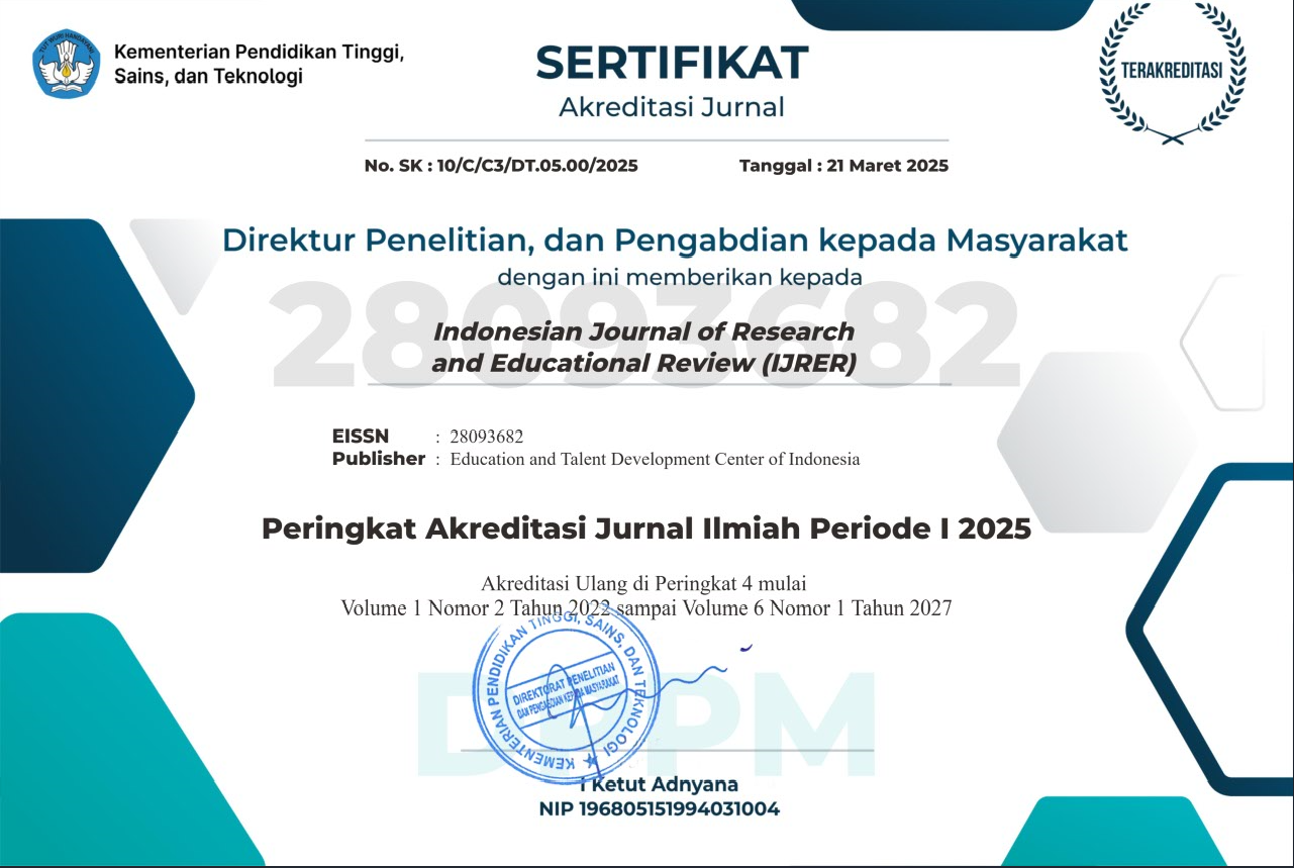
ACREDITATION
This research is motivated by the low activity and learning outcomes of students in natural science subjects at state elementary schools. This study aims to test and analyze the effect of the Think Pair Share (TPS) learning model on increasing the engagement and learning outcomes of fifth-grade science subject students at State Elementary Schools. This study uses a quasi-experimental method with a post-test-only nonequivalent control group design. The sample consists of two groups: the Experimental Class (n=27), which applies the TPS model, and the Control Class (n=26), which uses conventional learning at State Elementary School 3 Bandar Lampung. Data was collected through questionnaires, observation of learning activities, and learning outcome tests (post-test). Learning outcome data was analyzed using the independent sample t-test (Welch's t-test) after normality and homogeneity tests. The results of the study show: (1) Student learning engagement in the Experimental Class is in the High category with an average of 78.7%, while the Control Class is in the medium category with an average of 59.9%. (2) The average post-test score of the experimental class (88.52) was much higher than that of the control class (69.04). (3) The results of the hypothesis test indicated that there was a statistically very significant difference between the two groups (p-value = 0.000000019), which indicated that H_0 was rejected. The contribution of this study is to provide empirical evidence that the TPS learning model is a very effective and significant intervention in improving learning activities and cognitive learning outcomes among science students in elementary Islamic education.
Hasanah, A. N., Baharudin, B., & Hasnanto, A. T. (2025). Think of Pair Share Learning Model on Student Learning Activity in Science Subjects at State Elementary Madrasah. ETDC: Indonesian Journal of Research and Educational Review , 5(1), 331–346. https://doi.org/10.51574/ijrer.v5i1.4200
Downloads
Download data is not yet available.
- Ahmad, R. K. (2025). Enhancing Student Engagement and Performance in Indonesian Language Learning through the Think-Pair-Share (TPS) Model with Question Card Media. Journal of Education Innovation and Curriculum Development, 3(1), 30-37. https://journals.iarn.or.id/index.php/educur/article/view/452
- Azizi, F., Wiranda, N., Monnader, N. G., & Morales, U. (2025). Applying the Think-Pair-Share Model to Improve Elementary School Students' Learning Outcomes. Education Journal, 1(3), 107-123. https://journal.zmsadra.or.id/index.php/edunalar/article/view/154
- Basdogan, M., & Birdwell, T. (2024). How to design ‘cultivated spaces’ in active learning classrooms: analysis of faculty reflections on learning space. Learning Environments Research, 27(3), 669-689. https://doi.org/10.1007/s10984-024-09496-y
- Chuang, S. (2021). The applications of constructivist learning theory and social learning theory on adult continuous development. Performance Improvement, 60(3), 6-14. https://doi.org/10.1002/pfi.21963
- Cole, A. W., Lennon, L., & Weber, N. L. (2021). Student perceptions of online active learning practices and online learning climate predict online course engagement. Interactive Learning Environments, 29(5), 866-880. https://doi.org/10.1080/10494820.2019.1619593
- Fiqhiyah, F. A., Lestari, I. W., Suwandi, E., & Wafa, K. (2025). Exploring EFL Students’ Views on the Implementation of Think-Pair-Share in Reading Comprehension. Innovations in Language Education and Literature, 2(1), 38-47. https://doi.org/10.31605/ilere.v2i1.5251
- Ganatra, S., Doblanko, T., Rasmussen, K., Green, J., Kebbe, M., Amin, M., & Perez, A. (2021). Perceived effectiveness and applicability of think-pair-share including storytelling (TPS-S) to enhance clinical learning. Teaching and Learning in Medicine, 33(2), 184-195. https://doi.org/10.1080/10401334.2020.1811094
- García-Carmona, A. (2025). Scientific thinking and critical thinking in science education: Two distinct but symbiotically related intellectual processes. Science & Education, 34(1), 227-245. https://doi.org/10.1007/s11191-023-00460-5
- Guo, J. P., Yang, L. Y., Zhang, J., & Gan, Y. J. (2022). Academic self-concept, perceptions of the learning environment, engagement, and learning outcomes of university students: relationships and causal ordering. Higher Education, 83(4), 809-828. https://doi.org/10.1007/s10734-021-00705-8
- Hartikainen, S., Rintala, H., Pylväs, L., & Nokelainen, P. (2019). The concept of active learning and the measurement of learning outcomes: A review of research in engineering higher education. Education Sciences, 9(4), 276. https://doi.org/10.3390/educsci9040276
- Kaymak, S., Kassymbek, Z., Kalamkas, A., & Saydenov, F. (2021). The effect of cooperative learning on students academic achievement. Management, 9(6), 495-503.
- Kotsis, K. T. (2025). Optimal STEM educators for elementary school: Students from the Primary Education vs. Science Department. EIKI Journal of Effective Teaching Methods, 3(1). https://doi.org/10.59652/jetm.v3i1.360
- Li, M. M., & Tu, C. C. (2024). Developing a project-based learning course model combined with the think–pair–share strategy to enhance creative thinking skills in education students. Education Sciences, 14(3), 233. https://doi.org/10.3390/educsci14030233
- Liu, J., Tahri, D., & Qiang, F. (2024). How does active learning pedagogy shape learner curiosity? A multi-site mediator study of learner engagement among 45,972 children. Journal of Intelligence, 12(6), 59. https://doi.org/10.3390/jintelligence12060059
- Lombardi, D., Shipley, T. F., & Astronomy Team, Biology Team, Chemistry Team, Engineering Team, Geography Team, Geoscience Team, and Physics Team. (2021). The curious construct of active learning. Psychological Science in the Public Interest, 22(1), 8-43. https://doi.org/10.1177/1529100620973974
- Mansir, F. (2022). Integration of islamic science and science in schools: Studies on learning Islamic religious education in the digital era. TADRIS: Jurnal Pendidikan Islam, 17(2), 412-424. https://doi.org/10.19105/tjpi.v17i2.6769
- Nasucha, M. R., Khozin, K., & Thoifah, I. A. (2023). Synergizing islamic religious education and scientific learning in the 21st century: A systematic review of literature. Jurnal Pendidikan Agama Islam (Journal of Islamic Education Studies), 11(1), 109-130. https://doi.org/10.15642/jpai.2023.11.1.109-130
- Nurlaika, F., Sahade, S., & Rijal, A. (2024). The Effect of Cooperative Learning Model Type Think Pair Share (TPS) on Student Learning Outcomes. Golden Ratio of Data in Summary, 4(2), 641-653. https://doi.org/10.52970/grdis.v4i2.648
- Pajri, S., Sai'dy, S. D., Azizah, N., Saputra, M. I., & Asyha, A. F. (2025). Think Pair Share Strategy Supports Student Engagement in Islamic Education Lessons. Indonesian Journal of Innovation Studies, 26(3), 10-21070. https://doi.org/10.21070/ijins.v26i3.1441
- Pohan, K. (2024). Implementation of Think-Pair-Share Type Cooperative Learning Strategy to Improve Understanding of Islamic Religious Education Material in Junior High School Students. Educationist Journal, 2(2), 110-120. https://jurnal.uinsyahada.ac.id/index.php/Educationist/article/view/15440
- Purmiatin, A. I., & Prameswari, N. K. (2025). Implementation of the Think Pair Share Model on the Material of Light and its Properties on Students' Critical Thinking Skills. Journal of Education and Religious Studies, 5(02), 60-66. https://doi.org/10.57060/m7ncw086
- Rahmawati, H., & Haeriah, H. (2023). Enhancing Student Engagement and Learning Outcomes through the Implementation of the TPS (Think Pair Share) Cooperative Learning Model. Prisma Sains: Jurnal Pengkajian Ilmu dan Pembelajaran Matematika dan IPA IKIP Mataram, 11(3), 836-843. https://doi.org/10.33394/j-ps.v11i3.8718
- Sajidan, S., Atmojo, I. R. W., Ardiansyah, R., Saputri, D. Y., Roslan, R. M., & Halim, L. (2024). The Effectiveness of the Think-Pair-Project-Share (TP2S) Model in Facilitating Self Directedness of Prospective Science Teachers. Jurnal Pendidikan IPA Indonesia, 13(2).
- Samaila, K., Tsong, C. K., Masood, M., & Bervell, B. (2024). Think-pair-share based flipped classroom: A model for improving students’ learning achievement and self-efficacy. Journal of Digital Educational Technology, 4(1), ep2410. https://doi.org/10.30935/jdet/14422
- Shi, Y., Yang, H., MacLeod, J., Zhang, J., & Yang, H. H. (2020). College students’ cognitive learning outcomes in technology-enabled active learning environments: A meta-analysis of the empirical literature. Journal of Educational Computing Research, 58(4), 791-817. https://doi.org/10.1177/0735633119881477
- Standaert, F. X. (2018). How (not) to use welch’s t-test in side-channel security evaluations. In International conference on smart card research and advanced applications (pp. 65-79). Cham: Springer International Publishing. https://doi.org/10.1007/978-3-030-15462-2_5
- Sukelasmini, I. G. A. M. (2019). The implementation of think pair share (TPS) type of cooperative learning model to improve student’s motivation and nutrition science learning achievement. Journal of Education Action Research, 3(1), 9-15. https://doi.org/10.23887/jear.v3i1.17081
- Susiloningsih, E., Fathurohman, A., Maharani, S. D., Fathurohman, M. F., & Nurani, D. C. (2025). Integration of STEM Approach in Science Education: Enhancing Students' Critical Thinking, Creativity, and Engagement in Elementary Schools in Palembang. Jurnal Penelitian Pendidikan IPA, 11(4), 10-19. https://doi.org/10.29303/jppipa.v11i4.10615
- Sutiana, D., & Nugraha, M. S. (2025). Integration of Islamic Values and Science in Islamic Primary Schools: A Philosophy of Science Approach. Journal of Elementary Education Research and Practice, 1(1), 21-34. https://doi.org/10.70376/bv7bqx53
- Van Ryzin, M. J., & Roseth, C. J. (2018). Cooperative learning in middle school: A means to improve peer relations and reduce victimization, bullying, and related outcomes. Journal of educational psychology, 110(8), 1192. https://psycnet.apa.org/buy/2018-08642-001
- Yang, X. (2023). A historical review of collaborative learning and cooperative learning. TechTrends, 67(4), 718-728. https://doi.org/10.1007/s11528-022-00823-9
- Zaki, A., Sahid, S., Nurhaliza, R., Naufal, M. A., Huda, M., & Hassan, M. N. (2024). Enhancing Mathematical Achievement through the Think-Pair-Share Cooperative Learning Model with Higher-Order Thinking Skills Questions. Jurnal Riset Pendidikan Matematika, 11(2), 106-117. https://doi.org/10.21831/jrpm.v11i2.76963
Copyright (c) 2025 Asri Nur Hasanah, Baharudin Baharudin, Anton Tri Hasnanto

This work is licensed under a Creative Commons Attribution-ShareAlike 4.0 International License.
Most read articles by the same author(s)
- Umi Muslikhatul Khazanah, Baharudin Baharudin, Yuli Yanti, Contextual Teaching and Learning Model: Explosion Box Media on Learning Activity in Elementary School Students' IPAS Subjects , ETDC: Indonesian Journal of Research and Educational Review : Vol. 5 No. 1 (2025): December
- Viki Andriyani, A Fatoni, Anton Tri Hasnanto, Scramble Learning Model with the Assistance of Word Box Media: Beginning Reading Ability of Elementary School Students , ETDC: Indonesian Journal of Research and Educational Review : Vol. 5 No. 1 (2025): December
- Rosyadi Tomi, Baharudin Baharudin, M. Indra Saputra, Padlet-Based Predict Observe Explain (POE) Learning Model: Learning Outcomes of PAI and Character Education , ETDC: Indonesian Journal of Research and Educational Review : Vol. 5 No. 3 (2026): June
Similar Articles
- Andre Fanani, Syaiful Rizal, Implementation of Project-Based Learning Model in Improving Students' Learning Independence , ETDC: Indonesian Journal of Research and Educational Review : Vol. 4 No. 2 (2025): March
- Nurul Laeli, Pradika Adi Wijayanto, The Effectiveness of the PjBL Model Assisted by Story Maps Media: The Creative Thinking Skills of High School Students , ETDC: Indonesian Journal of Research and Educational Review : Vol. 4 No. 4 (2025): September
- Hasfiana Hasfiana, Islamic Religious Education Learning Innovation: The Role and Challenges of the Joyful Learning Approach , ETDC: Indonesian Journal of Research and Educational Review : Vol. 4 No. 4 (2025): September
- Kiswita Papuanga, Zainudin Notanubun, Ribka L Ririhena, The Utilization of Audiovisual Media in Improving Short Story Writing Skill of Fourth Grade Students at Elementary School , ETDC: Indonesian Journal of Research and Educational Review : Vol. 5 No. 1 (2025): December
- Fintje Oppier, Samuel P. Ritiauw, Lisye Salamor, Civics Education Learning and Discipline Character of Fifth-Grade Elementary School Students: A Correlational Study , ETDC: Indonesian Journal of Research and Educational Review : Vol. 5 No. 3 (2026): June
- Nurdalia Nurdalia, Learning Islamic Religious Education Through Contextual Learning Models: Islamic Moderation Studies , ETDC: Indonesian Journal of Research and Educational Review : Vol. 2 No. 3 (2023): June
- Marlina Rande, Mustamin Mustamin, Lu’mu Lu’mu, Cooperative Learning Model on Group Work Ability of Vocational High School Students: Learning Basic Electronics , ETDC: Indonesian Journal of Research and Educational Review : Vol. 5 No. 1 (2025): December
- Misriana Misriana, Problem-Based Learning Model and the Concept Map Method at Public Vocational School Students: Motivation and Learning Outcomes , ETDC: Indonesian Journal of Research and Educational Review : Vol. 4 No. 1 (2024): December
- Murni Fadhilah, Sela Sutrisna, Siti Nuri Muslimah, Muhammad Taufik Ihsan, An Exploring Methods in Online Learning: Synchronous and Asynchronous , ETDC: Indonesian Journal of Research and Educational Review : Vol. 1 No. 1 (2021): December
- Kartini Ester, I Wayan Kertih, I Wayan Lasmawan, The Role of Information Technology in Improving the Quality of Social Studies Learning in Elementary Education , ETDC: Indonesian Journal of Research and Educational Review : Vol. 4 No. 4 (2025): September
<< < 6 7 8 9 10 11 12 13 14 15 > >>
You may also start an advanced similarity search for this article.
Dimension Badge
Crossmark Badge

Section
Articles