Development of Realistic Mathematics Education (RME) Based Student Worksheets to Facilitate Junior High School Students' Mathematical Reasoning Ability

https://doi.org/10.51574/kognitif.v6i2.5154
Keywords:
ADDIE , Mathematical Reasoning Ability , Realistic Mathematics Education (RME) , Statistics , Student WorksheetAbstract
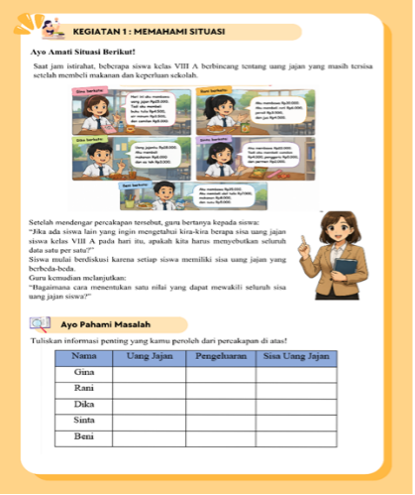
Junior high school students' mathematical reasoning ability still needs improvement, particularly in presenting mathematical information, formulating conjectures, applying concepts logically, evaluating the validity of arguments, and drawing conclusions. Therefore, this study aimed to develop a Realistic Mathematics Education (RME)-based Student Worksheet (SW) on statistics for eighth-grade junior high school students that is valid, practical, and limitedly effective in facilitating students' mathematical reasoning ability. This study employed a Research and Development (R&D) method using the ADDIE model, which consists of five stages: analysis, design, development, implementation, and evaluation. The research participants included two material experts, two media experts, 10 students in a small-group trial, and 25 eighth-grade students of SMP Negeri 13 Tasikmalaya in a field trial. Data were collected through interviews, validation sheets, student response questionnaires, and mathematical reasoning ability tests. The data were analyzed using descriptive quantitative and qualitative techniques. The results showed that the developed worksheet achieved a validity score of 88% from material experts and 95% from media experts, both categorized as highly valid. The practicality test indicated a student response rate of 91.5%, categorized as highly practical. The product's effectiveness was evaluated on a limited basis through a mathematical reasoning ability test, which showed a classical mastery level of 80%. These findings indicate that the RME-based Student Worksheet can facilitate students' mathematical reasoning ability in learning statistics. Therefore, the developed worksheet is feasible to be used as an alternative teaching material that supports contextual and student-centered mathematics learning.
Downloads
References
Fitriani, N., & Maulana, M. (2021). Pengembangan LKPD Berbasis Realistic Mathematics Education untuk Meningkatkan Kemampuan Penalaran Matematis Siswa SMP. Mosharafa: Jurnal Pendidikan Matematika, 10(3), 411–422. https://doi.org/10.31980/mosharafa.v10i3.987
Freudenthal, H. (1991). Revisiting Mathematics Education: China Lectures. Kluwer Academic Publishers.
Gea, N., Mendrofa, R. N., Lase, S., & Telaumbanua, Y. N. (2025). Pengembangan Lembar Kerja Siswa (LKS) Berbasis Proyek Untuk Meningkatkan Kemampuan Penalaran Matematis Siswa SMP. Jurnal PEKA (Pendidikan Matematika). https://doi.org/10.37150/h4d8r043
Gravemeijer, K. (2020). Realistic Mathematics Education Theory as a Guideline for Problem-Centered Instruction. In S. Lerman (Ed.), Encyclopedia of Mathematics Education (pp. 713–717). Springer. https://doi.org/10.1007/978-3-030-15789-0_170
Gravemeijer, K. P. E. (1994). Developing Realistic Mathematics Education. CD-β Press.
Hendriana, H., Rohaeti, E. E., & Sumarmo, U. (2021). Hard Skills dan Soft Skills Matematik Siswa. Refika Aditama.
Isnaeni, S., Fajriyah, L., Risky, E. S., Purwasih, R., & Hidayat, W. (2018). Analisis Kemampuan Penalaran Matematis dan Kemandirian Belajar Siswa SMP pada Materi Persamaan Garis Lurus. Journal of Medives: Journal of Mathematics Education IKIP Veteran Semarang, 2(1), 107–117. https://doi.org/10.31331/medives.v2i1.528
Joshi, A., Kale, S., Chandel, S., & Pal, D. K. (2015). Likert Scale: Explored and Explained. British Journal of Applied Science & Technology, 7(4), 396–403. https://doi.org/10.9734/BJAST/2015/14975
Lee, W. W., & Owens, D. L. (2004). Multimedia-Based Instructional Design: Computer-Based Training, Web-Based Training, and Distance Learning. Pfeiffer.
Lithner, J. (2008). A research framework for creative and imitative reasoning. Educational Studies in Mathematics, 67(3), 255–276. https://doi.org/10.1007/s10649-007-9104-2
Meika, I., Solikhah, E. F. F., Yunitasari, I., & Sujana, A. (2023). Efektivitas LKPD Berbasis RME terhadap Kemampuan Pemahaman Konsep Ditinjau dari Ketuntasan Belajar. SJME (Supremum Journal of Mathematics Education), 7(2), 211–221. https://doi.org/10.35706/sjme.v7i2.9314
National Council of Teachers of Mathematics. (2000). Principles and Standards for School Mathematics. NCTM.
Nazwani, S. N., Sabaruddin, S., Husna, R., & Anggreni, F. (2025). Penggunaan LKPD Berbasis Pendekatan Matematika Realistik untuk Meningkatkan Kemampuan Penalaran Matematis Siswa SMP. Jurnal Pendidikan Matematika: Judika Education. https://doi.org/10.31539/yjedzf45
OECD. (2023). PISA 2022 Results Volume I: The State of Learning and Equity in Education. OECD Publishing. https://doi.org/10.1787/53f23881-en
Prahmana, R. C. I. (2017). Design Research: Teori dan Implementasinya dalam Pendidikan Matematika. Rajawali Pers.
Prastowo, A. (2019). Panduan Kreatif Membuat Bahan Ajar Inovatif. Diva Press.
Rahman, A., Heryanti, L. M., & Ekanara, B. (2019). Pengembangan Modul Berbasis Education for Sustainable Development pada Konsep Ekologi untuk Siswa Kelas X SMA. Jurnal Eksakta Pendidikan (JEP), 3(1), 1. https://doi.org/10.24036/jep/vol3-iss1/273
Sugiyono. (2020). Metode Penelitian Pendidikan: Pendekatan Kuantitatif, Kualitatif, dan R&D. Alfabeta.
Sumarmo, U. (2013). Kumpulan Makalah Berpikir dan Disposisi Matematik serta Pembelajarannya. FPMIPA Universitas Pendidikan Indonesia.
Wandari, A., Kamid, & Maison. (2018). Pengembangan LKPD Berbasis Pendekatan Realistik pada Materi Statistika SMP. Edumatika: Jurnal Riset Pendidikan Matematika, 1(2), 45–54. https://doi.org/10.32939/ejrpm.v1i2.248
Wati, E., Sari, M. A., Rohana, S., Maylani, Z., & Revita, R. (2024). Uji Validitas LKPD Berbasis Problem Based Learning untuk Memfasilitasi Kemampuan Penalaran Matematis Siswa SMP/MTs pada Materi Peluang. Jurnal Media Akademik. https://doi.org/10.62281/4wwe6m69
Wijaya, A. (2012). Pendidikan Matematika Realistik: Suatu Alternatif Pendekatan Pembelajaran Matematika. Graha Ilmu.
Yusoff, M. S. B. (2019). ABC of Content Validation and Content Validity Index Calculation. Education in Medicine Journal, 11(2), 49–54. https://doi.org/10.21315/eimj2019.11.2.6
Zulkardi, Z., & Putri, R. I. I. (2019). Pengembangan Pembelajaran Matematika dengan Pendekatan RME. Journal on Mathematics Education, 10(2), 165–178. https://doi.org/10.22342/jme.10.2.165-178
Downloads
Published
How to Cite
Issue
Section
License
Copyright (c) 2026 This is an open-access under the CC-BY-SA license

This work is licensed under a Creative Commons Attribution-ShareAlike 4.0 International License.
Education and Talent Development Center of Indonesia (ETDC Indonesia)
e-mail: kognitif@gmail.com, website : https://etdc-indonesia.com

Kognitif: Jurnal Riset HOTS Pendidikan Matematika dengan Situs: https://etdci.org/journal/kognitif berlisensi Creative Commons Attribution-ShareAlike 4.0 International License






.png)