Effectiveness of Artificial Intelligence as a Learning Medium on Logical-Mathematical Thinking Skills and Self-Regulated Learning Among Senior Secondary Students: A Systematic Literature Review

https://doi.org/10.51574/kognitif.v6i2.5028
Keywords:
Artificial Intelligence, Mathematics Learning , Mathematical Logical Thinking Ability, Self-Regulated Learning, Systematic Literature ReviewAbstract
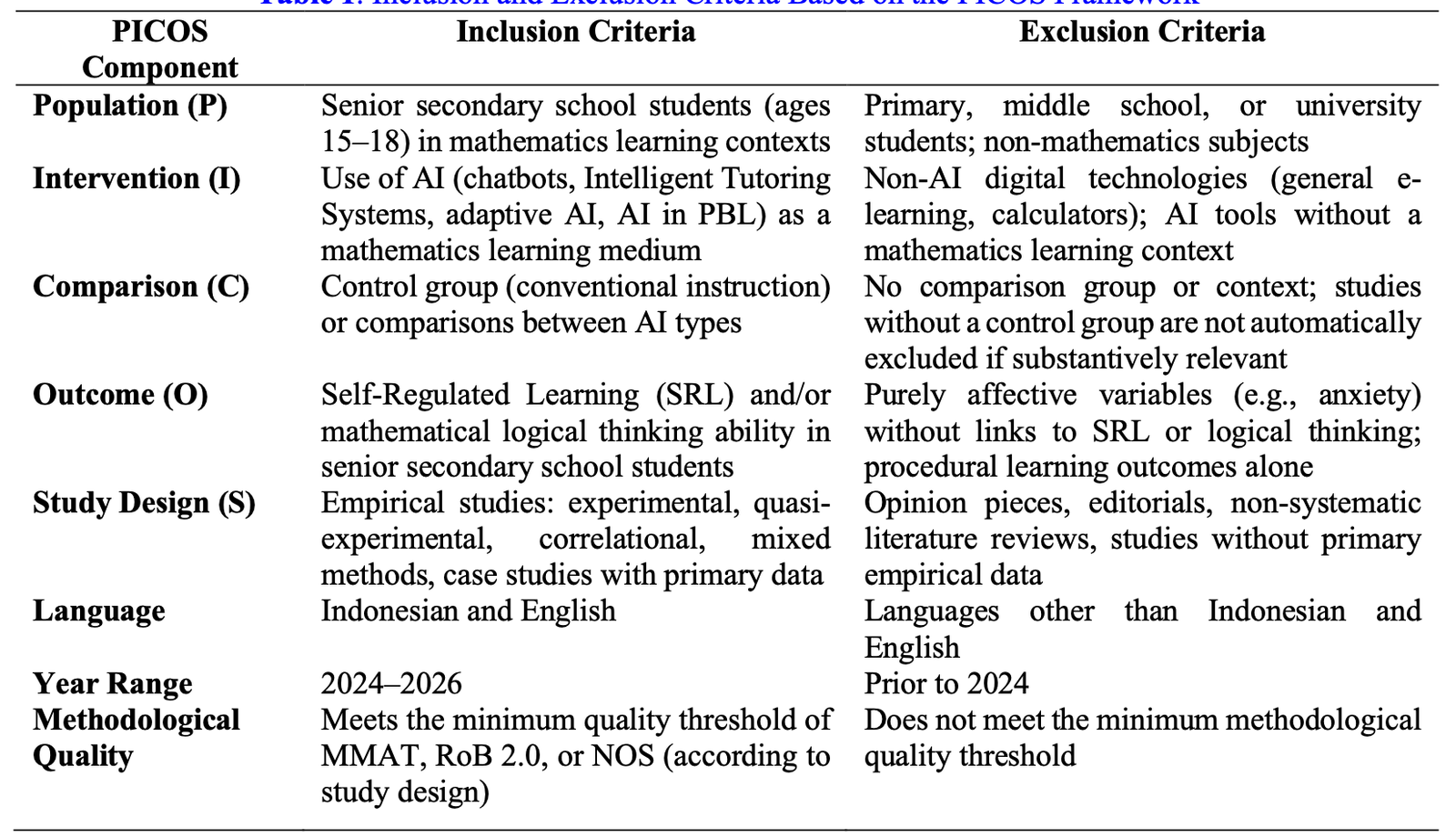
The low mathematical logical thinking ability of Indonesian students is reflected in Indonesia's 2022 PISA score of 366, which falls significantly below the OECD average of 472, indicating weaknesses in students' capacity to draw inferences, recognize patterns, construct arguments, and derive systematic conclusions. This study aims to synthesize empirical evidence regarding the effectiveness of Artificial Intelligence (AI) on both competencies, while identifying the types of technology, implementation designs, and moderating factors that influence its impact. A Systematic Literature Review (SLR) was conducted following the PRISMA 2020 guidelines, with searches performed on Google Scholar using PICOS-based keywords structured with Boolean AND/OR operators, restricted to publications from 2024 to 2026. Study selection was conducted independently by two researchers, with inter-rater reliability maintained through Cohen's Kappa. Of 538 initially identified articles, 15 final articles from eight countries were retained following deduplication, screening, and quality assessment using MMAT, RoB 2.0, and NOS. AI technologies were classified into five categories: generative AI, Intelligent Tutoring Systems, adaptive learning systems, educational chatbots, and AI-based Learning Management Systems. Results indicate that AI consistently exerts a positive influence on self-regulated learning through adaptive feedback and metacognitive support, and on mathematical logical thinking ability through its role as a cognitive partner. However, its effectiveness is conditional, necessitating that mathematics teachers integrate AI within structured instructional designs incorporating formative feedback, graduated scaffolding, and metacognitive reflection facilitation.
Downloads
References
Adilah, M., Hasanah, U., Wiradinata, R., & Febianti, Y. N. (2025). Artificial Intelligence-Based Learning on Learning Effectiveness , Learning Independence , and Student Satisfaction. JURNAL PENDIDIKAN DAN PENGAJARAN, 58(3), 669–679. https://doi.org/10.23887/jpp.v58i3.100525
Alatoai, A. A., & Alshahri, A. S. (2025). The development and validation of the AI-supported self-regulated science and mathematics learning scale ( AI-SSRSML ) among secondary school students in Saudi Arabia. BMC Psychology, 13, 1330. https://doi.org/10.1186/s40359-025-03764-z
Ardiansyah, K., & Wulandari, L. (2026). Implementasi Kecerdasan Buatan ( AI ) sebagai Tutor Personal dalam Pembelajaran Matematika di Sekolah Menengah : Studi Kasus dan Dampaknya terhadap Motivasi Belajar Siswa pembelajaran matematika di sekolah menengah . Penelitian ini bertujuan tidak hanya u. Jurnal Ilmiah Multi Disiplin Ilmu (MURAMU), 50–59. https://doi.org/10.64365/muramu.v2i1.244
Arifin, A., Pujiastuti, H., Nindiasari, H., & Ediwarman. (2025). Developing an AI-Based LMS to Support Self-Regulated Learning in Secondary Mathematics Education. Al-Ishlah: Jurnal Pendidikan, 17(4), 7580–7594. https://doi.org/10.35445/alishlah.v17i4.7686
Assagaf, S. H., & Subekti, F. E. (2025). Efektivitas Media Digital Terhadap Kemampuan Berpikir Matematis Siswa. Proximal: Jurnal Penelitian Matematika Dan Pendidikan, 8, 933–943. https://doi.org/10.30605/proximal.v8i3.6070
Awang, L. A., Yusop, F. D., & Danaee, M. (2025). Current practices and future direction of artificial intelligence in mathematics education : A systematic review. International Electronic Journal of Mathematics Education, 20(2). https://doi.org/10.29333/iejme/16006
Bastani, H., Bastani, O., Sungu, A., Ge, H., Kabakcı, Ö., & Mariman, R. (2025). Generative AI without guardrails can harm learning : Evidence from high school mathematics. PNAS, 122(26), 1–8. https://doi.org/10.1073/pnas.2422633122
Chau, D. B., Luong, V. T., Long, T. T., & Linh, N. T. T. (2025). Personalized Mathematics Teaching with The Support of AI Chatbots to Improve Mathematical Problem-Solving Competence for High School Students in Vietnam. European Journal of Educational Research, 14(1), 323–333. https://doi.org/10.12973/eu-jer.14.1.323
Elfani, E., Manullang, M. E. I., Sidabutar, A. N. L., & Windasari, R. (2025). Analisis Pengaruh Deep Learning Berbasis Kecerdasan Buatan Terhadap Kemampuan Berpikir Kritis Matematika Siswa. Seminar Nasional Pendidikan Matematika (SNPM), 449–458. https://snpm.unipasby.ac.id/prosiding/index.php/snpm/article/view/300
Hao, M., Wang, Y., & Peng, J. (2024). applied sciences Empirical Research on AI Technology-Supported Precision Teaching in High School Science Subjects. Applied Sciences, 14, 7544. https://doi.org/10.3390/app14177544
Holman, K., Marino, M., Vasquez, T., Taub, M., Hunt, J., & Tazi, Y. (2025). Artificial Intelligence Interventions in Mathematics Education : A Systematic Literature Review. Insights into Learning Disabilities, 22(1), 65–91. https://files.eric.ed.gov/fulltext/EJ1481890.pdf
Holmes, W., Bialik, M., & Fadel, C. (2019). Artificial Intelligence in Education. Promise and Implications for Teaching and Learning. https://www.researchgate.net/publication/332180327_Artificial_Intelligence_in_Education_Promise_and_Implications_for_Teaching_and_Learning
Khusna, L. K., & Fadli, F. (2025). Pengaruh Ketergantungan Kecerdasan Buatan terhadap Motivasi Belajar Siswa pada Sistem Persamaan Linear Dua Variabel. Jurnal Pendidikan Dan Kebudayaan, 10(2), 211–226. https://doi.org/10.24832/jpnk.v10i2.5903
Kulik, J. A., & Fletcher, J. D. (2016). Effectiveness of Intelligent Tutoring Systems : A Meta-Analytic Review. Review of Educational Research, 86(1), 42–78. https://doi.org/10.3102/0034654315581420
Létourneau, A., Martineau, M. D., Charland, P., Karran, J. A., Boasen, J., & Léger, P. M. (2025). A systematic review of AI-driven intelligent tutoring systems ( ITS ) in K-12 education. Npj Science of Learning, 10(29). https://doi.org/10.1038/s41539-025-00320-7
Luckin, R., Holmes, W., Griffiths, M., & Forcier, L. B. (2016). Intelligence Unleashed: An argument for AI in Education.
Mardhatillah, A. S., Efriyanti, L., & Razy, F. (2025). Evaluasi Efektivitas Pembelajaran Semi-Adaptif Berbasis Artificial Intelligence Terhadap Motivasi , Pemahaman , dan Kemandirian Belajar Siswa SMP Islam. Southeast Asian Journal of Islamic Education Management, 6(2), 141–156. https://doi.org/10.21154/sajiem.v6i2.551
Mehmood, W., Gondal, S., Faiz, M. S., & Ashir, K. (2025). The Critical Review of Social Sciences Studies AI-Assisted Metacognitive Strategies for Improving Self-Regulated Learning among High School Students. The Critical Review of Social Sciences Studies, 3(2), 2333–2349. https://doi.org/10.59075/vk7et188
Munawaroh, L., Mulyadi, M. A., Jasmiatussifilfila, Aulia, E. M., & Abrori, R. (2025). Systematic Literature Review ( Slr ) : Peran Artificial Intelligence Terhadap Proses Pembelajaran Mahasiswa. JMSI : Jurnal Mahasiswa Sistem Informasi, 6(2), 403–412. https://doi.org/10.24127/jmsi.v6i2.9220
Ng, D. T. K., Tan, C. W., & Leung, J. K. L. (2024). Empowering student self- regulated learning and science education through ChatGPT : A pioneering pilot study. British Journal of Educational Technology, 55, 1328–1353. https://doi.org/10.1111/bjet.13454
Novaliyosi. (2018). The Development of Instruments to Measure Student Mathematical Logical Thinking Ability in Kapita Selekta. 00054, 1–4. https://doi.org/10.1051/shsconf/20184200054
Novaliyosi, Tola, B., & Rahayu, W. (2019). Trends Of Mathematical Logical Thinking Ability Through The Cra (Concrete-Representational-Abstract) Approach With Portfolio Assessment. 6(2), 98–112. https://journal.unj.ac.id/unj/index.php/ijer/article/view/14077
Piaget, J. (1972). Intellectual Evolution from Adolescence to Adulthood. Human Development, 15, 1–12. https://doi.org/10.1159/000271225
Putri, S. N., Junaedi, I., & Kharisudin, I. (2025). Analysis of Critical Thinking Ability in Artificial Intelligence-Assisted Guided Inquiry Model Based on Mathematical Disposition. Unnes Journal of Mathematics Education, 6927(2), 179–190. https://doi.org/10.15294/ujme.v14i2.31544
Tashtoush, M. A., Qasimi, A. B., Hussein, L. A., & Hussein, L. A. (2025). The Efficacy of Utilizing Artificial Intelligence Techniques in Developing Critical Thinking in Mathematics among Secondary School Students and their Attitudes Toward it. Iraqi Journal for Computer Science and Mathematics Volume, 6(1). https://doi.org/10.52866/2788-7421.1231
Thomas, J., & Harden, A. (2008). Methods for the thematic synthesis of qualitative research in systematic reviews. BMC Medical Research Methodology, 8(45). https://doi.org/10.1186/1471-2288-8-45
Ulfah, M. (2024). Pendidikan Dampak Ketergantungan Pada Artificial Intelligence Terhadap Kemampuan Analitis Dan Kreatif Mahasiswa. VOX EDUKASI:Jurnal Ilmiah Ilmu Pendidikan, 15(April), 120–130. https://doi.org/10.31932/ve.v15i1.3892
Vygotsky, L. S. (1978). Mind in society: The development of higher psychological processes. Harvard University Press.
Wang, J., & Fan, W. (2025). The effect of ChatGPT on students’ learning performance, learning perception, and higher-order thinking: insights from a meta-analysis. Humanities and Social Sciences Communications, 12(621), 1–21. https://doi.org/10.1057/s41599-025-04787-y
Wardhani, A. K., Putra, R. H. D., & Amelin, F. O. (2025). Dampak Artificial Intelligence Dalam Pembelajaran Matematika Di Era Society 5 . 0 . Jurnal Penelitian Pendidikan Matematika Dan Sains, 9(2), 65. https://doi.org/10.26740/jppms.v9n2.p64-70
Zawacki-richter, O., Marín, V. I., & Bond, M. (2019). Systematic review of research on artificial intelligence applications in higher education – where are the educators ? International Journal of Educational Technology in Higher Education, 16(39). https://doi.org/10.1186/s41239-019-0171-0
Zimmerman, B. j. (2000). Attaining self-regulation: A social cognitive perspective. In M. Boekaerts, M.; Pintrich, P. R.; Zeidner (Ed.), Handbook of Self-Regulation (pp. 13–39). Academic Press. https://doi.org/10.1016/B978-012109890-2/50031-7
Downloads
Published
How to Cite
Issue
Section
License
Copyright (c) 2026 This is an open-access under the CC-BY-SA license

This work is licensed under a Creative Commons Attribution-ShareAlike 4.0 International License.
Education and Talent Development Center of Indonesia (ETDC Indonesia)
e-mail: kognitif@gmail.com, website : https://etdc-indonesia.com

Kognitif: Jurnal Riset HOTS Pendidikan Matematika dengan Situs: https://etdci.org/journal/kognitif berlisensi Creative Commons Attribution-ShareAlike 4.0 International License






.png)