Influence of Digital Literacy on the Critical Thinking Ability of Mathematics Education Students in Evaluating Digital Information

https://doi.org/10.51574/kognitif.v6i2.4877
Keywords:
Critical Thinking , Digital Literacy , Information Evaluation , Mathematics EducationAbstract
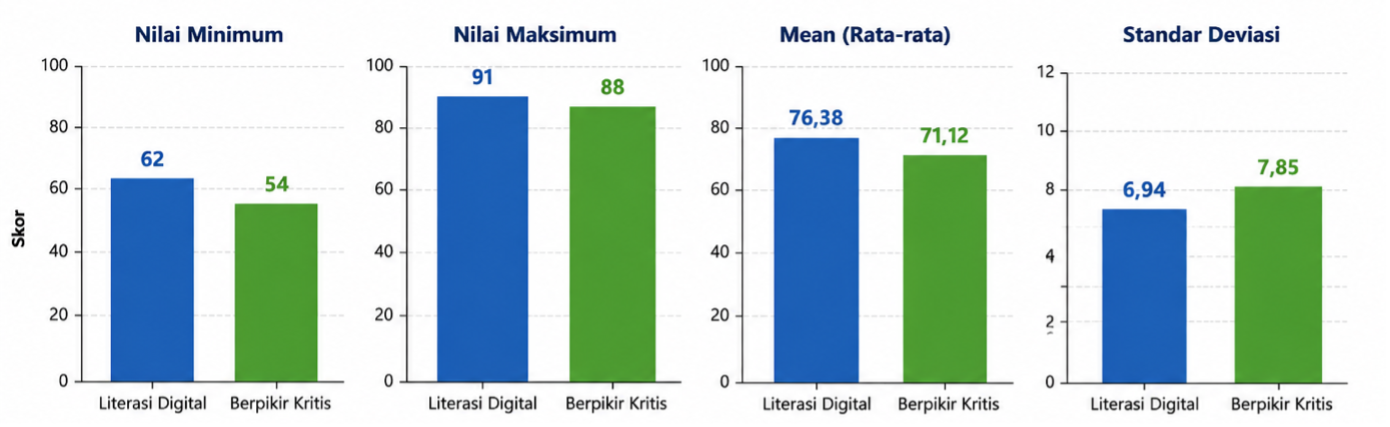
Students’ critical thinking skills in assessing digital information have not yet developed optimally. This study aims to analyze the relationship between digital literacy and the critical thinking ability of mathematics education students in evaluating digital information. The research employed a quantitative approach with a correlational design. The participants consisted of 120 students from the Department of Mathematics Education at Universitas Negeri Makassar, selected through purposive sampling. The research instruments included a digital literacy questionnaire measuring aspects of access, evaluation, verification, and utilization of digital information, as well as a critical thinking test assessing information analysis, source credibility evaluation, information verification, and conclusion drawing. The validity test results indicated that all instrument items had validity coefficients above 0.30 and were therefore considered valid, while the reliability test results showed Cronbach’s Alpha values of 0.87 for the digital literacy questionnaire and 0.82 for the critical thinking test, indicating that both instruments were reliable. Data were analyzed using descriptive statistics and simple linear regression analysis. The findings revealed that students’ digital literacy was categorized as high, whereas their critical thinking ability was categorized as moderate based on the predetermined score intervals. Regression analysis demonstrated that digital literacy had a positive and significant predictive relationship with students’ critical thinking ability (β = 0.48; p < 0.001), contributing R² = 0.32. This study recommends integrating digital literacy into mathematics learning through activities involving source evaluation, information analysis, and evidence-based argumentation to support the development of students’ critical thinking skills.
Downloads
References
Behnamnia, N., Kamsin, A., Ismail, M. A. B., & Hayati, S. A. (2025). Relationship between creative thinking and outcomes in a digital STEM-based learning environment: A mixed methods case study. Thinking Skills and Creativity, 57. https://doi.org/10.1016/j.tsc.2025.101816
Berta Dinata, K. (2021). Analisis Kemampuan Literasi Digital Mahasiswa. Jurnal Pendidikan, 19, 105–119. https://doi.org/10.31571/edukasi.v19i1
Cheng, C., & Weatherly, K. I. C. H. (2025). Navigating the double-edged sword: A meta-analysis of the effects of digital games on 21st century skills. In Educational Research Review (Vol. 48). Elsevier Ltd. https://doi.org/10.1016/j.edurev.2025.100710
Dwiki Darmawan, Nuris Syamsiyah, Alqina Abqariyah Alhasna, & Abdul Wafi. (2025). Telaah Pustaka Peran Literasi Digital dalam Membangun Daya Pikir Kritis Mahasiswa Masa Kini. Jejak Digital: Jurnal Ilmiah Multidisiplin, 1(4), 1195–1205. https://doi.org/10.63822/k8qdjp29
Haniko, P., Intang Sappaile, B., Prawiranegara Gani, I., Wilson Sitopu, J., Junaidi, A., & Cahyono, D. (2023). Menjembatani Kesenjangan Digital: Memberikan Akses ke Teknologi, Pelatihan, Dukungan, dan Peluang untuk Inklusi Digital. In Jurnal Pengabdian West Science (Vol. 02, Number 05). https://doi.org/10.58812/jpws.v2i5.371
Imjai, N., Aujirapongpan, S., & Yaacob, Z. (2024). Impact of logical thinking skills and digital literacy on Thailand’s generation Z accounting students’ internship effectiveness: Role of self-learning capability. International Journal of Educational Research Open, 6. https://doi.org/10.1016/j.ijedro.2024.100329
Lim, K. Y., & Darvin, R. (2026). Critical digital literacies, generative AI, and the negotiation of agency in human-AI interactions. System, 136. https://doi.org/10.1016/j.system.2025.103904
Luengo-Aravena, D., Cabello, P., & Rodriguez-Milhomens Bachino, B. (2024). Online collaborative problem-solving as a tangible outcome of digital skills in technical and vocational higher education. Computers and Education, 218. https://doi.org/10.1016/j.compedu.2024.105079
Mansour, N., Çevik, M., Uzun, Y., & Alotaibi, S. B. M. (2026). Exploring the impact of STEAM and connected learning on skills of digital age in primary schools. Thinking Skills and Creativity, 59. https://doi.org/10.1016/j.tsc.2025.102024
Mas Ramadhan, G., Bina Mutiara Sukabumi, S., & Jawa Barat, S. (2021). Pengaruh Kompetensi Literasi Digital Mahasiswa Pgsd Dalam Memanfaatkan Google Apps Terhadap Perilaku Conten Evaluation. Journal of Elementary Education, 04. https://doi.org/10.22460/collase.v4i6.9727
Mendoza Diaz, N. V., Yoon, S. Y., & Salvador, N. G. (2025). Digital equity and computational thinking privilege: The case of first-year engineering and computing students’ attitudes towards artificial intelligence. Computers and Education: Artificial Intelligence, 9. https://doi.org/10.1016/j.caeai.2025.100495
Mohommoud Zayid, E. I., Aldaleel, A. M., & Omar Alshehri, O. A. (2026). Classifiers’ competency in identifying digital innovation skills for teachers of Bisha Province, Saudi Arabia. Entertainment Computing, 57, 101102. https://doi.org/10.1016/j.entcom.2026.101102
Rany, R. M., Lusiana, E., & Perdana, F. (2025). Peran Literasi Digital dalam Meningkatkan Kemampuan Berpikir Kritis di Era Teknologi Informasi. In Journal of Global Humanistic Studies philosophiamundi.id e-issn (Vol. 3, Number 4). https://doi.org/10.33084/pedagogik.v21i1.12519
Rochmatika, I., & Yana, E. (2022). Pengaruh Literasi Digital Dan Gaya Belajar Terhadap Kemampuan Berpikir Kritis Siswa SMAN 1 Tukdana. Perspektif Pendidikan Dan Keguruan, 13(1), 64–71. https://doi.org/10.25299/perspektif.2022.vol13(1).9491
Rosalina, M. D., Daniela Iman, P., & Anggraini, V. R. (2023). Pengaruh Kemampuan Literasi Digital Terhadap Kemampuan Berpikir Kritis Siswa SD Kelas VI. Jurnal Riset Teknologi Dan Inovasi Pendidikan, 6(1), 1–10. https://doi.org/https://journal.rekarta.co.id/index.php/jartika
Rosyida, L., & Bahtiar, M. D. (2024). Pengaruh Kecerdasan Emosional, Self Confidence, Dan Literasi Digital Terhadap Kemampuan Berpikir Kritis Siswa Kelas X Akuntansi SMK NEGERI 4 SURABAYA. Jurnal Pendidikan Ekonomi (JURKAMI), 9(2), 382–395. https://doi.org/10.31932/jpe.v9i2.3603
Sachdeva, S., & Eggen, P.-O. (2021). Learners’ Critical Thinking About Learning Mathematics. International Electronic Journal of Mathematics Education, 16(3), em0644. https://doi.org/10.29333/iejme/11003
Saig, R., & Hershkovitz, A. (2024). Expanding digital literacies beyond the digital: Infusing computational thinking into unplugged pedagogical tools - Two case studies from mathematics education. International Journal of Child-Computer Interaction, 42. https://doi.org/10.1016/j.ijcci.2024.100703
Sappaile, B. I., Nisak, S. K., Afandi, A., Anshoriyah, S., & Mardiati, M. (2024). Enhancing Critical Thinking Skills in Mathematics Education: Integrating Problem-Based Learning in Seconday Schools. International Journal of Educational Research Excellence (IJERE), 3(2), 731–737. https://doi.org/10.55299/ijere.v3i2.1085
Sappaile, B. I., Wahyudin, M., Ahmadin, A., Lindawati, L., & Wardani, H. K. (2025). Integrating Problem-Based Learning to Develop Critical Thinking Competencies in Secondary Education. International Journal of Educational Research Excellence (IJERE), 4(1), 345–354. https://doi.org/10.55299/ijere.v4i1.1437
Susanti, Zainal, A., & Mirna. (2024). Analisis Berpikir Kritis Matematis Siswa SMP/MTs Melalui Penerapan Strategi Scaffolding. Journal Mathematics Education Sigma [JMES]. https://doi.org/10.30596/jmes.v5i2.19619
Sutamrin, & Khadijah. (2021). Analisis Kemampuan Berpikir Kritis dalam Project Based Learning Aljabar Elementer. Jurnal Ilmiah Pendidikan Matematika, 28–41. https://doi.org/10.46918/equals.v4i1.892
Wei, X., Wang, L., Koszalka, T. A., Lee, L. K., & Liu, R. (2025). Enhancing pre-service teachers’ reflective thinking skills through generative AI-assisted digital storytelling creation: A three-dimensional framework analysis. Computers and Education, 235. https://doi.org/10.1016/j.compedu.2025.105356
Weigelt, H., Segev, E., Kurtz, G., Kahana, O., & Fogel, N. R. (2026). Enhancing students’ critical thinking literacy in a generative AI context: Eye movement patterns of deepfake detection. Computers and Education, 244. https://doi.org/10.1016/j.compedu.2025.105529
Xiao, W., Wang, M., & Li, X. (2026). From “Digital Novices” to “Digital Pioneers”: Profiles and influencing factors of digital literacy among pre-service special education teachers. Teaching and Teacher Education, 170. https://doi.org/10.1016/j.tate.2025.105301
Young, K., Doğança Küçük, Z., Delahunty, T., Dempsey, M., & Maglaperidze, N. (2026). Evaluating the impact of a digital competency-based placement model on STEM pre-service teachers’ digital competence and teaching experiences. Teaching and Teacher Education, 175, 105466. https://doi.org/10.1016/j.tate.2026.105466
Downloads
Published
How to Cite
Issue
Section
License
Copyright (c) 2026 This is an open-access under the CC-BY-SA license

This work is licensed under a Creative Commons Attribution-ShareAlike 4.0 International License.
Education and Talent Development Center of Indonesia (ETDC Indonesia)
e-mail: kognitif@gmail.com, website : https://etdc-indonesia.com

Kognitif: Jurnal Riset HOTS Pendidikan Matematika dengan Situs: https://etdci.org/journal/kognitif berlisensi Creative Commons Attribution-ShareAlike 4.0 International License






.png)